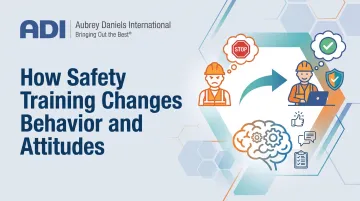
The core tension is clear: organizations invest heavily in safety training for compliance, yet incidents continue. Research across 1,283 construction companies found that more training hours correlated with more accidents, except when training came from qualified entities using continuous, engagement-focused methods. The gap between knowing what's safe and consistently doing what's safe remains one of the most stubborn challenges in workplace safety.
This article examines the behavioral science behind why training often fails, what actually drives lasting behavior and attitude change, and what distinguishes safety programs that work from those that merely check a box.
Key Takeaways
- Knowledge transfer alone rarely changes on-the-job behavior
- Lasting change requires consequences, feedback, and reinforcement following training
- Attitude shifts typically follow behavior change, not the reverse
- Behavior-based approaches produce more durable outcomes than compliance training
- Track observed safe behaviors (leading indicators) — they reveal training impact far faster than waiting for injury rates to drop
The Knowledge-Behavior Gap: Why Safety Training Rarely Changes Behavior on Its Own
Humans can fully understand a safety rule, believe it matters, and still fail to follow it consistently. This knowledge-behavior gap is well-documented: employees understand hazards intellectually but revert to shortcuts under time pressure, force of habit, or peer norms. The gap explains why safety equipment use remained at only 50% before intervention at one natural gas producer—despite universal training on proper PPE use.
Why Training Closes the Wrong Gap
Traditional safety training is designed to close the knowledge gap—teach people what to do and why. It excels at this. But knowledge transfer and behavior change are fundamentally different outcomes requiring different interventions.
Knowledge-focused training typically involves:
- Lectures and presentations
- Written materials and videos
- Comprehension quizzes
- Completion certificates
These methods confirm employees know the rules. They don't confirm employees will follow them when it's faster not to.
The Illusion of Change
Compliance-based training creates measurable outputs that give organizations confidence something has changed:
- Tracking 100% completion rates
- Collecting passing test scores
- Filing signed acknowledgment forms
Yet Burke et al.'s meta-analysis of 95 studies found passive training showed approximately 50% knowledge decay, and crucially, knowledge acquisition did not reliably predict behavior change. Another study found traditional safety lectures increased knowledge but produced a mean behavior change of only 0.2—near zero.
Behavior on the floor often remains identical to what it was before training. The question isn't why employees don't know better—it's why knowing better isn't enough.
What Actually Shapes Behavior
Behavior is shaped by what happens after an action, not just by the information provided before it. If taking a shortcut saves time and nothing bad happens, the shortcut is reinforced. If following procedure is slower, more cumbersome, and goes unnoticed, compliance is weakly reinforced.
Training provides the knowledge foundation. But without deliberate consequence management—what happens after safe behavior occurs—that foundation produces little lasting change. ADI has applied this principle for over 45 years, and Judy Agnew's co-authored book Safe by Accident makes the case directly: effective safety improvement requires understanding the science of behavior, not just the science of hazards.
What Behavioral Science Reveals About How Safety Behavior Actually Changes
The ABC (Antecedent-Behavior-Consequence) model explains what drives safe or unsafe behavior in the workplace:
- Antecedents (A): Events before a behavior that prompt it—safety training, signs, rules, reminders
- Behavior (B): Observable, measurable actions employees take (wearing PPE, following lockout/tagout, reporting hazards)
- Consequences (C): What happens after the behavior—outcomes that strengthen or weaken it
Why Antecedents Are Weak on Their Own
Antecedents set the stage but don't control behavior long-term. Training, signage, and policies prompt behavior initially, but their influence fades quickly unless consequences reinforce the prompted action.
A "Wear Hard Hat" sign is an antecedent. It reminds, but it doesn't make wearing the hard hat more likely over time unless there are meaningful consequences for compliance or non-compliance.
The Four Types of Consequences
Behavioral science identifies four consequence types that shape behavior:
| Consequence Type | Effect | Example in Safety |
|---|---|---|
| Positive Reinforcement | Increases behavior by adding something desirable | Supervisor acknowledges correct harness use; peer recognition for hazard reporting |
| Negative Reinforcement | Increases behavior by removing something unpleasant | Wearing gloves stops hand irritation; following procedure avoids supervisor criticism |
| Punishment | Decreases behavior | Written warning for not wearing PPE; suspension for safety violation |
| Extinction | Behavior stops when reinforcement is removed | Safe behavior fades when no one notices; reporting hazards stops when reports go ignored |
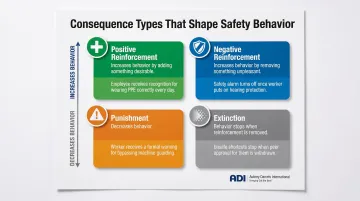
Of these four, positive reinforcement produces the most durable, self-motivated behavior change. Punishment generates temporary compliance — but it disappears when the punisher isn't present. That distinction matters when you're trying to change behavior for good.
Why Unsafe Behaviors Persist
Unsafe behaviors are often naturally reinforced:
- They're faster — saving time delivers an immediate, certain payoff
- Less effort required means the reward kicks in right away
- They're more comfortable (skipping hot PPE in summer brings instant relief)
Safe behaviors often lack immediate positive consequences:
- Compliance is invisible — no one notices or acknowledges it
- Benefits are delayed and probabilistic (avoiding injury that might happen someday)
- Safe behaviors may actually produce immediate negative consequences (extra time, physical discomfort, peer criticism for "slowing things down")
This imbalance explains why employees who "know better" still cut corners. The consequences favor the shortcut.
Redesigning the Consequence Landscape
Behavior-based safety (BBS) programs intervene by deliberately changing what follows safe behavior. They make safe behavior:
- Visible through structured observation
- Acknowledged through positive supervisor and peer feedback
- Reinforced immediately and frequently
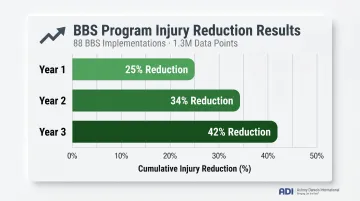
Research tracking 88 BBS implementations across 1.3 million data points documented cumulative injury reductions of 25% in Year 1, 34% in Year 2, and 42% in Year 3. This wasn't achieved by teaching employees new information—they already knew the rules. It was achieved by changing what happened after they followed them.
Do Attitudes Change First, or Does Behavior? (The Surprising Science)
Most organizations assume they must first change attitudes—convince people that safety matters—before behavior will follow. Invest in motivational posters, inspiring talks, and culture campaigns, and employees will embrace safety.
Behavioral science research shows the relationship often runs the other direction: behavior change precedes and drives attitude change.
The Mechanism: Behavior Shapes Attitudes
When employees practice safe behaviors and receive positive reinforcement for doing so, their experience of safety shifts. What was once seen as bureaucratic compliance becomes associated with positive outcomes—peer respect, supervisor recognition, and a sense of team ownership.
This is grounded in cognitive dissonance theory: when people change their behavior first, their attitudes adjust to align with the new behavior to reduce psychological discomfort. "I'm doing this consistently, so it must be important" becomes the new internal narrative.
Evidence supports this in safety contexts. Organizations implementing BBS showed a full standard deviation improvement in organizational culture scores over six years—a cultural shift driven by changing what people did, which then changed how they felt about it.
What Doesn't Work: Messaging Without Reinforcement
Organizations that spend disproportionate time on motivational safety messaging without changing the reinforcement environment see minimal attitude shifts. One study found traditional safety lectures improved knowledge but produced near-zero behavior change (mean change of 0.2), while motivational interviewing paired with behavioral support produced a mean change of 3.2.
Posters and talks can't compete with the natural reinforcement of shortcuts. Unless the environment makes safe behavior the easier choice, the message loses every time.
The contrast is stark:
- Motivational messaging alone: near-zero behavior change (mean 0.2)
- Behavioral support + motivational interviewing: 16x greater behavior change (mean 3.2)
- BBS implementation over 6 years: full standard deviation shift in culture scores
When Training Does Influence Attitudes
Training isn't powerless — the conditions matter. Well-designed training that connects hazards to personally meaningful consequences—not abstract statistics—and creates genuine emotional engagement can prime attitude change. But on-the-job experience must reinforce this priming for it to stick. If the post-training environment contradicts the message, the message fades.
What Makes Safety Training Stick: Reinforcement, Feedback, and Practice
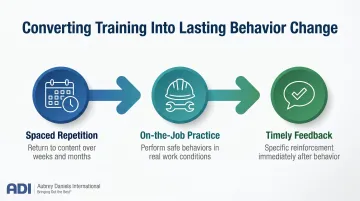
Three elements convert training into lasting behavior change:
1. Spaced Repetition Returning to content multiple times over weeks and months. Ebbinghaus's forgetting curve shows that without reinforcement, learned information decays rapidly — most significantly in the first days after learning. One-time training events, no matter how engaging, can't overcome this natural forgetting.
2. On-the-Job Practice Performing the safe behavior in actual work conditions, not just in a classroom. Practice with real equipment, real time pressure, and real environmental conditions builds behavioral fluency that simulated practice cannot.
3. Timely Feedback Receiving specific, credible reinforcement or correction immediately after the behavior. Feedback delayed by days or weeks loses its power to shape behavior.
Supervisor Behavior: The Most Powerful Reinforcer
Supervisors who consistently notice and positively acknowledge safe behaviors—rather than only reacting to incidents—reinforce training content where it matters most.
Research demonstrates this impact:
- Workers without supervisor safety support were 5.01 times more likely to report injury
- Supervisors receiving weekly feedback on safety interactions produced significant decreases in injury rates and improved safety climate
Building this kind of consistent supervisor behavior requires structure. ADI's consulting and Performance Management approach helps organizations embed the 4:1 ratio of positive-to-corrective feedback into daily leadership practice — so the reinforcement that sustains behavior change becomes routine, not occasional.
Peer Observation and Social Norms
Supervisors aren't the only reinforcement channel that matters. Safe behavior also spreads when employees observe respected peers practicing it and see it acknowledged. Analysis of optimal BBS design found:
- Dedicated observers (4-8% of workforce) outperformed all-employee participation
- Monthly observation rate of 16-65% of employees was optimal
- Observers conducting 7+ observations per month achieved greatest injury reductions
- 12-month observer rotation outperformed static observer groups
- The "observer effect" — employees who conduct observations improve their own safe practices
Behavior-based safety programs that involve frontline workers in observation and feedback consistently outperform top-down training mandates. When peers observe, give feedback, and rotate through that role themselves, safety stops being a rule imposed from above — it becomes the norm the team enforces together.
How to Know If Safety Training Has Actually Changed Behavior
Waiting for injury rates to drop is a poor test of whether training changed behavior. By the time that lagging indicator moves, many unreinforced behaviors have already faded.
Leading vs. Lagging Indicators
Lagging indicators measure past events:
- Total recordable injury rate
- Lost-time injury frequency
- Workers' compensation claims
- Fatality counts
Leading indicators reveal potential problems before incidents occur:
- Frequency of safe behaviors observed
- Near-miss reporting rates
- Hazard identification rates
- Training completion with skill demonstration
- Supervisor safety coaching frequency
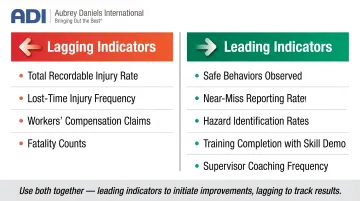
OSHA recommends using both together: leading indicators to initiate improvements, lagging indicators to track effectiveness over time.
Practical Methods for Measuring Behavior Change
Structured Behavioral Observations
Compare pre- and post-training safe behavior rates using standardized checklists. Observers note specific behaviors (proper PPE use, lockout/tagout compliance, housekeeping standards) before training, then re-measure at 30, 60, and 90 days after.
Effective observation programs include:
- 1-2 causal factor categories per observation (not excessive tagging)
- Monthly per-employee contact (weekly isn't significantly better)
- Anonymous posting of aggregate data with trend graphs
Supervisor Coaching Records
Track frequency and quality of safety conversations. An increase in documented positive safety interactions signals that leaders are reinforcing trained behaviors.
Near-Miss Reporting
A healthy safety culture generates 3-5 near-miss reports per employee per year. Rising near-miss reporting post-training signals that employees are more alert to hazards and trust the system enough to report. Both are meaningful behavioral outcomes.
Behavioral measurement tells you what people are doing. Attitudinal measurement tells you why — and whether those changes are likely to last.
Measuring Attitudinal Change
Surveying employees captures the attitudinal shifts accompanying genuine behavior change:
- Perceived ownership of safety: "I feel personally responsible for my safety and my coworkers' safety"
- Confidence in raising hazards: "I'm comfortable reporting unsafe conditions without fear of negative consequences"
- Trust in leadership commitment: "My supervisor cares about my safety, not just production numbers"
Validated safety climate instruments measure dimensions including safety involvement, positive safety practices, accountability, and supportive environment. Improvements on these scales signal that training has strengthened the cultural foundation where behavior occurs.
That said, attitude scores alone don't confirm behavior change. Tracking both gives you the full picture.
Frequently Asked Questions
Does safety training change behavior?
Safety training can change behavior when paired with reinforcement, feedback, and practice. Training alone typically transfers knowledge without reliably changing what employees do on the job, which is why one study found 50% knowledge decay from passive training with minimal behavior change.
How can you change safety behavior in the workplace?
Lasting safety behavior change requires identifying what currently reinforces unsafe behaviors, designing consequences that positively reinforce safe alternatives, and building a leadership environment where safe behavior is consistently noticed and acknowledged. Consequence management, not just information transfer, drives sustained change.
When safety training changes behavior, attitudes, and work habits, what does it typically reduce?
Effective safety training reduces workplace injuries and near-misses, decreases at-risk behaviors observed in the field, and lowers incident-related costs. Workplace injuries cost $181.4 billion annually in the US, including $54.9 billion in wage and productivity losses alone.
In what ways can training change people's attitudes in the workplace?
Training shifts attitudes by connecting hazards to personally meaningful consequences and building genuine engagement rather than passive compliance. The real driver is reinforcement: positive real-world experiences that make employees associate safe behavior with valued outcomes like peer recognition and supervisor support.
What is the difference between compliance-based and behavior-based safety training?
Compliance-based training focuses on ensuring employees know the rules and can pass a test. Behavior-based safety focuses on what actually shapes actions—the antecedents and consequences in the work environment—to produce observable, measurable, and durable behavioral change grounded in reinforcement science.
How long does it take for safety training to change behavior?
Knowledge can change immediately after training, but behavioral habits typically require weeks to months of consistent reinforcement and practice to solidify. Research shows new behaviors take an average of 66 days to become automatic (range: 18-254 days), and attitude change often follows gradually as employees accumulate positive experiences with safe behaviors.