Introduction
Despite widespread investment in formal safety programs, U.S. workplaces still recorded 4,337 preventable work deaths and 3.95 million medically consulted injuries in 2024, costing organizations $181.4 billion. The gap between having comprehensive safety policies and achieving actual safety outcomes remains stubbornly persistent across industries.
The problem isn't a lack of training manuals or compliance checklists. Organizations have policies, protocols, and regulatory frameworks in place. Yet incidents continue. Research reveals a critical insight: business units in the top quartile of employee engagement experience 63% fewer safety incidents than those in the bottom quartile, according to Gallup's analysis of over 183,000 work units globally.
Rules set the floor. Behavior determines what actually happens on the floor — and behavior is shaped by how connected, valued, and invested employees feel in their work. Understanding that connection is where genuine safety culture begins.
Key Takeaways
- Engaged employees follow safety procedures consistently, report hazards proactively, and hold peers accountable—resulting in 63% fewer incidents in highly engaged workplaces
- Positive reinforcement of safe behaviors builds lasting habits; compliance-only mandates produce short-term compliance, not culture
- Psychological safety drives near-miss reporting — rates climb 60–96% when employees trust that raising concerns won't cost them
- Leading indicators — reporting rates, safety participation, peer accountability — reveal engagement gaps before injury counts climb
Safety Culture vs. Safety Compliance: Why the Difference Matters
Safety compliance means meeting minimum regulatory requirements—following OSHA standards, completing mandatory training, maintaining required documentation. It's driven by external pressure: audits, penalties, enforcement actions. Organizations achieve compliance when they check the boxes regulators require.
Safety culture operates differently. It represents the internalized values, beliefs, and behaviors that shape how employees approach safety when no one is watching. The International Atomic Energy Agency describes it as the "assembly of characteristics and attitudes in organizations and individuals" that ensures protection and safety receive attention proportional to their significance.
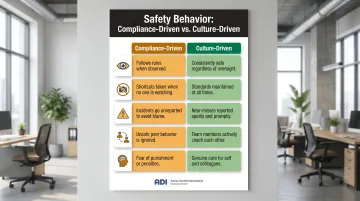
In practice, that distinction plays out in behavior:
| Compliance-Driven | Culture-Driven | |
|---|---|---|
| When supervised | Follows procedures | Follows procedures |
| When unsupervised | May cut corners | Acts safely by default |
| Near-misses | Often unreported | Reported and discussed |
| Peer behavior | Ignored | Coached and corrected |
| Motivation | Fear of consequences | Belief that safety matters |
Multiple meta-analyses encompassing tens of thousands of workers confirm that stronger safety culture directly correlates with fewer incidents and higher compliance rates. Union Pacific Railroad demonstrated this when they shifted from enforcement-only approaches to culture-based programs emphasizing open dialogue and peer observation—achieving an 80% drop in risky behavior over two years.
Organizations can achieve perfect regulatory compliance scores while maintaining cultures where near-misses go unreported and incidents remain inevitable. Compliance sets the floor. Engaged employees—who report hazards, coach peers, and stop unsafe work voluntarily—are what raise performance above it.
The Behavioral Science Behind Safety Engagement
Behavior Is Shaped by Consequences, Not Just Rules
Applied Behavior Analysis teaches a foundational principle: behavior is governed by its consequences. Behaviors followed by positive consequences are repeated and strengthened. Behaviors followed by negative consequences or no consequences diminish and eventually disappear. Policies, training, and signage are antecedents—they set expectations and create awareness—but they lack the power to sustain behavior over time. Consequences drive lasting behavioral change.
Apply this directly to workplace safety: warning signs, training sessions, and procedure manuals tell employees what to do, but they don't guarantee employees will consistently practice safe behaviors under real-world conditions. Only a consequence environment—where safe behavior is noticed, reinforced, and valued—produces genuine safety culture.
A systematic review of 100 safety intervention studies confirmed this. Training and education alone produced largely non-significant effects on injury rates. One study evaluated training for 2,795 construction workers and found minimal impact. Another randomized controlled trial of 4,000 postal workers using "back school" training found no significant effect on injury rates.
Consequence-based interventions, by contrast, showed significant results. When supervisors were trained to provide safety feedback, organizations saw measurable improvements in safety climate and worker behavior within four months across three companies.
Positive Reinforcement vs. Punishment: What the Data Shows
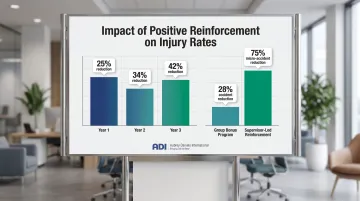
A study of 88 international client sites with 1.3 million observational data points demonstrated the power of behavior-based safety programs built on positive reinforcement:
- Year 1: 25% average injury reduction
- Year 2: 34% average injury reduction
- Year 3: 42% average injury reduction
The same research found that voluntary, reinforcement-based observation processes produce higher quality data and better sustainability than mandatory programs. Mandatory observation creates negative "have to" cultures where participants comply minimally. Voluntary programs built on positive reinforcement generate genuine engagement.
Compare this to punitive enforcement. Analysis of 8,645 manufacturing firms found that inspections resulting in penalties produced only a 5% reduction in injury rates over two years, while inspections without penalties had no significant effect.
Group-based positive reinforcement works. A study of 1,888 drivers using a group bonus system achieved a 28% reduction in accidents. Leadership-based positive reinforcement proved even more powerful: when supervisors prioritized safety interactions in a randomized controlled trial with 417 workers, the result was a 75% reduction in micro-accidents.
Discretionary Effort: What Genuine Safety Engagement Looks Like
Discretionary effort describes the behavior employees choose to exhibit beyond minimum job requirements. In safety contexts, discretionary effort includes:
- Proactively reporting a near-miss before it becomes an incident
- Coaching a peer who's taking shortcuts
- Suggesting a process improvement that reduces hazards
- Stopping work when conditions become unsafe, even when it delays production
What drives these behaviors isn't policy — it's the consequence environment. When employees receive specific recognition for safe behaviors, meaningful feedback on their contributions, and genuine care for their well-being, they choose to go beyond compliance. Fear-driven programs produce the opposite: employees comply only under surveillance and suppress hazard reporting to avoid blame.
ADI's approach to behavior-based safety, shaped by over 45 years of applied behavior analysis and the research of Judy Agnew (co-author of Safe by Accident), helps organizations build consequence environments where discretionary safety effort becomes the norm — not the exception.
How Employee Engagement and Safety Culture Reinforce Each Other
The relationship between engagement and safety culture runs in both directions. Strong safety culture signals to employees that the organization genuinely values their well-being, which increases engagement and psychological investment. Higher engagement means employees take greater personal ownership of safety—reporting hazards they'd otherwise ignore, coaching peers, and pushing for process improvements.
The first systematic review and meta-analysis examining healthcare staff engagement and patient safety outcomes analyzed 30,490 workers across 11 studies. The pooled correlation between engagement and safety culture was r = 0.22, statistically significant and consistent across settings.
Unit-level data reveals even stronger relationships. One study of over 5,000 inpatient units at Johns Hopkins found correlations between safety culture and engagement ranging from rho = 0.43 to 0.69 across three measurement periods. Another study found that 58% of highly engaged employees scored in the top quartile of patient safety culture, while only 3% were in the lowest quartile.
Hazard Identification: Seeing What Managers Cannot
Frontline employees see hazards managers miss. They work directly with equipment, navigate workflows daily, and encounter risks before they escalate. When employees feel their observations are taken seriously and acted upon, they report more hazards and near-misses—transforming safety from reactive incident-response to proactive prevention.
One study found strong unit-level correlations between engagement and frequency of incident reporting (r = 0.56, p < 0.01). The mechanism is psychological safety: when employees trust that reporting won't result in punishment, they speak up.
Research on near-miss reporting in a radiation oncology department quantified this effect. Higher psychological safety significantly increased near-miss reporting odds:
- Actual harm events: OR 1.96 (96% increase)
- High-proximity near misses: OR 1.60 (60% increase)
- Moderate-proximity near misses: OR 1.60 (60% increase)
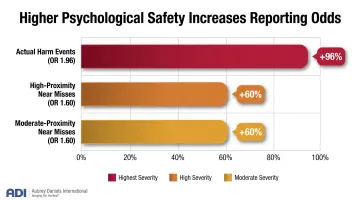
The effect strengthened as events moved closer to negative outcomes—precisely when reporting matters most.
The Retention Connection
Employees who believe their organization genuinely prioritizes their safety stay longer. A study of 117 nurses found that patient safety culture was negatively correlated with turnover intention (r = -0.277, p = 0.002). Stronger safety culture supports retention.
This creates a compounding effect: engaged employees stay, building the institutional safety knowledge that only comes with time. Their experience helps them catch subtle hazards newer employees miss and mentor those coming up behind them. When organizations lose these workers, that accumulated wisdom leaves with them.
The Erosion Dynamic
The cycle works in reverse. When employees feel unheard, under-recognized, or managed through fear, they disengage from safety. Near-misses go unreported to avoid blame. Shortcuts become normalized. Collective accountability erodes—often long before lagging indicators reflect it.
Nearly 46.6% of healthcare employees reported low perceptions of safety culture as of 2026, even as some national scores improved. Safety culture improvements on paper can mask deteriorating conditions on the floor when engagement isn't measured alongside them.
Building Safety Engagement: Behavioral Strategies That Work
Shift From a Punitive to a Reinforcement-Based Approach
Traditional safety programs focus heavily on accountability and discipline—identifying what went wrong and who's at fault. The behavioral science approach inverts this: systematically catch employees performing safe behaviors, reinforce those behaviors specifically and immediately, and make the safe choice the easiest choice.
This requires redesigning consequence systems. Practical shifts include:
- Celebrate error reporting rather than disciplining employees who surface problems
- Recognize teams with strong safety records, not just teams that avoided incidents by chance
- Reinforce rule-following publicly, not just punish violations when they occur
Organizations implementing this shift see measurable results. BBS programs using positive reinforcement achieve continuous safety improvement over multi-year periods, with injury reductions deepening annually rather than plateauing.
Make Leadership Safety Behavior Visible and Consistent
Leaders have disproportionate influence on safety engagement. Employees read leadership behavior as a signal of what the organization actually values—not what the policy manual says.
Leaders who participate in safety observations, reinforce safe behaviors publicly, respond constructively to near-miss reports, and hold themselves to the same standards as frontline workers send the strongest behavioral signal of all.
Research confirms leadership's impact. When supervisors received training to prioritize safety interactions, organizations achieved 75% reductions in micro-accidents. Supervisory safety feedback significantly improved safety climate within four months across multiple companies.
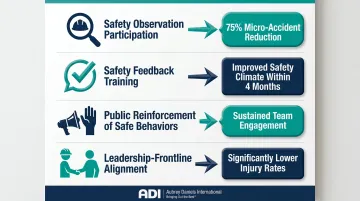
Conversely, leaders who skip safety training, prioritize production over safety, or punish employees for reporting incidents rapidly erode engagement—regardless of what the policy manual says. One manufacturing study found that when managers and workers disagreed on safety levels, injury rates were significantly higher. Leadership-frontline alignment isn't a soft goal—it's a measurable safety driver.
Create Feedback Loops That Reward Speaking Up
Psychological safety—confidence that speaking up about hazards will be welcomed, not punished—is a prerequisite for safety engagement. Build protected, transparent feedback channels where reports visibly lead to action. Close the loop by communicating what changed as a result of each report.
This reinforces reporting behavior and builds trust. One study found that safety committees with higher speed of corrective action on identified items were associated with lower injury rates. Employees who see their reports produce change continue reporting. Those who see reports disappear into bureaucracy stop participating.
Involve Employees in Safety Problem-Solving
Involving frontline employees in designing safety solutions—not just complying with them—drives ownership. When employees participate in hazard identification, risk assessment, and corrective action development, they gain personal investment in outcomes. Ownership is one of the most durable drivers of engaged behavior.
A study of 380 health and safety committee members across 176 manufacturing workplaces found that committees focusing on ergonomics and safety training planning had lower injury rates. Those committees invested an average of 1,167 hours annually ($40,500 in labor value)—and the investment paid off through measurably reduced incidents.
Safety committees, cross-functional safety teams, and pilot programs all provide practical mechanisms for building that co-ownership at scale.
Measuring Safety Engagement: Leading and Lagging Indicators
Most organizations over-rely on lagging indicators: injury rates, workers' compensation claims, days lost. These measure what already went wrong. They're backward-looking and reveal problems only after harm occurs.
Leading indicators are proactive, preventive, and predictive. They measure events and behaviors that precede injuries and reveal potential problems before incidents happen. OSHA defines them as measures that "provide information about the effective performance of your safety and health activities."
Organizations over-indexed on lagging indicators consistently miss early warning signs of cultural disengagement. By the time injury rates rise, the behavioral patterns causing them are already entrenched.
Leading Indicators Worth Tracking
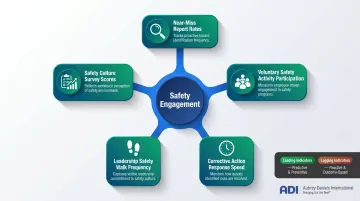
Near-miss and hazard report submission rates: The volume and quality of reporting signal whether employees feel psychologically safe and engaged. Establishments that eventually had a fatality had a near-miss rate of 1.21 vs. 0.18 for non-fatal establishments, according to analysis of 27,446 mining establishments.
Employee participation in voluntary safety activities: Voluntary participation in safety observations, committees, and training reveals genuine engagement. One coal mine study found that a 30% observer participation rate was sufficient to produce a 50% injury reduction over 14 years.
Percentage of reported safety concerns addressed within a defined timeframe: Speed of corrective action correlates with lower injury rates and reinforces reporting behavior.
Leadership safety walk frequency: Visible leadership participation signals organizational commitment and influences frontline behavior.
Employee perception scores from safety culture surveys: Measuring whether employees feel heard, trust leadership on safety, and believe safety is genuinely valued provides actionable data to identify gaps before incidents occur.
The Heinrich Triangle: Updated Understanding
The original Heinrich ratio suggested a fixed relationship: 300 near-misses predict 29 minor injuries, which predict 1 major injury. Modern research confirms the triangle form exists but ratios vary by context and severity definition.
Analysis of 27,446 mining establishments found that one permanently disabling injury increases fatality probability by 663%, while one near-miss increases it by 8%. It takes approximately 83 near-misses to equal the predictive effect of one permanently disabling injury.
No simple numeric formula applies universally. Organizations must build leading indicator systems calibrated to their specific risk profiles — and act on signals rapidly before patterns calcify.
Safety Culture Surveys: An Underused Tool
Safety culture surveys go beyond what incident data can tell you. They surface perception gaps between management and frontline workers — gaps that consistently correlate with higher injury rates — before those gaps show up in lagging numbers.
Effective survey programs do two things: feed findings into continuous improvement cycles, and share results back with employees. Closing that feedback loop reinforces that reporting and honest input actually change something. Without it, participation drops and the data loses its predictive value.
Frequently Asked Questions
How does employee engagement affect workplace safety outcomes?
Engaged employees consistently follow safety procedures, proactively report hazards, and hold peers accountable—resulting in measurably fewer incidents. Companies with highly engaged workforces see 63% fewer safety incidents compared to those with low engagement, according to Gallup's analysis of 183,806 business units globally.
What is the difference between safety compliance and safety culture?
Safety compliance means meeting minimum regulatory requirements, often driven by external pressure or fear of penalties. Safety culture means employees have internalized safe behavior as a shared value and act safely even without oversight or enforcement.
What is the purpose of a safety culture survey?
A safety culture survey measures employees' perceptions of how seriously safety is prioritized, whether they feel safe reporting concerns, and how committed leadership appears to be. It provides actionable data to identify gaps and drive targeted improvement efforts before lagging indicators reveal problems.
What is the goal of safety culture?
The goal is to embed safety into every decision, behavior, and process across the organization—so that safe practices become habitual and self-sustaining rather than dependent on rules or external enforcement.
What are the 5 elements of safety culture?
The IAEA framework identifies five characteristics:
- Safety is a clearly recognized value
- Leadership for safety is clear
- Accountability for safety is clear
- Safety is integrated into all activities
- Safety is learning-driven
Employee engagement is the behavioral thread running through all five.
What are the 5 C's of employee engagement?
The 5 C's framework includes Connection, Contribution, Communication, Clarity, and Care. In safety contexts, each plays a distinct role:
- Care drives discretionary safety effort
- Contribution drives hazard reporting participation
- Connection builds peer accountability
- Communication enables psychological safety
- Clarity ensures employees understand expectations and how their behavior impacts outcomes