Introduction
Leaders worldwide face a sobering reality: employee disengagement costs the global economy approximately $10 trillion annually—representing 9% of global GDP. Only 20% of employees were engaged in 2025, the lowest level since 2020. In the United States specifically, engagement fell to a 10-year low of 31%, with 3.2 million engaged employees lost in just one year. Meanwhile, the pressure on leaders to build inclusive, high-performing cultures in hybrid environments has never been greater.
Most organizations approach culture transformation backwards. They launch communication campaigns, rewrite values statements, and roll out training programs — then find those initiatives produce no lasting change. Employees often understand the new values perfectly well. The real problem is that the organization keeps reinforcing the old behaviors.
Culture transformation is fundamentally a behavior problem. Until leaders identify the specific behaviors their culture requires and redesign the consequences that reinforce those behaviors, change stays superficial and short-lived.
Why Most Culture Transformation Efforts Fall Flat
Organizations continue to invest millions in culture change programs that deliver minimal returns. McKinsey's 2021 research confirms the average success rate remains below 30%, meaning approximately 70% of transformation initiatives fail. Even successful transformations capture only 67% of the maximum financial benefit possible, while unsuccessful ones capture a mere 37%.
The core problem is what behavioral scientists call the "tell and train" fallacy. Leaders assume that informing employees about the need for change and training them on new values will produce different behaviors. It doesn't. Research in organizational behavior management demonstrates that knowledge and capability alone don't drive behavioral change—consequences do. Employees follow the strongest consequence, not the stated organizational value, when the two conflict. As management scholar Steven Kerr documented in his foundational research, most organisms seek information about what activities are rewarded, then do those things virtually to the exclusion of unrewarded activities.
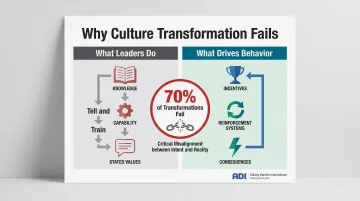
This creates structural misalignment. When existing incentive structures, performance reviews, and daily processes still reward old behaviors, new stated values become noise.
The disconnect shows up in predictable ways:
- A company declares "collaboration" a core value, then promotes individuals based solely on personal achievement metrics
- A manufacturer emphasizes "safety first," yet subtly rewards managers who hit production targets at any cost
Employees are expert observers of what actually gets reinforced. They follow the consequences they experience, not the words on the wall.
Closing that gap requires more than communication plans and training calendars. It demands deliberate redesign of the reinforcement systems that drive behavior every day—which is exactly what the five moves below address.
Bold Move 1: Show, Don't Just Tell
Human beings expand their behavioral repertoires through observation and experience, not directives. From a behavioral science perspective, new antecedents—seeing what's possible, witnessing alternatives in action—set the occasion for new behaviors to emerge. Yet most culture transformation efforts rely almost exclusively on presentations, emails, and policy documents to communicate change.
Research on the "Curse of Knowledge" illustrates why this fails. In a Stanford study cited by McKinsey, people who knew a song's rhythm predicted listeners would guess the song 50% of the time. The actual success rate was less than 5%. Leaders consistently overestimate how well their message is received because they can't "unknow" what they already understand. That gap between leader intent and employee comprehension quietly undermines even the most thorough communication campaigns.
Showing creates different neural pathways. When employees visit organizations with award-winning cultures, participate in cross-industry workshops, or hear senior leaders tell vivid, emotional stories about the desired future state, they experience possibilities rather than directives.
They see how behaviors translate into outcomes. They observe social proof: evidence that these new approaches work for people like them, in contexts that resemble their own.
Practical tactics include:
- Arrange go-and-see visits to organizations recognized for the cultural attributes you're building
- Run cross-industry learning exchanges so employees witness how other teams solve common challenges
- Hold senior leader storytelling sessions that create emotional connection to the vision, not just logical arguments
- Use job shadowing and rotational assignments to expose employees to new behavioral models in action
These tactics only work if access isn't limited to senior teams. When only executives attend conferences, visit benchmark companies, or participate in external learning, behavioral change stays at the top.
Frontline workers, middle managers, and individual contributors need the same exposure. Culture shifts when everyone, at every level, can see what the desired behaviors actually look like in practice.
Bold Move 2: Enroll, Don't Assign
Resistance isn't a character flaw—it's a predictable response to imposed change. When transformation is assigned to people, it triggers avoidance behaviors and surface-level compliance. From a behavioral science perspective, behavior driven by negative reinforcement (doing something to avoid punishment or pressure) is fragile. It stops the moment the pressure lifts. Employees attend mandatory training, nod in meetings, and return to old habits as soon as leadership attention shifts elsewhere.
The data on enrollment is compelling. McKinsey's 2021 research shows that when frontline staff feel genuine ownership, transformation success reaches 70%. When they take initiative to drive change themselves, it reaches 71%. By contrast, when line managers and frontline employees aren't engaged, the success rate drops to 3%. Voluntary participation isn't a nice-to-have—it's the mechanism of durable change.
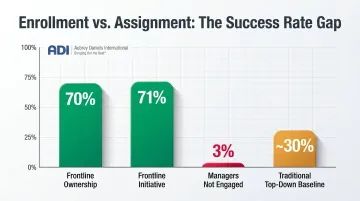
Those statistics reflect a behavioral reality: when employees choose to participate, they develop ownership. Positive reinforcement — where change itself produces meaningful rewards like autonomy, competence, and connection — produces lasting behavior change. Self-Determination Theory confirms it. External regulation produces compliance. Voluntary engagement produces results.
How to enroll rather than assign:
- Investigate before you roll out. Talk to different employee cohorts before launch. Understand what obstacles they anticipate, what trade-offs concern them, and what would make this change meaningful rather than burdensome. Use those insights to redesign the plan before resistance sets in.
- Build voluntary commitment mechanisms. Public commitments activate social reinforcement from peers and leaders. These work best when the commitment is visible, witnessed by others, and meaningful enough to signal genuine intent — not a checkbox exercise.
- Sustain enrollment over time. Reconnect employees to the "why" regularly. Recognize those who take initiative, experiment with new approaches, and help colleagues adapt. Ownership behaviors need reinforcement to stick.
Bold Move 3: Redesign Rituals and Reinforce New Behaviors
Culture doesn't live in mission statements or values documents. It lives in rituals—the daily routines, meeting norms, feedback habits, and decision-making processes that employees experience every day. These observable behaviors form the backbone of organizational culture. To change culture, these rituals must be intentionally redesigned.
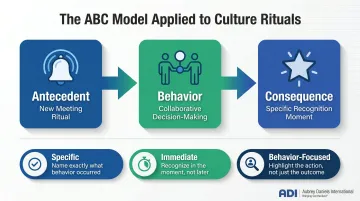
The ABC model (Antecedent → Behavior → Consequence) explains the mechanism. A new ritual creates an antecedent—a cue or prompt for a behavior. But the behavior will only be repeated and become habitual if a positive consequence follows.
Most culture initiatives redesign antecedents (new meeting agendas, new terminology, new processes) without redesigning consequences. That's why rituals don't stick. Employees try the new behavior once, receive no meaningful reinforcement, and revert to what they know works.
Why Incremental Tweaks Fail
Cosmetic changes to meeting formats or team names don't signal that real transformation is happening. Leaders must introduce rituals that are materially different—new ways of making decisions that distribute authority, restructuring teams around customer problems rather than functions, and visibly rewarding new behaviors in public forums. The discontinuity itself communicates seriousness and creates space for new norms to emerge.
Redesigning Incentive and Recognition Systems
Organizations must visibly and consistently shift which behaviors get praised, promoted, and rewarded. Only 1 in 3 U.S. workers feel recognized for their contributions, and those who don't receive recognition are twice as likely to quit within a year. Yet recognition is one of the highest-leverage, lowest-cost interventions available.
Effective recognition is:
- Specific — tied to observable behaviors, not vague praise
- Immediate — delivered close in time to the behavior
- Behavior-focused — reinforcing actions that drive results, not just outcomes
ADI's behavior-based Performance Management approach helps leaders design these reinforcement systems with measurable consistency. Rather than annual performance reviews focused on ratings, the methodology emphasizes continuous feedback loops where managers identify the specific behaviors the culture requires. They then systematically reinforce those behaviors—creating alignment between what the organization says it values and what it actually rewards.
Ensuring Consistency Across Levels
That alignment only holds if it runs throughout the organization. If senior leaders continue to be rewarded for siloed decision-making and hero leadership while frontline employees are asked to collaborate, the cultural signal is contradictory. Reinforcement systems must align from top to bottom. Executives, middle managers, and individual contributors should all experience consequences that support the same behavioral norms.
Bold Move 4: Activate Hidden Influencers as Behavioral Change Agents
Org charts don't predict influence. Informal influencers—employees who are heavily networked and highly respected but rarely appear in senior leadership roles—are the most powerful drivers of behavioral spread across organizations. McKinsey's research shows transformations are nearly 8 times more likely to succeed when organizations use all four influence-model building blocks, with role modeling by key opinion leaders often exerting more impact than CEO communications.
Research from MIT Sloan confirms that targeting the top 3-5% of informal influencers can reach a tipping point for norm adoption. When these individuals adopt new behaviors, they create social proof that accelerates spread throughout the network. Traditional culture change programs that ignore informal networks miss this multiplier effect.
How to identify informal influencers:
Formal titles won't help. Look for individuals who:
- Are frequently sought out for advice across departmental boundaries
- Have deep credibility with frontline employees and managers alike
- Command attention in meetings without formal authority
- Bridge silos and connect disparate parts of the organization
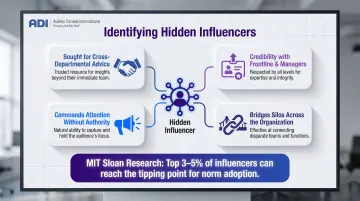
Mapping informal networks—understanding who trusts whom and who people turn to for guidance—is essential. These individuals amplify new norms, model behaviors publicly, and win over skeptics in their immediate circles. That combination of reach and credibility is what makes them so valuable to culture change efforts.
What activation looks like in practice:
Informal influencers can't be mere communicators. They need to become behavioral change practitioners. This means giving them:
- Targeted training on the specific behavioral changes the transformation requires — not just the strategic rationale
- Clear authority to observe and provide feedback on how behaviors are shifting across teams
- Practical tools to experiment with new approaches in their own spheres of influence
ADI's approach recognizes that influencers become effective when they understand behavioral science principles themselves — when they can identify antecedents, pinpoint behaviors, and design consequences that reinforce what matters. That knowledge base is what separates influencers who create lasting change from those who simply relay messages.
Don't overlook the mavericks:
Some of the most powerful influencers are employees who challenge the status quo and push back on norms. Rather than managing these individuals as threats, leaders should mentor and empower them.
Research on positive deviance shows that mavericks exhibit "bounded non-conformity" — they disregard lower-level policies but conform strictly to higher-level organizational goals. Their behavioral contrarianism can break through organizational inertia and surface opportunities that conformist change agents would miss.
Bold Move 5: Make Culture Change Personal
People struggle to change even when they want to. Long-established behaviors are maintained by years of reinforcement—they're deeply habitual and tied to identity, role, and relationships. Culture transformation asks employees to abandon behaviors that have been rewarded for years, which produces anxiety, resistance, and emotional friction. Leaders who ignore this human dimension watch their initiatives stall.
Why established habits resist change:
Every behavior employees perform today exists because it has been reinforced. The engineer who works in isolation learned years ago that solo contributions led to promotions. The manager who micromanages experienced early career success by controlling details. Asking these individuals to collaborate or delegate isn't just a skill request — it means walking away from the strategies that built their careers.
Research confirms that controlling environments filled with surveillance and pressure shift motivation from internal to external, making behavior change fragile and temporary.
Attend to the human side of change:
Leaders must acknowledge the personal difficulty of behavioral transition. This means:
- Connecting the new culture to what employees personally value: belonging, growth, purpose, and peak performance
- Creating space for recovery, since behavior change is cognitively and emotionally demanding
- Treating well-being as a core requirement of transformation, not an afterthought
Research shows that energizers in informal networks trigger intrinsic motivation in others, increasing performance and commitment, while de-energizers sap motivation and increase turnover. Leaders who attend to social connection, stress management, and purpose accelerate change.
Model change authentically:
Employees are expert behavioral observers. They notice when leaders say one thing and do another. McKinsey's research reveals that 86% of leaders believe they're role-modeling change, but only 50% of frontline employees agree. This gap destroys cultural credibility faster than any other factor.
Authentic modeling means:
- Making your own behavioral struggles visible
- Seeking feedback on how well you're living the new norms
- Correcting course publicly when you fall short
- Reinforcing others who call out inconsistencies constructively

Culture change becomes personal when leaders demonstrate that they're changing too. That visible effort — imperfect and public — is what gives others permission to try, fail, and keep going.
Frequently Asked Questions
How can organizational culture be changed?
Organizational culture changes when leaders identify the specific behaviors the new culture requires, redesign the antecedents and consequences that reinforce those behaviors, and ensure all systems—recognition, rituals, and role modeling—consistently support the new behavioral norms over time.
How long does it take to change an organization's culture?
Cultural change timelines vary by organization size and the depth of change required. Team and departmental shifts can emerge within months when reinforcement systems are redesigned; enterprise-wide transformation typically takes two to five years of consistent effort.
What are the 5 R's of culture change?
The 5 R's framework (Recognize, Reframe, Redesign, Reinforce, Repeat) maps to behavioral action at each stage. The Reinforce and Repeat steps are what make culture shifts stick—embedding new behaviors into the organization's consequence systems rather than letting them fade.
How do layoffs affect organizational culture?
Layoffs generate uncertainty, erode psychological safety, and often dismantle the informal influencer networks that culture depends on. Leaders need to respond by communicating transparently, reinforcing belonging behaviors, and reconnecting remaining employees to a shared sense of purpose.
How does the environment affect organizational culture?
The physical and digital work environment acts as a powerful antecedent, cueing certain behaviors, collaboration patterns, and communication norms. Changing the environment—space design, technology, visibility of goals—can accelerate behavioral change by making desired behaviors easier and more visible.
What are the 4 C's of organizational culture?
The 4 C's—Communication, Collaboration, Commitment, and Culture Fit—offer a useful starting framework. Lasting culture change, however, requires translating each concept into specific, observable behaviors that leaders can reinforce and measure.