Introduction
Learning and development leaders face a recurring frustration: employees attend training, rate it highly, then return to their desks and do exactly what they did before. This is the "training event trap"—organizations invest heavily in learning programs, but the real measure of success isn't what happened during the session. It's whether observable behavior changes afterward and stays changed.
The distinction between effective and ineffective training isn't content quality or engagement. It's whether the program was designed to change specific behaviors and whether the organizational environment supports those behaviors once training ends. Training initiatives fail not because the content was poor, but because they never defined what behavior should look like differently on Monday morning.
Performance-based training, grounded in behavioral science, offers a direct path from passive learning to lasting behavior change. This article covers how to design training around specific behavioral outcomes, how reinforcement drives post-training application, and what organizational conditions determine whether new behaviors stick or fade.
Key Takeaways
- Traditional training transfers knowledge; performance-based training changes behavior you can actually measure
- Most training fails because consequences — not content — are what sustain behavior change
- Lasting change demands reinforcement systems, practice opportunities, and an environment that rewards new behaviors
- Tracking satisfaction scores or knowledge tests hides whether behavior actually changed on the job
- Skip post-training support and old habits return — regardless of how good the program was
Why Traditional Training Falls Short of Behavior Change
Research consistently shows that only 10-40% of training results in sustained individual or organizational improvement. This isn't a content problem—it's a transfer problem, and it's predictable.
The knowledge-behavior gap is well documented. Employees acquire information during training but fail to apply it once they return to work. Studies tracking transfer over time reveal a sharp decline: approximately 62% immediately after training, dropping to 44% at six months and just 34% at one year.
Why the Gap Persists
Organizations design training as a one-time event: it happens at a specific time, in a specific place, then ends. Once employees return to the pressures of their real environment, competing habits, familiar cues, and existing consequences pull them back to established patterns. The new behavior has no support system.
Measurement compounds the problem. Most organizations assess training using satisfaction scores or knowledge tests. According to the Association for Talent Development, approximately 80% of training includes Level 1 (satisfaction) evaluation, but only 54% conduct Level 3 (behavior) evaluations and just 38% measure Level 4 (results).
Those metrics reveal whether learners enjoyed the experience or can recall content. They say nothing about whether behavior actually changed. Without that data, organizations operate on false confidence — believing training succeeded because participants smiled and passed the quiz.
Where Most Fixes Miss the Mark
When training fails, organizations typically respond by improving slides, adding gamification, or switching to microlearning. These changes enhance engagement. They don't solve the root problem.
The actual gap lies in what happens after the session ends: no behavioral objectives, no reinforcement, no structured support to anchor new habits in the real work environment.
The scale of this problem is hard to ignore. The global corporate training market reached $352.66 billion in 2024, with US organizations spending an average of $1,283 per employee on workplace learning in 2023. Harvard Business School Professor Michael Beer has called this investment "the great training robbery" — billions spent with minimal behavioral impact.
That gap between spend and behavior change is exactly what performance-based training is designed to close.
What Performance-Based Training Actually Means
Performance-based training starts with identifying specific, observable behaviors employees need to perform differently—not knowledge areas they need to understand. The entire learning experience is designed around producing and sustaining those behaviors.
Pinpointing: The Foundational Step
Before designing any training, translate vague performance goals into precise behavioral descriptions. "Improve customer service" becomes "acknowledge the customer's concern before offering a solution in every interaction." Without that specificity, you can't measure success or build effective reinforcement.
Pinpointing requires discipline. It forces stakeholders to define exactly what employees should do differently, how often, and under what conditions—surfacing the gap between aspirational goals and actionable behavior.
Performance Objectives vs. Learning Objectives
A learning objective describes what a learner will know. A performance objective describes what a learner will do, how often, and under what conditions.
| Learning Objective | Performance Objective |
|---|---|
| Understand active listening techniques | Paraphrase the customer's concern within 10 seconds of them finishing speaking, in 90% of interactions |
| Know the new quality standards | Complete the equipment pre-check using the 8-point checklist before every shift |
| Comprehend safety protocols | Secure the load using the tie-down sequence in the job aid, inspecting each anchor point before departure |
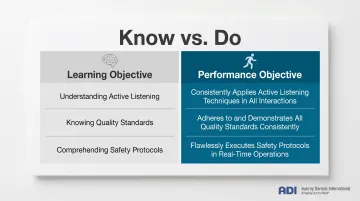
Writing objectives as performance statements changes how training is designed, practiced, and evaluated. It shifts focus from content coverage to behavioral fluency.
Why Targeted Training Outperforms Blanket Programs
Blanket training—sending everyone through the same content regardless of individual performance gaps—wastes resources and undermines engagement. Performance-based training addresses the specific behavioral gap each person or group needs to close, cutting wasted seat-time and raising the odds of on-the-job results.
How Behavioral Science Explains What Makes Change Stick
The ABC model—Antecedents → Behavior → Consequences—is the foundational framework from Applied Behavior Analysis that explains why behavior occurs and what drives lasting change.
Antecedents set the stage; consequences determine repetition:
Antecedents (training, instructions, goals, job aids) tell employees what to do. But antecedents alone produce only temporary compliance. The consequences that follow behavior—positive reinforcement, feedback, recognition—determine whether a behavior is repeated, strengthened, or abandoned.
Most traditional training operates almost entirely at the antecedent level — it shows employees how to perform the new behavior, then sends them back to work. Without deliberate consequences built into the environment, the behavior fades.
In practical terms, the difference looks like this:
- Antecedents: training sessions, job aids, instructions, goal-setting
- Consequences: manager recognition, performance feedback, reinforcement tied to the specific behavior
Positive reinforcement is the primary driver of lasting change:
Positive reinforcement—delivering something valued immediately after a desired behavior—is the most reliable mechanism for behavior change that holds. A meta-analysis of Organizational Behavior Modification studies found that positive reinforcement interventions produced an average 17% increase in task performance. When money, social recognition, and performance feedback were combined, performance increased by approximately 45%.
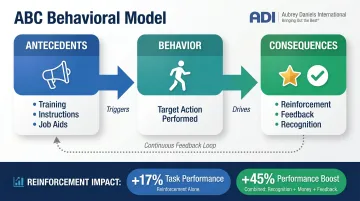
Effective reinforcement is specific, immediate, and tied to the precise behavior being targeted. Generic praise ("good job") or annual bonuses disconnected from daily performance don't move the needle. A manager who observes the new behavior and acknowledges it in the moment does: "I noticed you completed the pre-check before starting—that's exactly what we need."
The organizational environment is where behavior change is won or lost:
Even well-designed training with clear behavioral objectives will fail if employees return to an environment where old behaviors are reinforced or new behaviors go unrecognized. Research shows that supervisor support has a corrected correlation of .31 with training transfer—stronger than peer support or individual motivation.
The post-training environment—how managers respond, what gets acknowledged, what the culture rewards—determines whether new behaviors survive or die.
From Knowledge to Fluency: Designing Training That Drives Action
Behavioral fluency means performing the target behavior with both accuracy and automaticity under real-world conditions, not merely passing a one-time assessment. Fluency is a higher bar than competency, and it's what determines whether new behaviors survive workplace pressures.
What Fluency-Based Training Design Looks Like
- Repeated practice with feedback, not single exposure
- Graduated difficulty that mirrors real-world complexity
- Performance measurement against fluency criteria (speed + accuracy)
- Practice until the behavior becomes automatic
Applying this principle to training redesign, ADI's fluency-based learning approach helps organizations build programs where behavior actually holds. The measure of success isn't a single clean demonstration — it's consistent, fast, pressure-tested performance on the job.
Spaced Practice and Application Over Time
Rather than a one-time training event, performance-based training sequences learning across multiple touchpoints. Employees practice the behavior, receive feedback, refine their approach, and practice again — all within their actual work context. Decades of cognitive science research confirm that distributed practice produces stronger retention than massed practice. Brief, repeated learning sessions consistently outperform marathon training events.
Building the Organizational Environment That Sustains Change
Lasting behavior change requires engineering the organizational environment to support and reinforce new behaviors after training ends.
Three Elements That Must Align
- Management practices — Managers must understand how to observe, reinforce, and coach the target behaviors
- Feedback mechanisms — Employees need timely, specific data showing how their behavior connects to results
- Cultural norms — The broader environment must value and acknowledge the behaviors training introduced
Why Managers Are the Single Most Important Factor
Managers who understand how to use specific, immediate positive reinforcement sustain post-training behavior change. Behavioral coaching by managers looks like:
- Observing employees performing the target behavior in real work situations
- Providing specific feedback tied to the pinpointed behavior
- Reinforcing progress immediately and consistently
- Adjusting workload or systems to allow practice
When managers consistently apply these practices, the effects compound. One ADI case study found that when plant managers actively provided positive reinforcement and feedback in the field, employees began reinforcing each other — creating a cascade effect that increased both communication and productivity.
Organizations that sustain performance improvement treat the work environment itself as part of the solution. They shape the antecedents and consequences employees encounter every day — through recognition systems, manager coaching practices, performance feedback dashboards, and cultural messaging.
This is, at its root, an organizational design problem. The question isn't whether training was effective in the classroom — it's whether the system employees return to supports the behaviors they were trained to perform.
How to Measure Behavior Change After Training
Knowledge assessments and satisfaction surveys measure what happened during training—not what changed as a result. Effective evaluation must include observation of on-the-job behavior against the pinpointed performance objectives defined before training began.
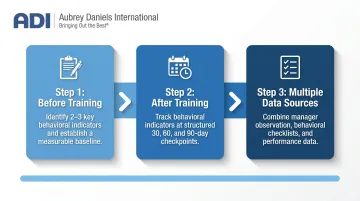
A practical measurement approach:
- Before training: Identify 2-3 key behavioral indicators for the initiative and establish baseline measurements
- After training: Track those indicators at defined intervals (30, 60, 90 days post-training)
- Use multiple data sources: Manager observation, behavioral checklists, relevant performance data
Example: If training teaches managers to provide specific positive reinforcement, measure how often managers deliver reinforcement tied to pinpointed behaviors (observed or self-reported), and track whether employee performance on those behaviors improves.
The business case for behavioral measurement:
Yet measurement at this level remains rare. Only 30% of organizations report being "good at" using learning program data to make business decisions, according to ATD research. Most stop at satisfaction and knowledge scores—neither of which tells you whether behavior actually changed.
Organizations that implement Level 3 (behavior) and Level 4 (results) evaluation can demonstrate ROI, justify continued investment, and identify what's working. That data turns training from an assumed expense into a documented contributor to business results.
Frequently Asked Questions
What are the 5 A's for behavior change?
The 5 A's (Assess, Advise, Agree, Assist, Arrange) originated in behavior change counseling as a structured process for guiding individuals toward commitment and action. In performance-based training, the same principles apply: assess employee readiness, provide clear behavioral guidance, and arrange follow-up support to reinforce change.
What are the 5 steps of BCC?
BCC's five steps—establishing rapport, exploring behavior, identifying motivation, addressing barriers, and planning for change—translate directly to performance-based training design. Each step prioritizes individual readiness and reinforcement, which are the same drivers that determine whether new workplace behaviors stick.
What are the 7 R's of behavior change?
The 7 R's (Reach, Relevance, Repetition, Reinforcement, Reward, Reflection, Retention) make one point clear: a single training event is not enough. Lasting behavior change depends on repeated practice and consistent reinforcement on the job until new behaviors reach fluency and become habitual.
How is performance-based training different from traditional training?
Traditional training focuses on building knowledge and is measured by what employees can recall. Performance-based training defines success by observable changes in on-the-job behavior, using pinpointed behavioral objectives, applied practice, and reinforcement systems to drive measurable performance improvement.
What role does reinforcement play in long-term behavior change?
Positive reinforcement delivered immediately after a desired behavior is the primary driver of habit formation. Without deliberate reinforcement structures post-training, new behaviors fade quickly as older, ingrained patterns reassert themselves.
How do you measure behavior change after training?
Effective measurement goes beyond post-training satisfaction surveys or knowledge tests to track observable behavior against pre-defined performance objectives. Use tools like manager observations, behavioral checklists, and performance data tracked at 30-, 60-, and 90-day intervals after training to assess whether behavior actually changed on the job.