Introduction
Most organizations treat safety as a compliance problem: more rules, more signage, more training sessions — yet incidents keep happening. Workers read the manuals and attend the sessions. They still make risky choices. What's missing isn't information. It's an understanding of what actually drives behavior.
Employees often know the safe behavior and still don't do it. A worker understands the lockout/tagout procedure but skips it to save three minutes. A driver knows proper lifting mechanics but bends at the waist anyway. Knowledge doesn't equal action — and that gap is where most safety programs fail.
Understanding what drives behavior is the real lever. That means looking at what happens before and after a behavior, not just whether the rule exists.
This article breaks down the behavioral science behind safe and unsafe choices — and what organizations can do to make safe behavior the path of least resistance.
Key Takeaways
- Safety behaviors are observable, measurable actions that prevent harm. They also predict incidents more accurately than policies or procedures alone
- Unsafe shortcuts often deliver immediate, certain benefits while injury consequences are future and uncertain, creating a behavioral trap that knowledge can't overcome
- The ABC Model explains why unsafe behaviors persist — and why consistent, immediate positive reinforcement is what actually builds lasting safe habits
- Leaders who model, observe, and reinforce safe behavior create cultures that outlast any compliance program
Why Safety Behaviors Matter More Than Rules and Policies
Safety behavior means the specific, observable actions an employee takes (or avoids) that directly reduce injury risk—wearing PPE correctly, following lockout/tagout procedures, reporting near misses, conducting pre-task hazard checks, using proper lifting mechanics. This differs from safety policies (written documents) and safety culture (the aggregate result of consistent behaviors over time).
Heinrich's foundational 1931 research proposed that 88% of industrial accidents stemmed from unsafe acts, with only 10% from unsafe conditions and 2% from unpreventable causes. While this ratio has been critiqued and is over 90 years old, it established a critical insight: human behavior is the primary lever for incident prevention.
The business stakes are substantial. The National Safety Council reports that work injuries cost $181.4 billion in 2024. That figure breaks down into:
- $54.9 billion in wage and productivity losses
- $36.8 billion in medical expenses
- $64.5 billion in administrative costs
Each medically consulted injury costs approximately $48,000. Fatal injuries average $1.54 million per incident.
Those costs make a strong case for prevention — but the method matters. Relying solely on compliance creates minimum-viable behavior: doing just enough to pass inspection. Workers follow procedures when supervisors watch, then revert to shortcuts when no one is looking.
Behavior-based approaches produce something different — Discretionary Effort, the voluntary contribution beyond minimum requirements. When safe behavior is reinforced rather than merely mandated, employees choose to act safely because it's the right call, not because someone is watching.
OSHA's Voluntary Protection Programs demonstrate this difference. Sites with exemplary safety management systems typically achieve lost-workday case rates 50% below industry averages, and effective programs save approximately $4 for every $1 spent. A Union Pacific behavioral intervention produced an 80% drop in risky behavior over two years through peer observation and collaborative risk management.
The Science Behind Safety Behaviors: The ABC Model
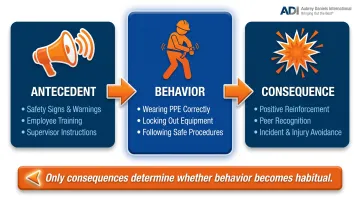
The ABC Model (Antecedent–Behavior–Consequence) is the core framework from Applied Behavior Analysis for understanding workplace behavior, including safety. Each component plays a distinct role:
- Antecedents are triggers or prompts that set the stage for behavior: safety signs, training sessions, supervisor instructions
- Behaviors are the observable actions themselves: putting on safety glasses, locking out equipment, reporting a spill
- Consequences are what follows the behavior and determine whether it will happen again
Behavioral science research confirms that while antecedents can prompt a behavior once, only consequences determine whether that behavior becomes habitual.
Why Unsafe Behaviors Persist
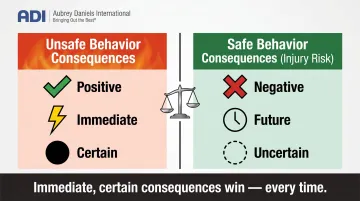
The consequence trap explains why workers make risky choices despite knowing better. Unsafe behaviors often produce consequences that are:
- Positive (saves time, avoids discomfort, feels easier)
- Immediate (benefit happens right now)
- Certain (happens every time)
Meanwhile, the negative consequence—injury—is:
- Negative (undesirable)
- Future (might happen someday)
- Uncertain (hasn't happened yet)
Immediate and certain consequences consistently outweigh future, uncertain ones. A worker who skips a PPE step saves 30 seconds right now — and that time savings reinforces the shortcut every single time, while the potential injury remains abstract and distant.
This is the core insight of PIC/NIC Analysis (Positive-Immediate-Certain vs. Negative-Future-Uncertain): knowledge alone can't overcome powerful behavioral reinforcement.
Why Rules and Training Alone Aren't Enough
Antecedents like rules, signs, and training can prompt behavior initially, but without consistent consequence management, behavior drifts back over time. A new safety course may boost compliance the week after delivery — then fade.
Research confirms that without reinforcement, behavior decays significantly. Burke et al.'s meta-analysis of 95 studies found engaging training methods were approximately 23% more effective than passive ones, but even the best training loses ground without ongoing feedback.
Behavioral consequences in safety include:
- Positive reinforcement: Something desirable follows safe behavior, increasing its frequency
- Negative reinforcement: Something unpleasant is removed when safe behavior occurs
- Punishment: Something negative follows unsafe behavior
Of these, positive reinforcement is the most effective long-term strategy. Punishment-only approaches create avoidance: employees hide problems rather than report them, driving safety information underground where it can't be addressed.
ADI has applied these principles to workplace safety for over 45 years. Safe by Accident (co-authored by Dr. Aubrey Daniels and Judy Agnew) translates this behavioral science directly into what leaders can do to make safe behavior the path of least resistance.
How to Build and Reinforce Safe Behaviors in Your Workplace
Step 1: Pinpoint the Critical Behaviors
Start by identifying the specific, observable safe behaviors that matter most for your workplace's unique hazards. Work with frontline employees to conduct job hazard analyses (JHAs) that identify both hazardous conditions and the precise behaviors needed to prevent incidents.
Behavioral pinpointing means defining safety in measurable terms:
- ✅ "Employee positions hands outside the blade guard during machine operation"
- ❌ "Employee is careful"
The more specific the behavior, the easier it becomes to observe, reinforce, and measure.
Step 2: Design Consequences That Make Safe Behavior the Path of Least Resistance
Audit your current consequence environment. Ask: what happens immediately after an employee engages in safe behavior? If the answer is "nothing," the behavior will extinguish over time.
Redesign workflows, scheduling, and supervisory practices so that safe behavior is systematically noticed and acknowledged. Remove friction that makes unsafe shortcuts tempting:
- Position safety equipment at point of use
- Simplify procedures to eliminate unnecessary steps
- Ensure safety gear fits properly and comfortably
- Schedule adequate time for safe task completion
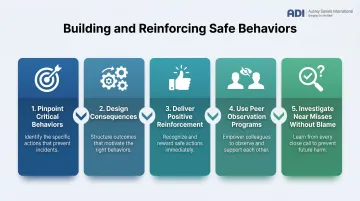
Step 3: Deliver Specific Positive Reinforcement Consistently
Effective reinforcement in safety contexts must:
- Happen close in time to the behavior — delay kills impact
- Name the exact behavior observed, not offer generic praise
- Come across as authentic, not scripted or checkbox-driven
Example: A supervisor catches a worker correctly using fall protection on a ladder and immediately says, "I noticed you took the time to secure your harness before climbing—that's exactly the kind of attention to detail that keeps our team safe." This is far more effective than waiting for an annual safety award.
Step 4: Use Peer Observation Programs to Expand Reinforcement Density
Peer-to-peer safety observation systems, trained in behavioral principles, dramatically increase the frequency of feedback workers receive. Research confirms that behavior-based safety interventions are associated with meaningful reductions in workplace accidents.
That impact depends heavily on how the program is designed. Behaviorally-informed peer observation differs from traditional compliance audits in both focus and outcome. Key elements of an effective program include:
- Workers develop the behavioral checklist themselves
- Trained observers note both safe and at-risk behaviors
- Observers deliver one-to-one behavioral feedback focused on reinforcement
- The interpersonal conversation matters more than data collection
Step 5: Investigate Near Misses and Unsafe Behaviors Without Blame
A behavioral approach to incident investigation focuses on the antecedents and consequences that made the unsafe behavior the "logical" choice in that moment—not on punishing the individual. This creates a reporting culture where near misses surface before they become incidents.
When organizations respond to safety concerns with curiosity and problem-solving rather than blame, they reinforce the behavior of speaking up. Research shows that adequate response to near-miss reports is associated with reduced accident occurrence.
Leadership's Role in Shaping Safety Culture
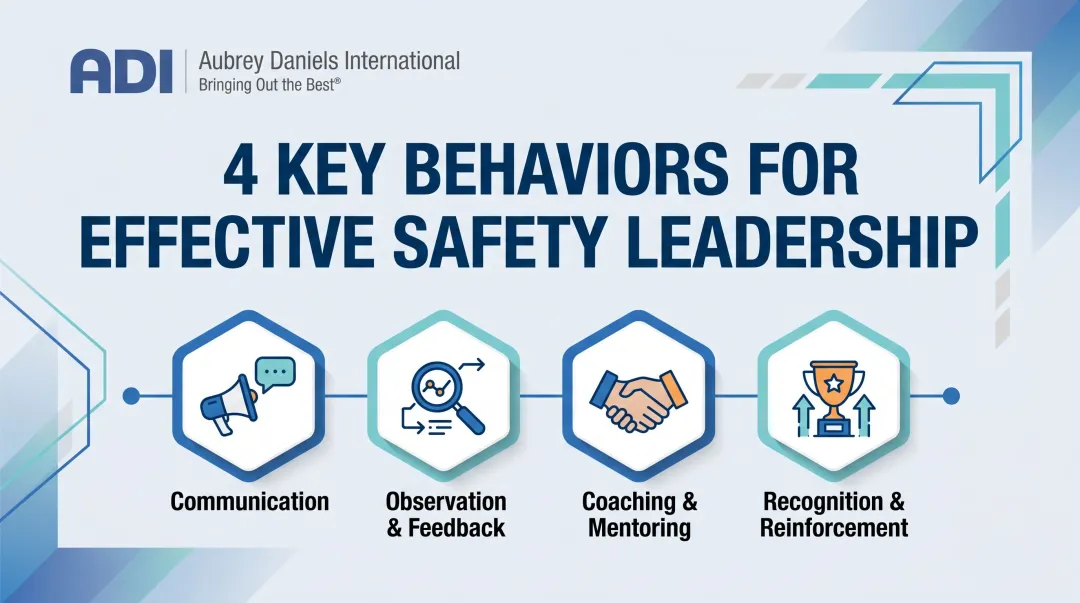
Leadership behavior—not leadership messaging—defines safety culture. Employees watch what leaders do, not what they say. A manager who skips PPE while walking the floor sends a more powerful behavioral message than any safety poster. The behavioral concept of modeling shows that when leaders consistently demonstrate safe behavior, they set the standard employees use to calibrate their own actions.
Leaders are the most influential consequence deliverers in any organization. They should:
- Notice and verbally reinforce specific safe behaviors during regular walkthroughs
- Deliver corrective feedback that addresses behavior without damaging relationships
- Make safety observation a precision leadership skill, not an added burden
Research on supervisor behavioral integrity found that when supervisors' words align with their deeds, the effect of top-management safety climate on employee safety compliance nearly doubles (effect size increases from 0.141 to 0.260). Brief, specific, genuine acknowledgment takes seconds and creates outsized impact on safety culture over time.

That behavioral integrity also shapes how employees respond to risk. When leaders react to reported near misses or safety concerns with curiosity rather than blame, safety information flows upward freely — the foundation of high-reliability organizations. Studies confirm that psychologically safe employees speak up more often and are more motivated to improve team safety performance.
How to Measure and Sustain Safety Behavior Improvements
Shift from Lagging to Leading Indicators
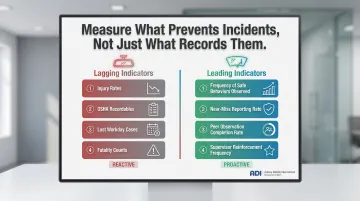
Traditional safety measurement relies on lagging indicators like injury rates and OSHA recordables—these tell you what went wrong after the fact. Behavioral safety programs measure leading indicators:
- Frequency of specific safe behaviors
- Rate of near-miss reporting
- Percentage of peer observations conducted
- Supervisor reinforcement frequency
OSHA guidance confirms that leading indicators are "proactive and preventive measures that shed light on the effectiveness of safety and health activities." The Campbell Institute's research found broad consensus among EHS leaders that focusing solely on lagging metrics is less effective than using leading indicators to anticipate and prevent injuries.
Use Behavioral Data to Sustain Improvements
Consistent measurement of targeted safe behaviors creates accountability and allows organizations to spot drift early, catching regression before it leads to incidents. Simple tracking tools give supervisors and safety managers actionable data to guide coaching conversations and recognize progress:
- Observation checklists
- Behavior frequency charts
- At-risk vs. safe behavior ratios
The Role of Continuous Reinforcement in Preventing Backsliding
When safe behavior is maintained only by rules and training, it decays the moment oversight relaxes. Positive reinforcement changes that dynamic. When workers associate safe behavior with consistent positive outcomes over time, the behavior holds — even without external pressure watching over it.
ADI's behavior-based safety programs help organizations build internal capability to sustain these systems without relying on external pressure as the primary driver. A distribution center using this approach achieved a 45% decrease in lost-time accidents and a 22% reduction in medical-only accidents, representing approximately $50,000 in savings at that facility.
Frequently Asked Questions
How can I improve safety behaviors?
Improving safety behaviors requires identifying the specific behaviors that matter most, ensuring those behaviors are prompted by clear antecedents (training, procedures), and critically, establishing positive consequences that reinforce safe behavior consistently over time rather than relying on rules and inspections alone.
What are some examples of safety behaviors?
Safety behaviors are observable, measurable actions — wearing PPE correctly, following lockout/tagout procedures, reporting near misses, conducting pre-task hazard checks, and using proper lifting mechanics. These differ from "safety attitudes," which are internal states and can't be directly observed or reinforced.
What are the 5 P's of safety?
The phrase most commonly stands for "Prior Planning Prevents Poor Performance" — a general adage applied to safety contexts to emphasize proactive hazard management over reactive responses. It's not a formal industry standard, and the exact wording varies by organization.
What is behavior-based safety and how does it work?
Behavior-based safety (BBS) is a systematic approach rooted in behavioral science that uses observation, data collection, and positive reinforcement to increase the frequency of safe behaviors and reduce unsafe ones. The focus stays on what people actually do, not what they intend or believe.
Why do employees engage in unsafe behaviors even when they know better?
Behavioral science points to the "consequence trap": unsafe shortcuts deliver immediate, certain payoffs (saved time, less physical effort), while the risk of injury is distant and uncertain. Immediate consequences reliably outweigh delayed ones, which is why knowledge alone doesn't drive consistent safe behavior.
How does positive reinforcement improve workplace safety?
Positive reinforcement, meaning specific and timely acknowledgment tied to a safe behavior, increases the likelihood that behavior will be repeated. Unlike punishment-based approaches, positive reinforcement builds safe habits without creating fear or avoidance, and over time produces employees who choose safe behavior intrinsically rather than only when being observed.