What's missing?
The answer: knowledge alone doesn't prevent injuries — behavior does.
According to research by Le (2025), when safety training is treated as a "ritual of compliance" or "paper safety" designed primarily to satisfy audits, it fails to guide daily work practices. Even worse, it creates a false sense of security. Workers may pass post-training knowledge tests yet revert to unsafe behaviors when production pressures mount.
This guide explains what occupational health and safety (OHS) training is, why it matters, what effective programs include, how to design training that drives real behavior change, and how to measure outcomes. OHS training is both a legal requirement and a strategic tool for building a safer, more productive workplace—but only when done right.
TLDR:
- OHS training equips workers with knowledge, skills, and behavioral practices to prevent workplace injuries
- Training must go beyond compliance to change actual on-the-job behavior
- Effective programs include hazard identification, emergency procedures, PPE use, and incident reporting
- Supervisors play a critical role in reinforcing safe behaviors through observation and positive feedback
- Success is measured by behavior change and reduced incident rates, not just training completion
What Is Occupational Health and Safety Training?
Workplace injuries cost U.S. employers over $167 billion annually — and most are preventable. Occupational Health and Safety (OHS) training gives employees and managers the knowledge and skills to identify hazards, change risky behaviors, and build safer working conditions before incidents occur.
OHS vs. OSH vs. OSHA: Clearing Up the Confusion
These acronyms are often used interchangeably, but they're not identical:
| Term | Full Name | Used By | Scope |
|---|---|---|---|
| OSH | Occupational Safety and Health | ILO, WHO | Global framework covering all aspects of health and safety in the workplace |
| OHS | Occupational Health and Safety | Common alternative | Functionally identical to OSH; used internationally in Australia, Canada, and other countries |
| OSHA | Occupational Safety and Health Administration | U.S. Department of Labor | U.S. federal regulatory agency that enforces workplace safety standards under the OSH Act of 1970 |
The key distinction: OHS/OSH is the broad field concerned with worker safety and health. OSHA is specifically the U.S. regulatory body that creates and enforces those regulations.
Two frameworks set the standard for OHS programs worldwide:
- U.S. baseline: OSHA's Recommended Practices for Safety and Health Programs establish the regulatory foundation for American workplaces
- Global framework: The ILO-OSH 2001 guidelines provide internationally recognized guidance applicable at both national and organizational levels
Why OHS Training Matters: The Business and Human Case
The human cost of workplace injuries is staggering. The International Labour Organization estimates 2.93 million work-related deaths annually, with 2.6 million from occupational diseases and 330,000 from accidents. An additional 395 million non-fatal occupational injuries occur each year.
Behind each number is a worker who didn't come home, a family navigating loss, and an organization left managing consequences it could have prevented.
The Business Consequences
Beyond the human tragedy, neglecting OHS training carries severe financial consequences:
Direct costs:
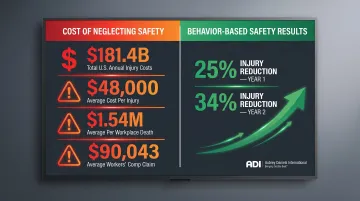
- Total U.S. workplace injury costs: $181.4 billion annually
- Average cost per medically consulted injury: $48,000
- Average cost per workplace death: $1,540,000
- Workers' compensation claims average: $90,043 per claim
OSHA penalties (effective January 15, 2025):
- Serious violations: up to $16,550 per violation
- Willful or repeated violations: up to $165,514 per violation
Hidden costs:
- Lost productivity from injured workers and colleagues covering their duties
- Increased insurance premiums following incident claims
- Reputational damage affecting recruitment and customer relationships
- Management time spent on investigations and corrective actions
Beyond Compliance: The Competitive Advantage
The costs above reflect what happens when safety is treated as a checkbox. When organizations shift from minimum compliance to behavior-based safety programs, the results look different. Research shows these programs deliver an average 25% injury reduction in Year 1 and 34% by Year 2—outcomes compliance-only training rarely achieves.
That performance gap compounds over time. Fewer incidents mean lower insurance premiums, less management time on corrective actions, and a workplace that attracts and retains talent.
Core Components of an Effective OHS Training Program
According to OSHA's Recommended Practices, effective OHS training programs include seven core elements. However, most training programs focus on five foundational components:
1. Hazard Identification and Control
Workers must learn to recognize workplace hazards before they cause harm. Training should teach the NIOSH Hierarchy of Controls—a framework for addressing hazards in order of effectiveness:
- Elimination - Physically remove the hazard
- Substitution - Replace the hazard with something safer
- Engineering Controls - Isolate people from the hazard
- Administrative Controls - Change how people work
- Personal Protective Equipment (PPE) - Protect the worker with equipment
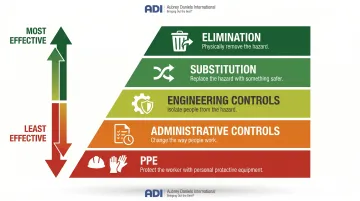
Workers who internalize this hierarchy instinctively ask "Can we eliminate this entirely?" when they spot a hazard — not immediately reach for PPE.
2. Emergency Procedures
Workers must know site-specific emergency protocols:
- Fire evacuation routes and assembly points
- Chemical exposure response procedures
- Who to contact and when
- What not to do during emergencies
Training should be practiced, not just presented. Drills build the muscle memory workers need to execute procedures correctly under pressure, when clear thinking is hardest.
3. Personal Protective Equipment (PPE) Use
Proper PPE training covers:
- When PPE is required
- How to properly don, adjust, and remove equipment
- Inspection procedures before each use
- Maintenance and storage requirements
- PPE limitations and when it's not sufficient protection
4. Incident Reporting Systems
Training must establish clear reporting procedures and psychological safety. Employees need to understand:
- How to report near misses, injuries, and unsafe conditions
- That reporting will not result in retaliation
- Why near-miss reporting helps prevent future injuries
- How supervisors conduct root cause analyses (not blame assignment)
Research shows that incident data is only useful if workers feel psychologically safe to report. Organizations that punish reporting drive incidents underground.
5. Workers' Rights and Employer Responsibilities
Employees must know their rights under OSHA regulations:
- The right to a workplace free from recognized hazards
- The right to receive training in a language they understand
- The right to request OSHA inspections
- Protection from retaliation for raising safety concerns
Employers have corresponding duties to provide training, maintain safe conditions, and respond to reported hazards.
Audience-Specific Training Requirements
Knowing what to teach is only half the equation — who receives it matters just as much. Training content must be tailored to each audience:
- Frontline workers need role-specific hazard training and safe work procedures
- Supervisors need investigation skills, coaching techniques, and how to reinforce safe behaviors
- Senior leaders need to understand their legal duties and how their decisions and resource allocation shape safety culture
Types of OHS Training: Who Needs What
OHS training isn't a single event. Different audiences need different training at different times.
Primary Training Audiences
1. New Employee Onboarding Every new hire requires foundational safety orientation covering:
- Facility-specific hazards and emergency procedures
- Basic safety rules and reporting systems
- Workers' rights and employer responsibilities
- Role-specific hazard training before beginning work
2. Job-Specific Hazard Training Frontline workers need training tailored to their specific roles:
- Equipment operation and lockout/tagout procedures
- Chemical handling and hazard communication
- Ergonomic practices for repetitive tasks
- Industry-specific risks (confined spaces, fall protection, etc.)
3. Supervisor and Leadership Training Supervisors and managers require additional training on:
- Conducting effective incident investigations
- How to observe and provide feedback on safety behaviors
- Coaching conversations that reinforce safe practices
- Creating psychological safety for reporting
4. Refresher and Recurring Training Refreshers aren't optional — they're how knowledge stays current. They're needed when:
- Roles, equipment, or processes change
- New regulations take effect
- Incident investigations reveal knowledge gaps
- Annual requirements mandate updates
OSHA-Mandated Training
Certain tasks require specific OSHA-mandated training:
HAZWOPER (29 CFR 1910.120) - Hazardous Waste Operations and Emergency Response
- 40-hour initial training for high exposure risk roles
- 24-hour initial training for occasional/limited tasks
- 8-hour annual refresher
- Required for hazardous waste site cleanup, treatment/storage/disposal facilities, and emergency response
Lockout/Tagout (29 CFR 1910.147) - Control of Hazardous Energy
- Training for authorized employees who service machinery
- Training for affected employees who operate equipment
- Covers purpose and function of energy control programs
- Required when unexpected energization could cause injury
Confined Space Entry (29 CFR 1910.146)
- Training for authorized entrants, attendants, and entry supervisors
- Covers hazards of permit-required confined spaces
- Must be completed before initial assignment and when duties change
Training Delivery Formats
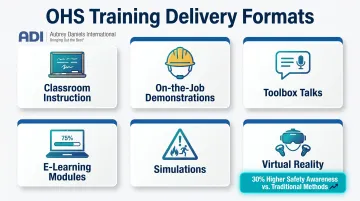
Knowing what to train is only half the equation — how you deliver it shapes whether the knowledge sticks. Procedural skills need hands-on practice; regulatory content works well in structured modules. Common formats include:
- Classroom/in-person instruction for foundational knowledge
- On-the-job demonstrations for equipment operation
- Toolbox talks for brief, site-specific reminders
- E-learning modules for regulatory compliance content
- Simulations for emergency response scenarios
- Virtual reality for high-hazard scenarios where real practice is dangerous
Research by Qawqzeh et al. (2025) found VR training produced 30% higher safety awareness and 25% higher safety knowledge compared to traditional methods.
Peer-to-Peer Training and Toolbox Talks
In construction and industrial settings, brief on-site conversations reinforce formal training. Toolbox talks—short, focused discussions before shifts—keep safety top of mind and address emerging hazards in real time.
Language and Literacy Requirements
OSHA explicitly requires that "if an employee does not speak or comprehend English, instruction must be provided in a language the employee can understand." If vocabulary is limited, training must match that level. If an employee is illiterate, written materials alone are insufficient.
This is a common compliance failure, particularly on multilingual worksites or with immigrant worker populations.
Designing OHS Training That Actually Changes Behavior
Here's the core problem: most OHS training is designed to transfer information and demonstrate compliance, not to change behavior on the job.
Research consistently shows knowledge gain does not automatically translate into behavior change. Murre and Dros (2015) replicated the forgetting curve, demonstrating approximately 66% of learned material is forgotten within 24 hours without reinforcement. That gap between knowing and doing is where most safety programs fail. The result is workers who pass post-training tests yet return to unsafe behaviors the moment they're back on the floor.
The Knowing-Doing Gap
Workers may pass post-training tests yet revert to unsafe behaviors when:
- Production pressures mount
- Shortcuts save time
- Safe procedures feel cumbersome
- Supervisors don't reinforce training
- Unsafe group norms dominate
Knowledge alone doesn't change behavior. Safe behaviors must be defined, practiced, and positively reinforced to become habitual.
Behavior Science Foundation
Effective safety training applies behavioral science principles:
1. Define specific safe behaviors Instead of vague goals like "work safely," specify observable actions: "Maintains three points of contact when ascending ladders" or "Wears cut-resistant gloves when handling sheet metal."
2. Provide deliberate practice Rather than exposing employees to content once, build fluency through repetition and performance feedback until safe behaviors become automatic. This is especially critical for emergency procedures and equipment operation.
3. Reinforce safe behaviors consistently Supervisors must recognize safe behaviors through immediate, specific feedback. Management behavior is the single biggest predictor of whether frontline training sticks.
Research by Douphrate et al. (2024) demonstrated that safety leadership training produces measurable behavior change among frontline supervisors, but only when supervisors actively apply what they learn in the field.
Applying these principles requires a structured process. The International Labour Organization recommends a six-step approach that puts behavior change — not just content delivery — at the center of training design:
The ILO Training Design Framework
- Assess needs - Identify skill gaps and training requirements
- Gain participant support - Involve workers in design and delivery
- Define learning objectives - Specify observable outcomes
- Select content and methods - Match format to objectives
- Implement training - Deliver with quality facilitation
- Evaluate and follow up - Measure behavior change and outcomes
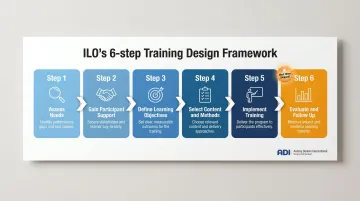
Most organizations skip step 6—evaluation—making it impossible to know if training worked.
The Supervisor's Critical Role
Training doesn't end in the classroom. Supervisors must:
- Observe workers performing trained tasks
- Provide immediate, specific feedback on safe behaviors
- Recognize improvement and safe performance publicly
- Address unsafe behaviors with specific corrective guidance, not blame
- Remove barriers that make safe work difficult
Organizations that implement behavior-based safety programs with supervisor coaching see 25-34% injury reductions within two years, far beyond what compliance-only training achieves.
Measuring Whether OHS Training Is Working
Training completion rates and quiz scores don't measure effectiveness. They measure compliance.
The real measures of OHS training effectiveness are observable behavior change on the job and downstream outcomes like reduced incident rates.
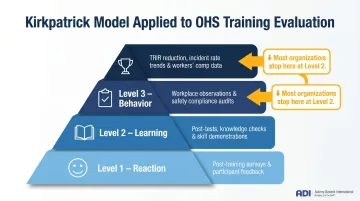
Beyond Kirkpatrick Levels 1 and 2
The Kirkpatrick Model defines four levels of training evaluation:
| Level | What It Measures | Safety Training Application |
|---|---|---|
| Level 1: Reaction | Whether participants liked the training | Post-training surveys |
| Level 2: Learning | Knowledge and skill acquisition | Post-tests, demonstrations |
| Level 3: Behavior | Application of learning on the job | Workplace observations, safety audits |
| Level 4: Results | Organizational outcomes | TRIR reduction, fewer workers' comp claims |
Most organizations stop at Level 2. But knowledge without behavior change produces no results. Reaching Levels 3 and 4 requires deliberate evaluation methods that go beyond the training room.
Practical Evaluation Methods
Behavioral observations: Supervisors conduct structured observations of workers performing trained tasks, noting adherence to safe procedures and providing feedback.
Incident trend analysis: Compare incident rates, severity, and types before and after training. Look for sustained improvements, not just short-term gains.
Near-miss reporting frequency: Counterintuitively, higher near-miss reporting often signals improved safety culture, not worse performance. It reflects willingness to identify and report hazards before they cause injury.
Periodic refresher assessments: Knowledge retention testing at 30, 60, and 90 days post-training reveals which skills need reinforcement before gaps become incidents.
The ROI of Continuous Training
Meta-analysis by Burke et al. (2006) found that engaging, hands-on training methods produced the strongest behavioral outcomes. Continuous training programs with behavioral reinforcement require more upfront effort, but the return shows up in lower injury costs, reduced workers' comp claims, and fewer lost workdays.
The difference between compliance-driven training and behavior-based training isn't just philosophy — it's the gap between checking a box and actually preventing the next incident.
Frequently Asked Questions
What is basic occupational safety and health training?
Basic OHS training covers hazard identification, emergency procedures, PPE usage, incident reporting, and workers' rights. It's the foundational knowledge every employee needs to work safely, regardless of industry or role.
What are the basic occupational health and safety trainings and principles?
Core OHS principles focus on preventing harm before it occurs and involving workers in safety planning. Primary training types include:
- Hazard communication and identification
- Emergency response procedures
- Equipment-specific safety protocols
- PPE selection and proper use
- Hierarchy of controls (from elimination down to PPE)
How is OHS different from OSHA?
OHS (Occupational Health and Safety) is the broad field concerned with worker safety and health. OSHA (Occupational Safety and Health Administration) is the U.S. federal agency responsible for creating and enforcing those regulations. In short, OHS is the discipline; OSHA is the authority that sets the legal standards within it.