Introduction
Applied Behavior Analysis (ABA) is a science-backed discipline grounded in nearly a century of research on why people do what they do — and how behavior can be systematically changed. Defined by the Association for Behavior Analysis International as "a natural science that seeks to understand the behavior of individuals," ABA traces its roots to B.F. Skinner's 1938 work on operant conditioning.
It became a formal field in 1968 when Baer, Wolf, and Risley established its seven defining dimensions.
ABA is often associated with clinical therapy, but its principles apply far beyond the clinic. The same behavioral science that helps a child develop communication skills can help an employee build safety habits or a manager drive consistent performance. Parents, educators, safety leaders, and executives all work with the same underlying mechanisms of human behavior — they just apply them in different contexts.
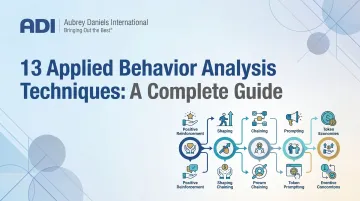
This guide breaks down 13 core ABA techniques: what each one is, how it works, and where it delivers the most impact.
TL;DR
- ABA is an evidence-based science using behavioral principles to increase helpful behaviors and reduce harmful ones
- The 13 techniques covered here span reinforcement strategies, skill-building approaches, and structured behavioral interventions
- Each targets specific outcomes and works best under certain conditions
- ABA extends well beyond clinical settings — it drives results in workplace safety, leadership development, and organizational performance
- Choosing the right technique depends on the behavior, the environment, and what sustainable change looks like for your organization
What Is Applied Behavior Analysis (ABA)?
ABA is a scientific discipline that applies principles of learning and behavior to bring about meaningful, measurable improvements in socially significant behaviors. The Behavior Analyst Certification Board describes it as "the science of behavior, with a history extending back to the early 20th century."
Its guiding philosophy is behaviorism — the premise that behavior change efforts will be most effective when behavior itself is the primary focus.
The ABC Framework
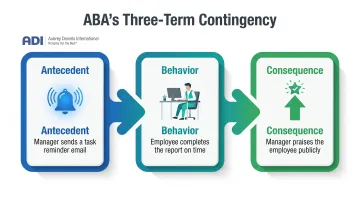
All ABA techniques operate within the Antecedent-Behavior-Consequence (ABC) model:
- Antecedent — the trigger or environmental condition before a behavior occurs
- Behavior — the observable action itself
- Consequence — what follows the behavior and either reinforces or discourages it
This three-term contingency is ABA's foundational analytical framework. Understanding this sequence allows practitioners to identify what prompts behavior, what the behavior looks like, and what maintains it over time.
A Toolkit of Evidence-Based Interventions
ABA is not one technique but a collection of evidence-based interventions — each individualized, data-driven, and outcomes-focused. That flexibility makes it adaptable across clinical, educational, and organizational settings. In business contexts, ABA's methods apply directly to workplace safety, leadership effectiveness, and sustainable performance improvement.
Why ABA Techniques Matter in Any Setting
Without a structured, behavior-based approach, attempts to change behavior rely on intuition, habit, or guesswork. This leads to inconsistent results and often reinforces the wrong behaviors accidentally. ABA techniques work because they target the root mechanisms of behavior change: antecedents, what reinforces behavior, and what follows it. That's a fundamentally different lever than addressing surface-level symptoms.
A 2022 scoping review analyzing 770 study records found improvement rates of 63% to 88% across cognitive, language, social, and adaptive behavior categories. ABA is endorsed by the U.S. Department of Health and Human Services and the Government of Canada as an evidence-based approach.
The principles that make ABA effective in clinical settings translate directly to organizational performance. The behavioral science is the same across contexts:
- Building safety habits on a job site by pairing correct procedures with immediate positive feedback
- Coaching employees to improve customer service by identifying what cues trigger unhelpful responses
- Shifting team culture by systematically reinforcing the behaviors leaders want to see more often
In each case, the work is the same: identify what reinforces the behavior, then engineer the environment around it.
The 13 ABA Techniques Explained
While each technique draws on the same behavioral science foundation, they differ in method, complexity, and the specific behavior problems they are best suited to address.
Reinforcement-Based Techniques
These four techniques share a common goal: changing the consequences that follow behavior to increase or decrease its future likelihood. They form the core of most ABA intervention plans.
Positive Reinforcement
Positive reinforcement involves adding a desirable consequence immediately after a target behavior occurs to increase the likelihood it will be repeated. It is the most widely used ABA technique because it is powerful, ethical, and builds lasting behavior change.
Research published in the Journal of Applied Behavior Analysis demonstrated that positive reinforcement was more effective than negative reinforcement in promoting compliance and reducing escape-maintained problem behavior. Participants also showed a strong initial preference for positive reinforcement when given a choice.
Unlike punishment, which may suppress behavior temporarily but does not teach new skills, positive reinforcement actively builds the behaviors you want. It works across all settings—from recognizing a child for using words instead of tantrums, to acknowledging an employee's specific safety action immediately after it occurs.
Negative Reinforcement
Negative reinforcement is NOT punishment. It involves removing an aversive stimulus when the desired behavior occurs, thereby increasing that behavior. For example, stopping an alarm when a safety checklist is completed reinforces the completion behavior.
The most common misconception, documented in behavioral literature, is that people equate negative reinforcement with punishment because "negative" sounds opposite to "positive." In reality, both positive and negative reinforcement increase behavior—they just do so through different mechanisms (adding something desirable vs. removing something aversive).
Understanding this distinction matters because it shapes how you design interventions. Both reinforcement types strengthen behavior, while punishment (adding aversives or removing positives) aims to weaken it.
Differential Reinforcement
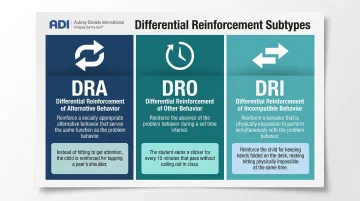
Differential reinforcement involves reinforcing a specific, desirable behavior while simultaneously withholding reinforcement for an undesirable one. This increases desired behavior and reduces problematic behavior without punishment.
Key subtypes include:
- DRA (Differential Reinforcement of Alternative Behavior) — reinforce an appropriate alternative to the problem behavior
- DRO (Differential Reinforcement of Other Behavior) — reinforce the absence of problem behavior over a specific interval
- DRI (Differential Reinforcement of Incompatible Behavior) — reinforce a behavior that physically cannot occur at the same time as the problem behavior
Research in the Journal of Applied Behavior Analysis showed that DRA can reduce problem behavior without extinction when reinforcement duration, quality, and delay are manipulated to favor appropriate behavior. The largest and most consistent behavior change occurred when multiple reinforcement dimensions were combined.
Extinction
Extinction is the deliberate withholding of reinforcement that previously maintained an undesired behavior, causing it to decrease over time. If a behavior occurred because it produced a specific consequence (attention, escape, access to items), removing that consequence weakens the behavior.
Critical consideration: Practitioners must anticipate the extinction burst—a temporary increase in the rate, frequency, duration, or intensity of the target behavior before it diminishes. Research shows that 62% of clinical participants displayed an extinction burst when treated with extinction alone.
Risks include physical injury from increased intensity, emergence of new problematic behaviors, and treatment failure if caregivers "give in" during the burst, accidentally reinforcing behavior at its most intense level.
Skill-Building Techniques
Where reinforcement-based techniques modify the consequences that follow behavior, skill-building techniques focus on constructing new behaviors from the ground up. These methods are used when a desired behavior doesn't yet exist in someone's repertoire.
Shaping
Shaping is the process of reinforcing successive approximations of a target behavior—rewarding each step that moves incrementally closer to the final desired behavior. This is used when the goal behavior does not yet exist in the learner's repertoire and must be built from the ground up.
For example, if teaching a child to write their name, you might first reinforce holding a pencil, then making any mark, then making a curved line, then forming a letter, and so on. Each step is closer to the final goal.
Shaping applies well beyond clinical contexts:
- Sports coaches reinforce progressively better athletic form
- Workplace leaders build complex performance behaviors through incremental improvements toward productivity targets
- Safety trainers shape proper equipment handling by reinforcing correct partial steps before requiring full compliance
Behavior Chaining
Chaining breaks a complex, multi-step behavior into individual components that are taught in sequence. The two main variations are:
- Forward chaining — teach the first step to mastery, then add the second step, and so on
- Backward chaining — teach the last step first (with the instructor completing all prior steps), then progressively add earlier steps
Comparative research in JABA found neither method consistently superior. Forward chaining was faster in 8 of 16 comparisons, backward in 6, and 2 were tied. Individual learner characteristics may determine which approach is more efficient.
Chaining is ideal for procedural tasks requiring a specific order of steps, such as hand-washing routines, equipment startup sequences, or multi-step assembly tasks.
Prompting and Fading
Prompting provides cues (verbal, physical, gestural, or visual) to guide someone toward a correct response during initial learning. Prompts include:
- Vocal/echoic prompts (verbal models for imitation)
- Gestural prompts (pointing or touching)
- Model prompts (demonstrating the movement)
- Physical guidance (providing touch or assistance)
Fading is the systematic and gradual removal of those prompts as the behavior becomes more independent. The goal is autonomous performance without external cues.
Critical risk: Prompt dependency occurs when learners become reliant on prompts and fail to respond independently, typically resulting from prompts that are not systematically faded.
Modeling
Modeling involves demonstrating the target behavior so the learner can observe and imitate it, drawing on observational learning. Modeling can be live, video-based, or via visual aids.
A meta-analysis of video modeling interventions calculated an overall effect size of Tau-U = 0.91, classified as "very large" magnitude. Skills targeted included task acquisition and employment-related social skills such as customer service and telephone communication.
Modeling is especially effective for social, communication, and procedural skills where seeing the behavior performed correctly accelerates learning.
Structured Intervention Techniques
The final group moves from individual techniques to structured systems — methods that organize the entire learning or assessment environment, not just a single behavior change strategy.
Discrete Trial Training (DTT)
DTT is a highly structured, one-on-one instructional method in which a specific skill is taught through repeated, controlled trials: prompt → response → consequence. Each trial is discrete—it has a clear beginning and end—and data is collected across trials to track progress.
Research reviewed by the National Professional Development Center found DTT meets evidence-based practice criteria with 13 single-case design studies, showing effectiveness for learners in preschool and elementary school across social skills, communication, behavior, and academic outcomes.
DTT is best suited for building foundational skills in a distraction-free setting, particularly when precision and repetition are needed.
Behavioral Skills Training (BST)
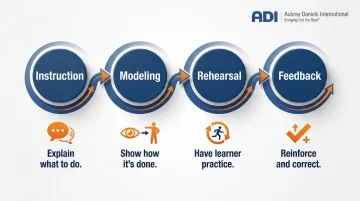
BST is a four-component training method:
- Instruction — explain what to do
- Modeling — demonstrate it
- Rehearsal — practice it
- Feedback — reinforce correct performance and correct errors
A randomized control trial with 99 healthcare staff found BST was significantly more effective than training-as-usual in improving observed safety skills. Mastery and competency scores were higher post-training and at one-month follow-up compared to the control group.
BST is particularly effective for teaching safety skills, job tasks, and any behavior requiring both knowledge and physical execution.
ABC (Antecedent-Behavior-Consequence) Analysis
ABC analysis is a structured observation and data-collection technique used to identify the function of a behavior—what triggers it (antecedent) and what maintains it (consequence).
This is a diagnostic tool. Rather than changing behavior directly, it identifies which intervention to use. The three components guide data collection:
- Antecedent — what happens immediately before the behavior
- Behavior — the specific observable action being tracked
- Consequence — what follows the behavior and may be maintaining it
By recording these patterns systematically, practitioners can select function-based interventions with confidence. For example, if ABC data shows an employee skips safety steps when supervisors are absent (antecedent) to save time (consequence = faster task completion), the intervention might involve restructuring the task or providing immediate recognition when safety steps are followed.
Token Economy
A token economy is a structured reinforcement system in which individuals earn tokens (points, stars, chips) for performing target behaviors, which they can later exchange for preferred rewards.
Research spanning over 80 years confirms token economies are among the most widely used procedures in behavior analysis. They are the second most delivered programmed consequence in educational settings after praise.
Token economies bridge the gap between immediate behavior and delayed reinforcement, making them useful in classrooms, clinics, and workplace incentive programs where immediate tangible rewards are not practical.
Functional Behavior Assessment (FBA)
FBA is a systematic process for identifying the purpose or "function" a challenging behavior serves for an individual. The four primary behavioral functions are:
- Attention/social reinforcement — behavior occurs to gain attention
- Escape/avoidance — behavior occurs to avoid tasks or aversive stimuli
- Access to tangibles — behavior occurs to obtain preferred items or activities
- Sensory/automatic reinforcement — behavior occurs because it feels good or provides sensory input
Research in JABA found that all participants who completed functional communication training achieved a 90% or greater reduction in challenging behavior, regardless of FBA rigor level. This supports the universal recommendation that interventions should be matched to behavioral function.
That 90% reduction figure matters: it holds across varying levels of FBA rigor, which means even a basic, well-conducted FBA is enough to dramatically improve outcomes — provided the intervention actually matches the function identified.
How ABA Techniques Apply in the Workplace
Organizational Behavior Management (OBM) is the direct application of ABA principles to improve employee performance, safety, and organizational culture. It is grounded in the same behavioral science that underlies every technique covered in this guide.
Concrete workplace applications include:
- Using positive reinforcement systems to increase safe behaviors on job sites
- Applying ABC analysis to understand why performance problems persist
- Using BST to onboard employees or train managers on new procedures
- Using shaping to develop new competencies progressively through incremental goal-setting
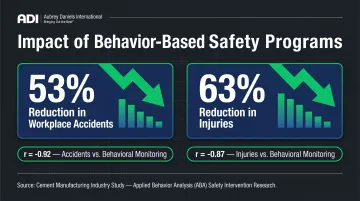
The research behind these applications is compelling. A study in a cement manufacturing setting found that a behavior-based safety program reduced workplace accidents by approximately 53% and injuries by approximately 63% over matched four-year periods. The Pearson correlation between behavioral monitoring and incidents was r = -0.92 for accidents and r = -0.87 for injuries.
For over 45 years, Aubrey Daniels International (ADI) has applied these exact behavioral principles across manufacturing, healthcare, financial services, and retail. ADI uses behavior science to drive measurable performance improvement — with data-driven pinpointing and reinforcer identification at the core of every engagement.
That scientific foundation is what separates behavior-based performance management from conventional training programs: results don't disappear when the workshop ends.
How to Choose the Right ABA Technique
No single ABA technique is universally superior. The right choice depends on the behavior being targeted, its current function, the setting, and whether the goal is to build a new behavior, increase an existing one, or reduce a problematic one.
Key decision factors:
| Question | Technique Recommendation |
|---|---|
| Does the behavior already exist in the person's repertoire? | Use positive reinforcement or differential reinforcement to strengthen it |
| Does the behavior NOT exist yet? | Use shaping or prompting and fading to build it |
| Do you need to diagnose the behavior's function first? | Use FBA or ABC analysis before selecting intervention |
| Is the setting structured and one-on-one? | DTT is well-suited |
| Is the setting naturalistic? | Modeling or reinforcement systems are preferred |
| Is the goal skill acquisition? | BST, chaining, or prompting work well |
| Is the goal behavior reduction? | Use extinction, differential reinforcement, or FBA-guided function-based intervention |
Common selection mistakes to avoid:
- Using punishment-based approaches before exhausting reinforcement-based options
- Applying extinction without identifying the behavior's function first (which can backfire)
- Choosing a complex structured technique when a simpler reinforcement adjustment would suffice
- Relying on intuition or habit instead of conducting a functional assessment
The BACB Task List (5th ed.) is the field's authoritative decision framework. It requires practitioners to base intervention goals on client preferences, environmental constraints, risks, and social validity — and to select function-based strategies grounded in the best available scientific evidence.
Frequently Asked Questions
What are some applied behavior analysis techniques?
Key ABA techniques include positive reinforcement, shaping, prompting and fading, discrete trial training, modeling, differential reinforcement, extinction, and behavioral skills training. Each targets a different aspect of behavior change—some build new behaviors, others strengthen existing ones, and some reduce problematic behaviors.
What are the 4 steps of applied behavior analysis?
The general ABA process follows four steps: assess and identify target behaviors, analyze their function using tools like ABC analysis or FBA, design and implement an appropriate intervention, then collect data to evaluate outcomes and adjust the plan as needed.
What are the 4 components of BST?
Behavioral Skills Training consists of instruction (telling the learner what to do), modeling (showing them how), rehearsal (having them practice), and feedback (reinforcing correct responses and correcting errors). These four components work together to build competence and independence.
What are the pros and cons of ABA?
ABA's strengths include being evidence-based, individualized, data-driven, and applicable across diverse settings and populations. Limitations include the need for trained practitioners, time and consistency required to see results, and the risk of misapplication when techniques are used without proper assessment or fading protocols.
What is an example of applied behavioral analysis?
A manager uses positive reinforcement by recognizing a specific safety behavior immediately after it occurs—for example, noting that an employee double-checked the equipment shutdown procedure before leaving. That immediate, specific acknowledgment increases the likelihood the behavior repeats. ABA principles work just as effectively in workplaces as in clinical settings.