Introduction
Rate-based safety incentive programs—those that reward employees for achieving injury-free days—don't just fail to prevent injuries. They often make workplaces more dangerous by discouraging workers from reporting incidents, creating a culture where injuries are hidden rather than addressed.
According to the Government Accountability Office (GAO), approximately 73.7% of manufacturers using rate-based programs specifically rewarded workers for having zero reported injuries. The problem? When workplace safety is tied to financial rewards or team bonuses, employees often hide minor injuries to preserve those rewards or avoid peer pressure from coworkers whose bonuses depend on maintaining perfect records.
Behavior-based safety (BBS) incentive programs offer a science-backed alternative. Rather than rewarding the absence of reported incidents, these programs reinforce the specific safe behaviors that actually prevent accidents from occurring.
By the end of this guide, you'll understand how to design a BBS incentive program that builds a genuine safety culture—one grounded in behavioral science, aligned with OSHA requirements, and resistant to the reporting suppression that undermines traditional approaches.
Key Takeaways
- BBS programs reward observable safe behaviors — completing inspections, reporting hazards — rather than just injury-free outcomes
- Grounded in Applied Behavior Analysis, positive reinforcement of safe acts builds lasting behavioral habits
- Traditional rate-based programs risk suppressing incident reporting; BBS programs focus on leading indicators instead
- OSHA's 2018 memorandum distinguishes permissible behavior-based programs from problematic rate-based ones
- Success depends on management buy-in, defined target behaviors, timely reinforcement, and ongoing evaluation
What Is a Behavior-Based Safety Incentive Program?
Behavior-based safety incentive programs are structured systems that identify critical safe behaviors, observe whether employees are performing them, and provide positive reinforcement to encourage those behaviors consistently over time. Unlike traditional programs that reward outcomes like "no recordable injuries," BBS programs focus on the specific actions that prevent those injuries.
Target behaviors in BBS programs are observable, measurable actions directly within employees' control, such as:
- Completing pre-task hazard assessments before starting work
- Wearing personal protective equipment (PPE) correctly
- Submitting near-miss reports when hazards are identified
- Conducting peer safety observations
- Participating in safety training sessions
- Following lockout/tagout procedures during equipment maintenance
These behaviors map directly to a core BBS concept: the distinction between leading indicators (the safe behaviors being reinforced) and lagging indicators (injury rates, recordable incidents). Leading indicators are proactive, preventive measures that provide current information about safety system performance. Lagging indicators only tell you what went wrong after the fact.
According to the Campbell Institute, leading indicators drive the identification and elimination of risks before injuries occur — making them the foundation of effective BBS program design.
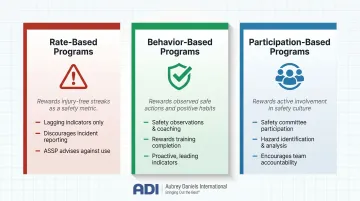
Three categories of safety incentive programs:
The American Society of Safety Professionals (ASSP) recognizes three main types:
- Traditional/Rate-Based Programs — Tied to lagging indicators like injury-free streaks; ASSP advises against these because they reward luck over behavior and encourage underreporting
- Behavior-Based Programs — Reward specific safe actions: identifying risky behaviors, completing training, or conducting safety observations
- Participation-Based Programs — Reward active involvement in safety improvement, such as joining safety committees or drafting job hazard analyses
The goal of BBS programs is to make employees active contributors to workplace safety — not compliance targets. When done well, they shift safety culture from reactive correction to consistent, reinforced prevention.
The Behavioral Science That Makes BBS Programs Work
BBS programs work because they're grounded in Applied Behavior Analysis (ABA), a scientific framework with nearly a century of research backing. According to a 2022 study in the Journal of Organizational Behavior Management, BBS is rooted specifically in the work of behavioral scientists Sulzer-Azaroff, Komaki, and Hopkins.
The ABC Framework
Behavior is a function of its antecedents (triggers or cues before the behavior) and consequences (what follows the behavior). Consequences are the most powerful drivers of whether a behavior is repeated or extinguished — this is operant conditioning at work.
Positive Reinforcement Principle
When a safe behavior is followed promptly by a meaningful, positive consequence — recognition, reward, praise — that behavior is more likely to be repeated. Negative reinforcement and punishment are far less reliable. Both tend to produce unintended side effects: resentment, avoidance, and employees hiding problems rather than reporting them.
Timing and Frequency Matter
Reinforcement delivered immediately and frequently during the learning phase builds behavioral habits far more effectively than infrequent or delayed rewards. Research cited in the Spigener et al. study found that daily observations with feedback outperformed weekly ones. When feedback is infrequent, specificity becomes critical.
ADI's Safe by Accident?, co-authored by Judy Agnew and Dr. Aubrey Daniels, translates these behavioral science principles into practical leadership strategies for building sustainable safety cultures.
Intrinsic vs. Extrinsic Reinforcement
The most durable safety cultures combine both types of reinforcement:
- Tangible rewards — gift cards, apparel, equipment — create visible, consistent recognition
- Social reinforcement — specific praise face-to-face, public acknowledgment in team meetings — produces longer-lasting behavioral change
Employees remember how leaders made them feel. That's why peer and manager recognition, delivered specifically and sincerely, tends to outlast any tangible reward on its own.
BBS Incentive Programs vs. Traditional Rate-Based Safety Programs
Traditional rate-based programs reward employees or teams for achieving a set number of injury-free or incident-free days. The core problem: these programs inadvertently incentivize not reporting injuries rather than not getting injured—a distinction that affects both worker safety and OSHA compliance.
The GAO's 2012 report found that while quantitative research linking rate-based programs directly to underreporting is limited, experts and industry officials consistently agreed these programs "may discourage reporting" through two key mechanisms:
- Workers hide minor injuries to preserve personal financial rewards
- Peer pressure discourages co-workers from reporting when group bonuses are at stake
In OSHA's recordkeeping audit findings, almost 50% of inspected worksites with incentive or disciplinary policies had recordkeeping errors affecting injury rates.
The BP Texas City refinery explosion in 2005 illustrates where this leads. Worker bonuses were tied to low injury rates, and an independent panel found this created a culture where employees "feared reprisals for reporting potentially risky conditions."
That contrast in culture is exactly what separates rate-based from behavior-based programs:
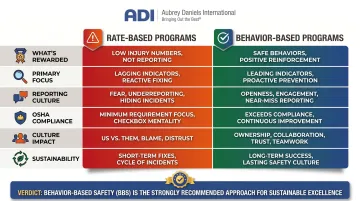
Side-by-Side Comparison:
| Dimension | Rate-Based Programs | Behavior-Based Programs |
|---|---|---|
| What's rewarded | Zero reported injuries for a time period | Specific safe behaviors (observations, near-miss reports, PPE compliance) |
| Primary focus | Lagging indicators (injury rates) | Leading indicators (behavioral observations) |
| Reporting culture | Risk of suppressing incident reporting | Actively encourages hazard and near-miss reporting |
| OSHA compliance | Requires safeguards to avoid discouraging reporting | Clearly permissible under OSHA guidance |
| Culture impact | Can create fear and hiding problems | Builds transparency and continuous improvement |
| Sustainability | Short-term results, long-term trust erosion | Builds lasting behavioral habits |
How to Design a Behavior-Based Safety Incentive Program
Step 1 — Identify Critical Behaviors
Conduct a behavioral analysis to identify which specific behaviors, when performed consistently, most significantly reduce injury risk in your environment. Target behaviors should be:
- Observable: Visible to observers in real time
- Measurable: Trackable by count or frequency
- Within employees' control: Not dependent on equipment or other factors
- Directly linked to injury risk reduction: Based on incident data or hazard analysis
Examples include equipment lockout/tagout compliance, ladder safety procedures, pre-task safety assessments, and near-miss reporting.
Step 2 — Gain Management Commitment and Communicate the Program
The program will fail without visible, active support from leadership at every level. Management commitment looks like:
- Managers participating in safety observations themselves
- Leaders personally delivering recognition, not delegating it
- Safety discussed in every team meeting
- Executives visibly modeling target behaviors
- Resources allocated for program sustainment
ASSP's design guidance is clear on this point: leadership must actively administer and participate from day one — not endorse from a distance.
Step 3 — Establish Observation and Data Collection Processes
Peer-based safety observation systems work by having employees observe and record whether critical behaviors are being performed safely. Data is reviewed by safety teams to identify patterns.
Best practices from the Spigener et al. research:
- Optimal contact rate: 16-65 observations per 100 employees per month
- Observers conducting 7+ observations monthly saw the greatest improvements
- Observing in one's own work area was more effective than cross-functional observation
- Voluntary participation is superior to mandatory quotas—forced observations produce poor data quality
Observations must be anonymous and non-punitive to maintain trust and honest reporting. When observations become a tool for punishment, trust erodes and the program collapses.
Step 4 — Design the Reinforcement System
Match reinforcement to what employees actually value. Gather input through surveys or informal conversations. Deliver recognition:
- Promptly — within minutes or hours, not days; delayed recognition loses its connection to the behavior
- Frequently — high repetition during the learning phase builds the habit before recognition tapers
- Specifically — "I noticed you completed a full pre-task assessment before starting that job" lands far better than a generic "good job"
ASSP research identifies several reward characteristics that drive better results:
- Visible rewards (stickers, apparel) rather than hidden ones (gift cards only the recipient sees)
- Recognizing many employees with smaller rewards vs. few with large ones
- Involving employees' families where possible (grocery gift certificates)
- Combining extrinsic rewards with sincere public appreciation
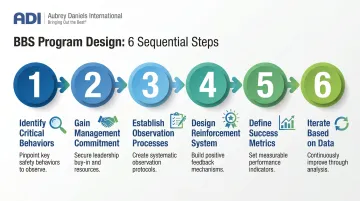
Step 5 — Define Success Metrics and Evaluate Regularly
Track both behavioral leading indicators and outcome lagging indicators:
Leading indicators to track:
- Observation completion rates
- Near-miss reports submitted
- Training participation and completion rates
- Pre-task hazard assessments completed
Lagging indicators to track:
- Total Recordable Incident Rate (TRIR)
- Days Away, Restricted, or Transferred (DART) rate
- Lost-time injury frequency
The Campbell Institute recommends monthly or quarterly reviews by EHS staff, with periodic reassessment to retire indicators that are no longer predictive of critical incidents.
Step 6 — Iterate Based on Data
A BBS program is not "set and forget." Programs must evolve based on what the data shows. If a target behavior is consistently being performed well, add a new behavior to the focus list or adjust reinforcement strategies. Use regular reviews to identify:
- Which behaviors are improving vs. plateauing
- Whether observations are producing actionable insights
- If reinforcement is still meaningful to employees
- Where new hazards or risk areas are emerging
Selecting Incentives and Staying OSHA Compliant
Knowing where your program stands legally is non-negotiable. OSHA's October 11, 2018 memorandum(https://www.osha.gov/laws-regs/standardinterpretations/2018-10-11) clarifies the agency's position on workplace incentive programs under 29 CFR §1904.35(b)(1)(iv). OSHA does not prohibit incentive programs, but takes issue with programs that could discourage injury reporting.
A compliant BBS incentive program must:
- Consistently enforce legitimate work rules
- Respond positively when employees report near-misses and hazards
- Actively encourage participation in safety and health management
- Not penalize employees for reporting work-related injuries
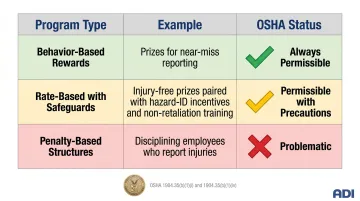
Permissible vs. problematic structures:
| Program Type | Example | OSHA Status |
|---|---|---|
| Behavior-based rewards | Prizes for reporting near-misses or hazards | ✅ Always permissible |
| Rate-based rewards with safeguards | Prizes for injury-free months, paired with hazard-ID incentives, non-retaliation training, and a willingness-to-report evaluation | ✅ Permissible with precautions |
| Penalty-based structures | Disciplining employees who report injuries | ❌ Problematic |
Once you understand what OSHA permits, the next step is choosing rewards that actually motivate safe behavior. ASSP's guidance offers practical advice on reward design:
- Make rewards visible and displayable (stickers, T-shirts, safety gear) rather than hidden
- Spread recognition broadly—many employees with smaller rewards vs. few with large ones
- Involve employees' families where possible (gift certificates they can use together)
- Avoid cutoff structures that punish employees who report an incident after weeks of safe behavior
- Gather employee input on what motivates them
- Ensure goals are perceived as fair and attainable
Rewarding specific behaviors — completing safety training, submitting hazard reports, participating in observations — keeps your program on solid regulatory ground. Rate-based structures can work, but only with the safeguards OSHA requires.
Common Pitfalls That Undermine BBS Programs
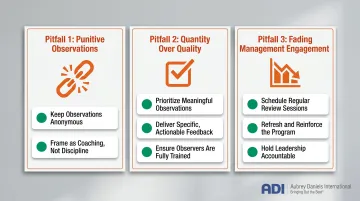
Pitfall 1 — Using Observations as Punishment
If employees perceive peer safety observations as a tool for blame or discipline rather than learning and improvement, trust erodes and the program collapses. Frame observations as supportive coaching moments, keep them anonymous, and never tie them to disciplinary action. According to [ASSP, behavior-based programs fail when they become tools for "punishment and blame."
Pitfall 2 — Prioritizing Quantity Over Quality of Observations
Programs that set numeric targets (for example, "each supervisor must complete 10 observations per month") can drive superficial, checkbox behaviors that produce data without insight. Balance frequency expectations with quality standards:
- Focus on meaningful observations of critical behaviors
- Provide specific, actionable feedback in observations
- Use 1-2 specific comment flags rather than many or none
- Train observers on what quality observations look like
Research in the Spigener et al. study found that forced/mandatory observations and irrelevant multi-page checklists were among the primary causes of BBS process failure.
Pitfall 3 — Failing to Sustain Management Engagement Over Time
Many BBS programs launch with enthusiasm but lose management participation within months. Build sustainability into program design:
- Schedule regular leadership reviews with accountability metrics
- Refresh the reinforcement system periodically to prevent it from becoming routine
- Celebrate program milestones publicly
- Assign specific roles and responsibilities for ongoing program administration
- Include BBS participation in leadership performance evaluations
- Create action plans to address environmental barriers or hazards identified through observations — unresolved findings signal to workers that safety data goes nowhere
Frequently Asked Questions
What is a behavior-based safety program?
A behavior-based safety program is a structured approach that identifies critical safe behaviors, uses observation to track whether they're being performed, and applies positive reinforcement to encourage those behaviors consistently—with the goal of preventing incidents before they occur.
What is an example of a behavior-based safety incentive program?
Consider a manufacturing facility where employees earn recognition and small rewards for completing pre-shift safety checklists, reporting near-misses, and completing monthly safety observations. Behaviors are tracked on a shared dashboard and celebrated in team meetings, creating transparency and accountability.
What is OSHA's rule on behavior-based safety incentive programs?
OSHA's 2018 memorandum clarifies that behavior-based incentive programs are permissible as long as they do not discourage injury reporting, consistently enforce work rules, and reward proactive safety participation rather than just incident-free outcomes.
How do behavior-based safety programs differ from traditional safety incentive programs?
Traditional programs reward outcomes (no injuries reported), which can suppress reporting and hide hazards. BBS programs reward safe behaviors and leading indicators (hazard reports, observations, PPE compliance), which address root causes and build safety habits through positive reinforcement.
What behaviors should be targeted in a behavior-based safety incentive program?
Target behaviors should be observable, measurable, linked to injury risk reduction, and within employees' control. Examples include hazard reporting, PPE compliance, pre-task safety assessments, lockout/tagout procedures, and peer observation completion.
How do you measure the success of a behavior-based safety incentive program?
Measure success through both leading indicators (observation completion rates, near-miss reports, training participation) and lagging indicators (injury rates, DART rates, days away from work). Conduct program reviews monthly or quarterly to assess whether targeted behaviors have become habitual.