Introduction
Despite decades of compliance-focused safety programs, approximately 80–90% of workplace accidents are linked to human error rather than equipment failures or missing rules. Organizations continue solving for the wrong problem: they focus on hazards and procedures while neglecting the behavioral factors that drive at-risk decisions on the floor.
Behavioral safety shifts the focus from rule enforcement to understanding why people make unsafe choices — and applying that understanding to drive sustainable behavior change. That requires diagnosing the problem before incidents occur, not just documenting them afterward. Employee surveys are one of the most underutilized tools for doing exactly that: unlike incident reports, surveys surface the antecedents and consequences shaping behavior while there's still time to intervene.
This post covers:
- What behavioral safety is and how it differs from traditional compliance programs
- What current industry survey data reveals about Behavior-Based Safety (BBS) adoption and gaps
- The seven core principles of effective BBS programs
- How to design and act on a behavioral safety survey that produces real change
Key Takeaways
- Behavioral safety focuses on observable employee behaviors to prevent incidents before they happen
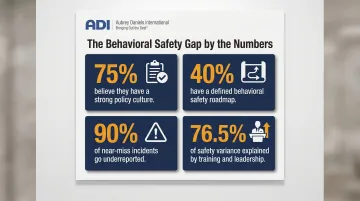
- Industry surveys show a wide gap: 75% of organizations claim safety is part of corporate culture, but only 40% have a well-defined safety performance roadmap
- Effective BBS programs apply behavioral science: antecedent analysis, consequence mapping, and positive reinforcement to shift behavior at the source
- Well-designed surveys uncover what drives at-risk behavior, not just whether employees know the rules
- Real change from survey data demands leadership commitment, targeted feedback, and a reinforcement-based culture shift
What Is Behavioral Safety in the Workplace?
Behavioral safety—often called Behavior-Based Safety (BBS)—is a systematic approach that focuses on identifying, observing, and positively influencing the specific behaviors employees exhibit on the job. Rooted in Applied Behavior Analysis (ABA), BBS differs fundamentally from traditional safety management, which centers on hazard control and rule enforcement.
The Behavioral Science Foundation
According to the Cambridge Center for Behavioral Studies, behavioral safety is "the application of behavioral research on human performance to the problems of safety in the workplace." The approach relies on one core principle: behavior is a function of its environment.
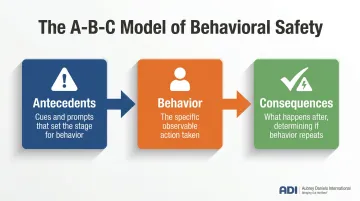
The A-B-C model explains this:
- Antecedents (cues and prompts) set the stage for behavior
- Behavior is the specific observable action
- Consequences (what happens after) determine whether the behavior is repeated
Most unsafe behaviors persist not because employees are careless, but because the consequences that reinforce unsafe shortcuts—like saving time or reducing physical effort—outweigh the perceived consequences of safe practices. ADI's book Safe by Accident? by Judy Agnew and Aubrey Daniels offers a deeper exploration of these dynamics for readers seeking a behavioral science–grounded resource.
BBS as the Expression of Safety Culture
BBS is not just a training program or a checklist exercise. It is the visible expression of an organization's safety culture. When these conditions are in place, safety culture becomes self-sustaining:
- Leaders consistently model safe behaviors on the floor
- Near misses are reported openly without fear of blame
- Safe actions are recognized and reinforced in the moment
What Industry Survey Data Reveals About Workplace Safety Behavior
Understanding the gap between policy and practice requires looking at what employees actually experience—not just what's written in the safety manual.
The Policy-Behavior Gap
A Sphera survey of nearly 350 risk and safety professionals found that while 75% said safety is part of their organization's corporate culture, only 40% said they have a well-defined safety performance roadmap. Another 27% reported that adoption of centralized safety processes is lagging, and 56% still track critical safeguards manually rather than through systematic processes.
The disconnect is clear: organizations have safety policies, but they lack the behavioral systems to translate them into consistent action.
BBS Adoption and Workforce Involvement
The behavioral-safety.com industry survey of 1,404 respondents revealed:
- 61% were implementing Behavioral Safety programs
- 92% involved employees in safety efforts
- Only 40% involve the majority of their workforce in BBS activities
BBS adoption is widespread — but most programs aren't tapping the full potential of frontline employees.
Why Awareness Alone Doesn't Change Behavior
Knowing the rules doesn't guarantee following them. When the immediate consequences of skipping a safe behavior outweigh the benefits of compliance, the unsafe habit wins — every time. Common examples include:
- Skipping PPE because it's uncomfortable and no supervisor is watching
- Bypassing lockout/tagout to finish a task faster
- Staying quiet about a near-miss to avoid drawing scrutiny
- Cutting corners under production pressure when no incident has occurred yet
Near-Miss Reporting Rates Reveal Psychological Safety Gaps
Research by Benchmark Gensuite (2024) found that 90% of workplace incidents, hazards, and near misses are going underreported—up from 79% the previous year. 45% of respondents estimate that at least a quarter of employees never report incidents at all.
Organizations where employees feel psychologically safe to report near misses tend to have lower injury rates. Fear of punishment suppresses reporting and masks systemic at-risk behaviors.
The Outsized Influence of Leadership Behavior
Research published in the International Journal of Environmental Research and Public Health found that safety training explained 76.5% of the variance in enterprise safety performance, and leadership behaviors fully mediated the relationship between management commitment and frontline compliance. Employees are more likely to follow safe practices when they observe leaders consistently modeling and positively acknowledging them.
The 7 Principles of Behavior-Based Safety
Principle 1 — Focus on Observable, Measurable Behaviors
BBS begins by pinpointing specific, observable actions—wearing a harness, locking out equipment, maintaining three points of contact—rather than attitudes or personality traits. This makes safety manageable and measurable.
Principle 2 — Analyze Antecedents and Consequences
Use the A-B-C model to understand what prompts a behavior and what reinforces it.
Example: A worker skips PPE because it is stored inconveniently (antecedent) and has never had an injury without it (consequence that reinforces the shortcut). The intervention isn't another safety talk—it's redesigning storage and recognizing PPE use immediately.
Principle 3 — Prioritize Positive Reinforcement Over Punishment
Behavioral science shows that positive reinforcement—recognizing and rewarding safe behavior in real time—is more effective at sustaining behavior change than disciplinary consequences. Research from Safety Science found that safety-specific positive feedback was positively associated with employee safety behaviors, with correlations ranging between 0.25 and 0.55.
People do more of what is positively reinforced. ADI's core principle of using R+® (positive reinforcement) reflects this foundational behavioral truth.
Principle 4 — Involve Employees as Active Participants
Peer-to-peer observation is more effective than top-down policing. A study published in the Journal of Applied Behavior Analysis found that "substantial improvements in safety performance occurred after participants conducted observations." Employees who conduct and receive safety observations become more behaviorally aware. Ownership drives compliance beyond what rules alone can achieve.
Principle 5 — Use Data-Driven Feedback Loops
Observations, surveys, and incident data must feed back into the program continuously. Tracking the "percent safe" metric—safe observations divided by total observations—gives teams a leading indicator of safety performance rather than relying on lagging indicators like injury counts.
OSHA's 2019 guidance on leading indicators recommends tracking proactive, preventive measures that provide early warning signs of potential failure.
Principle 6 — Align Leadership Behavior with Safety Expectations
Leaders who visibly model safe behaviors, ask behavioral safety questions on the floor, and publicly recognize safe actions set the behavioral norms for their teams. When leaders consistently demonstrate the behaviors they expect, frontline workers follow—not because the rules say so, but because the culture makes it the default.
Principle 7 — Design for Sustainability, Not Compliance
BBS programs that rely solely on audits and corrective action tend to decay over time. Sustainable programs embed behavioral reinforcement into daily routines, manager habits, and team culture. ADI's certification programs help organizations build this capability in-house—so the system sustains itself long after the initial implementation.
How to Design a Behavioral Safety Survey That Drives Change
A behavioral safety survey should measure more than general "do you feel safe?" sentiment. It should diagnose the behavioral environment.
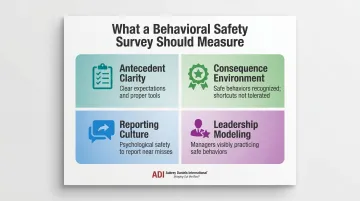
Four Core Areas to Cover:
- Antecedent clarity — Do employees have clear expectations and proper tools for safe behavior?
- Consequence environment — Are safe behaviors recognized and rewarded, or are shortcuts implicitly tolerated?
- Reporting culture — Do employees feel psychologically safe enough to report near misses and concerns without fear of blame?
- Leadership modeling — Do employees observe their managers consistently practicing and reinforcing safe behavior?
Example Survey Questions:
- "My supervisor acknowledges it when I do something safely."
- "I feel comfortable reporting a near miss without fear of discipline."
- "I have everything I need to do my job safely."
- "On this team, shortcuts are never overlooked in the name of getting work done faster."
- "When I see a hazard, I know how to report it and expect action will be taken."
- "My manager talks with me about safety behaviors, not just rules."
- "Safe work is recognized and appreciated on my team."
- "People on my team look out for each other's safety."
- "I believe my company values my safety as much as productivity."
- "Leaders in this organization model the safe behaviors they expect from others."
Once your questions are set, the structure of the survey itself determines whether you get honest, usable data.
Survey Design Best Practices
- Keep surveys anonymous to encourage honest responses about consequences and leadership
- Use a consistent Likert scale (1-5 or 1-7) for trend tracking
- Limit the survey to 10-15 questions to reduce drop-off
- Schedule them at regular intervals (e.g., quarterly) so data can reveal behavioral trends over time
How to Interpret Results Through a Behavioral Lens
Look for gaps between departments, shifts, or roles, which often signal differences in local consequence environments. Which supervisors are reinforcing safe behavior consistently, and which are not? Raw scores matter less than patterns and outliers — those point to exactly where supervisor coaching or consequence restructuring should begin.
Best Practices for Turning Survey Insights into Safer Behaviors
Translate Findings into Targeted Behavioral Interventions
If data reveals that employees don't report near misses due to fear of blame, the intervention is not a policy update—it is building a positive reinforcement practice around reporting. If workers skip PPE because it's inconvenient, the antecedent intervention is redesigning storage or access.
Each survey theme maps to a specific behavioral root cause and a corresponding action:
- Low reporting scores → Build reinforcement for reporting, eliminate punishment
- Low recognition scores → Train supervisors in positive feedback delivery
- Low tool/resource scores → Fix antecedent barriers (storage, accessibility, equipment)
- Low leadership modeling scores → Hold leaders accountable for visible safe behavior
Establish a Leadership Feedback Practice
Require managers and supervisors to review survey results for their teams and identify the top one or two behavioral safety gaps. From there, each leader commits to specific reinforcement actions, for example:
- Delivering three positive safety acknowledgments per shift
- Completing one peer observation per week
Track whether these leadership behaviors shift across subsequent survey cycles.
Close the Loop with Employees
Communicate survey results transparently and share what specific actions the organization is taking in response. When employees see their input result in visible change, they engage more honestly in future surveys and trust that safe behavior will be recognized and supported.
Frequently Asked Questions
What are the 7 principles of behavior-based safety?
The seven principles cover: observable behavior focus, A-B-C antecedent-behavior-consequence analysis, positive reinforcement over punishment, peer observation, data-driven feedback loops, leadership behavior alignment, and sustainability through embedded daily reinforcement habits. Together, they shift safety from a compliance activity to a behavior-change system.
What are the 5 C's of psychological safety?
One widely used framework includes Clarity, Candor, Curiosity, Commitment, and Consistency. Psychological safety underpins employees' willingness to report near misses and engage honestly in behavioral safety programs.
What are the 4 C's of safety?
A commonly referenced framework defines the 4 C's as Control, Communication, Co-operation, and Competence. Each maps directly to behavioral safety: leadership modeling, feedback loops, employee involvement, and training adequacy.
What is the difference between behavioral safety and psychological safety?
Behavioral safety targets observable physical actions—PPE use, lockout/tagout compliance—to prevent injuries. Psychological safety is an employee's confidence that they can speak up or admit mistakes without fear of punishment. Both matter: psychological safety is what makes behavioral safety data honest and usable.
How often should a workplace behavioral safety survey be conducted?
Quarterly pulse surveys are best practice for tracking behavioral trends, with additional targeted surveys following significant incidents or organizational changes. Consistency in timing and question format is what makes data comparable over time and allows you to measure the impact of interventions.
What makes a behavior-based safety program effective long-term?
Long-term BBS effectiveness depends on embedding positive reinforcement into daily leadership habits, maintaining continuous observation and feedback loops, and treating survey data as a diagnostic tool—not just a compliance checkbox. Programs built around audits and corrective action alone tend to decay once oversight pressure lifts.