This article covers the fundamental definition of an HSMS, the core structural elements required for effectiveness, a practical step-by-step build approach using the Plan-Do-Check-Act cycle, the often-overlooked behavioral science layer that determines whether people actually follow procedures, and how to sustain performance through continuous improvement.
Key Takeaways
- An HSMS is a formal framework for proactively identifying, controlling, and continuously improving occupational health and safety risks across an entire organization
- Effective systems pair structural elements with a behavioral layer for consistent follow-through
- Key building blocks include management commitment, hazard assessment, operational controls, training, and performance review
- Structure alone doesn't prevent incidents — people must consistently follow documented procedures for any system to work
- Plan-Do-Check-Act cycles drive continuous improvement and keep an HSMS effective long-term
What Is a Health & Safety Management System?
A Health & Safety Management System (HSMS)—also called an Occupational Health & Safety Management System (OHSMS)—is a formal, organization-wide approach to managing workplace safety risk. It covers the procedures, policies, and practices an organization uses to identify and control hazards before they cause harm.
An HSMS goes beyond a basic safety program. A safety program typically addresses specific hazards or training requirements in isolation—confined space entry procedures, forklift certification, or lockout/tagout training.
An HSMS, by contrast, is a comprehensive management framework that governs how the entire organization spots, controls, and continuously improves safety risks across all functions and levels.
In practice, most organizations structure their HSMS around internationally recognized standards, primarily ISO 45001:2018 and ANSI/ASSP Z10.0-2019. While certification to these standards is voluntary—not legally mandated—they provide proven blueprints for developing systems suited to organizations of any size or industry. Global adoption has accelerated, with over 355,000 ISO 45001 certificates issued in China alone by 2024, driven by supply-chain requirements and risk management priorities rather than legal compulsion.
Why Most HSMS Implementations Fall Short
Many organizations invest significant resources building an HSMS yet still experience incidents, near-misses, and stagnant safety performance. The root cause is consistent: the system was designed around documentation and compliance, not around the behavior of people doing the work.
Three failure patterns appear repeatedly:
- Leadership disengagement: Campbell Institute research identified lack of leadership commitment as the top barrier to safety performance improvement, rated 4.07 out of 5.0 by safety professionals. When executives treat safety as a paperwork exercise, resource allocation and behavioral modeling both suffer.
- Training that doesn't transfer: Employees pass quizzes and check compliance boxes, but shortcuts persist on the job. Most safety training focuses on information transfer rather than building behavioral competency under real working conditions.
- Overreliance on lagging indicators: OSHA data shows that injury rates and lost-time counts only track what already happened. Only 16.7% of organizations use mostly leading indicators at the corporate level — despite 89% rating them as extremely or very important. Systems that can't measure predictive behaviors stay permanently reactive.
What separates high-performing HSMS implementations is a deliberate strategy for influencing behavior — not just documenting it. The sections below break down how to build that into every layer of the system.
The Core Elements of an Effective HSMS
While HSMS frameworks vary, all effective systems share foundational elements that must be in place before implementation begins.
Safety Policy and Management Commitment
The safety policy is the organization's formal declaration of commitment to worker health and safety. It defines objectives, assigns responsibilities to management and employees, and communicates leadership priorities visibly and consistently.
Management commitment is measurable, not merely symbolic. OSHA defines it as making "worker safety and health a core organizational value" and "being fully committed to eliminating hazards, protecting workers, and continuously improving workplace safety and health." Commitment shows up in resource allocation, time invested in safety activities, and leader behavior on the floor or job site.
Organizations that reward rather than discipline workers who identify problems build trust and participation. Those that talk safety but don't fund it or model it create cynical workforces that view the HSMS as theater.
Hazard Identification and Risk Assessment
A comprehensive inventory of all workplace hazards — physical, chemical, ergonomic, psychosocial — forms the foundation of the entire system. The process:
- Identify all hazards in the work environment
- Assess their likelihood and potential severity
- Prioritize by risk level
- Select controls using the hierarchy of controls
NIOSH's hierarchy of controls arranges interventions from most to least effective:
- Elimination — Physically remove the hazard
- Substitution — Replace with a safer alternative
- Engineering controls — Modify equipment or workspace to reduce exposure
- Administrative controls — Establish work practices like training, job rotation, or rest breaks
- Personal protective equipment (PPE) — Least effective because it relies entirely on consistent human behavior
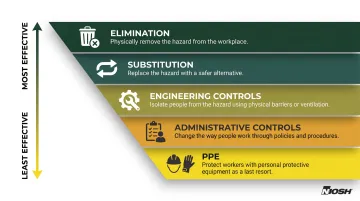
NIOSH emphasizes that elimination, substitution, and engineering controls are more effective precisely because they don't depend on workers remembering or choosing to follow procedures — they remove the hazard from the system.
Hazard identification is not a one-time exercise. New equipment, process changes, or workforce shifts all create new risk profiles that require fresh assessment.
Operational Controls and Emergency Preparedness
Documented, role-specific procedures translate risk controls into daily work practices. Emergency response plans prepare the workforce for low-probability, high-consequence events like fires, chemical releases, or severe injuries.
Documentation alone does not equal control. Procedures must be trained to fluency and reinforced through consistent management behavior. A lockout/tagout procedure sitting in a binder achieves nothing if supervisors don't verify compliance or if workers face pressure to skip steps for speed.
Training and Competency Development
Every employee, from frontline workers to senior managers, needs training calibrated to their role in the HSMS. Effective safety training goes beyond compliance awareness to build genuine competency: the ability to apply knowledge correctly under real working conditions.
ADI's fluency-based learning approach emphasizes repeated practice so workers can generalize knowledge across different situations. Rather than passing a quiz and moving on, fluency-based training ensures workers perform safe behaviors reliably, even when conditions vary or time pressure increases.
Communication and Worker Participation
A two-way communication system is essential: management pushing out safety updates, hazard notifications, and policy changes, while workers have accessible, psychologically safe channels for reporting concerns, near-misses, and unsafe conditions.
Worker participation, as OSHA defines it, means "workers are involved in establishing, operating, evaluating, and improving the safety and health program." This isn't just legal best practice — workers often have the most direct and accurate knowledge of where actual risk lies. When employees fear punishment for reporting problems, organizations lose their early warning system for hazards that haven't yet caused injury.
How to Build Your HSMS: A Step-by-Step Approach
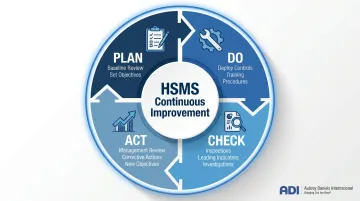
The Plan-Do-Check-Act (PDCA) cycle, endorsed by ISO 45001 and ANSI Z10, gives organizations a proven implementation framework — not a one-time project sequence, but a continuous loop that drives ongoing improvement.
Step 1 — Plan: Establish Context and Set Objectives
Planning begins with a baseline review:
- Existing policies and procedures
- Known hazards and past incident data
- Regulatory requirements specific to your industry and location
- Your organization's operational context—size, complexity, workforce characteristics
From this baseline, leadership sets measurable health and safety objectives—not generic aspirations like "improve safety culture," but specific targets tied to priority risks: "Reduce fall-related incidents in roofing operations by 50% within 12 months" or "Achieve 100% completion of hazard identification training for all supervisors by Q2."
Involve both management and frontline workers in setting objectives. Workers understand actual conditions on the floor, in the field, or on the job site. Objectives developed without that input often miss the hazards that matter most.
Step 2 — Do: Implement Controls and Operations
With objectives set, implementation deploys everything from the planning phase:
- Install engineering controls identified in hazard assessment
- Launch training programs for all roles
- Establish communication systems and reporting channels
- Assign clear accountability for each HSMS element
- Document procedures and make them accessible
Implementation quality depends on whether management models expected behaviors. A procedure manual on a shelf achieves nothing. Supervisors must use the procedures, reference them in daily conversations, and visibly follow them. When leaders cut corners or ignore protocols, employees learn that the documented system isn't the real system.
Step 3 — Check: Monitor, Measure, and Investigate
An active monitoring program includes:
Regular workplace inspections — Scheduled audits of work areas, equipment, and practices to verify controls remain effective.
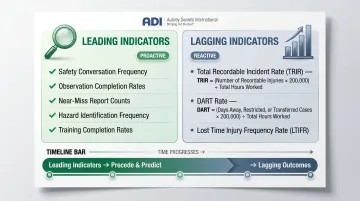
Leading indicators — OSHA defines these as "proactive and preventive measures that shed light about the effectiveness of safety and health activities." Examples include:
- Safety observation completion rates
- Near-miss report frequency
- Hazard identification counts
- Training completion percentages
- Behavioral compliance rates during observations
Lagging indicators — Total Recordable Incident Rate (TRIR), Days Away, Restricted, or Transferred (DART) rate, and fatality counts track what already happened.
Campbell Institute research found that only 46% of organizations have established a statistical link between leading and lagging indicators, yet organizations that track leading indicators consistently outperform those relying solely on injury rates.
Root-cause incident investigation searches for systemic causes rather than assigning blame. Was the hazard identified in the risk assessment? Were controls in place? Did training build genuine competency? What systems or behavioral factors contributed? Blame-focused investigations teach workers to hide incidents; root-cause investigations drive system improvement.
Step 4 — Act: Review, Correct, and Improve
At least annually, senior leadership and safety stakeholders review all performance data, audit findings, incident investigations, and employee input to assess whether the HSMS achieves its objectives.
Use this review to drive:
- Updates to policy and risk controls
- Changes to training content or delivery methods
- Adjustments to resource allocation
- New objectives for the next cycle
This step closes the loop and converts data into sustained organizational learning. Without it, monitoring becomes a reporting exercise rather than a driver of continuous improvement.
The Behavioral Science Factor: Why People Are the Heart of Your HSMS
The structural elements of an HSMS create conditions for safety. Human behavior—the daily decisions, habits, and responses of every person in the organization—determines whether those conditions actually prevent harm.
While the widely cited claim that "80-95% of workplace incidents involve human behavior" lacks a clean primary source and has been methodologically challenged by safety scholars like Fred Manuele, it's undeniable that behavior plays a critical role. The question isn't whether to blame workers—it's how to design systems that make safe behavior the easiest, most reinforced choice.
Behavior is reliably shaped by antecedents (what comes before) and consequences (what follows). When safety shortcuts are faster, easier, or more socially accepted than safe behaviors—and when safe behaviors go unrecognized—the system inadvertently reinforces the wrong patterns, regardless of what the policy manual says.
Research published in Safety Science analyzed 73 organizations implementing behavior-based safety (BBS) over five years. Average incident-rate reductions were 26% in Year 1, increasing to 69% by Year 5—demonstrating that behavior-focused approaches work when sustained.
Those results don't happen by accident. A behaviorally sound HSMS looks different in practice:
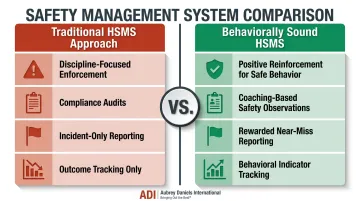
- Leaders use positive reinforcement to recognize safe behavior rather than relying solely on discipline for violations
- Safety observations are coaching conversations, not compliance audits
- Near-miss reporting systems reward transparency rather than punish the reporter
- Performance data tracks behavioral indicators (what people are doing) alongside outcome indicators (what has happened)
ADI's work in this area — including Judy Agnew's co-authored book Safe by Accident? — examines how organizational systems either support or undermine safe behavior, and offers concrete methods for building reinforcement structures that stick.
The practical payoff: safety cultures built on positive reinforcement sustain themselves. They don't depend on enforcement pressure or fear of consequences to keep people doing the right thing.
Measuring and Sustaining HSMS Performance Over Time
A successful HSMS is never "finished." It's a living system that evolves as the organization grows, the workforce changes, hazards shift, and performance data reveals new priorities.
Organizations that treat safety management as a one-time project watch gains erode within 18–24 months. Building continuous improvement infrastructure is what separates systems that sustain results from those that stall.
Key Performance Metrics
Leading indicators measure system health before incidents occur:
- Safety conversation frequency
- Behavioral observation completion rates
- Near-miss report counts
- Hazard identification frequency
- Training completion and competency verification rates
Lagging indicators measure outcomes:
- Total Recordable Incident Rate (TRIR) = (Recordable Incidents × 200,000) / Total Hours Worked
- DART Rate = (Days Away/Restricted/Transfer Incidents × 200,000) / Total Hours Worked
- Severity rates and fatality counts
Best-in-class organizations weight leading indicators heavily because they measure what's happening now—the real-time health of the system—rather than waiting for incidents to reveal weaknesses.
Documenting and Communicating Performance
HSMS performance data must flow throughout the organization, not just to safety teams. When workers see their near-miss reports trigger real changes, participation in the system compounds over time.
Transparency is what builds that trust. Organizations that communicate both wins and gaps consistently demonstrate that the system exists to protect people — not to satisfy a compliance checkbox. Effective communication includes:
- Posting leading and lagging indicator trends where workers can see them
- Closing the loop on near-miss reports with visible corrective actions
- Sharing improvement progress in team meetings and safety reviews
- Acknowledging gaps honestly alongside plans to address them
Frequently Asked Questions
How to develop a health and safety management system?
Developing an HSMS involves establishing a safety policy with clear management commitment, conducting hazard identification and risk assessment, implementing operational controls and training, and building continuous monitoring and improvement processes. Most frameworks follow the Plan-Do-Check-Act cycle, as outlined in ISO 45001 or ANSI Z10.
What are the key elements of a health and safety management system?
The core elements include management commitment and safety policy, hazard identification and risk assessment, operational controls and emergency preparedness, training and competency development, communication and worker participation, and performance monitoring and review. Each element depends on the others — gaps in any one area weaken the whole system.
What is the difference between a safety program and a health and safety management system?
A safety program typically addresses specific procedures or training requirements for particular hazards (fall protection, hazardous materials handling). An HSMS is a broader organizational framework that governs how safety risk is managed and improved across the entire operation, with defined roles, systematic processes, and built-in accountability.
How long does it take to build a health and safety management system?
Timeline depends on organization size, industry complexity, and current safety maturity. A basic framework typically takes several months to a year to implement; embedding it into culture is a multi-year effort that requires sustained leadership commitment.
What role does employee behavior play in a successful HSMS?
Behavior is the mechanism through which all HSMS elements either succeed or fail. Without consistent, reinforced safe behaviors from workers and leaders alike, even a well-documented system will underperform. Behavioral science is a critical component of effective HSMS design because it ensures that people actually do what the system requires.
What is ISO 45001 and is certification required?
ISO 45001:2018 is the internationally recognized standard for occupational health and safety management systems, providing a framework for policy, risk management, implementation, and continuous improvement. Certification is not legally required in most jurisdictions but is widely pursued as a marker of HSMS credibility, rigor, and supply-chain compliance.
The organizations with the lowest incident rates share a common trait: they treat structure and behavior as inseparable. Documentation creates the framework; consistent leadership and reinforced behaviors are what make it function. Continuous improvement keeps the system relevant as conditions, people, and risks evolve.