Introduction
In safety-critical industries—manufacturing, oil and gas, nuclear, mining, construction, and utilities—a single training failure can produce irreversible consequences. Yet despite widespread training programs, preventable incidents continue: in 2024, the Bureau of Labor Statistics recorded 5,070 fatal work injuries, with construction, manufacturing, mining, and utilities accounting for 1,509 deaths combined. More troubling, a NIOSH study found that 52.9% of employers inspected after work-related hospitalizations had not corrected the triggering hazard.
The gap persists because compliance-focused training builds knowledge but does not automatically produce lasting behavior change. Passing a test demonstrates recall. Performing the correct procedure under pressure, fatigue, or production deadlines is a different skill entirely. That requires behavioral fluency built through repeated practice in consequence-driven environments.
This guide explains the step-by-step process for managing safety training that changes behavior, not just checks boxes. You'll learn how to:
- Conduct risk-based needs assessments
- Design training for fluency rather than information transfer
- Prepare leaders to reinforce trained behaviors on the job
- Establish refresh cadences before skill decay occurs
- Measure whether training is producing measurable safety improvements
TL;DR
- Safety training must be designed to change behavior, not just satisfy regulatory audits
- Effective management begins with a thorough risk assessment before any training is selected or designed
- Effective training addresses adult learning principles, role-specific hazards, and ongoing reinforcement — not a single delivery event
- The primary reason safety training fails is lack of on-the-job reinforcement by supervisors
- Track effectiveness through behavioral observation and leading indicators, never completion rates alone
How to Manage Safety Training in Safety-Critical Industries
Step 1: Conduct a Risk-Based Needs Assessment
Perform systematic hazard identification for each job role. Inventory the physical, chemical, electrical, and procedural risks workers actually face—not just what appears in job descriptions. According to OSHA's hazard identification framework, this includes inspecting the workplace, identifying health hazards, conducting incident investigations, and characterizing emergency scenarios.
Review incident and near-miss data to identify training gaps. Examine where training has previously failed or been absent. Historical data surfaces the highest-priority gaps. If fall protection violations recur despite annual training, the issue is not knowledge—it's either training design or post-training reinforcement.
Cross-reference findings against regulatory requirements. The top 10 most-cited OSHA standards in 2024 include six with direct training requirements:
- Fall Protection (29 CFR 1926.501)
- Hazard Communication (29 CFR 1910.1200)
- Lockout/Tagout (29 CFR 1910.147)
- Respiratory Protection (29 CFR 1910.134)
- Powered Industrial Trucks (29 CFR 1910.178)
- Fall Protection Training (29 CFR 1926.503)
Distinguish between legally mandated training and training that addresses behavioral gaps beyond compliance. Regulatory minimums are starting points, not finish lines.
Step 2: Design Training Tailored to Behavior Change, Not Just Knowledge Transfer
Training that informs workers what to do is not the same as training that builds automatic, reliable behaviors under pressure. The target is behavioral fluency—reliable responses that hold up when seconds matter, not just knowledge that surfaces on a written test.
A meta-analysis of 95 studies by Burke et al. found that the most engaging methods—behavioral modeling, hands-on practice, and interactive dialogue—produced knowledge effect sizes of d=1.46 compared to d=0.55 for passive lectures. That's nearly 2.6x more effective.
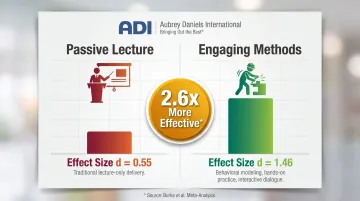
Use scenario-based and hands-on methods that simulate actual hazard conditions:
- Confined space entry drills
- Lockout/Tagout demonstrations on actual equipment
- Emergency response simulations with role-playing
- Live-fire extinguisher training
- Rescue practice exercises
Passive instruction does not build the muscle memory and decision-making patterns required when seconds matter.
Assign training content by role. A frontline operator in a chemical plant and a site supervisor have different hazard exposures and different responsibilities. Role-specific modules improve relevance and retention compared to blanket programs. Generic training produces surface compliance—workers complete it without internalizing it.
Step 3: Implement with Leadership Alignment and Ongoing Reinforcement
Prepare supervisors to reinforce trained behaviors. Brief supervisors and managers on their role as the primary reinforcers of safe behavior after training ends. What leaders observe, acknowledge, and correct on the floor determines whether trained behaviors become habitual or fade within weeks.
Research confirms this: Zohar and Luria's study of 3,952 workers found that group-level safety climate—driven by supervisory practices—correlated with safety behavior at r=.38 and explained 19% of behavioral variance. The effect of organization-level climate on safety behavior was fully mediated by supervisors. In other words, corporate safety programs only work if supervisors implement them consistently.
Consequences—positive reinforcement and corrective feedback—are far more powerful drivers of sustained safe behavior than antecedents like training alone. As detailed in Judy Agnew's Safe by Accident?, the behavioral science evidence shows:
- Positive reinforcement maintains or increases desired behavior
- Consequences must be immediate and certain
- A 4:1 ratio of positive-to-corrective interactions is recommended
When supervisors ignore unsafe shortcuts or prioritize production over safety, workers receive a clear signal that training doesn't matter—regardless of what the classroom covered.
Step 4: Establish a Refresher and Update Cadence
Define refresh intervals based on risk and regulatory requirements. Some certifications require annual re-qualification; others should be triggered by new equipment, process changes, incidents, or observed behavioral drift—not just calendar schedules.
Skill decay is measurable and significant. Arthur et al.'s meta-analysis found that after one year of nonuse, the average participant performed at less than 92% of post-training level, with cognitive tasks decaying faster than physical tasks. High-consequence tasks warrant more frequent practice than regulatory minimums.
Build a system for incorporating lessons learned. Near-miss reports and incident findings should flow directly into updated training content. Training that never evolves becomes a compliance artifact rather than a live safety tool.
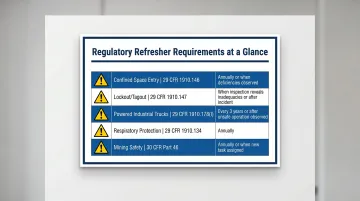
| Standard | Refresher Requirement |
|---|---|
| Confined Space Entry (29 CFR 1910.146) | Retraining on duty/operational changes; rescue practice every 12 months |
| Lockout/Tagout (29 CFR 1910.147) | Retraining when inspections reveal inadequacies; annual inspections required |
| Powered Industrial Trucks (29 CFR 1910.178) | Performance evaluation every 3 years; refresher on unsafe operation or incidents |
| Respiratory Protection (29 CFR 1910.134) | Annual fit testing; retraining on workplace changes |
| Mining (30 CFR Part 46) | Minimum 8 hours annual refresher training |
What You Need Before Building a Safety Training Program
Confirm that leadership has explicitly committed resources—budget, time off-task, and qualified facilitators—before a single training session is scheduled. Safety training treated as a checkbox activity squeezed between production targets produces compliance theater, not behavioral change.
Equipment, Compliance, and Role Documentation
Build a complete inventory before designing anything. A training matrix built from this data makes scheduling, tracking, and compliance gaps visible at a glance. That inventory should cover:
- Job roles and associated equipment
- Regulatory training mandates by role
- Current certification status for each worker
- Gaps between required and completed training
Skill and Behavioral Baseline Assessment
Before designing new training, assess what workers already know and what behaviors they are actually performing in the field. This prevents wasted time re-teaching mastered content and focuses resources where behavioral risk is highest. Effective baseline assessment includes:
- Direct observation of task performance (not just written tests)
- Identifying which at-risk behaviors are already habitual
- Documenting what workers do correctly so training reinforces it
Key Variables That Determine Safety Training Outcomes
Training quality is not determined by hours delivered or materials produced, but by how well these core variables are controlled. Four variables consistently separate training programs that reduce incidents from those that merely satisfy compliance calendars: design and delivery format, supervisory reinforcement, refresher frequency, and role specificity.
Training Design and Delivery Format
How training is structured determines whether workers can recall and apply procedures under stress. Passive lecture-based formats rarely produce the fluency needed in high-hazard environments — workers may pass a knowledge check and still hesitate at the critical moment.
Burke et al.'s research showed that engaging methods (behavioral modeling, hands-on practice) produced measurably better outcomes across knowledge acquisition, safety performance, and injury reduction. The probability of a randomly selected individual from the most engaging training group exceeding someone from the least engaging group in knowledge acquired was 0.74 — a substantial margin in any safety context.
ADI's fluency-based learning framework is built on this evidence: it trains workers to perform procedures accurately and fast enough to be reliable under pressure, not just to recognize the correct answer on a test.
Leadership and Supervisory Reinforcement
The behaviors workers maintain after training depend heavily on what their direct supervisors observe, acknowledge, and correct. A manager who routinely overlooks unsafe shortcuts sends a more powerful signal than any training course ever will.
Positive reinforcement of safe behaviors — delivered consistently and immediately — is the single strongest predictor of whether training outcomes persist. Peker et al.'s study of 455 manufacturing workers found that supervisor behavioral integrity for safety moderates the relationship between top-management safety climate and employee safety performance.
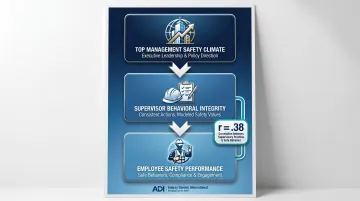
In practice, this means:
- Supervisors who actively observe and reinforce correct procedures extend training's shelf life
- Those who ignore deviations effectively erase it
- Top-management safety climate only reaches workers when front-line supervisors carry it through
Training Frequency and Recency
Skill decay in safety-critical environments is not theoretical — it's measurable. Arthur et al.'s research showed significant skill loss within 1–2 weeks of training, with cognitive tasks decaying faster than physical ones. Effect sizes ranged from d=−1.01 after 1–7 days to d=−1.27 after more than 365 days.
The gap between training and a required response directly determines how reliable that response will be under pressure. Refresher frequency should be calibrated to the severity of consequence if the skill fails — not just to regulatory minimums.
Relevance and Role Specificity
Workers disengage from training that feels generic. When procedures don't map to their actual tasks or hazard exposures, they comply on paper and forget in practice — which means the next time that hazard appears, they're no better prepared than before training.
Role-specific, hazard-relevant training produces higher retention and on-the-job application rates. Campbell Institute research with Cummins found a very strong negative correlation (r=−.86) between training hours and incidence rate — but only when that training was targeted and relevant. Volume alone does not drive the result; specificity does.
Common Mistakes in Safety Training Management
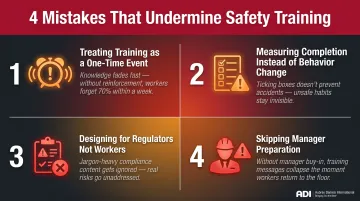
Four patterns consistently undermine safety training programs — even in organizations with strong compliance records and high course-completion rates.
Treating training as a one-time event. Workers revert to habitual patterns within weeks if safe behaviors are not observed and reinforced by supervisors after training ends. Training is an antecedent that sets the stage; workplace consequences determine whether behaviors persist.
Measuring completion instead of behavior change. High completion rates can mask poor outcomes. An organization where everyone has passed the course but no one has changed how they perform the task has not improved safety — it has only reduced legal exposure. The Campbell Institute notes that "sole focus on lagging metrics is not as effective in promoting continuous improvement as using leading indicators."
Designing training for regulators, not workers. Programs built primarily to satisfy audit requirements often use dense, legalistic content that workers cannot apply on the job. Training must be designed around the learner's decision-making environment, not around what looks good in a compliance binder.
Skipping the manager preparation step. Deploying worker-facing training without equipping supervisors to reinforce those behaviors afterward is a structural failure. Managers unprepared to coach and acknowledge safe behaviors become inadvertent obstacles to training transfer.
Research shows that when the person providing consequences — positive or corrective — leaves the situation, behavior returns to baseline unless environmental reinforcement systems are in place. That reinforcement infrastructure is what most safety training programs skip entirely.
How to Measure Whether Your Safety Training Is Actually Working
Lagging vs. Leading Indicators
Incident rates and workers' compensation claims are lagging measures—by the time they change, many exposures have already occurred. Effective programs also track leading indicators:
- Safe behavior observation rates
- Near-miss reporting frequency (tracked by 84% of EHS professionals as their top leading indicator)
- Corrective action closure times
- Ratio of safe to unsafe observations
These leading indicators give you actionable data before an incident occurs—not after.
Moving From Knowledge Checks to Behavioral Evidence
A post-test measures what workers can recall immediately after training. A structured on-the-job behavioral observation measures whether workers are applying trained behaviors days or weeks later—under production pressure, when tired, or when supervisors aren't watching. That gap between knowing and doing is where most training programs fail.
Behavioral drift—the gradual return to pre-training patterns when reinforcement is absent—is one of the most common failure modes. Periodic observation data can reveal drift before it becomes an incident, enabling targeted refresher sessions or coaching rather than waiting for accident trends to signal the problem.
Qualitative feedback rounds out the picture. Structured input from workers (what was unclear, what seems impractical in the field) and supervisors (what behaviors they are and are not seeing) pinpoints gaps in training content and delivery that observation scores alone won't surface.
The final step is connecting these data streams. An effective training measurement system links completion records, behavioral observation scores, and incident data into a single dashboard—showing not just whether training happened, but whether it's producing safer behavior on the floor. ADI's Performance Management framework provides the structure for building and sustaining these feedback loops over time, grounded in over 45 years of applied behavioral science.
Frequently Asked Questions
What are the 5 basic safety trainings?
The most universally required categories are hazard communication/GHS, emergency action procedures, personal protective equipment use, incident reporting, and job-specific hazard training. The exact required trainings vary by industry and regulatory framework—manufacturing may require lockout/tagout and machine guarding, while construction emphasizes fall protection and scaffolding.
What are the 4 P's of safety?
The 4 P's framework covers People (training, competency, behavior), Process (procedures, workflows), Place (physical environment, equipment), and Program (policies, systems, culture). A sound safety management approach addresses all four—neglecting any one dimension creates exploitable gaps.
How often should safety training be refreshed in high-risk industries?
Refresh intervals depend on regulatory requirements (such as annual re-certification for respiratory protection), risk severity, and observed field performance. Calendar minimums are a floor, not a target—high-consequence tasks and infrequently performed skills require more deliberate refresher planning than schedules alone will provide.
Why do workers ignore safety procedures even after completing training?
Training is an antecedent—it creates awareness and sets expectations—but behavior is shaped by its consequences. If safe procedures are slower, less comfortable, or go unacknowledged while shortcuts go uncorrected, workers will follow the path reinforced by their environment, not the one shown in a course. Research shows that 45-55% of the motivational problem of taking shortcuts is explained by safety training effectiveness combined with stress-based tension.
What is the difference between safety training and safety culture?
Training is a structured event that delivers knowledge and skills. Safety culture is the persistent, shared set of values, norms, and behavioral expectations that determine what workers actually do when no one is watching. Training can inform culture but cannot create it alone—culture is built through daily leadership behaviors, consequence management, and reinforcement systems.
How do you measure the effectiveness of a safety training program?
Effective measurement combines behavioral observation data, leading indicators (near-miss reporting rates, corrective action closure speed), and lagging indicators (incident rates). Course completion records and quiz scores measure knowledge transfer only—they tell you who attended, not who changed behavior.