Introduction
In 2024, 5,070 workers died from work-related injuries in the United States — a worker every 104 minutes. That's a 4% decrease from the prior year, but the toll remains unacceptably high.
The numbers also obscure a deeper problem. Nearly 30% of workers who experience pain at work don't report it, according to a 2025 National Safety Council study, and safety leaders consistently rate workplace culture more positively than frontline employees do.
Both gaps — in reporting and in perception — tend to originate at the supervisory level. Supervisors sit between organizational safety policy and the day-to-day behaviors of workers. Their training determines whether safety protocols become ingrained habits or remain documents nobody reads.
This article delivers the seven key elements that make supervisor safety training effective, and makes the case for why a behavior-based approach produces lasting results that compliance checklists, on their own, cannot.
TL;DR
- Supervisor safety training must build behavioral skills, not just technical knowledge
- The 7 key elements span role clarity, hazard recognition, communication, behavioral observation, incident investigation, documentation, and safety leadership
- Most programs fail by treating training as a one-time event rather than an ongoing behavior-shaping process
- Positive reinforcement of safe behaviors — not punishment alone — drives lasting change
- Measure effectiveness through behavioral change and incident trends, not completion rates
Why Supervisor Safety Training Is Different From Standard Employee Training
Supervisors carry a dual responsibility that frontline workers don't share: they must protect their own safety while directly influencing the behavior of every worker in their unit. This requires a distinct skill set that extends far beyond general hazard awareness.
OSHA's 29 CFR 1960.55 mandates specific supervisor training that covers:
- Recognizing and eliminating workplace hazards
- Managing the safety program within their work unit
- Motivating workers toward safe practices
The standard requires new supervisors to receive this training within the first two weeks of employment.
General employee training focuses on following safe work practices. Supervisor training must go further — developing leadership and coaching capabilities that actively shape how others behave.
Research published in Safety and Health at Work found that supervisor safety support acts as a buffer against physical hazards. Across 2,112 workers studied, those exposed to high hazards but supported by strong supervisors had significantly lower injury risk. Notably, supervisor support could partially compensate for weak organizational policies — but weak supervisor support undermined even strong ones.
Supervisors shape safety culture through daily interactions, modeling, and reinforcement. That's precisely why effective supervisor safety training can't stop at hazard recognition — it must build the behavioral leadership skills that drive consistent safe performance across the team.
The 7 Key Elements of Effective Safety Training for Supervisors
Element 1: Clear Role Definition and Accountability
Supervisors must understand that workplace safety isn't a shared responsibility in abstract terms — they are specifically accountable for maintaining safe conditions in their work unit.
Key responsibilities include:
- Identifying hazards proactively through regular inspections
- Ensuring team members complete required training
- Documenting all safety activities systematically
- Maintaining safe conditions continuously, not just during audits
OSHA 29 CFR 1960.11 requires that performance evaluations of supervisory employees measure their performance in meeting safety program requirements. This isn't optional — accountability must be reinforced through the performance management system. Supervisors should have safety outcomes included in appraisals alongside operational goals, with superior safety performance formally recognized.
When safety metrics appear in performance reviews, supervisors understand their career progression depends on safety outcomes, not just production numbers.
Element 2: Hazard Recognition and Risk Assessment
Supervisors must be trained in systematic hazard identification methods so they can recognize both physical conditions and unsafe work practices before incidents occur.
Core hazard identification methods:
- Job Hazard Analysis (JHA): Break each job into steps, then identify what can go wrong at each stage before work begins
- Workplace inspections: Walk through the facility using comprehensive checklists covering chemical, electrical, ergonomic, fall, fire, and other hazard categories
- Behavioral observations: Watch how work is actually performed — not just whether equipment passes a checklist
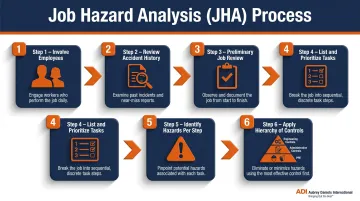
OSHA Publication 3071 outlines a structured JHA process supervisors should master. Key steps include:
- Involve employees in the analysis
- Review accident and near-miss history for the task
- Conduct a preliminary job review
- List and prioritize job tasks
- Identify specific hazards for each step
- Develop controls using the Hierarchy of Controls — engineering solutions first, administrative controls second, PPE only as a last resort
Training must also cover how to assess risk levels and prioritize corrective actions, including when to stop work entirely. Supervisors who hesitate to halt operations when serious hazards emerge undermine every other safety element.
Heinrich's accident triangle research, based on analysis of more than 75,000 accident reports, found a 1:29:300 ratio of major injuries to minor injuries to no-injury accidents. Supervisors have hundreds of opportunities to intervene proactively for every serious injury that occurs.
Element 3: Effective Communication and Training Delivery
Supervisors need training on how to present safety information clearly to diverse workforces. Simply reading from a manual does not constitute effective training.
Essential communication skills:
- Accommodate different learning styles (visual, auditory, hands-on)
- Address language barriers through translated materials, interpreters, or visual demonstrations
- Check for comprehension, not just attendance
- Use real workplace examples instead of generic scenarios
OSHA Publication 3824 identifies core adult learning principles supervisors should apply: adults prefer self-direction, learn best from experience, need to know why they're learning something, and value practical problem-solving over theoretical lectures. The most effective delivery methods include hands-on training, small group activities, case studies using actual workplace incidents, role-playing, and demonstration followed by practice.
Best practices for toolbox talks and safety briefings:
- Keep sessions focused (10-15 minutes maximum)
- Cover one topic thoroughly rather than multiple topics superficially
- Encourage questions and discussion
- Relate the topic to recent near-misses or incidents
- Verify understanding through demonstration or discussion
Comprehension gaps don't always look like comprehension gaps. Research on Hispanic immigrant workers shows fatal work injury rates of approximately 4.6 per 100,000 full-time equivalent workers — compared to the national average of 3.7 — with language barriers and limited safety training access identified as contributing factors. Effective communication isn't just about delivery; it's about confirming understanding before work begins.
Element 4: Behavioral Observation and Positive Reinforcement
Supervisors should be trained to conduct behavioral safety observations — regularly watching how work is actually performed, not just auditing physical conditions — and to document both safe and at-risk behaviors without assigning blame.
The most effective supervisors reinforce safe behavior immediately and specifically. Research in applied behavior analysis shows this produces more lasting safety performance than reliance on rules and corrective consequences alone. Judy Agnew's co-authored resource Safe by Accident?, developed through ADI's 45+ years of behavioral science work, offers a practical framework supervisors can apply directly.
Why positive reinforcement works better than punishment:
- Creates intrinsic motivation rather than compliance only when watched
- Encourages near-miss reporting instead of hiding mistakes
- Builds trust between supervisors and workers
- Produces behavior change that persists when supervision decreases
Research published in Safety Science found that leadership behaviors including safety commitment and positive feedback were directly associated with employee safety behaviors over time.
Effective behavioral observation includes:
- Scheduled observations (not just random walk-throughs)
- Focus on high-risk tasks and new employees
- Documentation of both safe and at-risk behaviors
- Immediate, specific feedback ("I noticed you used three points of contact on that ladder — that's exactly right" rather than generic "good job")
- Follow-up conversations, not just data collection
Element 5: Incident Investigation and Root Cause Analysis
Supervisors should be trained to lead or participate in structured incident and near-miss investigations with the goal of identifying systemic causes rather than attributing blame to individual workers.
OSHA's Incident Investigation Guide outlines a four-step systems approach:
- Preserve and document the scene — secure the area, photograph conditions, sketch layout
- Collect information — conduct interviews promptly, review equipment manuals, training records, maintenance logs
- Determine root causes — dig beyond immediate causes to find underlying issues in equipment design, procedures, training gaps, or safety program weaknesses
- Implement corrective actions — program-level improvements, not superficial fixes
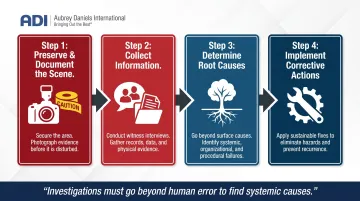
Investigations should never stop at "human error" — that's where they begin. When a worker makes a mistake, the real question is what made that mistake possible. Effective supervisors dig into root causes:
- Was training inadequate or unclear?
- Was the safe method slower or more physically difficult than the shortcut?
- Were shortcuts inadvertently rewarded through faster production?
Near-miss reporting is just as important as incident investigation. Bird's expanded accident triangle, based on analysis of 1.7 million accident reports, found a 1:10:30:600 ratio — for every serious injury, there were 10 minor injuries, 30 property-damage accidents, and 600 near-misses. Supervisors must build team environments where workers feel safe reporting without fear of retribution, and that trust doesn't happen by accident.
Element 6: Regulatory Compliance and Documentation
Supervisors must understand the specific OSHA standards, company safety policies, and industry regulations applicable to their work units.
Required knowledge areas:
- Permit-to-work requirements for confined spaces, hot work, energized electrical work
- Required personal protective equipment for each task
- Recordkeeping obligations under 29 CFR 1904
- Reporting timelines (within 8 hours for fatalities, 24 hours for hospitalizations, amputations, or loss of eye)
Documentation is not bureaucratic box-checking. Training records, inspection logs, and incident reports are legal protections for the organization and essential data for identifying patterns and improving safety programs over time.
OSHA's recordkeeping requirements mandate that organizations with more than 10 employees maintain OSHA Form 300 (Log of Work-Related Injuries and Illnesses), Form 300A (annual summary posted February 1 - April 30), and Form 301 (detailed incident report for each recordable event). Supervisors are typically responsible for initial reporting and documentation.
Supervisors should also understand OSHA's leading indicators framework — proactive measures like frequency of safety inspections, near-miss reporting rates, employee training completion, and behavioral observation counts. These predict future performance better than lagging indicators like injury rates.
Element 7: Safety Leadership and Culture Building
A supervisor's visible behavior communicates more to workers than any formal policy — whether they wear PPE, whether they stop unsafe work, whether they take near-miss reports seriously.
Training should build awareness of this modeling effect. When a supervisor walks past a tripping hazard without addressing it, or completes a task without required PPE "just this once," workers learn that rules are suggestions, not requirements.
How supervisors actively shape safety culture:
- Involve workers in hazard identification and JHA development
- Set meaningful safety goals with team input
- Celebrate safety milestones and recognize safe behaviors publicly
- Make safety part of regular team conversations, not a once-a-year compliance event
- Demonstrate that production never takes priority over safety
- Respond to near-miss reports with gratitude, not criticism
OSHA's guidance on worker participation identifies this as a core element of effective safety programs. Workers should participate in routine inspections, incident investigations, pre-task safety briefings, and selection of PPE. When supervisors create this involvement, workers develop ownership of safety outcomes rather than viewing safety as management's responsibility.
The Behavioral Science Factor: Why Knowledge Alone Isn't Enough
Conventional safety training focuses almost entirely on antecedents — rules, warnings, instructions, posters — while neglecting the consequences that actually drive whether behavior changes. Research in Applied Behavior Analysis shows that consequences, especially immediate positive ones, are the primary drivers of sustained behavior change.
The ABC model, rooted in Skinner's behavioral model, demonstrates this:
- Antecedents set the stage for behavior but don't guarantee it will occur
- Behavior is the observable action
- Consequences determine whether the behavior will be repeated
Why Unsafe Behaviors Persist Despite Training
Often, consequences for shortcuts are immediate and positive (work gets done faster, less physical discomfort, no incident occurs), while consequences for following safe procedures are delayed or nonexistent (no immediate feedback, more time required, physical strain from proper lifting technique). When the consequences favor unsafe behavior, training alone won't create lasting change.
Supervisors trained in behavioral principles can use the ABC model to diagnose exactly why unsafe behaviors persist. Take lockout/tagout as an example: workers skip the procedure because task completion is faster and no incident occurs — immediate, positive consequences for the unsafe choice.
To shift that pattern, the supervisor asks what would make the safe behavior more likely:
- Immediate recognition when the procedure is followed correctly
- Removing obstacles that slow down the process
- Peer modeling that normalizes the behavior on the floor
Compliance-driven safety versus behavior-based safety:
Compliance-driven safety produces behavior that occurs only when supervisors are watching or when consequences are threatened. Behavior-based safety produces internalized practices because the work environment consistently reinforces them. Organizations that rely solely on compliance see performance slip when supervision decreases.
ADI's 45+ years of applying behavioral science to organizational performance gives supervisors a structured approach to making behavior change durable. The method works by identifying and applying the right reinforcers for each specific team — not through fear-based enforcement, but through building an environment where safe behavior is the path of least resistance.
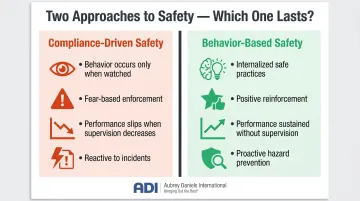
Behavior-based safety training is not a replacement for technical knowledge or regulatory compliance. It's the layer that makes all other training elements actually work by closing the gap between what people know and what they consistently do.
Common Mistakes Organizations Make in Supervisor Safety Training
Treating training as a one-time event rather than continuous development.
Supervisors get promoted, regulations change, new hazards emerge, and skills degrade without practice. Annual refreshers are the minimum required to maintain competence. Best practice involves quarterly skill-building sessions, regular coaching from senior leadership, and immediate refresher training when incidents reveal capability gaps.
Providing the same generic safety training to supervisors that frontline workers receive.
Supervisors need a program built specifically for their role. That means training that covers:
- Conducting job hazard analyses (JHAs)
- Leading incident investigations
- Coaching workers on safe behavior
- Managing the safety program within their unit
Training that doesn't differentiate supervisory responsibilities from worker responsibilities leaves supervisors unprepared for their unique accountabilities.
Measuring success by completion rates and sign-in sheets.
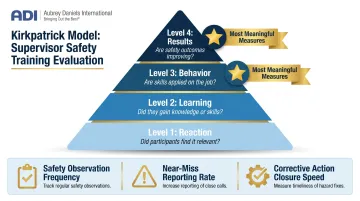
OSHA Publication 3824 outlines four levels of training evaluation aligned with the Kirkpatrick Model. Most organizations stop at Level 1 (did participants enjoy it?) and Level 2 (did they pass a test?). Meaningful evaluation requires reaching Level 3 — are supervisors applying skills on the job — and Level 4: are safety outcomes actually improving?
Completion rates prove attendance, not competence or behavior change.
How to Evaluate Whether Your Supervisor Safety Training Is Working
Effective evaluation moves beyond participant satisfaction to measure whether supervisors apply what they learned on the job and whether that application produces measurable safety outcomes.
The Kirkpatrick Model provides a framework:
- Level 1 — Reaction: Did participants find training relevant and engaging?
- Level 2 — Learning: Did participants acquire new knowledge or skills?
- Level 3 — Behavior: Are supervisors applying skills on the job?
- Level 4 — Results: Did training produce organizational safety improvements?
Most organizations measure only Levels 1 and 2. The meaningful indicators are Levels 3 and 4.
Key behavioral indicators to track post-training:
- Frequency of supervisor-led safety observations (target: weekly minimum)
- Rate of near-miss reporting in their teams (increase indicates trust and engagement)
- Quality and timeliness of hazard reporting
- How quickly corrective actions are closed out
- Completion rates for team safety training
- Frequency of positive safety feedback given to workers
Outcome indicators:
- Reduction in recordable incident rates
- Reduction in lost-time injuries
- Reduction in property damage incidents
- Improvement in safety culture survey scores
- Reduction in OSHA citations during inspections
These metrics only move when supervisors actually change their behavior — and that requires reinforcement from above, not just training from below.
Supervisors need the same positive reinforcement for applying safety leadership skills that they are expected to give their own workers. When a senior leader sees a supervisor conducting a thorough behavioral observation or delivering specific positive feedback to a worker, acknowledging it on the spot is what makes that behavior stick.
Frequently Asked Questions
What are the key elements of safety training for supervisors?
Effective supervisor safety training includes role accountability, hazard recognition, communication skills, behavioral observation, incident investigation, regulatory compliance, and safety leadership. The emphasis must be on both technical knowledge and behavior-shaping skills that supervisors apply daily.
What are the objectives of supervisor safety training?
Supervisor safety training aims to build the skills and accountability needed to run a safe team. Core objectives include:
- Identifying and controlling workplace hazards before incidents occur
- Meeting OSHA compliance requirements
- Training and coaching team members effectively
- Building a workplace culture where safe behavior is the consistent standard
How often should supervisors receive safety training?
OSHA and most industry standards require annual refresher training at minimum. Best practice calls for more frequent updates — especially when regulations change, new equipment is introduced, or incidents expose gaps in supervisor knowledge or skills.
What is the difference between supervisor safety training and employee safety training?
While both cover hazard awareness, supervisor training additionally covers leadership responsibilities: conducting hazard analyses, leading incident investigations, coaching safe behaviors, enforcing policies, and building team safety culture — skills frontline workers are not required to have.
How do you measure the effectiveness of supervisor safety training?
Effectiveness should be measured by post-training behavioral changes (frequency of safety observations, quality of hazard reports, near-miss reporting rates) and by downstream outcomes like reductions in incident frequency and severity in the supervisor's work unit.
What role does positive reinforcement play in supervisor safety training?
Supervisors who recognize and reinforce safe behaviors consistently build more durable safety performance than those who rely solely on rules and consequences. Positive reinforcement makes safe behavior genuinely rewarding — so people maintain it even when no one is watching.