Introduction
In 2024, 4,337 preventable deaths and 3.95 million medically consulted injuries occurred in U.S. workplaces, costing employers $181.4 billion. These numbers reveal a harsh reality: preventable workplace incidents continue to extract an enormous human and financial toll despite decades of regulatory progress. While most organizations provide some form of safety training, the gap between "training completed" and "behavior actually changed" is where injuries still happen.
Done right, OHS training is one of the most consequential investments an organization makes — protecting workers, cutting costs, and reducing legal exposure all at once. This article examines why OHS training matters, what separates effective programs from box-checking exercises, and how organizations can move beyond knowledge transfer to genuine, lasting behavior change.
Key Takeaways
- OHS training equips workers with hazard recognition skills and safe work practices
- Effective programs prevent injuries, ensure compliance, and protect the business legally
- Most training fails because it builds knowledge without changing on-the-job behavior
- Supervisors shape safety culture through every daily interaction — for better or worse
- Organizations that apply behavioral science to safety see measurable, lasting reductions in incidents
What Is Occupational Health and Safety Training?
Occupational health and safety training is a structured process that educates workers, supervisors, and managers about workplace hazards — how to recognize them, control them, and respond when things go wrong.
The goal is to build workplaces where people understand risks and know how to act on them. That requires more than a one-time session; it requires training embedded into how work actually gets done.
The scope of OHS training spans multiple formats and audiences:
- Awareness programs for all employees
- Role-specific hazard training for workers exposed to particular risks
- Leadership training for managers and supervisors
- Emergency response protocols for incident management
These programs apply across all industries—from construction and manufacturing to healthcare, financial services, and beyond. Wherever workers face physical, chemical, ergonomic, biological, or electrical hazards, structured training is essential.
In the U.S., OSHA requires employers to provide hazard-specific training to workers under Section 5(a)(1) of the Occupational Safety and Health Act. Per OSHA Publication 2254, employers must provide and pay for required training, present it in a language and vocabulary employees can understand, deliver it prior to initial assignment, maintain records, and provide refresher training when workplace conditions change.
Compliance sets the minimum standard. Effective OHS training goes further — building the behavioral systems that sustain safe practices long after any single training session ends.
Key Advantages of OHS Training
The advantages below translate directly into measurable outcomes that organizations track: injury rates, costs, compliance standing, and employee performance.
Preventing Injuries, Illnesses, and Fatalities
The most direct advantage of OHS training is reducing the frequency and severity of workplace incidents by ensuring workers can identify and respond to hazards before harm occurs. Research demonstrates this conclusively.
Worksites participating in OSHA's Voluntary Protection Programs (VPP) have a Days Away, Restricted, or Transferred (DART) case rate 52% below the average for their respective industries. At the Weston 4 Power Plant construction project, the Total Case Incident Rate was 69% below the state average, and the DART rate was 75% below average.
The human cost of incidents includes suffering, lost workdays, and permanent disability. The financial cost is equally staggering. In 2024, the average cost per medically consulted injury was $48,000, while each workplace death cost $1.54 million. The 2025 Liberty Mutual Workplace Safety Index estimates employers spend more than $1 billion per week on direct workers' compensation costs for serious non-fatal injuries alone.
Incident-prevention benefits are highest in high-hazard industries:
| Industry | 2024 Deaths | Death Rate per 100K Workers |
|---|---|---|
| Agriculture, forestry, fishing, hunting | — | 20.9 (highest) |
| Construction | 988 | (highest total count) |
| Mining | — | (2nd highest rate) |
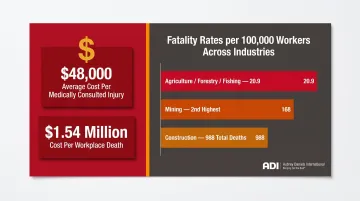
Source: NSC Injury Facts
But these benefits apply wherever workers face physical, chemical, ergonomic, or biological risks. Even office environments benefit from training on ergonomic hazards, emergency procedures, and workplace violence prevention.
Regulatory Compliance and Legal Protection
OSHA requires employers to provide training specific to identified hazards and to demonstrate training effectiveness. Non-compliance exposes organizations to inspections, fines, and legal liability.
Current OSHA penalty amounts (effective January 15, 2025):
| Violation Type | Maximum Penalty |
|---|---|
| Serious | $16,550 per violation |
| Willful or Repeated | $165,514 per violation |
| Failure to Abate | $16,550 per day beyond abatement date |
Source: OSHA Penalties
In FY 2024, OSHA conducted 34,625 inspections with only 1,850 inspectors covering 130 million workers at 8 million worksites. The agency prioritizes high-hazard industries and responds to complaints, fatalities, and referrals—meaning any organization can face scrutiny.
Employers who maintain documented, effective OHS training programs are better protected in the event of an incident or legal claim. Training records demonstrate due diligence and can significantly reduce liability exposure. A Cal/OSHA study found that inspections led to a 9.4% drop in injury claims and 26% average savings on workers' compensation costs in the four years following an inspection, with average per-firm savings of $355,000.
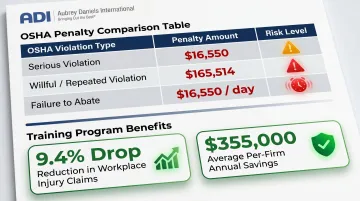
Industries subject to frequent OSHA inspections or those with high workers' compensation claim histories have the most immediate need for rigorous, documented training. The top three most frequently cited standards in FY 2024 were Fall Protection (1926.501), Hazard Communication (1910.1200), and Lockout/Tagout (1910.147)—all of which require specific training.
Productivity, Employee Morale, and Business Performance
A workforce that feels safe and well-informed performs better. OHS training signals organizational care for employees, which research links to higher engagement, lower turnover, and greater discretionary effort.
The financial case is well-documented:
- Over 60% of CFOs report every dollar invested in injury prevention returns $2 or more, with 40% citing productivity as the top benefit
- Anthony Forest Products invested ~$50,000 in safety improvements and training, yielding over $1 million in savings — roughly a 20:1 ROI
- A Goldman Sachs JBWere study found companies with poor safety management underperformed financially compared to high-safety peers
- Workplace safety ranks among the top criteria employees weigh when evaluating job offers, linking safety culture directly to talent attraction and retention
For organizations facing high turnover, declining morale, or productivity gaps, safety culture is a lever that moves multiple metrics at once. Stronger training reduces absenteeism, limits incident-related disruptions, and builds the employee commitment that shows up in output — not just in injury rates.
Why Most OHS Training Fails to Change Behavior
Most OHS training programs succeed at transferring knowledge—workers know the rules—but fail at changing behavior—workers don't consistently follow them. This gap is where preventable incidents still occur. Research shows that as little as 10% of what is learned during safety training is actually applied on the job. Most employees who experience a safety incident have received some prior training.
The root cause isn't a flawed curriculum. It's that training ignores the behavioral science of what actually sustains safe habits over time.
The ABC Model: Antecedents, Behavior, Consequences
Training typically focuses only on antecedents—information, instructions, warnings, and policies. These prompt behavior, but they don't sustain it. Behavior is primarily driven by consequences: what happens after a safe or unsafe behavior determines whether it recurs.
According to behavioral research, consequences are most powerful when they are immediate and certain. Unsafe behaviors are often reinforced because they offer immediate rewards—saving time, avoiding discomfort, finishing the job faster. Safe behaviors, by contrast, offer only delayed, uncertain rewards: avoiding an injury that might never happen anyway.
In one study, adding personal praise and recognition for proper boxcar preparation increased performance from 45% to 95%—demonstrating the power of positive, immediate consequences.
That finding points to a problem most organizations don't want to acknowledge: the consequences they rely on are the wrong kind entirely.
Why Punitive Approaches Backfire
When organizations rely on punitive consequences or focus solely on reducing injury numbers through negative pressure, employees may withhold reporting injuries to avoid punishment. This hides risk without fixing the underlying behavior. Fear-based approaches produce compliance only when being watched, not genuine behavioral change.
Workers can forget up to 70% of new information within 24 hours without reinforcement, based on the Ebbinghaus forgetting curve applied to workplace training. Without consistent reinforcement of safe behaviors, even well-designed training fades quickly.
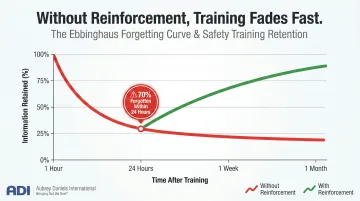
The Critical Role of Supervisors
The supervisor is the single most influential factor in daily safety behavior. Supervisors who understand behavioral principles reinforce safe practices consistently—while those who overlook shortcuts or at-risk behaviors can quietly undo even the best training.
Research in steel manufacturing found that safety leadership is a significant predictor of deep compliance—mindful adherence versus surface compliance—with a strong correlation (beta = 0.30, p < 0.001). Safety leadership was also negatively correlated with adverse safety outcomes (r = -0.12, p < 0.05), meaning stronger leadership equals fewer accidents.
This is precisely where most OHS programs leave a gap. ADI has spent over 45 years applying Applied Behavior Analysis to workplace safety, helping organizations move beyond antecedents alone. Their approach—co-developed with Judy Agnew (Senior Vice President and co-author of Safe by Accident)—builds consequence systems grounded in recognition, feedback, and coaching that sustain safe behavior long after the training room.
What Happens When OHS Training Is Missing or Ignored
Absent or inadequate OHS training produces direct and cascading consequences:
Direct consequences:
- Elevated incident and fatality rates
- Rising workers' compensation and insurance costs
- OSHA fines ranging from $16,550 per serious violation to $165,514 per willful violation
- Legal exposure in the event of worker injury or fatality
Organizational ripple effects:
- Reactive firefighting after incidents: investigations, shutdowns, emergency retraining
- Damaged employee morale and trust in leadership
- Difficulty attracting and retaining talent in safety-sensitive roles
- Increased scrutiny from regulators and insurers
Organizations that skip or under-invest in OHS training tend to have weaker safety cultures, which makes every other safety intervention harder to sustain. Gaps in training don't sit idle — they compound risk across every level of the operation.
Liberty Mutual data shows that while serious workplace accidents have decreased approximately 40% over 25 years, total workers' compensation costs have increased by 30% over the same period. Each incident that does occur is more expensive than ever — making prevention the only cost-effective strategy.
How to Get the Most Value from OHS Training
Effective OHS training works best when it is:
- Needs-based and role-specific — not one-size-fits-all
- Delivered in the language and literacy level of the workforce — ensuring comprehension
- Revisited regularly — especially when equipment, processes, or personnel change
Training effectiveness must be measured beyond completion rates. Organizations should assess whether worker behavior in the field actually changes post-training, using:
- Direct observation of work practices
- Near-miss reporting trends
- Incident data as indicators of real impact
A meta-analysis of 95 studies involving over 20,000 participants found that highly engaging training methods—behavioral modeling, hands-on practice, dialogue—are approximately 3 times more effective than passive methods like lectures and videos at knowledge acquisition and produce the greatest reductions in accidents, illnesses, and injuries.
Building Behavioral Reinforcement Systems
The highest-performing safety programs pair structured training with an ongoing system of behavioral reinforcement. Supervisors and managers must be equipped not just with safety knowledge but with the behavioral coaching skills to recognize, reinforce, and sustain safe practices daily.
Research identifies four supervisor behaviors essential for training transfer:
- Developing shared understanding of safety expectations
- Role modeling safe behaviors
- Facilitating team discussions about hazards and solutions
- Recognizing employees who apply training
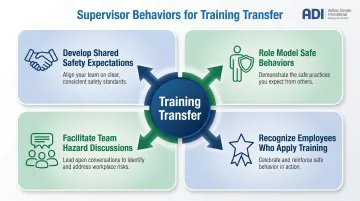
Getting these behaviors to stick requires more than awareness—it requires deliberate consequence systems. ADI's work in behavior-based performance improvement helps organizations design exactly that: structured frameworks of positive reinforcement, timely feedback, and recognition that keep trained behaviors in place long after the initial training ends. The goal is moving from compliance-driven training to a safety culture where safe behavior is the norm, not the exception.
Conclusion
OHS training's importance lies in its power to prevent harm, protect the business legally, and drive sustained performance—but only when it moves beyond information delivery to genuine behavior change. Training alone doesn't create safety. What does is a reinforcement system that makes safe behavior the path of least resistance—every shift, every day.
Organizations that treat OHS training as an ongoing practice—grounded in behavioral science, supported by trained supervisors, and measured by actual behavioral outcomes—are the ones that compound their safety gains over time and build cultures where safe behavior becomes the default, not the exception.
Frequently Asked Questions
What are the benefits of workplace safety training?
Workplace safety training prevents injuries and illnesses, ensures regulatory compliance, reduces workers' compensation and insurance costs, and strengthens organizational performance. Well-trained employees recognize hazards, work more confidently, and help build a culture of safety that protects both people and the bottom line.
Why is supervision important in health and safety?
Supervisors directly influence whether trained behaviors are consistently practiced. They reinforce safe behaviors through daily interactions, model safe practices themselves, and address at-risk behavior before it leads to incidents.
How often should occupational health and safety training be conducted?
Initial training is required for all new workers and whenever roles, equipment, or processes change. Annual refreshers are the baseline for most roles — more frequently for high-hazard work — and OSHA mandates annual refreshers for respiratory protection, bloodborne pathogens, and HAZWOPER training.
What topics should be covered in OHS training?
Core topics include hazard identification (physical, chemical, ergonomic, biological, electrical), emergency response procedures, personal protective equipment use, and reporting protocols. Training should also cover role-specific risks relevant to each employee's work environment and responsibilities.
How do you measure the effectiveness of OHS training?
Completion rates alone don't tell the full story. Meaningful measures include observed changes in worker behavior on the job, near-miss and incident trends, hazard reporting rates, and direct assessments of knowledge and skill application after training.
What happens if an employer fails to provide OHS training?
Employers face OSHA citation risk and financial penalties up to $16,550 per serious violation or $165,514 per willful violation. Failure to train also increases the likelihood of workplace injuries and associated costs, and creates potential legal liability if a worker is injured or killed.