Introduction
New hires face a startling reality: 36% of all workplace injury and illness cases involve employees with one year or less on the job, according to a 2024 OSHA report. In construction, the picture is even grimmer—47% of injuries occur in workers' first year, driving 51% of workers' compensation costs. These aren't just statistics. They represent preventable injuries, lost workdays, regulatory fines, and in the worst cases, avoidable fatalities.
The financial toll compounds the human one. The National Safety Council estimates work injuries cost the U.S. economy $181.4 billion annually, with each medically consulted injury averaging $48,000 and each workplace death reaching $1,540,000. Poor safety induction exposes workers to harm, erodes trust, and creates regulatory and financial liability that compounds over time.
This guide covers what safety induction training is, what to include in an effective program, best practices for delivery and verification, why behavior—not just information—drives lasting safety, and common mistakes to avoid.
Key Takeaways
- Safety induction is the first formal safety orientation delivered before workers begin tasks on site—not a one-time checkbox
- Effective programs cover hazards, PPE, emergency procedures, and incident reporting—tailored to workers, contractors, or visitors
- Verify comprehension through assessments and demonstrations, not just attendance records
- Behavior changes through reinforcement, not information delivery alone—ongoing follow-up is essential
- Induction sets the foundation; what supervisors reinforce after day one determines whether safe behavior actually sticks
What is Safety Induction Training?
Safety induction training is the first formal safety education workers receive before starting tasks on site. It covers workplace hazards, emergency procedures, safety protocols, and organizational policies — but the depth varies by who's walking through the door:
- New employees receive comprehensive orientation covering company safety culture, policies, and reporting structures
- Contractors get role-specific training on permit-to-work systems and site operating procedures
- Visitors receive essentials: PPE requirements, restricted areas, and emergency exits
Induction vs. Ongoing Training
Safety induction is the foundational baseline delivered once at the point of entry. It establishes minimum competency before exposure to workplace hazards. Ongoing safety training—toolbox talks, refresher courses, and job-specific skill development—reinforces and builds on this foundation over time. Induction sets the floor; ongoing training raises it.
Regulatory Context
Safety induction is not optional in most jurisdictions. Key regulatory requirements include:
| Framework | Requirement |
|---|---|
| OSHA 29 CFR 1926.21 | Employers must instruct each employee in hazard recognition and avoidance before exposure |
| ISO 45001 (Clauses 7.2–7.3) | Mandates demonstrated competence and worker awareness of safety policies, objectives, and consequences of noncompliance |
| Safe Work Australia | Requires induction before work begins, with documented understanding verified through signed checklists |
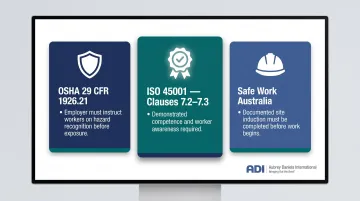
These frameworks set the compliance floor. Checking the box doesn't produce behavioral change — it just confirms the training happened.
What to Include in a Safety Induction Program
Company Safety Policy and Culture
Induction should open with the organization's safety vision, values, and management commitment. When leaders articulate why safety matters — and visibly demonstrate that commitment — workers arrive at every rule and procedure already understanding the intent behind it.
Hazard Identification and Site-Specific Risks
Cover the full range of workplace hazards relevant to the specific site or role:
- Physical hazards: Machinery, working at heights, confined spaces, moving vehicles, noise, vibration
- Chemical hazards: Hazardous substances, flammable materials, toxic gases, corrosive agents
- Ergonomic risks: Manual handling, repetitive strain, awkward postures
- Biological risks: Exposure to blood-borne pathogens, infectious materials, mold
- Environmental risks: Extreme temperatures, weather exposure, poor lighting
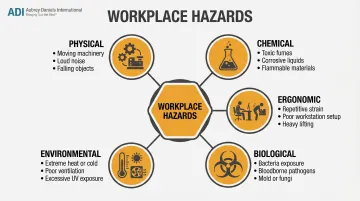
Generic hazard lists are insufficient. Workers need to know the specific dangers they will actually encounter in their work area, on their shift, using their equipment.
Emergency Procedures and Response
Detail what workers must know for emergencies:
- Evacuation routes and assembly points
- Fire procedures and location of fire extinguishers, alarms, and exits
- Chemical spill response protocols
- Medical emergency procedures and first aid kit locations
- Key contact numbers: local emergency services, first aiders, fire wardens, safety officers
Workers should receive a physical site walkthrough, not just a slide deck. Walking an evacuation route creates spatial memory that no presentation can replicate.
PPE, Safety Rules, and Incident Reporting
Cover three interconnected elements:
Personal Protective Equipment (PPE):
- What PPE is required by role (hard hats, safety glasses, gloves, respirators, high-visibility clothing)
- Where to obtain it and how to request replacements
- Correct usage, fit testing, and maintenance
Site-Specific Rules:
- Restricted zones and permit-to-work systems
- Access control and visitor protocols
- Mobile phone and distraction policies
- Behavior expectations (no running, maintaining clean walkways, reporting spills immediately)
Incident Reporting:
- How to report hazards, near-misses, and incidents
- Who to report to and what information is required
- Why a no-blame reporting culture makes this more effective
Research shows that near-miss reporting provides awareness of potential injury causes and prompts safety management initiatives. Workers are more likely to report when processes are simple and when they receive feedback on previous reports — organizational barriers like fear of blame suppress reporting rates.
Roles and Responsibilities
Workers should leave induction knowing exactly who is responsible for what. Putting names and faces to roles builds accountability — and makes safety feel human rather than bureaucratic.
Introduce key contacts by name and role:
- Safety officer or EHS manager — the go-to for hazard concerns and policy questions
- First aiders — who they are, where they're located, and when to call them
- Fire wardens — responsible for evacuation and headcounts
- Supervisors — the first point of contact for incidents, near-misses, and procedural questions
Workers who know exactly who to approach — and why — are far more likely to act when something goes wrong.
Best Practices for Delivering Safety Induction Training
Tailor Content to Audience Type
Visitors need the basics: PPE requirements, emergency exits, assembly points, and site rules. They typically spend limited time on site and face lower hazard exposure.
Contractors need detailed, role-specific content: permit-to-work systems, safe operating procedures for their equipment, site-specific hazards in their work area, and incident reporting processes. They often work in high-risk environments and need depth, not just breadth.
Employees need the full picture: organizational safety policy, culture expectations, long-term safety objectives, and integration into the safety management system. New hires are forming habits that last years — generic content leaves them less prepared than they appear.
Use Blended Delivery Methods
No single format covers everything. A blended approach draws on the strengths of each delivery method:
- Site walkthroughs: Workers physically locate emergency exits, hazard zones, and first aid kits
- Digital modules: Deliver consistent content across large or multi-site teams; workers can revisit material anytime
- Videos and simulations: Reinforce key procedures in a low-stakes environment
- Quizzes and scenario exercises: Test comprehension and surface gaps before workers hit the floor
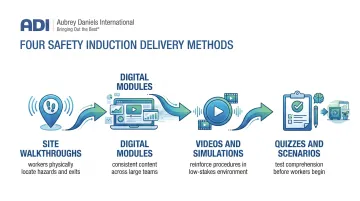
A 2022 CPWR study comparing face-to-face and distance learning for OSHA training found that face-to-face delivery produced higher test scores: 95.3% vs. 88.6% for OSHA 500 courses. Distance learning is a viable and scalable alternative, but blended approaches combining both formats offer the strongest outcomes. Strategic scheduling—longer sessions with extended breaks spread across multiple days—improved knowledge retention.
Verify Comprehension Through Competency Checks
Measure understanding, not just attendance. There is a critical difference between tracking who completed the induction and assessing what was retained and can be applied.
Include:
- Short written or oral assessments covering key hazards, emergency procedures, and reporting protocols
- Practical demonstrations such as PPE donning and doffing, use of safety equipment, and emergency response drills
- Q&A sessions where workers can ask clarifying questions
Issue certificates only when comprehension is confirmed. Certificates based solely on attendance create false confidence and legal exposure.
Maintain Complete Documentation
That legal exposure doesn't end at the induction room door. Regulatory compliance and incident investigation both require documented proof of training. Maintain:
- Signed completion checklists with worker and supervisor signatures
- Assessment scores and pass/fail records
- Certificates with issue and expiry dates
- Training logs showing date, duration, content covered, and trainer name
OSHA and ISO 45001 both require organizations to retain documented evidence of competence. When an incident occurs or an audit arrives, your documentation is what demonstrates that workers were properly trained and that the organization met its duty of care.
Define and Schedule Refresher Triggers
Re-induction is required when:
- Role changes or transfers to a new site occur
- Workers return from extended leave (maternity, paternity, medical)
- New equipment or processes are introduced
- A significant incident occurs
Build these triggers into your safety management system so they are never missed. The Canadian Centre for Occupational Health and Safety (CCOHS) identifies young workers (under 25), internal transfers, and workers affected by process changes as groups requiring re-orientation, emphasizing that "not all training can or should be done on the first day."
Why Behavior—Not Just Information—Drives Lasting Safety
The Information-Behavior Gap
Most safety induction programs assume that providing information changes behavior. Behavioral science research shows this is rarely true on its own. Workers may understand a rule perfectly and still skip it under time pressure, peer influence, or when shortcuts go unpunished.
A 2014 study of 2,106 workers in the petroleum sector found that safety knowledge alone does not ensure compliance. Deliberate non-compliance stems from individual risk-taking attitudes, poor hazard appraisal, and perceived irrelevance of rules to real-world conditions. Notably, knowledge exchange among immediate colleagues predicted compliance better than formal training systems.
Induction training is the antecedent—the prompt before behavior. But it is consequences that determine whether safe behaviors continue.
The ABC Model in Practice
The ABC (Antecedent-Behavior-Consequence) model explains how behavior works:
- Antecedent: Training, signage, instructions, induction programs
- Behavior: Safe or unsafe action taken by the worker
- Consequence: What happens after—recognition, correction, nothing, or injury
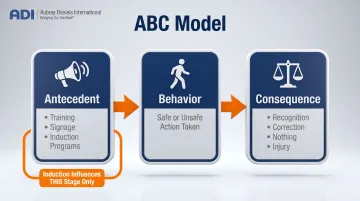
Induction training can only influence antecedents. To sustain safe behavior, organizations must also manage consequences, particularly positive reinforcement of safe practices observed after induction.
Positive Reinforcement Sustains Behavior
Positive reinforcement means catching workers following the safety procedures introduced during induction and acknowledging it specifically and immediately. This could be a supervisor saying, "I noticed you used the three-point contact rule on that ladder—exactly what we covered in your induction. That's the standard we need."
Contrast this with organizations that only respond to unsafe behavior through correction or discipline while ignoring safe behavior. This misses the most powerful lever for sustaining what induction establishes.
Peer-reviewed research across 88 international sites and 1.3 million observations shows that behavior-based safety programs reduce injuries by 25% in Year 1, 34% in Year 2, and 42% in Year 3. Sites where observers performed seven or more voluntary, positively reinforced safety observations per month saw the greatest injury reductions. Mandatory observation processes became "paperwork exercises with little real value."
Why Knowledge Fades Without Reinforcement
Judy Agnew, Senior Vice President at ADI and co-author of Safe by Accident?, argues that induction training is the starting point of safety engagement—not the endpoint. Organizations must move beyond compliance-based safety toward cultures where behavior is actively shaped after day one.
The data supports this urgency. Behavioral science research shows approximately 50% of new information is forgotten within 24 hours and up to 90% within a week without reinforcement. Induction must be followed by ongoing coaching, observation, and positive reinforcement to convert knowledge into ingrained safe habits.
Common Mistakes to Avoid in Safety Induction Training
Using Generic, Non-Tailored Content
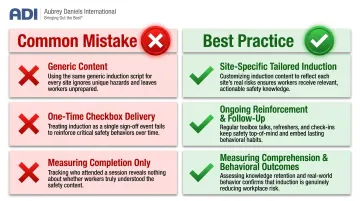
A one-size-fits-all induction that doesn't reflect the specific hazards, procedures, and culture of the actual workplace leaves workers less prepared than they appear. Each induction should be reviewed and updated whenever site conditions, equipment, or processes change significantly. Generic content satisfies a paperwork requirement — it does not build the situational awareness workers need to stay safe.
Treating Induction as a One-Time Compliance Checkbox
Workers receive thorough induction on Day 1 and then receive no reinforcement of those behaviors, no follow-up, and no refresher until an incident occurs. Induction effectiveness degrades rapidly without sustained support from supervisors and the broader safety culture.
Organizations that mandate participation without positive reinforcement see diminished safety outcomes compared to those fostering voluntary engagement and ongoing recognition. Supervisors who coach safe behaviors daily — and recognize them when they occur — do more for safety culture than any single training event.
Measuring Completion Instead of Comprehension and Behavior
That gap between one-time delivery and ongoing reinforcement shows up clearly in how organizations measure success. Those that track only "induction completed" — without assessing knowledge retention or observing safe behaviors in the weeks after — have no real indication of whether the training worked. ISO 45001 Clause 9.1 explicitly requires organizations to use training sessions as a "leading indicator" to evaluate health and safety system performance — measuring not just completion but effectiveness.
Behavioral outcomes — are workers wearing PPE correctly, following lockout/tagout procedures, reporting near-misses — are the true measure of induction success, not attendance sheets.
Frequently Asked Questions
Am I paid during occupational health and safety induction training?
In most jurisdictions, time spent in mandatory safety induction training is considered work time and is therefore compensable. Per DOL Fact Sheet #22, training is non-compensable only if all four criteria are met: outside normal hours, voluntary, not job-related, and no concurrent work. Mandatory safety induction fails all four. Entitlements may vary by country and employment type—check with your local authority or legal counsel.
What are the stages of occupational health and safety induction?
Typical induction follows this sequence: (1) general company orientation and safety policy overview, (2) site-specific hazard and emergency procedure briefing, (3) role-specific safety training and PPE instruction, and (4) competency verification via assessment and sign-off. Not all stages must occur on Day 1—CCOHS recommends spacing content to match workplace needs and learning capacity.
Can I take occupational health and safety induction training online?
Online induction delivery is widely accepted and increasingly preferred for consistency and scalability. However, certain components—such as physical site walkthroughs and hands-on PPE demonstrations—are best completed in person. A blended approach combining online modules for foundational knowledge and in-person sessions for practical application is the most effective option.
What are the 5 C's of occupational health and safety?
The 5 C's framework covers five core elements:
- Communication — establishes the foundation for ongoing safety dialogue
- Compliance — ensures adherence to regulations and company policies
- Co-operation — engages all employees in safety programs
- Culture — builds a positive environment focused on hazard reduction and reporting
- Continuous Improvement — drives progress through audits, corrective action, and near-miss programs
How long should safety induction training last?
Duration depends on industry risk level and role complexity. A basic visitor induction may take 15–30 minutes; a full employee or contractor induction in a high-risk environment may span several hours or multiple days. What matters most is that all required content is covered and comprehension verified—CCOHS notes that spaced sessions with breaks produce the best retention outcomes.
When should safety induction training be repeated?
Re-induction is required when: role or work location changes, new equipment or processes are introduced, workers return from extended absence (maternity, paternity, medical leave), following a significant incident, or when a set period has elapsed without a refresher. Build these triggers into your safety management system to ensure they are never missed.