Introduction
Workplace injuries cost U.S. employers $181.4 billion annually, with wage and productivity losses alone accounting for $54.9 billion of that total. For most safety leaders, the harder frustration is this: most organizations already have comprehensive safety rules in place. The real problem is the persistent gap between what employees are supposed to do and what they actually do when no one is watching.
Safety incentive programs can bridge that gap — but only when designed correctly. The difference between a program that drives real behavioral change and one that simply masks injuries through underreporting comes down to one thing: what behaviors you're reinforcing, and whether your reward structure actually encourages them.
Key Takeaways
- Safety incentive programs reward employees for safe behaviors or safety milestones, which reduces injuries and strengthens safety culture when designed correctly
- The most effective programs reward observable behaviors (not just injury-free outcomes), making reinforcement immediate and consistent
- Program types range from behavior-based rewards and peer recognition to team challenges and safety suggestion systems — each with different reinforcement strengths
- Poorly designed programs that only reward zero-incident outcomes can push employees to underreport injuries rather than prevent them
- Success requires clear behavioral targets, frequent feedback, rewards employees actually want, and supervisors who reinforce safe behavior consistently
What Is a Safety Incentive Program and Why Does It Matter?
A safety incentive program is a structured initiative that encourages and rewards employees for engaging in safe behaviors or achieving safety-related goals. Rewards can range from recognition and bonuses to gift cards, time off, or non-monetary incentives like team lunches or public acknowledgment.
The business case is compelling: fewer incidents mean lower workers' compensation costs, less downtime, higher productivity, and stronger regulatory standing. OSHA estimates a return of $4 to $6 for every $1 invested in workplace safety and health programs, with a 20% or greater reduction in injury and illness rates. Those numbers reflect real financial performance, not just regulatory compliance.
Not all program designs are equally effective. OSHA clarified its position in an October 11, 2018 memorandum, affirming that safety incentive programs — both behavior-based and rate-based — are permissible under 29 CFR 1904.35(b)(1)(iv), provided they don't discourage incident reporting.
The design distinction matters: programs that reward only outcomes (like 90 consecutive days without accidents) can unintentionally suppress near-miss reporting. Programs tied to observable behaviors address the root drivers of safety performance instead.
OSHA's guidance makes this distinction explicit:
- Near-miss reporting and hazard identification programs — always permissible
- Outcome-based programs — permissible, but require additional safeguards to ensure employees feel free to report injuries without fear of losing a reward
Best Safety Incentive Program Ideas & Examples
The right mix of incentive programs depends on your workforce size, industry risk profile, and organizational culture. Here are the most proven formats:
Behavior-Based Safety (BBS) Rewards
BBS reward programs identify specific, observable safe behaviors—such as proper PPE use, pre-task hazard checks, or lockout/tagout (LOTO) compliance—and reinforce employees who consistently demonstrate them. Supervisors or safety observers use checklists to track behavior, and rewards are tied to consistent performance, not just outcomes.
This format is considered the gold standard because it reinforces actions that prevent accidents before they happen—rather than rewarding the absence of a recordable event. ADI's Judy Agnew, co-author of Safe by Accident, has written on why behavior-focused reinforcement outperforms outcome-based approaches: behaviors are what organizations can actually manage, while outcomes are partly a function of luck.
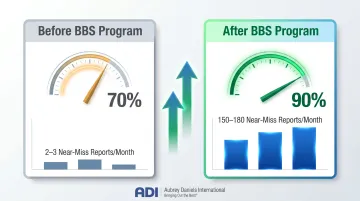
In practice, BBS programs work by pinpointing 3-5 critical safe behaviors for high-risk roles, then systematically recognizing employees who perform them. One documented case saw safe behaviors improve from 70% to 90% within two months, with near-miss reporting increasing 50-90 fold—from 2-3 reports per month to 150-180—demonstrating that behavioral reinforcement also drives proactive hazard identification.
Peer-to-Peer Recognition Programs
These programs empower employees to nominate colleagues for demonstrating safe behaviors—such as reporting a hazard, assisting a coworker with proper technique, or consistently wearing PPE. Recognition can include monthly awards, small prizes, or public acknowledgment in team meetings or on safety boards.
Peer recognition creates social reinforcement that's often more powerful than top-down awards—it signals that safety is a shared value among coworkers, not just a management mandate. When employees see peers acknowledged for safe actions, those behaviors get normalized across the team. Safety participation stops feeling like a compliance requirement and starts feeling like part of how the group operates.
Safety Milestone Programs
Milestone programs reward teams or individuals when they reach defined safety benchmarks—such as 30, 90, or 180 consecutive days without a lost-time incident. Typical rewards include:
- Team lunches or catered events
- Gift cards or bonuses
- Extra time off or flexible scheduling
- Recognition plaques or certificates
Important caveat: Milestone programs work best when combined with behavior-based tracking to ensure the milestone reflects genuine safety improvement, not underreporting. Standalone outcome milestones carry OSHA compliance risk, as they can create incentives to hide injuries rather than prevent them.
Safety Suggestion Programs
These programs invite employees to submit actionable safety improvement ideas, with rewards for suggestions that are implemented. This can include hazard identification, process improvements, or near-miss reports. Rewards are modest—$25-$100 gift cards, recognition in company communications, or points in a broader incentive system.
The dual benefit: frontline employees often spot hazards that managers miss, so suggestion programs tap into ground-level knowledge while reinforcing a culture where safety participation is recognized and rewarded.
Team-Based Safety Incentives
Team-based programs reward entire departments or crews for collectively meeting safety goals—such as completing all safety training modules, passing inspections, or achieving a period of incident-free operations. Rewards are shared equally among the team, creating collective accountability.
Shared accountability encourages teammates to coach each other on safe practices, distributing safety culture horizontally across the workforce rather than relying solely on top-down enforcement. That peer dynamic is a natural extension of how high-performing teams already operate.
Gamified Safety Challenges
Gamification approaches use points systems where employees earn credits for safety activities—attending toolbox talks, completing observations, reporting near-misses—with leaderboards, prizes, or recognition for top performers. Employees can track their progress, compete for monthly rankings, or earn badges for specific achievements.
Gamification increases participation rates—particularly among younger or hourly workforces—by giving employees a concrete way to see and act on their safety engagement. Research from TalentLMS found that 83% of employees who received gamified training felt motivated, compared to only 28% with non-gamified training. While this data comes from a learning management system vendor survey rather than an independent research firm, it reflects a consistent theme: gamification elements can substantially improve training engagement and participation.
Behavior-Based vs. Outcome-Based Safety Incentives: Why the Distinction Matters
The core difference between these two approaches is simple: outcome-based incentives reward the absence of accidents (a lagging indicator), while behavior-based incentives reward the presence of safe practices (a leading indicator). Outcomes are partly a function of luck. Behaviors are what organizations can actually manage and reinforce — and that difference has real consequences for program design.
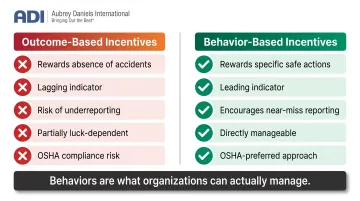
The Underreporting Risk in Outcome-Based Programs
When employees or supervisors have a financial stake in maintaining a zero-incident record, there is a natural incentive to downplay or not report near-misses and minor injuries. This is precisely the concern OSHA flagged in its 2018 guidance, and it masks real risk exposure rather than reducing it.
A 2012 GAO report noted that "experts and industry officials suggest that rate-based programs may discourage reporting of injuries and illnesses." While some studies found no relationship between incentive programs and reporting behavior, the risk remains significant enough that OSHA's own Voluntary Protection Program (VPP) prohibits participants from using rate-based incentive programs.
That risk compounds when the consequence for reporting is a lost opportunity to receive a substantial reward. As OSHA's 2018 memo acknowledges, a non-retaliation statement alone "may not, by itself, be adequate to ensure that employees actually feel free to report."
The Behavioral Science Principle Behind Effective Reinforcement
For a reward to change behavior, it needs to be:
- Contingent on the specific behavior — not tied to vague outcomes
- Timely — delivered close to when the behavior occurs, not weeks later
- Meaningful to the individual receiving it, not just convenient for the program
ADI's approach to Performance Management applies these principles to safety programs, drawing on over 45 years of Applied Behavior Analysis research. When reinforcement meets all three conditions, it shapes behavior reliably. Miss any one of them, and the impact drops — sometimes to zero.
The Hybrid Approach
These behavioral principles help explain why the most effective safety incentive programs don't rely on a single approach. They combine behavior-based reinforcement for day-to-day safe practices with milestone recognition for longer-term outcomes — delivering both immediate behavior change and sustained cultural improvement.
A 2014 study by Yeow and Goomas demonstrated that a combined outcome-and-behavior-based safety incentive program at a fluid manufacturing plant achieved a 75% reduction in accidents. The hybrid model overcame the limitations of each individual approach: behavior-based tracking prevented underreporting, while outcome-based milestones provided long-term motivation.
How to Design a Safety Incentive Program That Actually Works
Step 1: Start with a Safety Needs Assessment
Before selecting a program type, analyze your injury data, near-miss reports, and audit findings to identify which unsafe behaviors or gaps are driving your highest risks. Programs should target the behaviors most linked to actual injury exposure, not generic "safety awareness."
Ask:
- What are our top three injury types by frequency and severity?
- Which unsafe behaviors most commonly precede these injuries?
- Where do our audit findings consistently flag non-compliance?
Step 2: Define Specific, Observable Behavioral Targets
Vague goals like "be safe" don't drive behavior change. Identify 3-5 critical safe behaviors for each high-risk role or task, and write them in observable, measurable terms.
Examples:
- ❌ "Be careful with equipment"
- ✅ "Conducts a pre-lift check before operating the forklift"
- ❌ "Always wear PPE"
- ✅ "Wears safety glasses, gloves, and hard hat when entering the production floor"
Observable behaviors enable consistent recognition and measurement, which are essential for effective reinforcement.
Step 3: Choose Incentives That Are Meaningful to Your Workforce
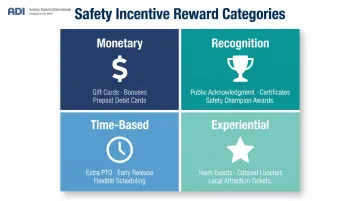
What motivates one workforce segment may not motivate another—hourly manufacturing workers may value different rewards than office staff. Involve employees in incentive selection, and offer variety to serve diverse preferences:
- Monetary: Gift cards, bonuses, prepaid debit cards
- Recognition: Public acknowledgment, certificates, safety champion awards
- Time-based: Extra PTO, early release days, flexible scheduling
- Experiential: Team events, catered lunches, tickets to local attractions
Step 4: Build in Consistent Feedback and Recognition Cadence
Infrequent or delayed recognition has minimal behavioral impact. Programs should include:
- Immediate, on-the-spot recognition: Supervisor acknowledgment when safe behavior is observed
- Structured periodic recognition: Monthly awards, quarterly milestones, annual safety champions
Behavioral research distinguishes between two reinforcement approaches: performance-contingent schedules (tied directly to specific behaviors) and time-contingent schedules (given periodically regardless of actions). Performance-contingent reinforcement consistently produces higher, more sustained behavior change — which is why tying recognition to specific, observed actions matters more than calendar-based reward cycles.
Step 5: Train Supervisors to Be Reinforcement Agents
The program's success depends on front-line supervisors knowing how to observe, acknowledge, and reinforce safe behaviors in real time — not just administer a reward system on paper. That means coaching skills: how to deliver specific positive feedback when safe behavior occurs, and how to redirect constructively when it doesn't.
This is where many programs stall. ADI's supervisor coaching programs teach managers to apply reinforcement science in day-to-day interactions — turning routine walkthroughs into behavior-change opportunities rather than compliance checkboxes.
Common Mistakes That Undermine Safety Incentive Programs
Rewarding Only Outcomes, Not Behaviors
Programs tied solely to zero-incident records create incentives to hide incidents rather than prevent them. The fix: add behavioral tracking and near-miss reporting rewards alongside outcome milestones. According to OSHA's 2018 guidance, counterbalancing rate-based programs with incentives for identifying unsafe conditions is a recommended safeguard.
Using a One-Size-Fits-All Approach
Programs deployed uniformly across vastly different roles, risk levels, or locations fail to resonate because the targeted behaviors and meaningful rewards differ significantly. Customize programs by role or site—what works for warehouse staff may not work for office employees.
Failing to Sustain the Program After Launch
Many safety incentive programs start strong but fade due to inconsistent follow-through, supervisor disengagement, or reward fatigue. Program sustainability requires:
- Regular reviews and updates to behavioral targets
- Refreshed reward offerings to maintain interest
- Ongoing leadership commitment and visible participation
- Measurement of both leading indicators (behavior compliance) and lagging indicators (incident rates)
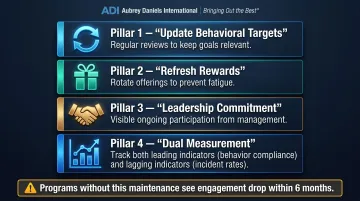
Programs that skip this ongoing maintenance typically see engagement drop within six months of launch.
Frequently Asked Questions
What is a safety incentive program for employees?
A safety incentive program is a structured initiative that rewards employees for demonstrating safe behaviors or achieving safety-related goals, using tools such as recognition, bonuses, or non-monetary rewards to reinforce a proactive safety culture. Programs can be behavior-based, outcome-based, or a combination of both.
What are examples of behavior-based safety incentive programs?
Common examples include:
- Supervisor-led observation programs that recognize employees for specific safe actions, such as PPE compliance or hazard reporting
- Peer-to-peer safety recognition programs
- Point-based systems where employees earn rewards for completing safety checklists, attending toolbox talks, or submitting near-miss reports
Do safety incentive programs actually work?
Yes—research supports their effectiveness when designed around behavioral reinforcement rather than outcome-only metrics. A meta-analysis by Tuncel et al. (2006) found that 8 of 13 behavior-based safety intervention studies achieved statistically significant reductions in workplace injuries and accidents.
What is the difference between behavior-based and outcome-based safety incentives?
Outcome-based programs reward the absence of accidents (a lagging indicator), while behavior-based programs reward specific safe actions (leading indicators). Behavior-based approaches are generally considered more effective and OSHA-compliant because they reinforce proactive safety rather than discouraging incident reporting.
Are safety incentive programs OSHA-compliant?
Yes—OSHA's October 11, 2018 guidance affirms that safety incentive programs are permissible under 29 CFR 1904.35(b)(1)(iv), provided they do not discourage incident reporting. Programs rewarding near-miss reporting or unsafe condition identification are "always permissible." Rate-based programs require additional safeguards so employees feel free to report injuries.
How do you measure the effectiveness of a safety incentive program?
Track both leading indicators — behavioral compliance rates, near-miss reporting frequency, training completion — and lagging indicators such as incident rates, lost-time injuries, and workers' compensation costs. Review program data regularly and adjust targets to keep driving genuine behavioral change, not just administrative compliance.