Introduction
Construction recorded 1,034 fatalities in 2024 — the highest count of any private industry sector in the U.S. Yet this persistent death toll exists despite widespread adoption of safety programs, personal protective equipment (PPE) policies, and OSHA compliance training. The gap is stark: 40% of construction employers lack a proactive approach to safety, and 48% are not confident their training prepares workers to perform safely, according to a 2025 survey of 719 construction professionals.
The disconnect reveals a fundamental truth: having a written safety program is not the same as having a safety culture. Most organizations comply with regulations when observed. But safety culture is defined by what workers do when no one is watching — shaped by shared values, peer expectations, and what gets consistently reinforced on site.
Changing construction safety culture is uniquely difficult. Transient workforces, multiple subcontractor tiers, compressed schedules, and constant project turnover reset crew dynamics every few weeks. Meanwhile, a long-standing "accidents are part of the job" mindset normalizes risk. Success requires more than new policies; it demands changing how people actually behave every day, and what reinforces those behaviors.
This article explains why culture change in construction is harder than it looks, the behavioral prerequisites that must exist first, the key steps required, and the common pitfalls that cause well-intentioned safety efforts to stall.
TL;DR
- Changing safety culture means changing daily behavior on site — not just updating the safety manual or launching new training
- Safety culture lives in what workers do when no one is watching, driven by what gets consistently reinforced
- Reinforcing specific safe behaviors produces durable culture change — punishing unsafe acts alone only drives compliance
- Visible, consistent safe behavior from leaders has to come first — crews won't change what leadership doesn't model
- Track leading indicators (near-miss reports, safety observation scores), not just lagging injury rates
Why Changing Construction Safety Culture Is Harder Than It Looks
Most organizations miss a critical distinction: safety compliance is doing what is required when observed or when consequences are immediate; safety culture is how workers actually behave when no one is watching, driven by shared values and peer expectations. Industry research defines culture simply as "how we really do work around here."
Construction makes culture change particularly difficult. Several structural realities create friction that other industries simply don't face:
- Transient workforces and multiple subcontractor tiers mean crews change constantly
- Compressed schedules and project turnover reset team dynamics every few weeks
- A long-standing "accidents are part of the job" mindset normalizes risk across generations of workers
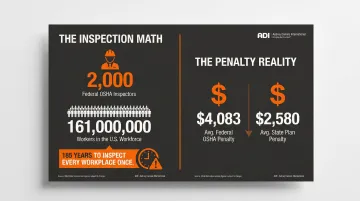
Compliance-focused safety programs hit a ceiling because when safety is enforced primarily through punishment or the threat of OSHA citations, workers learn to comply just enough to avoid consequences. This is negative reinforcement — it produces minimum behavior, not discretionary safe behavior. Consider the enforcement gap: fewer than 2,000 federal and state OSHA inspectors cover 161 million workers. At current staffing levels, it would take 185 years to inspect every U.S. workplace just once. Average penalties for serious violations? Just $4,083 federally, $2,580 in state plans. Employers cannot rely on enforcement alone — the math simply doesn't work.
The framework that drives actual culture change centers on antecedents, behaviors, and consequences. Antecedents — signs, rules, training — set the stage for behavior. Consequences — specifically positive reinforcement — are what sustain it. This is the behavioral science approach ADI applies in construction safety work, detailed in Safe by Accident? by Judy Agnew and Aubrey Daniels.
Behavior change precedes culture change — not the other way around. Organizations cannot mandate mindset shifts. By consistently reinforcing specific safe behaviors, attitudes and values follow over time. The steps below show what that reinforcement looks like in practice.
Key Steps to Change Construction Safety Culture
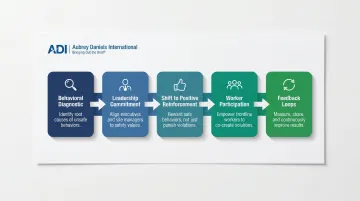
Step 1: Conduct a Behavioral Safety Culture Diagnostic
A behavioral diagnostic assesses actual on-site behaviors — not just written policies. It examines:
- How supervisors respond when workers raise safety concerns
- Whether safe behavior is observed and reinforced, or ignored
- What currently reinforces unsafe shortcuts: speed, peer pressure, schedule pressure
- Who models safe behaviors consistently, and who doesn't
What must be established before moving forward:
- Clear definitions of the specific observable behaviors that constitute "safe" on each site type
- Identification of who currently models those behaviors
- Understanding of the reinforcement landscape: what happens to workers who act safely vs. those who don't
The diagnostic reveals whether the current system rewards speed over safety, whether supervisors respond to concerns with genuine interest or dismissiveness, and whether workers believe reporting hazards will lead to action or retaliation.
Step 2: Establish Visible, Consistent Leadership Commitment
Leadership commitment must be behavioral — not just verbal. Workers watch whether leaders consistently wear PPE, stop unsafe work without hesitation, and ask about safety before productivity during site visits. One exception to these behaviors sends a louder message than ten safety posters.
Consistency means:
- The frequency and reliability of leadership safety behaviors determines whether workers interpret safety as genuinely non-negotiable or as situational
- Leaders must model target behaviors under both favorable and pressured conditions
- Leadership walkthroughs should be designed specifically to model and reinforce the target behaviors, not just to audit compliance
When leaders shortcut safety under schedule pressure, they teach workers that safety standards are negotiable. Consistency teaches it's a non-negotiable value.
Step 3: Shift the Reinforcement System from Punitive to Positive
Positive reinforcement of specific safe behaviors is the behavioral lever most construction organizations underuse. It creates discretionary effort and internalized motivation — results that punishment-dominant systems cannot achieve, because compliance disappears the moment supervision does.
Practical reinforcement methods:
- Acknowledge crews who raise near-misses in toolbox talks
- Provide specific behavioral feedback: not "good job staying safe today," but naming the exact behavior — "You stopped work when you noticed the trench wall wasn't shored properly. That's exactly what we need."
- Connect safe behavior observations to meaningful recognition systems
Generic safety awards programs frequently fail because they reward outcomes — injury-free days — rather than the behaviors that prevent injuries. This suppresses reporting and creates perverse incentives. Effective reinforcement is specific, timely, and behavior-focused.
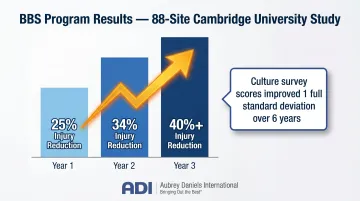
A Cambridge University study using behavior-based safety (BBS) data from 88 international client sites found injury reductions of approximately 25% in Year 1, 34% in Year 2, and 40%+ in Year 3. Culture survey scores improved by a full standard deviation over six years. The key finding: positive reinforcement systems produce sustained, compounding returns that compliance-only approaches cannot match.
Step 4: Involve Workers as Active Participants in Safety
Those compounding returns from reinforcement extend further when workers are active participants — not just recipients of top-down directives. Workers closest to the hazards hold the most operationally relevant knowledge, yet organizations rarely consult them in safety planning, rule development, or hazard identification. Active participation increases ownership of safety outcomes.
Before participation can happen, one condition must exist: workers need to report concerns and near-misses without fear of blame or retaliation. Research on offshore workers found that those with low leadership support were 11.19 times more likely to remain silent about safety concerns. Leadership behavior either establishes or destroys this condition.
Three questions reveal whether psychological safety actually exists on your sites:
- Do workers report near-misses freely, or only after incidents occur?
- Are concerns met with genuine interest and follow-up action, or defensiveness?
- Do workers fear getting themselves or coworkers in trouble for reporting?
Step 5: Build Feedback Loops That Sustain Behavior Over Time
Safety stand-downs, training kickoffs, and safety weeks don't produce lasting cultural change on their own. Without continuous feedback loops, behavior reverts. Sustained change requires structured observation, near-miss debrief discussions, and real-time behavioral data built into daily operations.
How to design practical feedback loops:
- Safety observation programs focused on catching workers doing the right thing, not only catching violations
- Near-miss reporting systems that reward reporting rather than penalize it
- Regular data reviews where leading behavioral indicators are discussed at the team level — not just reviewed by management
These loops create continuous reinforcement cycles that keep safe behaviors visible and valued.
What You Need Before Starting a Safety Culture Change Effort
Leadership Alignment: The Non-Negotiable First Prerequisite
Culture change cannot succeed if senior leadership is not willing to:
- Change their own behavior first
- Hold themselves to the same standards as front-line workers
- Sustain effort beyond the initial announcement
Honest self-assessment of leadership readiness is required before investing in any culture change program. If leaders are unwilling to visibly model safe behavior under production pressure, the effort will fail.
A Behavioral Baseline, Not Just an Incident Record
Before launching interventions, organizations need data on current safety behaviors — not just lagging OSHA recordable rates. A behavioral baseline assessment should capture:
- Observation data on current safe vs. at-risk behaviors
- Near-miss reporting frequency
- How hazard reports are currently responded to
- The ratio of positive to corrective safety feedback workers receive
Lagging indicators only tell you that something went wrong; they cannot predict what is about to go wrong or confirm that culture is genuinely shifting.
Realistic Time and Resource Commitment
That behavioral shift takes time to build on. Safety culture change plays out over years, not quarters — and the data backs this up. Organizations setting aggressive EHS targets using leading indicators achieved an average 77% reduction in incidence rates within 3-12 years. The BBS study cited earlier documented culture scores improving over six years, with compounding injury reductions each year.
Sustaining that effort requires ongoing investment across four areas:
- Observation programs with trained observers
- Coaching for supervisors on delivering behavioral feedback
- Reinforcement system design and ongoing adjustments
- Leadership time for modeling and site engagement
Key Variables That Determine Whether Safety Culture Change Sticks
Reinforcement Consistency Across All Levels and Sites
Whether safe behaviors are positively reinforced reliably — by all supervisors, on all projects, under both favorable and pressured conditions — determines whether culture holds or reverts.
Workers adjust their behavior based on what is actually reinforced, not what is officially stated. Inconsistent reinforcement creates variable behavior — safe when supervised, unsafe when not.
Inconsistency teaches workers that safety standards are negotiable. Consistency teaches them it is a non-negotiable value. Inconsistency is the primary reason culture change collapses under schedule pressure — supervisors must reinforce safe behaviors even when behind schedule, short-staffed, or pushed to prioritize production.
Supervisor Behavior as the Primary Culture Transmitter
Front-line supervisors are the most powerful cultural signal on any site because workers observe them continuously. Supervisor behavior defines local culture more than any policy document — how they respond under schedule pressure, and whether they treat worker concerns with genuine interest or dismissiveness, sets the standard crews follow.
Supervisors sit at the intersection of production pressure and safety expectations. Their daily behavioral choices either reinforce the culture change effort or erode it.
Research on safety climate consistently shows that supervisor response to safety concerns is one of the highest-rated predictors of worker safety behavior. A study of front-line construction supervisors found that supervisor self-reported leadership skills improved significantly after training, but crew perception of supervisor behavior did not change during the study window. This reveals a critical gap: supervisors' self-perception changes faster than their observable behavior. Culture change requires sustained reinforcement until behavior shifts visibly enough for crews to notice.
The Shift from Lagging to Leading Indicators
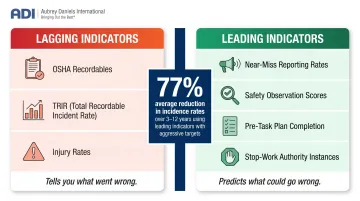
Organizations measuring culture change solely through OSHA recordables and TRIR are measuring outcomes from the past — not the behavioral health of the culture today. Lagging indicators only tell you that something went wrong; they cannot predict what is about to go wrong or confirm that culture is genuinely shifting.
Organizations that track leading indicators alongside lagging metrics can intervene before incidents occur and demonstrate culture progress to leadership even before injury rates change. Leading indicators include:
- Near-miss reporting rates
- Safety observation scores
- Pre-task plan completion rates
- Instances of workers exercising stop-work authority
Research shows that organizations using leading indicators with aggressive targets achieved an average 77% reduction in incidence rates within 3-12 years. Higher near-miss reporting rates indicate a healthier, not worse, culture — they reflect psychological safety and worker engagement in hazard identification.
Psychological Safety as the Reporting Foundation
The willingness of workers to report near-misses, hazards, and unsafe conditions without fear of retaliation is the behavioral signal of a genuinely healthy culture. Near-miss data is the richest source of predictive safety intelligence — but it only flows when workers trust that reporting will be responded to positively rather than used against them.
Sites with low near-miss reporting rates typically don't have better safety records — they have under-reported records. Research shows that an estimated 75% of nonfatal injuries among Hispanic construction workers and 40% among white workers in small establishments go unreported. Workers cited several reasons for not reporting:
- Fear of employer retaliation
- Loss of work opportunities
- Desire to remain eligible for safety incentive prizes
When workers see that reporting leads to genuine follow-up action rather than blame, reporting increases — and so does the quality of hazard data leadership can act on.
Common Mistakes That Derail Construction Safety Culture Change
Treating Culture Change as a Training Event Rather Than a Behavioral System
Launching a safety culture initiative with a strong kickoff, training sessions, and new materials — then reverting to business as usual within weeks — is the most common failure mode. Culture change is not a program with a start and end date; it requires sustained daily behavioral reinforcement built into how supervisors operate every shift.
Training creates awareness and knowledge. Behavior change, however, requires ongoing reinforcement, observation, feedback, and accountability. Skip that reinforcement, and behaviors revert to baseline faster than most leaders expect.
Focusing Exclusively on Incident Reduction as the Definition of Success
When "zero injuries" is the only goal, workers and leaders lose sight of the specific safe behaviors that produce that outcome. An injury-rate-only focus drives underreporting and creates a false picture of cultural health.
Contrast this with a behavior-focused definition of success:
- Increased near-miss reporting (indicating trust and engagement)
- Higher safety observation scores (indicating behavior is improving)
- Increased stop-work authority exercises (indicating workers feel empowered)
- Positive reinforcement delivery frequency (indicating supervisors are actively coaching)
These leading indicators predict future injury rates and reflect actual cultural health.
Excluding Subcontractors and Transient Workers from the Culture Change Effort
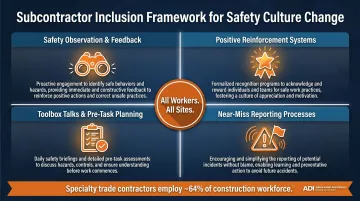
On most construction projects, a significant proportion of the workforce, often the majority, are subcontractor or temporary personnel. Specialty trade contractors employ approximately 64% of the construction workforce, according to BLS data.
The fatality numbers make the stakes clear. Between 2011 and 2016, 2,555 contracted construction workers died. In 2016 alone, 503 contracted workers died, representing 63% of all contracted worker fatalities across all U.S. industries.
Culture change efforts that reach only direct employees leave the most significant portion of site risk unaddressed. Subcontractors must be included across every element of the program:
- Safety observation and feedback programs
- Positive reinforcement systems
- Toolbox talks and pre-task planning
- Near-miss reporting processes
Leaving subcontractors outside the culture change effort doesn't reduce your exposure — it concentrates it.
Frequently Asked Questions
How to improve safety culture in construction?
Improving safety culture requires moving beyond compliance to actively reinforcing specific safe behaviors every day. Leaders must visibly model safe practices, and organizations must build positive reinforcement systems that reward workers for acting safely — consequences alone only produce minimum compliance. Culture shifts when daily behavior is shaped by what gets reinforced consistently.
What is the difference between safety culture and safety compliance in construction?
Compliance is doing what is required when being observed or when consequences are immediate. Culture is how workers actually behave when no one is watching, shaped by shared values, peer expectations, and what is consistently reinforced on site. Compliance is externally motivated; culture is internally sustained.
How long does it take to change a construction safety culture?
Meaningful cultural indicators typically require 2-3 years of sustained behavioral effort to shift at an organizational level. Early behavioral metrics — near-miss reporting rates, safety observation scores, pre-task plan completion — can show measurable improvement within months, making them useful early signals of real progress.
What role does leadership play in construction safety culture change?
Leadership behavior is the primary driver, not leadership statements. Workers calibrate their own behavior against what they observe leaders consistently doing, especially under production pressure or time constraints. Leaders who shortcut safety when behind schedule teach workers that safety is negotiable.
Why do most construction safety programs fail to change culture?
Most programs rely on negative reinforcement — avoiding punishment, citations, or incidents — which only produces minimum compliance. Lasting culture change requires positive reinforcement of specific safe behaviors practiced daily; without it, behavior reverts to baseline once supervision decreases.
How do you measure whether construction safety culture is genuinely improving?
Shift from lagging indicators such as injury rates to leading indicators including near-miss reporting frequency, safety observation scores, pre-task plan completion rates, and instances of workers exercising stop-work authority. These reflect behavioral culture in real time and predict future injury trends before incidents occur.