Introduction
Most workplaces check every box: comprehensive safety manuals, OSHA-compliant training sessions, hazard posters on every wall, and detailed incident reporting systems. Yet preventable injuries and fatalities continue. In 2024, 5,070 workers died from occupational injuries in the U.S.—one fatality every 104 minutes. Despite decades of regulatory progress and billions spent on safety programs, the absolute toll remains staggering. The disconnect is clear: having safety policies doesn't equal having a safety culture.
The gap between compliance-focused organizations and those with genuine safety cultures is fundamentally a behavior problem, not a policy problem. Policies tell employees what they should do; culture determines what they actually do when no one is watching.
This article is for safety officers, operations leaders, HR professionals, and managers whose safety systems aren't delivering the results they need. It covers the behavioral science behind sustainable safety culture and how to build it through reinforcement rather than fear-based compliance.
TLDR:
- Safety culture is driven by leader behavior and daily reinforcement, not written policies alone
- Positive reinforcement sustains safe behavior far better than punishment or fear-based compliance
- Trust and open reporting are non-negotiable prerequisites for cultural change
- Training must change actual workplace behavior, not just check compliance boxes
- Recognition of safe behavior is the most underused—and most powerful—safety tool available
Safety Culture Is a Behavior Problem, Not Just a Policy Problem
Most organizations fall into what we call the compliance trap: they confuse having safety rules with having a safety culture. Policies establish expectations, but culture determines whether those expectations are actually followed when supervisors aren't present, when production pressure mounts, or when shortcuts seem convenient. Policies don't save lives—culture does.
Behavioral science reveals why compliance-focused systems plateau: behavior is shaped by its consequences, not just its rules. Rules, procedures, and warning signs function as antecedents—they set the stage for behavior, but they don't sustain it. When organizations rely solely on antecedents and fear of punishment, they achieve minimum compliance, not genuine safety commitment. Research by Guerin et al. (2020) confirms that safe behavior is driven primarily by perceived consequences, outcome expectancies, self-efficacy, and social norms—not by posted policies alone. A structural equation modeling study of 380 workers found that safety culture has a statistically significant positive impact on safety performance (beta = 0.200), explaining 35.8% of the variance in outcomes.
The distinction between rule-based safety and behavior-based safety culture is critical:
- Rule-based safety: Workers follow procedures primarily to avoid punishment. Compliance is reactive, inconsistent, and stops when observation ends.
- Behavior-based safety culture: Workers proactively identify hazards, report near-misses without fear, and look out for coworkers because safe behavior is reinforced, valued, and embedded in daily norms.
True safety culture shows up in informal, daily moments: a junior worker stopping a senior colleague mid-task to flag a hazard; near-misses reported and treated as learning opportunities; safety conversations happening naturally on the floor, not just during formal audits.
Weak safety culture reveals itself in the opposite pattern. Incident reports drop — not because conditions improve, but because workers stop trusting the system. Blame follows accidents. And a persistent belief takes hold that safety competes with productivity, rather than enabling it.
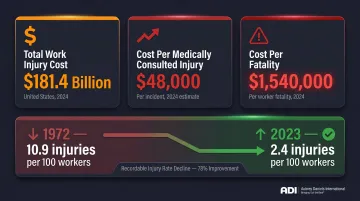
Despite the U.S. recordable injury rate falling from 10.9 per 100 workers in 1972 to 2.4 per 100 workers in 2023, the National Safety Council estimates that work injuries cost $181.4 billion in 2024, including $54.9B in wage and productivity losses. The cost per medically consulted injury: $48,000. The cost per death: $1,540,000. Those numbers reflect what happens when rule-following substitutes for genuine behavioral change — and why culture work is ultimately cost-reduction work.
Why Leadership Behavior Is the Foundation of Safety Culture
Safety culture follows what leaders do, not what they say. Employees observe leader behavior constantly and adjust their own actions accordingly. The most compelling illustration of this principle is the Alcoa turnaround under CEO Paul O'Neill. When O'Neill took over in 1987, he shocked investors by refusing to discuss financials and instead announcing a goal of zero workplace injuries. At the time, nearly every Alcoa plant averaged at least one accident per week.
By the end of O'Neill's tenure in 2000, Alcoa's worker injury rate fell to one-twentieth (5%) of the U.S. average. Some facilities went years without a single lost workday. Annual net income grew five-fold, market capitalization increased by $27 billion, and stock value quintupled — an investor who put $1 million into Alcoa on O'Neill's first day would have earned $1 million in dividends by the time he left.
The mechanism behind this was behavioral: O'Neill used safety as a "keystone habit" that forced operational excellence and released discretionary energy by demonstrating genuine care for employees.
The Behavioral Mechanism
Leaders function as both antecedents and consequence providers. As antecedents, they set conditions for safe behavior by modeling it and establishing clear expectations. As consequence providers, they reinforce or inadvertently punish safe behavior through how they respond. A leader who overrides a hazard report under time pressure — or simply walks past a spill without a word — sends a behavioral message that undermines the entire system.
Visible Commitment vs. Performative Commitment
Visible commitment looks like:
- Showing up physically at safety walkthroughs, not just signing off on reports
- Asking substantive questions about frontline hazards
- Following every safety protocol personally, without exception
- Making resource decisions that prioritize safety even when it's inconvenient
Performative commitment means hanging a safety banner in the lobby and calling it done.
The Frontline Supervisor Factor
Safety leadership isn't just the CEO's job. Frontline supervisors have the most direct, day-to-day influence on employee safety behavior. Research by Yanar et al. (2018) involving 2,390 workers found that supervisor safety support moderates occupational health and safety vulnerability. Workers reporting low supervisor support had higher rates of workplace injury and illness.
That supervisor influence runs both directions. Peker (2022) found that supervisor behavioral integrity for safety moderates the relationship between top-management safety climate and employee safety behavior. When supervisors' actions align with their words, the effect is amplified. When they diverge, it's undermined.
The Cost of Inconsistency
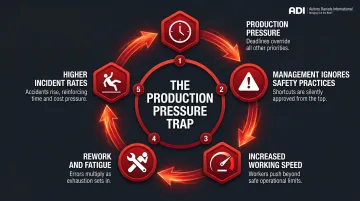
When safety is deprioritized in favor of production pressure, workers learn that safety is conditional—enforced only when convenient. Research by Mohammadi & Tavakolan (2019) used system dynamics modeling to identify a destructive feedback loop: Production Pressure → Management ignoring safety practices → Increased working speed → Rework/Fatigue → Higher Incident Rates. This inconsistency is one of the most powerful destroyers of safety culture. Leaders must apply safety standards consistently across all roles and levels, or the message becomes that some people are above the rules.
Practical Safety Leadership Behaviors That Drive Real Culture Change
Lead by Example, Always
Leaders must visibly follow every safety protocol they ask of others. This isn't optional—it's the foundational behavior that signals safety is a genuine value. Specific examples include:
- Wearing required PPE on the floor, even during brief visits
- Stopping meetings immediately when a safety concern is raised
- Refusing to override a hazard report under time pressure
- Following lockout/tagout procedures without exception
When leaders model safe behavior consistently, they create credibility. When they cut corners, they give permission for everyone else to do the same.
Make Safety Conversations Daily and Informal
Safety culture is built in small, consistent moments—not annual training sessions or quarterly reviews. Effective leaders integrate safety into daily interactions:
- Brief pre-task safety check-ins ("What hazards are you watching for today?")
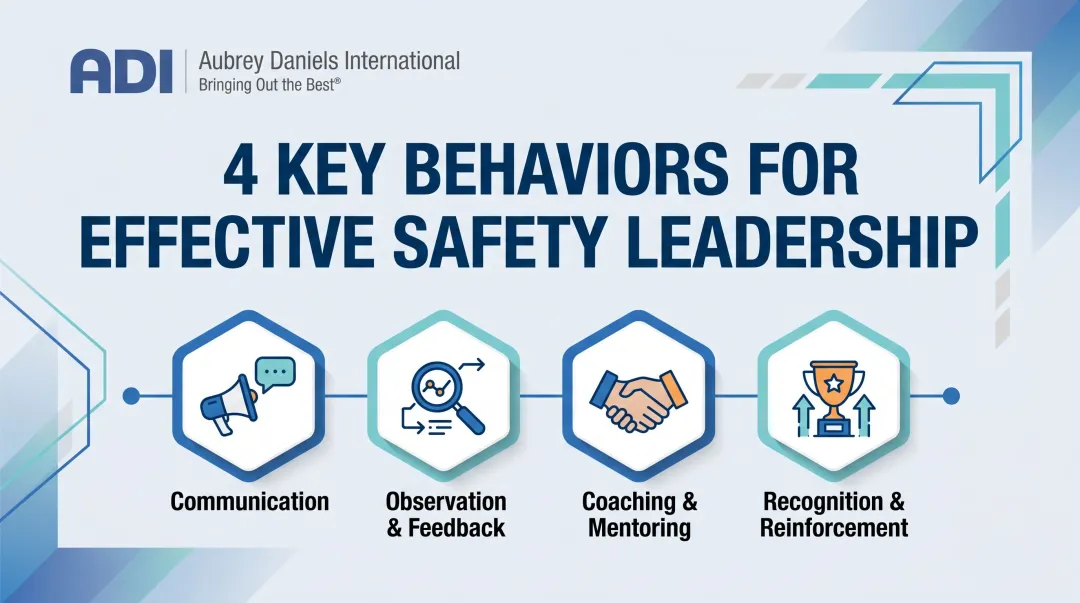
- Recognizing a worker who flagged a risk ("Thanks for catching that spill—that's exactly the kind of awareness we need")
- Asking frontline staff, "What's getting in the way of working safely today?"
These micro-conversations build trust and surface hidden hazards before they escalate. Over time, they shift safety from a compliance obligation to something workers actively participate in.
Respond to Errors and Near-Misses with Curiosity, Not Blame
How a leader reacts to the first reported near-miss sets the tone for whether anyone will ever report again. A prospective cohort study of 2,755 Japanese workers found that inadequate company response to near-miss reports increased subsequent accident odds by 53%, while no response at all increased odds by 75%. Blame responses drive incidents underground and destroy the psychological safety workers need to speak up. Shifting to curiosity—"What can we learn from this?" or "What system failure allowed this to happen?"—builds the reporting culture that prevents serious harm.
Why Clear Behavioral Expectations Matter
When workers trust that near-misses will be met with curiosity rather than blame, they need to know exactly what behaviors are expected of them. Vague expectations ("be safe") create confusion. Specific, observable standards create clarity:
- "Always walk, never run on the floor"
- "Report every near-miss within 24 hours"
- "Complete the equipment inspection checklist before starting your shift"
These expectations must be communicated repeatedly and held equally for senior leaders and frontline workers alike.
Recognize and Positively Reinforce Safe Behavior
Most safety systems are designed to detect and correct unsafe behavior through negative reinforcement and punishment. What they rarely do is recognize safe behavior—and that gap matters. Systematically reinforcing what workers do right creates the motivational environment where safety becomes a genuine value:
- Publicly acknowledge workers who report hazards
- Recognize employees who follow protocols under pressure
- Celebrate teams who mentor peers on safety practices
A meta-analysis of 13 behavior-based safety studies found all 13 showed decreased accidents post-intervention, with a pooled effect of 0.61—a statistically significant reduction.
Building Trust and Creating Psychological Safety for Open Reporting
Without trust, employees won't report near-misses, won't raise hazards, and won't tell supervisors when a procedure is unsafe. Reporting only increases when employees believe they'll be treated fairly and that their input will be acted on—not ignored or used against them.
The Just Culture Framework
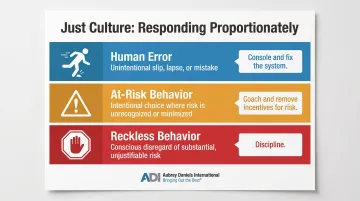
A just culture distinguishes between human error, at-risk behavior, and reckless behavior, and responds proportionately. James Reason (2000) defines a just culture as "an atmosphere of trust in which people are encouraged to provide essential safety-related information, but in which they are also clear about where the line must be drawn between acceptable and unacceptable behavior." The framework identifies:
- Human Error (slips, lapses, mistakes): Unintentional. Response = Console and fix the system.
- At-Risk Behavior: Intentional choice where risk is not recognized or believed justified. Response = Coach and remove incentives for risk.
- Reckless Behavior: Conscious disregard of substantial, unjustifiable risk. Response = Discipline.
Reason proposes the "Substitution Test": Would another competent person have made the same error in the same circumstances? If yes, blaming the individual is counterproductive.
Demonstrate Trust Through Follow-Through
If someone raises a safety concern and hears nothing back, trust erodes. Even when a concern can't be acted on immediately, acknowledging it, explaining the decision-making process, and closing the feedback loop maintains credibility and encourages future reporting.
The Accident Pyramid and Underreporting
That follow-through matters more than most leaders realize, because reporting volume is a direct indicator of trust. The research on near-miss ratios makes the stakes concrete.
Heinrich's foundational research analyzed approximately 75,000 insurance claims and proposed the ratio 1 major injury : 29 minor injuries : 300 no-injury incidents (near-misses). Bird (1969) analyzed 1,753,498 accidents and proposed 1 serious injury : 10 minor injuries : 30 property damage accidents : 600 near-misses.
These ratios vary by industry and context, but the pattern is consistent: near-misses vastly outnumber serious injuries and represent the largest available pool of learning opportunities. When a blame culture or "zero accident" targets push employees to hide incidents, leaders lose access to exactly the data they need to prevent the next serious injury.
Designing Safety Training That Actually Changes Behavior
The most common failure mode in safety training is designing programs to check a compliance box rather than change behavior. One-size-fits-all annual programs that employees passively sit through create awareness—but awareness alone does not change behavior. Knowledge transfer is not the same as behavior change.
Research by Casey & Krauss (2014) reports that as little as 10% of what is learned during safety training is actually applied when employees return to the workplace—meaning up to 90% of training content is lost or remains unapplied. Most employees who experience safety incidents have actually received prior training in safe work practices, highlighting the knowing-versus-doing gap.
What Effective Safety Training Looks Like
Effective training from a behavior-change perspective is:
- Tailored to the actual hazards employees face — not built from generic compliance modules
- Built around practice, demonstration, and hands-on application rather than passive lecture
- Reinforced with immediate feedback during training and follow-up coaching on the job
- Supported by supervisors who actively reinforce safe behaviors in real work situations
Training Must Be Ongoing and Contextual
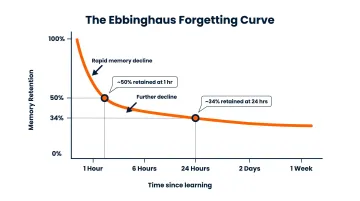
Hermann Ebbinghaus's foundational research (1885) demonstrates that approximately 50% of newly learned information is forgotten within one hour, and approximately 66% within one day. Spaced repetition and retrieval practice are what cement information into long-term memory — which means training cannot be an annual event.
Regular toolbox talks, brief situational safety conversations, and supervisor-led coaching sessions build behavioral fluency over time. Chen et al. (2022) conducted a bibliometric review of 66 studies and found a "prominent contradiction" between "high frequency and wide coverage" of safety training and "low transfer efficiency." The implication is clear: frequency alone doesn't drive behavior change — the structure and follow-through of training does.
Reinforcing Safe Behavior: The Key to Making Safety Culture Last
Most safety cultures plateau or regress because organizations invest heavily in setting up rules and initial training but never build a reinforcement system to sustain safe behavior over time. Without ongoing positive consequences, even enthusiastic safety commitment fades. Behavior that goes unreinforced eventually disappears.
The Reinforcement Framework for Safety
Dr. Aubrey Daniels states that "positive reinforcement is the most important element affecting behavior and the weakest link in most safety management systems." Most safety systems rely on negative reinforcement — workers perform safely only to avoid punishment or criticism. That approach is fundamentally weaker for sustaining behavior long-term.
Building a safety habit may require "hundreds of occasions" of positive reinforcement. Punishment and infrequent rewards simply cannot deliver the frequency needed for lasting behavior change.
The reinforcement framework for safety includes:
- Identify safe behaviors: Define what safe behaviors look like — specific, observable actions
- Determine who reinforces: Supervisors, peers, and safety officers all play roles in observation and recognition
- Establish consistent recognition: Deliver genuine, timely recognition for safe behavior
This framework pairs naturally with leading-indicator measurement. Unlike lagging indicators — injury rates tracked after incidents occur — leading indicators catch problems before they become accidents.
OSHA guidance states: "A good safety and health program uses leading indicators to drive change and lagging indicators to measure effectiveness."
Leading indicators worth tracking include:
- Frequency of safety walkthroughs completed
- Near-miss reports filed
- Training completion rates
- Hazard correction timeliness
ADI's Behavior-Based Approach
ADI's work in behavior-based performance improvement — including the principles in Judy Agnew's Safe by Accident? — provides a practical, science-grounded framework for leaders who want to move beyond compliance and create safety cultures where safe behavior becomes the norm because it is genuinely valued and reinforced. ADI's consulting and certification programs give safety leaders the tools to apply these behavioral principles directly — from reinforcement system design to supervisor coaching on recognition delivery.
Frequently Asked Questions
What is the difference between safety culture and safety compliance?
Compliance means following rules to avoid punishment—it's reactive and stops when observation ends. Safety culture means employees genuinely value and practice safe behavior even when no one is watching, driven by trust, reinforcement, and shared ownership rather than fear.
Why do traditional safety training programs often fail to create lasting behavior change?
Most training focuses on knowledge transfer rather than behavior change. Without follow-up reinforcement, on-the-job coaching, and supervisors actively acknowledging safe practices, the training effect fades quickly—often within hours or days.
What specific behaviors should safety leaders model to build a strong safety culture?
Leaders should follow all safety protocols themselves, respond to near-miss reports with curiosity rather than blame, hold regular informal safety conversations with frontline workers, and visibly recognize safe behavior when they see it.
How can leaders encourage near-miss and hazard reporting without creating a blame culture?
Respond to every report with a learning orientation — not blame. Make clear that reporting is protected and valued, then close the loop by acting on each concern or explaining why a specific action was or wasn't taken.
How do you measure whether a safety culture is genuinely improving?
Lagging indicators (injury rates) measure outcomes after the fact. Leading indicators—such as frequency of near-miss reports, safety conversation rates, and observation of safe versus at-risk behaviors—provide a more accurate picture of cultural health and predict outcomes.
What role does positive reinforcement play in workplace safety?
Timely, genuine recognition of safe behavior is the primary mechanism for sustaining safety culture over time. When reinforcement is consistent, safe behavior follows. A culture built on reinforcement consistently outperforms one built on rules and fear alone.