Introduction
Picture the familiar scene: a project team gathers for a final review. The plan has a visible flaw—several people spotted it days ago—but no one speaks. Everyone nods, the meeting adjourns, and weeks later, the predictable failure arrives. The problem wasn't a lack of insight. It was that raising the concern felt too risky.
This gap between what people know and what they feel safe saying is the essence of psychological safety. While the concept has entered mainstream leadership language, most leaders underestimate how much their daily behavioral choices determine whether it actually takes root — far more than any policy or poster ever will.
A leader's visible reaction to a question, their response to a mistake, how they handle dissent, and whether they reinforce or suppress employee voice all shape team climate in ways no initiative can replicate.
This article defines psychological safety through a behavioral lens, explains its direct impact on performance and culture, walks through specific actions leaders can take, and identifies the most common mistakes that silently erode progress.
Key Takeaways
- Psychological safety means people can speak up, admit mistakes, or challenge ideas without fear of punishment — and it directly drives team performance
- Leader behavior, not policy, creates or destroys safety: how you respond to questions and failure sets the norm
- High standards and psychological safety reinforce each other; the best teams operate with both
- Build safety in sequence — inclusion, then learning, then contribution, then challenge — skipping stages breaks trust
- Most leaders quietly undermine safety through subtle habits: reacting visibly to mistakes, dismissing input, or defaulting to the same voices
What Is Psychological Safety at Work?
Psychological safety, as defined by Amy Edmondson's foundational 1999 research, is "a shared belief held by members of a team that the team is safe for interpersonal risk-taking." This means employees can speak up, ask questions, admit mistakes, or disagree without fear of negative consequences. This is a group-level climate, not just individual confidence. It reflects what the team collectively believes is safe.
The most common misconception is that psychological safety means comfort, conflict avoidance, or relaxed standards. It doesn't. Healthy disagreement and candid feedback are markers of psychological safety, not threats to it. High performance and psychological safety reinforce each other. Teams that feel safe to challenge ideas and surface problems consistently outperform those that don't, because they catch and address issues others quietly ignore.
Psychological Safety Isn't Uniform
Research from the Center for Creative Leadership reveals that 62% of senior leadership teams show significant variability in psychological safety perceptions. Some members feel far less safe than others—often those from underrepresented groups or lower in the hierarchy.
This unevenness carries real costs. When certain voices are consistently absent:
- The team's collective intelligence is incomplete
- Decisions get made without critical input from those closest to the work
- Blind spots go unaddressed until they become costly problems
Why Psychological Safety Is a Leadership Imperative
Globally, only one in four employees strongly agree their opinions count at work, according to Gallup. That means three-quarters of your workforce may be holding back what they know. The costs are measurable: initiatives proceed despite known flaws, talent disengages quietly, and innovation never surfaces.
The performance link is clear. Teams with higher psychological safety demonstrate measurably better outcomes:
- Higher overall performance and productivity
- Lower interpersonal conflict
- Greater learning behavior and knowledge-sharing
- Greater willingness to take calculated risks
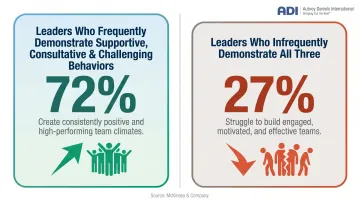
McKinsey research found that 72% of respondents reported a positive team climate when leaders frequently demonstrated supportive, consultative, and challenging behaviors—but that dropped to just 27% when leaders infrequently demonstrated all three.
The Hybrid Work Challenge
Distributed teams face a harder challenge. Trust builds more slowly across screens, and the informal cues that signal safety—a leader's reaction in a meeting, a side conversation afterward—are harder to observe and transmit. Edmondson notes that hybrid work expands the scope of psychological safety beyond work content to include personal circumstances: health-risk comfort levels, family situations, and work-life balance. Reduced nonverbal cues make it harder for leaders to detect disengagement or silence. This makes deliberate, visible leadership behavior more important than ever—and that starts with how leaders behave day to day.
How Leaders Build Psychological Safety: A Step-by-Step Behavioral Approach
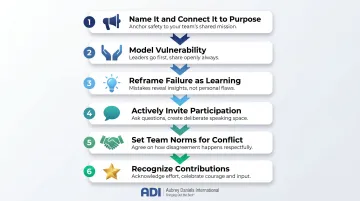
Step 1: Name It and Connect It to Purpose
Psychological safety rarely develops by default. Leaders must explicitly declare that speaking up, questioning assumptions, and admitting mistakes are valued, not merely tolerated. Frame this around team purpose to make the expectation concrete:
"We can only catch what isn't working if everyone feels free to say so. That's not optional—it's how we deliver quality."
That framing moves psychological safety from abstract HR language to a meaningful operational standard tied to what the team is actually trying to accomplish.
Step 2: Model Vulnerability Before Expecting It from Others
When leaders go first—admitting what they don't know, acknowledging when they were wrong, or sharing a past mistake—they demonstrate that vulnerability is safe and professionally acceptable. The effect is strongest at the top. McKinsey research found that senior leaders' inclusive behaviors cascade directly into team-level psychological safety: team leaders are more likely to exhibit supportive and challenging leadership when senior leaders model it first.
When the person with the most to lose speaks honestly, everyone else gets a clearer signal that it's safe to do the same.
Step 3: Reframe Failure as a Learning Signal, Not a Verdict
Describe difficult projects as learning challenges rather than performance tests: "We've never done this before—we'll learn as we go and course-correct together." Reducing the perceived cost of mistakes matters more than leaders often realize. From a behavioral science perspective, behavior that is punished decreases in frequency. If employees associate speaking up with negative consequences—even subtle ones like a visible wince or rapid dismissal—they stop doing it.
Language examples that reframe failure:
- Instead of: "How did this happen?"
- Try: "What did we learn, and what do we need to change?"
The shift from blame to inquiry signals that mistakes are opportunities for the team to get smarter, not reasons to retreat.
Step 4: Actively Invite Participation and Reinforce Speaking Up
Invitation must be active, not passive. Asking "Does anyone have concerns?" at the end of a meeting isn't enough. Leaders must:
- Specifically invite dissenting perspectives
- Direct questions to quieter team members
- Create structured moments for input (asynchronous input before decisions, anonymous feedback for sensitive topics)
The behavioral science here is direct: when positive consequences reliably follow a behavior, it increases in frequency. When a leader responds to an uncomfortable question with genuine appreciation and follow-through—not just once, but consistently—speaking up becomes a reinforced behavior.
ADI's Performance Management framework, grounded in Applied Behavior Analysis, makes this operational: leaders who apply positive reinforcement systematically outperform those who rely on appeals or policy mandates alone. Research across 27,000 workers confirms that when employees speak up and nothing bad happens, they're far more likely to do it again. Reinforcing the act of speaking up—not just the outcome—is what drives the pattern.
Step 5: Set Explicit Team Norms for Conflict and Feedback
Productive conflict is a feature of psychological safety, not a failure of it—but only if teams have agreed-upon norms for how to handle disagreement respectfully. Use team discussion questions to build these norms:
- How will we raise concerns about a process that isn't working?
- What does respectful challenge look like here?
- How do we give feedback that is honest but not personal?
These conversations create shared expectations, so disagreement doesn't feel like personal attack.
Step 6: Recognize Contributions, Not Just Results
When leaders consistently acknowledge the act of speaking up—the brave question, the dissenting view, the mistake surfaced early—rather than only praising outcomes, they signal that participation itself is valued. Specific recognition carries more weight than generic praise:
"I'm glad you raised that—it changed how we thought about the problem."
This reinforces the behavior of contributing, not just the result of being right.
The 4 Stages of Psychological Safety Every Leader Should Know
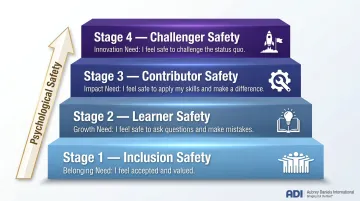
Psychological safety doesn't appear all at once. Dr. Timothy Clark's model describes four sequential stages, each tied to a fundamental human need — belonging, learning, contributing, and challenging. Leaders must actively support each stage before the next becomes accessible. Skip one, and people get stuck below the level their role demands.
Stage 1: Inclusion Safety
Inclusion safety satisfies the basic human need to connect and belong. Employees must feel accepted for who they are before any other kind of risk-taking is possible. Leaders create inclusion safety by:
- Actively welcoming different perspectives
- Ensuring no voices are systematically excluded
- Addressing microexclusions when they occur (being talked over, having ideas credited to someone else)
A telling signal: if people stay quiet in meetings but talk freely in the hallway afterward, inclusion safety is missing.
Stage 2: Learner Safety
Learner safety satisfies the need to grow and experiment. Employees feel safe asking questions, trying new approaches, and making mistakes. This is also where leaders most often create barriers without realizing it — punishing visible mistakes, expressing impatience with questions, or rewarding only polished answers all signal that learning carries risk.
Leaders build learner safety by normalizing questions, celebrating curiosity, and treating early mistakes as natural parts of skill development:
- Responding to questions with genuine interest, not impatience
- Recognizing experimentation even when it doesn't produce the intended result
- Separating the quality of a decision from the quality of its outcome
Stage 3: Contributor Safety
Contributor safety satisfies the need to make a meaningful difference. Employees feel safe using their skills and judgment to solve real problems, not just executing instructions. Leaders signal trust by:
- Delegating meaningfully
- Giving ownership of decisions within a defined scope
- Resisting the urge to over-correct
When people know their judgment is trusted, they bring more than compliance — they bring initiative.
Stage 4: Challenger Safety
Challenger safety — the highest and most powerful stage — satisfies the need to make things better. Employees feel safe questioning assumptions, challenging the leader's position, and proposing disruptive ideas. This stage is only achievable after the prior three are stable, and it is the stage most directly linked to innovation, quality improvement, and organizational resilience.
Leaders who reach this stage actively invite dissent and reward constructive challenge. They demonstrate — through consistent behavior, not just stated values — that the best idea wins regardless of rank. That credibility is what separates teams that merely perform from those that improve.
Common Mistakes Leaders Make When Building Psychological Safety
Punishing Failure, Even Subtly
Leaders often don't realize the nonverbal signals they send. CCL research analyzing 153 distinct leader behaviors found that negative affect (expressions of anger or anxiety) uniquely predicts lower psychological safety. A visible grimace when a question seems basic, moving quickly past a concern without acknowledgment, or visibly favoring certain contributors can communicate that speaking up is risky.
Psychological safety erodes through patterns, not single events. Behavioral consistency matters more than any single intervention. Leaders are typically 150% to 300% more vocal than team members, making their behavioral cues disproportionately influential.
Treating It as a One-Time Initiative
Running a single workshop, publishing a values statement, or having one honest team conversation is insufficient. Psychological safety is not a program—it is a climate that must be continuously maintained through day-to-day leader behavior. Research shows that psychological safety is often among the first things to go during resource constraints, precisely when it's needed most. Without consistent reinforcement, safety fades during high-pressure periods when leaders revert to command-and-control instincts.
Creating Safety for Some but Not All
Research consistently finds variability within teams. Gallup data on Black women in the workplace reveals that only 33% of Black women feel like valued team members, and only 31% are confident their employer would do what's right if they raised a concern about ethics. Leaders must actively audit whose voices are heard, who gets credit for ideas, and whether their "open door" is equally open in practice.
That audit should be ongoing — inclusion gaps rarely announce themselves.
Confusing Psychological Safety with the Absence of Standards
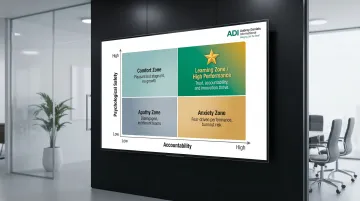
Leaders who soften feedback to the point of dishonesty, allow underperformance to go unaddressed, or avoid difficult conversations in the name of "keeping the peace" are not building psychological safety—they're building false comfort. Edmondson's 2x2 matrix plots psychological safety against accountability: the ideal is the upper right quadrant (high safety + high accountability), where people are not afraid to have difficult conversations that bring real progress.
The goal is candor with care: leaders who hold the line on performance while making it safe to admit mistakes, ask questions, and disagree. One without the other produces either a comfortable team that doesn't improve or a high-performing team that burns out.
Frequently Asked Questions
What is a culture of psychological safety?
A culture of psychological safety is one where speaking up, questioning assumptions, admitting mistakes, and taking interpersonal risks are consistently met with respect—not as isolated gestures, but as the recognized norm reinforced by leaders at every level.
What are the 4 stages of psychological safety?
The four stages are inclusion safety, learner safety, contributor safety, and challenger safety. Each stage builds on the prior one, progressing from the need to belong through the need to learn, contribute meaningfully, and ultimately challenge the status quo.
How do you measure psychological safety in the workplace?
The most widely used tool is Edmondson's 7-item psychological safety scale, which measures individuals' perceptions of risk-taking safety within their team. Leaders can supplement that data by watching for behavioral signals: do employees ask questions, volunteer concerns, and push back constructively in meetings?
What is the difference between psychological safety and just being "nice"?
Psychological safety is not about pleasantness or avoiding conflict. It's about creating conditions where honest, sometimes uncomfortable conversations happen without fear of punishment. Teams with high psychological safety often engage in more productive disagreement, not less.
Can psychological safety coexist with high performance standards?
Yes: psychological safety and high standards are not in tension. Both are required for peak performance. Without safety, people comply silently; without standards, comfort replaces rigor. The most effective leaders hold both simultaneously.
What behaviors most quickly destroy psychological safety?
The most damaging behaviors are publicly criticizing someone who raised a concern, dismissing ideas without engagement, taking credit for team input, and reacting defensively to feedback. Each sends the same message: speaking up is costly. Once teams learn that lesson, reversing it takes significant, sustained effort.
About Aubrey Daniels International
For over 45 years, Aubrey Daniels International (ADI) has helped leaders apply the science of behavior to improve business performance. Grounded in Applied Behavior Analysis, ADI's Performance Management approach gives leaders concrete tools for building environments where people speak up, take initiative, and sustain high performance. Through workshops, consulting, and leadership development programs, ADI partners with organizations across manufacturing, healthcare, financial services, and other industries to build cultures where high standards and psychological safety reinforce each other.