Introduction
Manufacturing workplaces continue to face significant safety challenges. In 2024, 353 manufacturing workers lost their lives to workplace fatalities, accounting for approximately 7% of all private-industry deaths. Beyond fatalities, the sector recorded a Total Recordable Incident Rate (TRIR) of 2.7 per 100 full-time workers—slightly above the private sector average—with substantial variation across manufacturing subsectors: motor vehicle manufacturing reached 5.6, while computer and electronics hovered at just 0.9.
These numbers represent more than statistics. Each incident carries human cost and organizational consequence: the National Safety Council estimates $181.4 billion in total annual injury costs across all U.S. industries, including $54.9 billion in wage and productivity losses.
Those costs are preventable—but only when safety becomes embedded in how people actually behave, not just what policies require. This article delivers a practical, behavior-based breakdown of eight keys that transform safety from a compliance checkbox into a genuine organizational culture, with each key grounded in what behavioral science shows actually drives lasting change.
Key Takeaways
- Safety culture is built on shared behaviors and values, not rules alone—it starts with leadership commitment
- The eight keys address mindset, leadership visibility, psychological safety, incentive design, role clarity, communication, reporting systems, and measurement
- Outcome-based incentive programs often backfire by suppressing incident reporting rather than improving behavior
- Behavioral science—what reinforces safe vs. unsafe actions—is what separates lasting culture from short-term compliance
- Shift complexity, production pressure, and workforce diversity make people-centered strategies essential in manufacturing
What Makes Manufacturing Safety Culture Uniquely Challenging
Manufacturing environments compound safety risks in ways that generic safety programs cannot address. These workplaces run around the clock, involve repetitive tasks that breed complacency, and expose workers to hazardous machinery — all while managing diverse workforces with varying language skills and experience levels.
The Shift Work Hazard
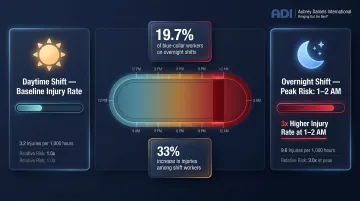
Research analyzing over 400,000 workplace injuries found that injury rates at 1:00-2:00 AM are nearly three times higher than midafternoon rates. Blue-collar manufacturing workers make up 19.7% of the workforce during overnight hours versus just 7% during daytime, intensifying exposure to risk. A separate study of Fortune 500 manufacturers documented a 33% increase in occupational injuries among shift workers, with annual excess healthcare costs exceeding $1.39 million at one company alone.
Production Pressure Dynamics
When output targets and safety appear to conflict, workers and supervisors often prioritize speed. Unsafe shortcuts produce immediate results — the task gets done faster — while injury consequences remain delayed or invisible. This is a behavioral dynamic, not a values problem. A systematic review of 181 safety studies found that production pressure drives "increased error rates, poor safety climate, normalization of deviance, and adverse events." Under cost pressure, organizations consistently push toward the edge of acceptable risk.
Workforce Diversity Barriers
Latino immigrant workers experience a workplace fatality rate of 5.9 per 100,000 person-years—nearly 50% higher than the general workforce rate of 4.0. Key barriers include language gaps, cultural reluctance to challenge authority, and PPE designed for 1950s-era military recruits that doesn't fit women or non-white workers. With immigrants and their children projected to account for 83% of U.S. working-age population growth through 2050, these challenges will only intensify.
Program vs. Culture
These structural challenges — shift fatigue, production pressure, workforce diversity — expose a gap that no binder of policies can close. A safety program is a set of procedures and training materials. A safety culture reflects what people actually do when no one is watching. Most manufacturing organizations have thorough documentation. Far fewer have the behavioral change to match it.
The 8 Keys to Creating a Safety Culture in Manufacturing
Key 1: Embed Safety into the Daily Operational Mindset
Safety cannot exist as a separate agenda item discussed only at weekly meetings. It must integrate into shift huddles, production planning, toolbox talks, and daily decisions so it becomes the default thinking pattern rather than an add-on.
What This Looks Like:
- Safety as the first topic at every meeting, every shift
- Managers asking safety questions during floor walks before discussing production
- Safety framed as enabling production, not slowing it down
- Pre-task conversations that connect specific hazards to the work ahead
Research on Toolbox Talk effectiveness showed that customized pre-task discussions improved safety knowledge by 22% and increased the likelihood of safe behavior by 33.2%. In one study, supervisor use of daily Toolbox Talks rose from 13% to 68% after structured training—but success required overcoming production pressure and adapting content for multilingual crews.
Common Barriers:
- Experienced workers perceiving talks as redundant
- Supervisors rushing or skipping discussions to meet deadlines
- Generic materials that fail in diverse workforces
- Lack of connection between discussion topics and actual daily hazards
The difference between a ritualistic compliance exercise and a genuine safety conversation comes down to relevance—workers engage when the topic connects directly to what they're doing that day.
Key 2: Secure Visible Leadership Commitment at Every Level
Safety culture is not driven by the safety manager alone. It requires managers and supervisors to visibly model safe behaviors—wearing PPE, following procedures, stopping unsafe work—rather than merely communicating expectations to others.
OSHA's Management Leadership framework identifies visible demonstration of commitment as the foundation of an effective safety program. Seven action items include leading by example, integrating safety into business operations, and expecting performance. Leaders who bypass their own safety rules send a louder message than any poster or training session.
The Relationship Factor
A study of 598 hourly production workers at five Pennsylvania wood manufacturers found that Leader-Member Exchange (LMX)—the quality of the supervisor-subordinate relationship—was a stronger predictor of safety outcomes than safety communication alone. LMX accounted for 2.3% of unique variance in safety events (p < .001).
Safety communication alone was statistically insignificant once other factors were controlled.
Translation: if the underlying supervisor relationship is poor, safety communication is perceived as lip service.
Leadership Behaviors That Build Culture:
- Managers stopping work when they observe unsafe conditions—immediately
- Leaders participating in incident investigations, not delegating them
- Executives conducting safety walks on all shifts, including nights and weekends
- Supervisors allocating time and resources for safety tasks without penalizing production delays
Workers watch what leaders do far more closely than what they say—and culture forms around that gap.
Key 3: Build Psychological Safety—Make It Safe to Speak Up
Psychological safety in the safety context means employees feel confident they can report near-misses, raise hazards, or question unsafe practices without fear of blame, retaliation, or embarrassment. The absence of this trust is a primary reason incidents go unreported.
Barriers to Reporting
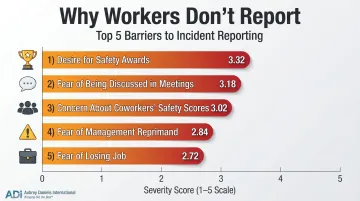
A study of 631 workers across manufacturing, construction, mining, and hospitals identified the top barriers to incident reporting:
- Desire for safety awards (3.32 on a 5-point scale)
- Fear of becoming the subject of discussion in meetings (3.18)
- Concern about negatively affecting coworkers' safety scores (3.02)
- Fear of management reprimand (2.84)
- Fear of losing job (2.72)
The study found that employees who received safety training paradoxically had lower reporting culture scores than those who didn't, suggesting training alone doesn't translate into behavior change.
The GAO estimated that employers failed to report injury and illness data on more than 50% of required establishments between 2016-2018—a systemic underreporting problem that blinds organizations to real risk.
How to Build Psychological Safety:
- Separate root cause analysis from disciplinary proceedings
- Avoid blame-focused incident investigations; focus on system failures
- Actively recognize employees who surface hazards before they cause harm
- Demonstrate visible follow-through on reported concerns
- Train leaders in non-defensive listening and response
When workers see that reporting leads to action rather than punishment, trust builds—and critical information flows.
Key 4: Rethink How You Use Incentives and Recognition
Outcome-based incentive programs—such as bonuses for zero reported injuries—backfire. They incentivize underreporting, not safe behavior. Employees hide incidents to preserve rewards, leaving the organization blind to real risk.
OSHA's 2012 guidance identified four prohibited incentive practices, including programs where the loss of a reward "might have dissuaded reasonable workers from reporting injuries." Group incentives where one person's injury disqualifies an entire workgroup are "particularly problematic."
Why Behavioral Recognition Works Better
Recognize and reinforce specific safe behaviors that prevent incidents:
- Conducting a proper lockout/tagout procedure
- Flagging a near-miss immediately
- Completing a thorough pre-shift inspection
- Stopping work when conditions change
- Actively participating in safety observations
Research by behavioral safety expert E.S. Geller found that outcome-based programs "stifle the reporting of injuries and near misses," creating false pictures of safety performance.
What Works:
- Behavior-based recognition tied to observable actions
- Peer-nominated safety awards for proactive hazard identification
- Public acknowledgment of employees who report near-misses
- Incentives for participation in safety committees, training completion, and safety suggestion submission
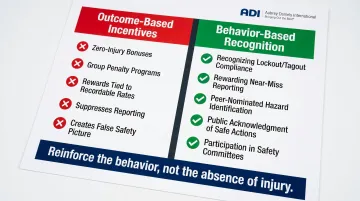
The goal is simple: make the safe behavior itself worth doing—not just the absence of an injury.
Key 5: Define Safety Roles, Responsibilities, and Ownership
When safety is "everyone's job" without specific accountabilities, it often becomes no one's active priority. Ambiguity enables diffusion of responsibility. Documented roles—including designated safety champions at each facility or shift—close this gap.
OSHA's Worker Participation framework emphasizes that workers should participate in all aspects of the safety program: hazard identification, incident investigation, and program evaluation.
The Safety Champion Model
A respected floor-level employee who:
- Leads peer observations and safety walks
- Escalates concerns to management
- Participates in incident investigations
- Bridges communication between workers and supervisors
- Serves as a cultural ambassador, not a compliance officer
Safety champions work because peer influence carries weight that top-down directives often don't. They're not policing behavior—they're modeling it and coaching others. That distinction matters for adoption.
Beyond the champion role, organizations need formal accountability structures that assign ownership across every level:
Clear Accountability Structures:
- Assign specific individuals responsibility for monthly safety audits
- Designate shift-level safety leads with authority to stop work
- Create safety committee roles with defined deliverables and timelines
- Document who owns follow-through on corrective actions from incident investigations
When everyone knows who is responsible for what, safety tasks stop falling through the gaps between shifts and departments.
Key 6: Invest in Consistent, Two-Way Safety Communication
Effective safety communication is not one-directional. It requires open channels for workers to surface concerns, suggest improvements, and receive timely responses. This feedback loop builds the trust required for genuine culture.
The Shift Consistency Challenge
Safety messaging, enforcement standards, and leadership visibility must be equivalent across all shifts—day, evening, and overnight. When they're not, separate shift subcultures develop with different norms and risk tolerance. Remember: injury rates peak at 1-2 AM, yet leadership presence typically concentrates during first shift.
Communication Best Practices:
- Establish regular forums where frontline workers can raise safety concerns directly to management
- Close the loop: communicate back to employees what actions were taken in response to their input
- Use multiple channels (shift huddles, visual boards, digital platforms, face-to-face conversations) to reach diverse workforces
- Offer language classes to all workers (not just immigrants) to foster shared struggle and break down social barriers
- Train supervisors in active listening, not just message delivery
Communication volume alone isn't enough. The Pennsylvania wood manufacturers study confirmed that relationship quality outweighs communication frequency—which means supervisors need training that develops genuine two-way engagement, not just better broadcast skills.
Key 7: Build a System for Reporting, Learning, and Correcting
A near-miss reporting system is only valuable if employees trust that reports lead to action rather than discipline. Effective systems include simple reporting mechanisms, visible follow-through, shared learnings communicated back to the floor, and closed-loop correction processes.
Root Cause Over Individual Blame
The goal of incident and near-miss analysis should be to identify root causes in systems, processes, and organizational conditions—not to assign individual blame. Organizations with high near-miss reporting rates typically have fewer serious incidents over time.
Heinrich's foundational Safety Triangle (1931) established the framework: for every major accident, there are 29 minor accidents and 300 near-misses. That ratio means near-miss data is far richer than incident data—and ignoring it is costly.
A prospective cohort study of 2,755 participants found that companies with inadequate responses to near-miss reports had an Odds Ratio of 1.53 (p < .001) for subsequent occupational accidents—meaning those workers were 53% more likely to experience an accident. When employees perceived the response as inadequate due to lack of feedback, reporting itself became a "barrier to safety behavior."
Essential System Elements:
- Non-punitive, confidential (or anonymous) reporting channels
- Root cause investigation that follows every report
- Corrective actions implemented and tracked to closure
- Lessons learned shared broadly across shifts and departments
- Regular audits to ensure the system drives continuous improvement
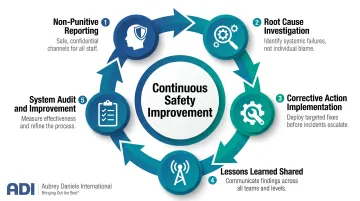
The NSC Near-Miss Reporting framework emphasizes that leadership must establish a reporting culture from the top and demonstrate through action that reporting is valued, not punished.
Key 8: Measure What Matters—Lead with Leading Indicators
Lagging indicators (TRIR, DART rate, lost-time incidents) measure what already went wrong. Leading indicators (near-miss reports, safety observation completion, pre-shift huddle participation, stop-work authority usage) measure proactive activities that prevent harm before it occurs.
OSHA Publication 3970 defines leading indicators as proactive, preventive, and predictive. They should be actionable, timely, practical, and meaningful. Categories include Management Leadership, Worker Participation, and Find and Fix Hazards.
Why Leading Indicators Matter
A culture overly focused on lagging metrics misses opportunities to intervene before harm occurs. The Campbell Institute's Practical Guide found that sole focus on lagging metrics is "not as effective in promoting continuous improvement as using leading indicators to anticipate and prevent injuries."
Three Categories of Leading Indicators:
- Systems-based: Management system audits, compliance rates
- Organization-based: Training completion, safety meeting frequency
- Behavior-based: Observation rates, at-risk behavior frequency, stop-work authority usage
Pair Metrics with Perception Surveys
Conduct periodic safety culture surveys by shift and department to surface perception gaps between management and workers. The 2025 NSC/Campbell Institute white paper emphasizes that "leadership engagement is the single most critical enabler" for leading indicator programs and that perception gaps frequently predict where the next serious incident will occur.
What to Track:
- Number of near-miss reports submitted per month (by shift)
- Percentage of safety observations completed on schedule
- Frequency of stop-work authority invoked
- Attendance and participation rates in safety committees
- Corrective action closure rates within target timelines
- Employee trust scores in reporting systems (from surveys)
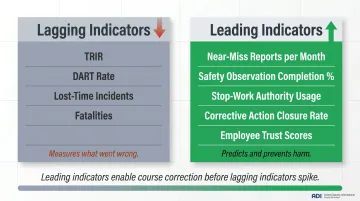
Leading indicators provide early warning signals and enable course correction before lagging indicators spike.
The Role of Behavioral Science in Building a Sustainable Safety Culture
Behavior is driven more powerfully by its consequences than by rules, training, or antecedents alone. Understanding what immediately and consistently reinforces unsafe behavior (speed, convenience, peer acceptance) is essential to lasting change.
Core Behavioral Insight
E.S. Geller's behavioral safety research identified seven principles of behavior-based safety (BBS):
- Focus on observable behavior
- Look for external factors influencing behavior
- Use the ABC model (Activator-Behavior-Consequence)
- Focus on positive consequences to motivate behavior
- Apply the scientific method (DO IT process: Define, Observe, Intervene, Test)
- Use theory to integrate information
- Consider internal feelings and attitudes
Geller's research introduced the "Actively Caring" model, which identifies five psychological states that increase safety participation: self-esteem, belonging, personal control, self-efficacy, and optimism.
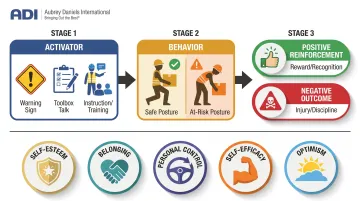
Positive Reinforcement as a Safety Lever
Rather than relying primarily on compliance enforcement and discipline, organizations that systematically reinforce safe behaviors through specific, timely, and meaningful acknowledgment see more lasting change. A systematic review of 18 behavioral safety programs implemented specifically in manufacturing settings demonstrated measurable incident reductions through behavior-based approaches.
ADI's Behavior-Based Approach
That research aligns directly with how Aubrey Daniels International (ADI) has operated for over 45 years. Judy Agnew, Senior Vice President at ADI, co-authored Safe by Accident?, a resource grounded in Applied Behavior Analysis covering workplace safety culture and risk mitigation.
ADI's consulting and workshop services help organizations identify the behavioral drivers behind safety failures, then redesign the reinforcement environment to address them.
Compliance vs. Culture
Rule-following safety depends on surveillance and enforcement — remove the oversight, and the behavior often disappears with it. Value-driven safety is self-sustaining because safe behavior becomes intrinsically and socially reinforced. Behavioral science provides the tools to make that transition real, not just aspirational.
Common Pitfalls That Undermine Safety Culture Progress
Treating Safety Culture as a Campaign
The most frequent mistake is launching safety culture initiatives with fanfare, then letting them fade after initial rollout. When safety culture has a start and finish line, workers recognize management commitment as performative. Trust erodes, and reporting and engagement collapse.
Day-Shift Bias
When leadership presence, resources, and recognition concentrate on the primary shift while off-shifts feel neglected, distinct and often less safety-conscious subcultures develop. Incidents on those shifts become disproportionately likely. Remember the data: injury rates at 1-2 AM are three times higher than midafternoon.
The Compliance Trap
Organizations that focus exclusively on OSHA conformance and recordable rates may achieve short-term numbers without building the underlying culture. Surface metrics look fine—until a serious incident reveals the fragility beneath. GAO found that over 50% of establishments failed to report required injury data, highlighting how compliance focus masks real risk.
Incentive-Driven Suppression
Outcome-based incentive programs create environments where workers are discouraged from reporting. OSHA's 2012 guidance and Geller's research both show how these programs stifle near-miss and injury reporting.
Ignoring Experienced Worker Disengagement
More experienced workers often tune out toolbox talks and safety meetings they've heard dozens of times. When safety communication doesn't evolve to respect their expertise, you lose your most influential peer leaders — the workers others look to and follow.
Avoiding these pitfalls requires more than awareness. Each one demands a deliberate, sustained behavioral response — which is exactly what the keys in this guide are designed to provide.
Conclusion
Safety culture in manufacturing accumulates through daily decisions — how leaders show up on the floor, how near-misses get handled, whether workers feel safe enough to speak up. No single program creates it. What creates it is the consistent application of behavioral principles, clear accountabilities, and a leadership commitment that outlasts any one initiative.
Manufacturing leaders should start with a clear assessment of where their current culture sits on the compliance-to-culture spectrum. Ask:
- Do workers report near-misses without fear?
- Are safety behaviors reinforced as often as production achievements?
- Is leadership visibility consistent across all shifts?
- Do we measure what predicts incidents, or just what records them?
- Is safety integrated into daily decisions, or compartmentalized into meetings?
The metrics matter, but they follow from the foundations: behavioral reinforcement, psychological safety, and leaders who model what they expect. Culture change is gradual. When those foundations are in place, however, it tends to sustain itself — not because of a program, but because the right behaviors get repeated and recognized every day.
Frequently Asked Questions
What is the difference between a safety program and a safety culture?
A safety program is the formal set of policies, procedures, and training an organization has in place. A safety culture reflects what people actually do and how they think about safety when no one is enforcing the rules. Culture is the outcome of sustained behavioral and leadership investment, not documentation alone.
What are the 3 C's of safety?
The 3 C's of safety are Commitment, Communication, and Compliance. These cover leadership's dedication to safety, open information channels, and adherence to established procedures. Behavioral approaches add a fourth dimension: consistent reinforcement of safe behaviors.
What are the 5 S's of safety?
The 5 S's (Sort, Set in Order, Shine, Standardize, Sustain) originate from lean manufacturing and organize the workplace to reduce hazards, improve efficiency, and create visual order. They support safety culture by eliminating environmental conditions that increase incident risk.
What are the 5 C's of a leader?
The 5 C's of leadership are Competence, Character, Commitment, Communication, and Courage. In safety culture, these show up as leaders who model safe behaviors, communicate clear expectations, and make tough calls that protect workers over short-term production pressure.
How do you measure safety culture in manufacturing?
Safety culture is measured using both leading indicators — near-miss reporting rates, safety observation completion, stop-work authority usage — and lagging indicators like TRIR and DART rates. Perception surveys round out the picture by assessing employee trust in reporting systems and comfort raising safety concerns.
Why do traditional safety incentive programs often fail?
Outcome-based incentives—such as bonuses for zero reported injuries—motivate employees to hide incidents rather than prevent them, creating a false picture of safety performance. Effective recognition instead targets specific safe behaviors that reduce risk, reinforcing the actions that actually drive cultural change.