Introduction
Safety programs exist in nearly every regulated workplace. Companies maintain detailed policies, conduct regular training, and post protocols throughout their facilities. Yet incidents continue, near-misses go unreported, and workers treat safety as something to perform during audits rather than practice daily. Generic, off-the-shelf systems are usually the culprit — they don't reflect how work actually happens in that organization.
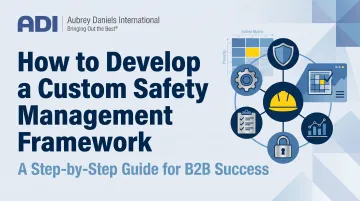
A custom safety management framework addresses this gap by aligning safety policies, risk controls, and behavioral expectations with your organization's specific hazards, workflows, and workforce culture. This guide walks through how to build that framework step by step, with particular attention to the behavioral dimension most generic systems overlook.
Key Takeaways:
- Generic safety frameworks fail because they don't reflect real operational contexts
- Effective frameworks integrate four pillars: Policy, Risk Management, Assurance, and Promotion
- Customization requires mapping actual hazards, roles, and behavioral patterns
- Behavioral factors drive most incidents — and need different interventions than engineering controls
- Leading indicators and behavioral observation sustain culture change over time
Why Generic Safety Frameworks Fall Short
Off-the-shelf safety management templates offer obvious appeal: they deploy quickly, come pre-formatted for regulatory compliance, and require minimal internal expertise to implement. Yet they consistently underperform because they describe what a framework should contain, not how to adapt it to the specific risk profile, operational reality, or workforce culture of a given organization.
The result is a compliance trap. Organizations develop elaborate safety documentation that satisfies regulatory requirements but doesn't influence daily behavior. OSHA's 2012 research distinguishes sharply between programs with genuine management commitment and worker participation versus "paper programs" that exist in documentation only — the latter proving ineffective at reducing injuries.
Organizational culture, supervision quality, and peer behavior determine whether workers actually follow written protocols. When employees perceive safety as a documentation exercise rather than an operational priority, compliance happens primarily under observation. Remove the supervisor, and the behavior changes.
That behavioral gap is where generic frameworks fail most visibly — and where customization matters most.
A custom safety management framework is built by mapping your organization's actual hazards, job roles, workflows, and behavioral patterns. Building one requires:
- Direct hazard identification from your specific operations and equipment
- Input from workers who perform high-risk tasks daily
- Analysis of historical incident patterns unique to your facility
- Understanding which behaviors your current systems inadvertently reinforce
Frameworks built this way reflect operational reality — so workers trust them and actually use them.
The Core Components of a Custom Safety Management Framework
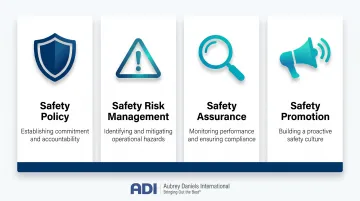
Regardless of industry, effective safety management rests on four foundational pillars. The framework that follows originates from aviation (ICAO) but translates across sectors. Customization happens within and across these pillars, not instead of them.
The four pillars:
- Safety Policy - Leadership commitment and accountability structure
- Safety Risk Management - Hazard identification and control prioritization
- Safety Assurance - Monitoring, auditing, and corrective action
- Safety Promotion - Training, communication, and culture development
Safety Policy and Leadership Commitment
A meaningful safety policy extends beyond a signed statement. It defines measurable objectives, assigns accountability at every organizational level, and demonstrates genuine management commitment through visible action.
OSHA's research involving over 270 safety experts identified management leadership and employee involvement as the two most important elements of an effective safety system. Leadership visibility in safety activities—participating in safety walks, reviewing incident data in leadership meetings, responding visibly when concerns are raised—directly shapes whether employees treat safety as genuine priority or performative compliance.
Safety Risk Management
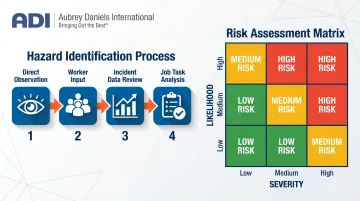
The safety risk management process follows this sequence: hazard identification, risk analysis (likelihood × severity), risk assessment using a risk matrix, and implementation of controls following the hierarchy of controls.
The custom element here means identifying hazards specific to your operations, equipment, and workforce behaviors—not importing a generic industry checklist. This requires direct observation, worker input, and analysis of your historical incident data.
Safety Assurance
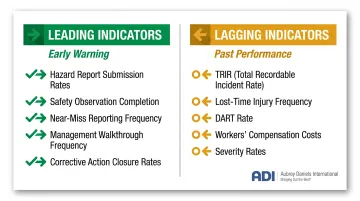
Safety assurance provides the monitoring function: internal audits, incident investigations, near-miss reporting systems, and corrective action tracking. Effective assurance uses both:
- Leading indicators: Hazard reports filed, safety observations conducted, training completion rates
- Lagging indicators: Injury rates, lost-time incidents, workers' compensation costs
OSHA's leading indicators guidance notes that lagging metrics tell you what already went wrong, while leading indicators provide early warning signals before incidents occur.
Safety Promotion
Safety promotion builds culture through training, communication, and creating environments where employees feel safe reporting concerns without fear of punishment. It's also the most frequently underdeveloped component in generic frameworks—and where applying behavioral reinforcement principles produces the most measurable culture shift.
Effective safety promotion includes:
- Consistent recognition for safe behaviors, not just consequences for unsafe ones
- Open near-miss reporting systems that reward disclosure rather than punish it
- Communication channels that make hazard reporting easy and visible
- Training designed around behavior change, not just information transfer
How to Build a Custom Safety Management Framework: Step-by-Step
Building a custom framework follows a phased development process. Organizations at different maturity levels enter at different points, but every framework starts with honest assessment, not documentation.
Step 1: Conduct a Gap Analysis and Baseline Assessment
Begin by understanding where your organization currently stands:
- Audit existing safety policies, procedures, and incident records
- Identify gaps between current practices and regulatory requirements (OSHA standards, ISO 45001, industry-specific mandates)
- Assess what exists on paper but doesn't function in practice
The output is a prioritized list: what you have, what's missing, and what requires strengthening.
Step 2: Define Scope, Roles, and Accountability Structures
Set clear boundaries:
- Which sites, departments, and job functions does the framework cover?
- Who owns each component (policy development, risk management, auditing)?
- What does accountability look like at each organizational level?
Assign named accountability, not just job titles. Vague ownership is one of the main reasons safety programs stall.
Step 3: Perform Hazard Identification and Risk Prioritization
Map hazards specific to your operations using:
- Direct observation of work processes
- Frontline worker input from those performing high-risk tasks
- Historical incident and near-miss data
- Job task analysis for critical positions
Apply a risk matrix (likelihood × severity) to prioritize where control resources should focus first.
Step 4: Design Controls and Document Procedures
Build the operational core:
- Standard operating procedures for high-risk tasks
- Inspection and audit protocols
- Emergency response plans
- Incident reporting and investigation systems
Write procedures for the people who will use them—plain language, role-specific, and developed with frontline input to ensure they reflect actual workflows.
Step 5: Roll Out in Phases with Role-Based Training
Implement starting with highest-risk areas or most-ready teams. Differentiate training by role:
- Frontline workers: Procedure understanding, hazard recognition, reporting mechanisms
- Supervisors: Observation skills, coaching techniques, incident investigation
- Executives: Leadership behaviors that reinforce safety culture
Training creates awareness. Sustaining that awareness over time requires structured follow-through—which is where review cycles become essential.
Step 6: Establish Review Cycles and Continuous Improvement
Build formal review mechanisms:
- Scheduled safety audits (quarterly recommended)
- Management reviews with documented decisions
- Corrective action tracking and closure verification
- Annual program evaluations
A custom framework is never truly finished. As operations shift and performance data accumulates, the review cycle surfaces what's working, what's not, and where the next improvements should go.
Why Behavior Is the Missing Link in Most Safety Frameworks
Most safety frameworks emphasize engineering controls and administrative procedures but underinvest in the behavioral dimension. Research published in the International Journal of Occupational Medicine and Environmental Health indicates approximately 90% of workplace incidents involve unsafe behavior and human error—though this figure, originating from Heinrich's 1931 study, should be understood directionally given methodology limitations.
The critical insight: employees may comply with procedures under observation but revert to at-risk shortcuts when compliance pressure disappears. This reflects a fundamental difference between rule-following and genuine safety behavior.
Compliance versus participation:
Neal, Griffin, and Hart (2000) established two distinct behavioral dimensions:
- Safety compliance: Following standard operating procedures (mandatory, in-role behavior)
- Safety participation: Voluntary proactive safety actions like reporting hazards and suggesting improvements (discretionary, extra-role behavior)
Griffin's 2013 research found that different leadership approaches drive each type. Safety monitoring drives compliance; safety-inspiring leadership drives participation. Frameworks relying solely on monitoring address compliance but not the discretionary behaviors that build culture.
Behavioral observation and feedback:
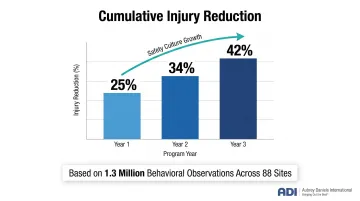
Systematic peer observation programs combined with specific positive feedback help shift culture from compliance-based to values-based safety. A 2022 study across 88 international sites with over 1.3 million behavioral observations found average injury reductions of 25% (Year 1), 34% (Year 2), and 42% (Year 3)—demonstrating cumulative effectiveness when properly implemented.
The role of positive reinforcement:
OSHA's 2012 policy memorandum warns that rate-based safety incentive programs (rewarding zero-incident outcomes) can suppress injury reporting. OSHA recommends activity-based programs that reward proactive behaviors:
- Reporting near-misses before they escalate
- Identifying and flagging hazards proactively
- Participating in safety committees and improvement discussions
When employees receive meaningful recognition for proactive safety actions, safe behavior becomes self-sustaining rather than surveillance-dependent.
Embedding behavioral science into your framework:
This is where behavioral expertise matters most. ADI has spent over 45 years applying Applied Behavior Analysis to organizational performance across industries from manufacturing to mining. Judy Agnew's co-authored book Safe by Accident? offers observation checklists, reinforcement schedules, and feedback frameworks specifically designed to address the human element that compliance-focused systems leave unresolved.
Measuring What Matters: Safety Performance Monitoring and Continuous Improvement
Relying solely on lagging indicators—incident rates, lost-time injuries, workers' compensation costs—tells you what already went wrong, not what might go wrong next. The Campbell Institute concluded that sole focus on lagging metrics is "ineffective in driving continuous improvement," while leading indicators provide early warning signals.
Building a Performance Monitoring Dashboard
Select 3–5 leading and 3–5 lagging KPIs relevant to your risk profile:
Leading indicators:
- Hazard report submission rates
- Safety observation completion percentage
- Near-miss reporting frequency
- Management safety walkthrough frequency
- Corrective action closure rates
Lagging indicators:
- Total recordable incident rate (TRIR)
- Lost-time injury frequency
- Days away/restricted/transferred (DART) rate
- Workers' compensation costs
- Severity rates
Assign ownership for tracking each metric and establish a regular review cadence: monthly operational reviews, quarterly management reviews, and annual program audits.
Management Review as an Accountability Mechanism
Leadership should review safety performance data on a defined schedule, evaluate whether the framework functions as designed, and document decisions about adjustments. Review frequency should align with applicable requirements:
- OSHA: No universal annual review mandate, but many specific standards require periodic program reviews
- ISO 45001: Requires management review at planned intervals — quarterly reviews are recommended for meaningful improvement cycles
ADI's Performance Management methodology supports this process by focusing on the behaviors that drive outcomes, not just the outcomes themselves. Rather than reacting to incident counts after the fact, the approach helps leaders set measurable behavioral goals, track leading indicators consistently, and reinforce the actions that reduce risk before incidents occur.
Common Pitfalls to Avoid When Building Your Safety Framework
Lack of leadership ownership beyond launch:
Leaders who champion frameworks during rollout but disengage from ongoing activities send a clear signal: safety is a project, not a value. OSHA's guidance notes that increased management response time to hazard reports signals "lack of management concern," leading to lower worker morale and decreased reporting.
Sustained involvement looks like:
- Participating in regular safety walks
- Reviewing incident data in leadership meetings
- Responding visibly when concerns are raised
Treating the framework as documentation:
Organizations with elaborate safety manuals that don't translate to daily operational routines achieve "paper compliance"—systems that look complete on audit but don't influence behavior. The test of a real framework: can frontline workers describe it in their own words and apply it in real situations?
Skipping the behavioral foundation:
Paper compliance exposes the deeper issue: no set of controls or procedures sustains itself without addressing what actually reinforces safe behavior day to day. Building a framework without this foundation means supervisors spend their time enforcing rules rather than reinforcing habits — and the moment that pressure lifts, behavior drifts. Organizations that close this gap see safety become embedded in how work gets done, not just how it gets documented.
Frequently Asked Questions
What are the key components of a safety management system?
The four core components are Safety Policy (leadership commitment and objectives), Safety Risk Management (hazard identification and control), Safety Assurance (monitoring and auditing), and Safety Promotion (training and culture building). Effective systems integrate all four rather than treating them as separate programs.
What are the 6 functional requirements for a safety management system?
The six commonly cited requirements are management commitment, hazard identification, risk assessment, risk control, performance monitoring, and continuous improvement. These are framed differently across standards like ISO 45001 and ICAO frameworks but reflect the same core principles.
What are the 5 steps of risk management?
The five steps are hazard identification, risk analysis (likelihood and severity), risk assessment (acceptable versus unacceptable using a risk matrix), risk control (applying hierarchy of controls), and monitoring/review to ensure controls remain effective.
What is risk assessment in safety management?
Risk assessment evaluates identified hazards by analyzing the probability of harm and the severity of potential consequences — typically using a risk matrix to prioritize where controls are most urgently needed. Organizations use this process to direct resources toward highest-risk exposures first.
Do OSHA programs require annual review?
Not universally — but many specific OSHA standards (process safety management, emergency action plans) require periodic reviews. OSHA's Injury and Illness Prevention Program guidance recommends at least annual evaluation of overall safety program effectiveness.
Ready to build a safety management framework that drives real behavioral change? ADI has partnered with organizations across manufacturing, energy, mining, and utilities to implement behavior-based safety programs that produce measurable, lasting results. Contact ADI at 1-678-904-6140 or info@aubreydaniels.com to learn how behavior-based safety can integrate with your custom framework development.