Introduction
Every year, nearly 2.93 million workers die globally from work-related accidents and diseases, according to the International Labour Organization—with approximately 330,000 deaths resulting from occupational accidents alone. In the United States, 5,070 workers died from work-related injuries in 2024, meaning a worker died every 104 minutes. These aren't just statistics—they represent preventable tragedies that devastate families, disrupt operations, and cost businesses billions annually.
Most industrial incidents don't happen by chance. They stem from a predictable chain: unaddressed hazards, inadequate controls, and unsafe behaviors that go unchecked. What separates high-incident workplaces from low-incident ones comes down to whether organizations systematically identify risks, apply the right safeguards, and build cultures where safe behavior is consistently reinforced—not just required on paper.
This guide walks you through the complete framework for industrial safety management. It covers the seven major hazard types, the assessment tools (HIRA and JSA) that identify risks before incidents occur, the hierarchy of controls that prioritizes the most effective safeguards, and the cultural factors that determine whether those controls hold in practice.
TLDR
- Industrial safety management prevents worker harm, costly downtime, and regulatory penalties across high-risk environments like manufacturing, construction, and energy
- The seven major hazard types—chemical, physical, biological, ergonomic, mechanical, electrical, and psychosocial—often overlap and require structured assessment
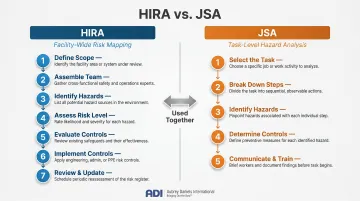
- Use HIRA for facility-wide risk mapping and JSA to zoom into task-level hazards — they work best together
- The hierarchy of controls prioritizes elimination and engineering solutions over administrative controls and PPE because they don't rely on human behavior
- Sustainable safety requires consistent reinforcement of safe behaviors, not just controls installed and left unmonitored
What Is Industrial Safety and Why Does It Matter
Industrial safety management is the systematic process of identifying, evaluating, and controlling hazards to protect workers, assets, and operations across high-risk environments—including manufacturing, construction, mining, oil and gas, and similar sectors. In the United States, OSHA (the Occupational Safety and Health Administration) serves as the primary regulatory body, setting enforceable standards across most industrial industries under the Occupational Safety and Health Act of 1970.
The stakes extend far beyond regulatory compliance. Industrial safety failures produce three layers of consequence that make safety management a business-critical priority:
- Worker harm — injuries, illnesses, and fatalities with lasting consequences for workers and their families
- Financial exposure — the total cost of work injuries in 2024 reached $181.4 billion, per the National Safety Council, including $54.9 billion in wage and productivity losses, $36.8 billion in medical expenses, and $64.5 billion in administrative costs
- Operational disruption — downtime, legal liability, rising insurance premiums, and reputational damage that compounds over time
Industrial safety management is an integrated discipline — not a one-time program. It spans hazard recognition, risk control, training, emergency preparedness, and cultural reinforcement. These elements are mutually dependent: controls without training fail in practice, and training without cultural backing erodes under production pressure.
This guide addresses each component in sequence, showing how they work together to build lasting protection.
The 7 Types of Industrial Hazards
Hazard classification is the starting point for any safety program—you cannot control what you haven't categorized. OSHA and international safety bodies recognize seven primary hazard types commonly found across industrial workplaces. Understanding these categories helps safety professionals conduct thorough assessments and select appropriate controls.
Hazard Categories at a Glance
The seven categories span a wide range of exposure types:
- Physical — noise, vibration, extreme temperatures, and radiation. Foundry workers face heat and noise levels that cause permanent hearing loss; nuclear facilities require strict containment and monitoring protocols.
- Chemical — toxic, corrosive, or flammable substances. A single spilled corrosive can injure workers immediately and shut down entire production areas.
- Biological — bacteria, viruses, bodily fluids, and mold. Wastewater treatment workers encounter pathogens through direct contact with contaminated water and surfaces; healthcare and lab settings carry similar risks.
- Ergonomic — repetitive motion, improper lifting, and poor workstation design. Assembly line workers repeating the same motion thousands of times per shift develop musculoskeletal disorders that cause chronic pain and drive up absenteeism.
- Mechanical — moving parts, sharp edges, pinch points, and unguarded machinery. Conveyor systems, presses, and rotating equipment can catch clothing or crush limbs when safeguards fail or workers bypass them.
- Electrical — shock, electrocution, arc flash, and fire from uninsulated wiring or improper grounding. Arc flash incidents, common in utilities and high-voltage facilities, can cause severe burns and fatalities.
- Psychosocial — workplace stress, fatigue, shift work, and poor management practices that increase error rates. The WHO formally classifies these as occupational hazards, linking time pressure, lack of task control, and long hours to both mental health deterioration and safety failures.
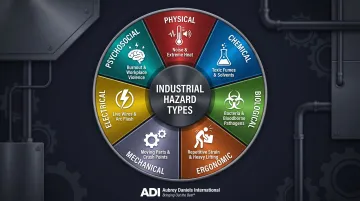
In practice, most facilities deal with several of these categories at once. A chemical plant handles toxic substances, high temperatures, rotating pumps, electrical systems, and shift-driven fatigue within the same operation. That overlap is precisely why systematic assessment tools — not informal walkthroughs — are required: a hazard missed in one category can interact with another to create failures no single-point inspection would catch.
Hazard Identification and Risk Assessment: HIRA and JSA Explained
HIRA (Hazard Identification and Risk Assessment) is the formal process organizations use to proactively find and evaluate workplace hazards before incidents occur. OSHA identifies it as a cornerstone requirement under its Recommended Practices for Safety and Health Programs, where it appears as one of seven core elements of an effective safety program.
How HIRA Works: The 7-Step Process
The HIRA methodology follows seven sequential steps:
Define the scope and assemble the team — Determine which areas, processes, or operations will be assessed and bring together supervisors, workers, safety staff, and subject matter experts
Identify all potential hazards — Use workplace surveys, incident history review, regulatory checklists, and direct worker input to catalog every hazard present
Determine who is at risk and under what conditions — Identify which workers, contractors, or visitors face exposure, and specify the circumstances (routine operations, maintenance, emergencies)
Evaluate likelihood and severity — Use a risk matrix to rate each hazard based on how likely harm is to occur and how severe the consequences would be
Determine and implement risk control measures — Apply the hierarchy of controls to select the most effective safeguards for each identified hazard
Document findings and assign responsibilities — Record all hazards, assigned controls, responsible parties, and target completion dates in a formal register
Review and update the assessment regularly — Revisit the HIRA on a defined schedule (annually, quarterly, or whenever conditions change—new equipment, process modifications, incidents)
Worker involvement at each stage isn't optional. Front-line employees have direct knowledge of conditions that supervisors and safety officers may miss. OSHA explicitly recommends worker participation as a best practice, stating that workers "often know the most about potential hazards associated with their jobs."
Job Safety Analysis (JSA): Hazard Assessment at the Task Level
JSA (also called Job Hazard Analysis or JHA) zooms into individual job tasks, breaking each one into sequential steps to identify specific hazards and controls at every point. This makes it useful for high-risk or nonroutine tasks—confined space entry, hot work, crane lifts, or maintenance on energized equipment.
The 5 steps of JSA:
- Select the job to analyze — Prioritize based on injury history, risk severity, frequency of performance, or newness of the task
- Break the job into sequential steps — List each step in order, keeping steps specific enough to identify hazards but not so granular that you have 50 steps
- Identify hazards present at each step — Ask what could go wrong at each point in the sequence
- Determine preventive measures for each hazard — Apply the hierarchy of controls to specify what safeguards will protect workers at that step
- Document, communicate, and update — Share the completed JSA with all affected workers and revise when the task changes
HIRA and JSA operate at different scales but answer the same question: where could someone get hurt, and what stops that from happening? HIRA maps the facility-wide risk picture—what hazards exist across the site and how they rank. JSA addresses specific tasks—exactly what can go wrong at each step of a high-risk job and what controls are in place. Used together, they give safety teams both the strategic overview and the task-level detail needed to make informed decisions before work begins.
The Hierarchy of Hazard Controls: Selecting the Right Safeguard
NIOSH's Hierarchy of Controls is the gold-standard framework for deciding how to address identified hazards. The hierarchy ranks controls from most to least effective. Controls higher on the hierarchy rely less on human behavior, making them more reliable over time.
The five control levels, from most to least effective:
Elimination physically removes the hazard from the workplace. Redesigning a process to eliminate a toxic chemical entirely means no exposure can occur, no matter what workers do. This is the preferred solution whenever feasible.
Substitution replaces the hazard with a less dangerous alternative. Switching from a solvent-based paint to a water-based formulation reduces toxicity and flammability risk without changing the core process.
Engineering controls isolate people from the hazard through physical changes. Machine guarding prevents contact with moving parts, ventilation systems remove airborne contaminants, and interlocks shut down equipment when safety doors open. These controls work automatically, with no reliance on workers remembering to act.
Administrative controls change how people work to reduce exposure. Job rotation limits ergonomic strain by varying tasks, permit-to-work systems require authorization before high-risk activities, and lockout/tagout procedures prevent accidental equipment startup. These controls require consistent human compliance to work.
PPE (personal protective equipment) protects the worker directly as a last resort. Respirators, hard hats, safety glasses, gloves, and protective clothing provide a barrier between the worker and the hazard—but only when workers wear them correctly and consistently.
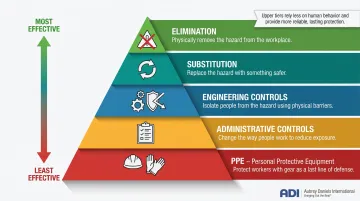
The critical limitation of relying too heavily on PPE and administrative controls: both depend on consistent human behavior and therefore have higher failure rates. NIOSH states that elimination, substitution, and engineering controls "are more effective because they control exposures without significant human interaction," while PPE is effective "only when workers use it correctly and consistently."
Developing and Implementing a Hazard Control Plan
Effective control implementation follows a structured process:
- List hazards in priority order — Address the worst-first: any serious hazard that could cause death or serious physical harm must be eliminated or controlled immediately, per OSHA guidance
- Assign clear ownership — Specify who is responsible for implementing each control measure
- Set target completion dates — Establish realistic deadlines and track progress
- Define verification methods — Determine how you'll confirm controls remain effective (inspections, industrial hygiene monitoring, observation programs)
OSHA's Hazard Prevention and Control page emphasizes that interim controls may be necessary while permanent solutions are developed—but the overall goal is effective long-term control. When resources are limited, implement measures on a "worst-first" basis, prioritizing controls that are the most feasible, effective, and permanent.
Controls are not a one-time fix. Regular inspections, industrial hygiene monitoring, and worker feedback loops are needed to confirm that controls remain effective as operations, equipment, and personnel change.
Engineering guards get removed during maintenance and never replaced. Ventilation systems lose effectiveness when filters clog. Administrative procedures drift when supervisors don't reinforce them. Without consistent follow-up, even well-designed control programs quietly fail when it matters most.
Building a Behavior-Based Safety Culture That Sustains Results
Most industrial safety programs suffer from a behavior gap: organizations install controls, post procedures, and deliver training—yet incidents keep happening. Occupational safety research consistently finds that 80-90% of serious workplace injuries trace back to human behavior as a contributing factor.
Compliance-based approaches tell workers what to do but don't address why people behave unsafely—especially when safe behaviors are inconvenient, or when unsafe shortcuts go unnoticed and unpunished.
The difference between a reactive safety culture and a proactively reinforced one determines whether safety systems hold under pressure. Reactive cultures focus on incident investigation and enforcement after something goes wrong. Proactive cultures consistently recognize and reinforce safe behaviors before incidents occur. The result is discretionary safe behavior—workers who follow safe practices even when no one is watching.
The Critical Role of Leadership Behavior
Leaders set the behavioral norms that define what's actually valued in an organization. When leaders visibly participate in safety audits, solicit hazard reports without blame, and use positive reinforcement to acknowledge safe behaviors, they create the conditions for a self-sustaining safety culture.
Conversely, when production pressure routinely overrides safety—when supervisors praise workers for skipping lockout/tagout to save time, or when safety concerns get dismissed as obstacles—workers quickly learn what the organization truly values, regardless of what the policy manual says.
NIOSH identifies several key attributes of an effective safety culture that leadership must actively model:
- Strong, visible support from organizational leadership at every level
- A blame-free environment where errors and near-misses get reported, not hidden
- Demonstrated organizational commitment of resources to address safety concerns
What Behavior-Based Safety Reinforcement Looks Like in Practice
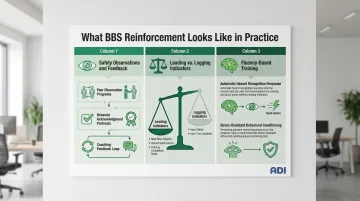
Organizations seeking to move beyond compliance and build cultures where safe behavior becomes the norm need practical systems for measuring and reinforcing specific behaviors:
- Safety observations and feedback: A structured tool for peers and supervisors to observe work, acknowledge safe behaviors, and coach specific improvements—not a blame mechanism
- Leading indicators over lagging indicators: The Campbell Institute found that organizations using a balanced scorecard of both achieve better outcomes than those relying solely on injury rates. Leading indicators include near-miss reports, hazard submissions, safety observations completed, and training completion rates
- Fluency-based training: Effective programs build automatic responses to hazards—so workers react correctly even under stress or time pressure, not just when conditions are ideal
ADI's work in this area is grounded in over 45 years of applied behavior analysis across industrial and high-hazard environments. Safe by Accident?, co-authored by Judy Agnew, Senior Vice President at ADI, translates that science into a practical framework organizations can implement to make safe behavior the default—not the exception.
Frequently Asked Questions
What is hazard identification in industrial safety?
Hazard identification is the systematic process of recognizing conditions, substances, or behaviors in the workplace that have the potential to cause harm. It's the first step of HIRA — without it, risk evaluation and control selection have no starting point.
What are the 7 steps of HIRA?
HIRA follows seven steps:
- Define scope and assemble the team
- Identify all potential hazards
- Determine who is at risk
- Evaluate risk using likelihood and severity
- Select and implement controls using the hierarchy
- Document findings with assigned responsibilities
- Review and update the assessment regularly
What are the 5 steps of JSA?
A JSA covers five steps:
- Select the job to analyze based on risk level
- Break the job into sequential tasks
- Identify hazards present at each step
- Determine preventive controls for each hazard
- Document and communicate the JSA to all affected workers
What are the 7 types of hazards?
Industrial hazards fall into seven categories: physical, chemical, biological, ergonomic, mechanical, electrical, and psychosocial. Most workplaces involve several of these simultaneously, which is why structured assessment methods like HIRA exist.
What are the 7 basic general industry safety rules?
Seven fundamentals apply across virtually every industrial setting:
- Wear appropriate PPE at all times
- Follow lockout/tagout procedures without exception
- Keep work areas clean and organized
- Report hazards immediately
- Know and follow emergency procedures
- Never bypass safety guards or controls
- Participate in all required safety training
What are the 4 industrial safety measures?
Four measures form the backbone of industrial safety:
- Risk assessment — identifying and evaluating hazards before work begins
- Engineering and administrative controls — eliminating or reducing hazards at the source
- Personal protective equipment — providing last-line physical protection for workers
- Safety training — ensuring workers understand hazards and know how to respond