Introduction
Workplace injuries cost U.S. employers $181.4 billion annually, according to the National Safety Council — covering medical costs, lost productivity, and administrative expenses. In 2024 alone, the Bureau of Labor Statistics recorded 5,070 fatal work injuries, a rate of one worker death every 104 minutes.
Yet most safety failures aren't caused by reckless individuals. They're the product of systems that discourage honest reporting. 90% of workplace incidents, hazards, and near-misses go underreported, according to a 2026 EHS benchmarking study. The reason? Fear of punishment drives organizational silence.
While "safety culture" is widely discussed, most organizations still default to blame-based responses after incidents. That reflex silences the very reporting that could prevent the next one. This guide breaks down what a fair and just culture is, why it works, and how to build one that holds.
Key Takeaways
- Just culture assigns accountability at the right level — system design falls on the organization, behavioral choices fall on the individual
- It improves safety by making it psychologically safe to report errors and hazards before they escalate
- It distinguishes human error, at-risk behavior, and reckless behavior so responses stay proportionate to actual culpability
- Without it, organizations experience underreporting, repeat incidents, and a workforce that hides problems
- Building it requires deliberate leadership behavior, clear frameworks, and consistent reinforcement
What Is a Fair and Just Culture?
A fair and just culture is a system of shared accountability. Organizations are responsible for the systems they design — the workflows, equipment, staffing levels, and procedures that shape daily work. Employees are responsible for the quality of their behavioral choices within those systems. Critically, organizational responses are calibrated to the nature of the behavior, not just the severity of the outcome.
At the heart of this model are three behavioral categories, defined by David Marx and since adopted by regulatory bodies including AHRQ and The Joint Commission:
| Behavior Type | Definition | Appropriate Response |
|---|---|---|
| Human Error | Inadvertent action; slip, lapse, or mistake | Console the individual; redesign the system |
| At-Risk Behavior | Behavioral choice that increases risk where risk isn't recognized or is mistakenly believed justified | Coach the individual; remove incentives for risk |
| Reckless Behavior | Conscious disregard of substantial and unjustifiable risk | Disciplinary action warranted |
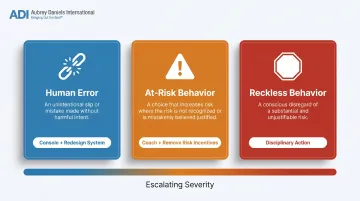
Treating all three the same way — either through blanket punishment or blanket tolerance — is both unfair and counterproductive. A nurse who makes a medication error due to confusing labeling needs system-level support, not discipline. A worker who consciously bypasses a safety lockout requires accountability. Just culture ensures the response matches the behavior.
That calibrated response serves a clear purpose: creating conditions where people report near-misses, flag hazards, and surface problems honestly — the exact information organizations need to prevent serious incidents before patterns become tragedies.
Key Safety Advantages of a Fair and Just Culture
The advantages below are operational and measurable — they directly affect the metrics organizations use to track safety performance, incident rates, and organizational learning.
Advantage 1: Higher Reporting Rates for Near-Misses and Hazards
Just culture removes the primary barrier to reporting: fear of punishment. This shift increases the volume of safety-relevant information coming from the frontline.
When employees trust that honest reporting leads to system improvement rather than personal blame, near-misses and at-risk conditions surface before they become injuries or fatalities. Heinrich's foundational safety research analyzed over 75,000 accident reports and found that for every major injury, there are approximately 29 minor injuries and 300 near-misses — a ratio that makes clear how much preventable risk goes unreported in punitive environments.
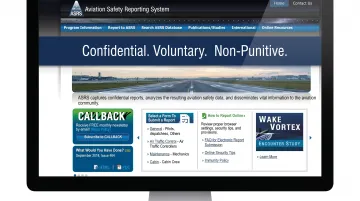
NASA's Aviation Safety Reporting System (ASRS), a voluntary, confidential, non-punitive reporting system established in 1976, has collected over 2 million safety reports. The FAA offers reporters protection against certificate action and civil fines in exchange for this data, which is used to identify systemic hazards and prevent future incidents. This model demonstrates how removing fear unlocks safety intelligence.
KPIs impacted:
- Near-miss report volume
- Leading safety indicators
- Hazard identification rate
- Incident frequency rates
When this advantage matters most: In high-complexity, high-consequence environments — healthcare, nuclear, aviation, chemical processing — the gap between near-misses and catastrophic failure is narrow. Early reporting is the difference between learning and tragedy.
Advantage 2: More Proportionate Accountability and Better Behavioral Outcomes
Just culture doesn't eliminate accountability — it improves it. By distinguishing between behaviors that warrant coaching and system redesign versus behaviors that warrant disciplinary action, organizations create better behavioral outcomes.
When employees see that mistakes are met with support and at-risk behaviors are corrected rather than punished, they're more likely to seek help, ask questions, and follow safe procedures consistently. Research published in Frontiers in Health Services confirms that "retributive justice — where the emphasis is on penalizing individuals for errors — undermines learning and safety," while just culture "focuses on repairing harm and supporting the well-being of everyone affected."
A safety leadership training study published in Safety and Health at Work found that coaching-based interventions increased safety compliance from 80.38% to 95.68% — a 15.3 percentage-point improvement — and measurably improved safety climate scores.
KPIs impacted:
- Safety compliance rates
- Behavioral observation data
- Repeat incident rates
- Employee engagement in safety programs
When this advantage matters most: In organizations managing large frontline workforces where supervisors make daily judgment calls about how to respond to errors and deviations. Consistency in proportionate response builds trust and reinforces safe behavior.
Advantage 3: Stronger Organizational Learning and Continuous Safety Improvement
Those behavioral improvements don't stop at the individual level — they generate data. When safety information flows freely, organizations can identify patterns, address root causes, and redesign systems before harm occurs rather than reacting after the fact.
This advantage compounds over time. Each reported near-miss, deviation, or anomaly becomes an input for improvement. Organizations that sustain just culture build an increasingly accurate picture of how work actually happens versus how it's assumed to happen.
Case example: When Paul O'Neill became CEO of Alcoa in 1987, he made workplace safety his sole strategic priority with a target of zero injuries. The lost workday injury rate declined from 1.86 per 100 workers in 1987 to 0.2 per 100 workers by 1999. Net income grew five times higher during his tenure, and market capitalization increased from $3 billion to over $27 billion. Rigorous accident analysis, direct reporting channels, and strict accountability for dishonesty about safety drove process improvements that also accelerated operational efficiency and communication across the organization.
KPIs impacted:
- Root cause identification rate
- Corrective action completion
- Safety audit scores
- Long-term injury and illness rates
- OSHA recordable rates
When this advantage matters most: At scale. Larger organizations or those with complex operations and multiple sites gain disproportionate value from the aggregated learning that just culture enables.
What Happens When Just Culture Is Absent
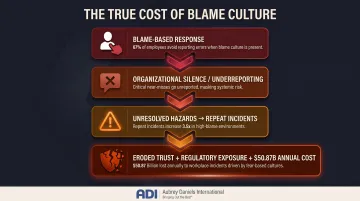
Without just culture, most organizations fall into a default pattern: a blame-based response where whoever was closest to the incident is held responsible, regardless of systemic factors. This creates organizational silence, where safety-critical information stays hidden at the frontline rather than being reported up.
The consequences are predictable:
- Underreporting leads to unresolved hazards
- Unresolved hazards lead to repeat incidents
- Repeat incidents erode workforce trust and increase regulatory exposure
Liberty Mutual's 2025 Workplace Safety Index found that the top 10 causes of serious, non-fatal workplace injuries cost U.S. companies $50.87 billion per year in direct workers' compensation costs alone. Many of these injuries are preventable if organizations could access the early warnings their frontline workers observe daily.
The problem doesn't stop at the frontline. In a blame culture, managers self-protect too — supervisors downplay problems, investigations focus on individual fault rather than system failure, and the organization loses the ability to learn from the near-misses that precede every serious accident.
Case in point: The Francis Report (2013) investigated Mid Staffordshire NHS Foundation Trust and found an estimated 1,200 avoidable patient deaths. The inquiry identified three compounding failures:
- A "shame/blame culture of fear" that suppressed quality and safety concerns
- Staff engaged in "willful blindness" and normalization of deviance
- A deep disconnect between frontline staff and organizational leadership
The report's central conclusion was direct: "What you permit, you promote." Leaders bear responsibility for the standards they fail to enforce.
How to Build a Fair and Just Culture That Lasts
Just culture doesn't take hold through policy updates alone. It requires leaders at every level to consistently model the right responses to errors — and to keep doing so long after the initial rollout.
ADI's approach, grounded in over 45 years of behavioral science expertise, emphasizes that sustainable culture change depends on reinforcement, not one-time training. Senior Vice President Judy Agnew co-authored Safe by Accident?, which applies behavioral science principles directly to workplace safety culture — showing how leadership actions create the conditions for just culture to take root.
Three Practical Levers to Activate
1. Create a clear, shared framework
Define how your organization distinguishes error types and what proportionate responses look like. Both employees and managers need to know what to expect. Use structured tools like behavioral consequence analysis to identify root causes without defaulting to blame.
When Fairview Health Services implemented just culture, they conducted a "big bang" educational session for 350 leaders that caused "the organizational perspective on justice and accountability to shift almost overnight," according to AHRQ's Patient Safety Network. That kind of leadership alignment compresses what might otherwise take years into months.
2. Actively recognize and reinforce proactive safety behaviors
Don't just measure compliance — reinforce employees who surface risks and near-misses voluntarily. When reporting leads to visible system improvements and positive recognition, it becomes a reinforced behavior.
The maritime company Moran increased near-miss reports from 2-3 per month to 150-180 per month through safety leadership coaching that engaged managers in reinforcing safe practices and proactive reporting. Safe behaviors improved from 70% to 90% in the second month.
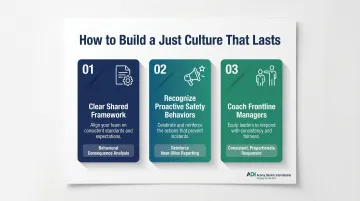
3. Support frontline managers with specific coaching
Frontline supervisors make the daily judgment calls that either build or erode just culture. Train them on how to respond consistently and fairly to safety deviations — distinguishing when to coach, when to redesign systems, and when to hold individuals accountable.
The U.S. Nuclear Regulatory Commission's Safety Culture Policy Statement identifies "Leadership Safety Values and Actions" as Trait 1 of a positive safety culture: "Leaders demonstrate a commitment to safety in their decisions and behaviors." Visible, consistent leadership commitment is foundational.
Sustainability Requires Reinforcement
Just culture must be embedded in how performance is reviewed, how incidents are investigated, and how safety conversations happen day-to-day. Consistency in leadership behavior determines whether it takes hold or fades after the initial rollout.
Three specific practices keep just culture alive beyond the launch:
- Performance reviews that evaluate how managers handle errors, not just outcomes
- Incident investigations that default to system analysis before individual accountability
- Regular safety conversations where near-miss reports are acknowledged and acted on visibly
Organizations that skip these reinforcement steps don't maintain a neutral state — they drift back toward blame.
Conclusion
A fair and just culture improves safety not through softer standards, but through smarter ones. It generates better safety data, drives more appropriate behavioral responses, and creates the organizational learning engine that prevents serious incidents over time.
Organizations that commit to just culture consistently see measurable improvements in safety outcomes, workforce trust, and their ability to scale safe operations. The dividends compound over time:
- Reported near-misses become opportunities to prevent the next serious injury
- Honest conversations build the psychological safety that surfaces hidden risk
- Proportionate responses reinforce the behaviors that keep people safe
The cost of inaction — $181.4 billion annually in the U.S. alone, 5,070 preventable deaths, and countless near-misses that signal the next tragedy — is reason enough to act. Just culture is the foundation organizations build when they're serious about preventing the next incident — not just responding to the last one.
Frequently Asked Questions
Why does a fair and just culture improve safety?
Just culture removes the fear of punishment that suppresses reporting, so hazards, near-misses, and at-risk conditions get identified and corrected before they cause serious harm. It makes safety a shared, active responsibility rather than a compliance exercise.
What is the just culture model?
The just culture model categorizes behavior into three types: human error, at-risk behavior, and reckless behavior. Each type calls for a proportionate organizational response that balances individual accountability with the systemic and situational factors that shape behavior.
What is one key difference between just culture and a blame-free culture?
A blame-free culture eliminates all accountability, while just culture maintains accountability calibrated to intent and behavior type. Reckless behavior still warrants consequences, but organizations respond to honest mistakes with support and system-level investigation rather than punishment.
What is the culture of accountability in healthcare?
Accountability in healthcare means both the organization and individual clinicians own their respective roles in safety outcomes. Healthcare organizations must design safe systems; staff must report errors and follow established protocols. Responses are calibrated to behavior type, not punitive by default.
What is an example of a just culture in healthcare?
A nurse makes a medication administration error due to ambiguous labeling. In a just culture, the investigation focuses on the labeling system design and workflow pressures, not just the individual nurse, and the nurse is supported in reporting rather than punished for honesty.
What are the 4 C's of culture in healthcare?
The 4 C's typically refer to Control, Cooperation, Communication, and Competence: the organizational conditions that define a strong safety culture, covering how teams manage risk, collaborate, share information, and maintain workforce capability.