Safety culture isn't built through policy manuals or annual training sessions. It's shaped by specific, observable behaviors leaders exhibit consistently. This perspective comes directly from behavioral science: behavior is driven by its consequences, and leaders control many of those consequences. When leaders respond to safe behavior with recognition and to at-risk behavior with correction, workers learn what is truly valued—not what's written in the handbook, but what's reinforced in practice.
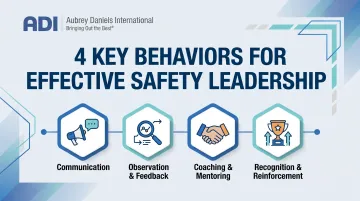
The four behaviors outlined here aren't personality traits or abstract leadership qualities. They're practical, science-backed actions that any leader can learn, practice, and improve. They represent the difference between managing compliance and leading culture.
Key Takeaways
- Safety culture is built by what leaders do consistently, not what policies say
- Four key behaviors drive results: actively observing work, reinforcing safe performance, engaging in two-way conversations, and modeling personal accountability
- These behaviors are grounded in Applied Behavior Analysis, proven science applied across industries for decades
- Changing leadership habits requires specific, observable behaviors — not generic safety training
- Any leader at any level can adopt these behaviors and create measurable safety improvements
Why Leader Behavior — Not Policy — Drives Safety Culture
Safety management and safety leadership are fundamentally different:
- Safety management is compliance-driven — focused on rules, audits, recordables, and regulatory adherence. It sets the minimum.
- Safety leadership is behavior-driven — focused on what leaders model, reinforce, and respond to every day. It's what moves organizations from compliant to excellent.
According to Zohar and Luria's intervention studies, when supervisors received weekly feedback on their safety-oriented interactions, workers' safety behavior and safety climate scores both improved significantly. The improvements continued even after the formal intervention ended — safety behavior had become an internalized part of supervisory responsibility.
Management commitment is cited as "perhaps the most important factor" for promoting strong safety culture. Not because of speeches or policies, but because of how leaders behave.
Behavior is a function of its consequences. When leaders consistently respond to safe behavior with recognition and to at-risk behavior with correction, workers learn what matters. When leaders ignore safe performance and only speak up during incidents, workers learn that safety is about avoiding blame rather than building excellence.
This is what drives discretionary effort in safety — the difference between workers who follow minimum rules and those who proactively look out for themselves and their coworkers. Workers who check a colleague's equipment, correct hazards they didn't create, or speak up during near-misses are exhibiting that effort.
Effective leader behaviors are what unlock that commitment. Research on safety-specific leader reward omission found that when leaders fail to recognize safe behavior, distributive justice perceptions decline significantly — directly reducing safety compliance.
Behavior 1: Actively Observe the Work — Not Just the Incidents
Active observation means leaders physically going to where work happens—the floor, the site, the job—to watch actual tasks being performed. It's not reviewing incident reports in an office or attending safety committee meetings. It's witnessing work as it unfolds in real time.
Leading Indicators vs. Lagging Indicators
Most organizations rely heavily on lagging indicators: injury counts, OSHA recordables, lost-time incidents. These metrics tell you what already went wrong.
Leading indicators, by contrast, measure what's happening right now—the behaviors, conditions, and near-misses that precede incidents.
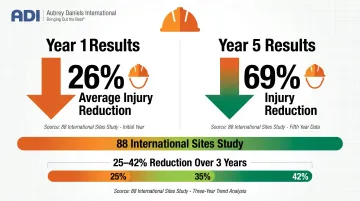
Behavioral observation programs have demonstrated measurable results: a meta-analysis by Krause, Seymour, and Sloat found an average 26% injury reduction in Year 1 and 69% by Year 5 across 73 companies. A DEKRA/Cambridge study across 88 international sites confirmed 25-42% reductions over three years.
Effective observation focuses on both at-risk behaviors (to correct) and safe behaviors (to reinforce). Many leaders are trained only to spot what's wrong, which creates a culture of surveillance and fear rather than learning and improvement.
When workers believe observation is about catching people doing something wrong, they hide problems instead of solving them.
Compliance Walkthrough vs. Behavioral Observation
A compliance walkthrough asks: "Are people wearing PPE?" A behavioral observation asks: "Are people using the correct technique, and do they understand why it matters?"
The difference is profound. Compliance checks create a checkbox culture—workers perform to the minimum standard when watched and revert when not. Behavioral observation creates dialogue, understanding, and intrinsic motivation. Leaders who observe for behavior engage with workers, ask questions, and identify systemic barriers—not just individual rule-breaking.
Effective observation includes:
- Watching task execution, not just outcome
- Identifying both safe and at-risk behaviors
- Understanding context: why workers chose a particular approach
- Noting environmental factors that encourage or discourage safe behavior
- Following up with specific feedback immediately
Frequency and Consistency Matter
Research shows that observation needs to be regular and consistent to be meaningful. Sporadic visits signal that safety is a priority only when something goes wrong. The optimal observation contact rate is 16-65% of employees per month—meaning each worker is observed approximately once monthly. Monthly observation outperforms more frequent weekly observation, suggesting that quality and consistency matter more than volume.
Sites where 4-8% of the workforce served as dedicated observers achieved better results than those with broader participation exceeding 20%, and observers conducting 7+ observations per month saw significantly greater improvements. Observation only works when it becomes routine — built into how leaders lead, not reserved for audits or incidents.
Behavior 2: Reinforce Safe Performance Specifically and Immediately
Most safety feedback is dangerously imbalanced. Leaders speak up when something is wrong and stay silent when work is done safely. This creates an environment where "no news is good news"—and where safe behavior goes unrecognized and therefore unreinforced.
Why Positive Reinforcement Works
Behavioral science research confirms that positive reinforcement is one of the most powerful tools for sustaining behavior over time. Studies show that when safety performance is paired with graphic feedback and social reinforcement (praise), performance can increase from 70% to 96% and maintain improvement for over a year.
When leaders omit rewarding safe behavior, perceived distributive justice declines, which directly reduces safety compliance. The absence of positive reinforcement isn't neutral—it actively undermines safe behavior by signaling that the effort doesn't matter.
What Effective Reinforcement Looks Like
Effective safety reinforcement must be specific, timely, and genuine:
- Name exactly what the person did: "I noticed you stopped and re-secured that load before moving the forklift. That's exactly the kind of thinking that prevents incidents."
- Deliver it close to the behavior — ideally within minutes or hours, not days later.
- Keep it genuine, not scripted. "Good job being safe today" is not reinforcement.
Examples of effective reinforcement:
- "I saw you check the equipment before starting. That kind of thoroughness catches problems before they become incidents."
- "You stopped the line when you noticed the guard wasn't in place. That decision just prevented a serious injury."
- "Thanks for walking around that spill instead of over it and then reporting it immediately. That's ownership."

Reinforcement Doesn't Mean Ignoring At-Risk Behavior
A common misconception is that positive reinforcement means letting unsafe behavior slide. It doesn't. Reinforcing safe behavior increases its frequency, which naturally displaces at-risk behavior — making this approach more effective and more sustainable than a purely punitive correction strategy.
Correction is still necessary when at-risk behavior occurs. But research demonstrates that reinforcement and correction serve different psychological functions: reinforcement shapes perceptions of fairness and builds workers' investment in safe habits, while correction reduces role ambiguity by clarifying expectations. Both are needed — but reinforcement must significantly outweigh correction for lasting culture change.
Building Reinforcement into Daily Routines
Leaders can embed informal reinforcement into everyday interactions:
- Brief recognition during site walks
- Positive callouts during team huddles
- Acknowledgment during shift start meetings
- Real-time feedback during task observation
Reinforcement should be consistent and individualized. What motivates one worker (public recognition in a meeting) may make another uncomfortable. Effective safety leaders learn what types of acknowledgment resonate with different team members and adjust accordingly.
Behavior 3: Engage Workers in Genuine Two-Way Safety Conversations
There's a critical difference between a safety briefing and a safety conversation. A briefing is one-way: leader talks, workers listen. A conversation is two-way: leader asks questions, listens, and responds to what workers share. The former communicates compliance expectations. The latter builds trust and surfaces real hazard information.
Why Worker Input Matters
Front-line employees have the most detailed knowledge of daily hazards, workarounds, and near-misses. They know which procedures don't work in practice, which equipment is unreliable, and where time pressure creates shortcuts. But they'll only share this knowledge if they believe leaders will listen and act without blame.
Research on psychological safety and near-miss reporting found that psychological safety nearly doubled the odds of reporting near-miss events. Without it, willingness to report distal near-misses dropped to 4.64 on a 7-point scale. In low psychological safety environments, less than 10% of incident system submissions pertained to near-misses.
That gap matters because near-misses occur far more frequently than actual harm events — making them the most actionable early warning signal leaders have.
When workers don't believe management will take corrective action, they stop reporting. Two-way dialogue changes this dynamic by demonstrating that input leads to action.
Questions That Open Meaningful Conversations
Swap closed compliance checks for open-ended questions. Instead of "Did you read the safety bulletin?" try "What's the hardest part of doing this task safely?" Rather than "Are you following the procedure?" ask "Is there anything that gets in the way of working the way we trained?"
Other questions that open real dialogue:
- "What would make this task easier to do safely?"
- "Have you noticed any near-misses or close calls lately?"
- "If you could change one thing about how we approach safety here, what would it be?"
- "What do you think causes most of the safety issues on this job?"
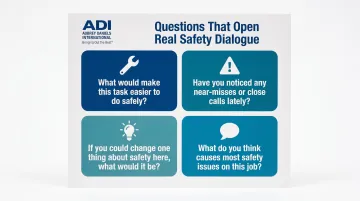
These questions shift the conversation from interrogation to collaboration. They invite workers to be problem-solvers, not just rule-followers.
Acting on What Workers Tell You
Two-way conversations surface the real obstacles to safe behavior — equipment issues, time pressure, conflicting priorities — that policy alone can't fix. Leaders who ask the right questions often learn more in a 10-minute walkthrough than from a month of incident reports.
Studies on toolbox talks show that when conducted as genuine conversations rather than lectures, safety knowledge improved by 22% and the likelihood of safer behavior increased by 33.2%. Foremen conducting daily conversational safety meetings increased from 13% to 68% following training that emphasized dialogue over monologue.
The conversation itself is only part of the equation. Workers watch what happens after they speak up. When leaders document concerns and follow through, participation grows. When concerns disappear without explanation, so does honesty.
Behavior 4: Personally Model Accountability for Safety
In behavioral science, accountability means making the connection between behavior and consequences clear and consistent — and that starts with the leader's own behavior, not just the rules they enforce on others.
Behavioral Integrity: Alignment Between Words and Actions
Workers constantly watch whether leaders follow the same rules they enforce. Do leaders wear their PPE? Do they take shortcuts when under time pressure? Do they override safety procedures to meet production deadlines?
Research on leader behavioral integrity for safety studied 79 vessels and 230 crewmembers in the maritime industry. The findings supported the intrinsic commitment model: when leaders demonstrate genuine alignment between their words and actions, workers respond with intrinsic motivation and preventive behavior.
The extrinsic compliance model — leaders enforcing rules without modeling them — was not supported. Workers respond to leader authenticity, not rule enforcement alone.
Inconsistency here is one of the fastest ways to erode safety culture. When a supervisor tells workers to never skip lockout/tagout but then bypasses it personally "just this once" because the line is down, the message is clear: the rule is optional when inconvenient.
What Accountability Looks Like Beyond Self-Modeling
Self-modeling is the foundation, but accountability also requires consistent follow-through in two additional areas:
Defining expectations clearly:
- Specific, observable behaviors expected during each task
- Consequences for both safe and at-risk behavior
- Role clarity so workers know exactly what's expected
Applying recognition and correction consistently:
- Acknowledge safe behavior when it occurs
- Address at-risk behavior immediately and without exception
- Don't let unsafe behavior slide when production pressure is high
Using a Just Culture framework: Just Culture distinguishes three classes of behavior requiring different responses:
- Human error (console and support, improve system design)
- At-risk behavior (coach the individual to understand risk)
- Reckless behavior (disciplinary action)
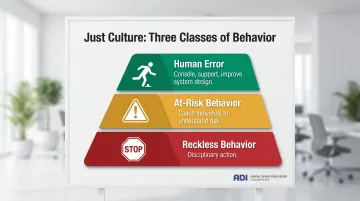
This framework holds both individuals and the organization accountable — maintaining clear expectations and consequences without defaulting to blame.
Putting the 4 Behaviors into Practice
Knowing these behaviors is different from performing them consistently under real-world conditions. Time pressure, production demands, and ingrained habits all work against behavior change. A supervisor who genuinely values positive reinforcement may still default to criticizing mistakes when a deadline is tight.
Effective safety leadership development requires practice, feedback, and coaching—not just awareness. Organizations serious about improving safety culture should treat leader behavior development the same way they treat any performance improvement initiative: identify specific behaviors, measure them, provide feedback, and reinforce progress.
ADI's behavior-based approach to safety leadership applies exactly this model, drawing on over 45 years of behavioral science in organizational settings. Judy Agnew's Safe by Accident? translates that framework into practical tools for building leader behaviors that produce sustainable safety culture—not temporary compliance.
The Compounding Effect of Consistent Leader Behavior
When leaders consistently observe, reinforce, converse, and model accountability, workers begin to internalize safety as a value rather than a rule. Safe behavior becomes habitual rather than forced. The organization shifts from compliance-driven safety—where workers perform to the minimum standard when watched—to a self-sustaining culture where workers look out for themselves and each other because it's the right thing to do.
The 2025 Liberty Mutual Workplace Safety Index found that the top 10 causes of serious workplace injuries cost $58.78 billion annually. Over 25 years, serious accident rates declined 40%, but total costs rose 30%—fewer but costlier injuries make proactive safety leadership an economic imperative, not just a moral one.
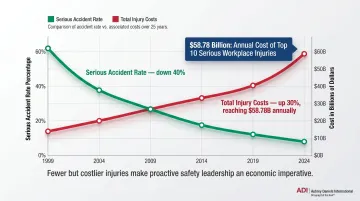
Leader behavior is the leverage point. What leaders do consistently shapes what workers do daily—and daily worker behavior is what determines outcomes.
Frequently Asked Questions
What are the four leadership behaviors?
The four behaviors are: actively observing work in real time, reinforcing safe performance specifically and immediately, engaging in genuine two-way safety conversations, and personally modeling accountability. These are rooted in behavioral science rather than personality traits, meaning any leader can learn and practice them.
What is the difference between a safety manager and a safety leader?
A safety manager enforces compliance with policies and rules, focusing on audits, recordables, and regulatory adherence. A safety leader actively shapes the behaviors, culture, and attitudes of the workforce through daily actions, interactions, and visible commitment to safety values.
How does positive reinforcement improve workplace safety?
Recognizing specific safe behaviors promptly and genuinely increases the likelihood those behaviors are repeated. Over time, this makes safe performance the norm rather than an exception driven by fear of punishment—building intrinsic motivation instead of minimum compliance.
Why do most safety programs fail to change behavior?
Most safety programs focus on training and rule enforcement while neglecting the behavioral consequences that actually drive what workers do. Without reinforcement for safe behavior and consistent accountability, training fades and compliance becomes performative.
How can a leader build a safety culture through daily habits?
Culture is built through repeated daily behaviors—brief observations during site walks, specific recognition during huddles, genuine conversations at shift starts—not through occasional safety events or campaigns. Small consistent actions, not big initiatives, are what shift culture.
What role does accountability play in safety leadership?
Effective accountability in safety leadership means modeling the expected behaviors personally and consistently connecting consequences (both positive and corrective) to observable actions—rather than using blame or punishment after incidents occur. When leaders hold themselves to the same standard they expect from workers, accountability becomes credible rather than punitive.