Introduction
Most organizations measure safety through injury rates and compliance audits — but these lagging indicators only reveal what went wrong after the fact. A comprehensive analysis of 3.26 trillion work hours found that Total Recordable Incident Rate (TRIR) is 96% to 98% random variation, with predictive models accounting for only 2-4% of outcomes. Organizations focused solely on incident rates are measuring noise, not meaningful safety performance.
That's where a health and safety culture assessment changes the equation. Rather than counting what went wrong, it examines the beliefs, behaviors, and leadership norms that determine whether safety is genuinely lived or merely documented — asking not "How many injuries occurred last quarter?" but "What behavioral patterns and reinforcement systems are driving decisions on the shop floor today?"
This guide covers:
- What a health and safety culture assessment actually is
- The core dimensions that separate thriving safety cultures from compliant ones
- A step-by-step process for conducting a rigorous assessment
- Why behavioral science is what most assessment frameworks leave out
Key Takeaways
- A health and safety culture assessment evaluates the values, behaviors, and systems shaping how safety is practiced — not just what's written in policy
- Tracking injury rates alone is insufficient; leading indicators like employee behavior, leadership visibility, and reporting culture prevent incidents before they occur
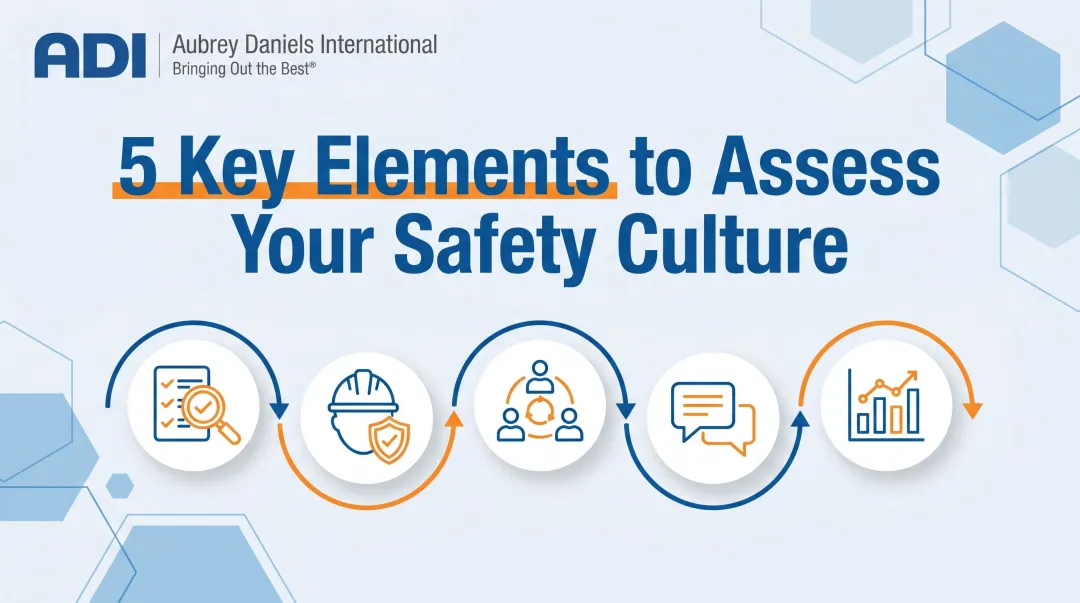
- Core dimensions include leadership commitment, employee participation, psychological safety, training effectiveness, and reinforcement-based accountability
- Effective assessments follow six stages — from defining scope and collecting data to sharing results and building behavior-focused action plans
- Behavioral science identifies what reinforces safe vs. unsafe behaviors, turning assessment findings into lasting cultural change
What Is a Health and Safety Culture Assessment?
A health and safety culture assessment is a structured process that evaluates the underlying beliefs, behavioral norms, leadership practices, and organizational systems that determine how safety is actually experienced by employees, not just what policies and procedures state on paper. According to the UK Health and Safety Executive (HSE), an organization's culture can have as big an influence on safety outcomes as the safety management system.
Culture vs. Climate: Understanding the Difference
Safety culture and safety climate are related but distinct concepts:
- Safety culture refers to the deep-rooted, stable values and behavioral norms embedded in the organization — the "way we do things around here" that persists over time
- Safety climate represents employees' current perceptions of how much safety is prioritized — a snapshot of conditions at a given point in time
Safety culture represents stable, deep-rooted norms while safety climate reflects current perceptions — and the difference matters practically. Climate can shift quickly based on recent events or management focus, but changing culture requires sustained behavioral reinforcement over months and years.
Assessment Methods: Beyond Single-Source Data
Effective assessments combine multiple approaches to capture the full picture:
- Employee surveys and questionnaires — Measure perceptions, attitudes, and self-reported behaviors across the workforce
- Direct behavioral observation — Document actual safety behaviors in real work environments, not just what employees say they do
- Leadership interviews and focus groups — Capture leadership commitment, understand decision-making priorities, and identify reinforcement patterns
- Incident and near-miss data analysis — Review historical patterns to identify systemic issues and reporting culture health
The International Atomic Energy Agency (IAEA) recommends triangulating at least five methods: questionnaires, interviews, observations, focus groups, and document reviews. Perception surveys alone miss actual behavior; observations alone miss the beliefs and systems driving those behaviors. Only by combining methods does a complete picture emerge.
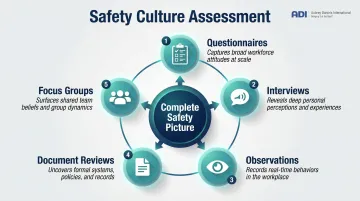
Key Dimensions of Safety Culture to Assess
A meaningful assessment must go beyond checking whether policies exist. It must examine whether safe behaviors are consistently occurring at every level of the organization — and why or why not. Research shows that approximately 80-90% of industrial incidents derive from human factors rather than mechanical failure, making behavioral assessment essential.
Leadership Commitment and Visible Modeling
Management commitment is consistently ranked as the most important element of a strong safety culture. According to OSHA, "management commitment almost always leads to better employee safety and health, less hazardous working conditions, and lower costs".
The key question is not whether senior leaders endorse safety in documents — it is whether they are visibly modeling safe behaviors, prioritizing safety in resource decisions, and engaging directly with frontline workers on safety issues.
Distinguish between:
- Stated commitment: what leaders put in writing — policies, memos, meeting agendas, verbal endorsements
- Demonstrated commitment: what leaders actually do on the shop floor, in budget decisions, and when production pressure conflicts with safety
Assessors should observe leadership behavior directly through workplace walkthroughs, safety meetings, and incident response, not just survey opinions about leadership commitment. As HSE notes, the culture and style of management is even more significant than employee inclination to comply with rules.
Employee Behavior and Participation
Employee behavior is the most observable output of safety culture. Assess whether workers are:
- Actively identifying hazards before incidents occur
- Voluntarily reporting near-misses and close calls
- Participating in safety initiatives and improvement teams
- Following procedures consistently even when not observed
These are leading indicators that predict future incident rates far better than after-the-fact injury counts alone.
The Near-Miss Reporting Paradox:
Low near-miss reporting is often a warning sign of a punitive or blame-focused culture, not a safe one. Organizations with strong cultures typically report MORE near-misses, not fewer — because employees trust that reporting will lead to improvement, not consequences.
A study of 2,755 near-miss reporters confirmed this directly: workers at companies that gave inadequate responses to near-miss reports had 1.53 times higher odds of a subsequent occupational accident. Those receiving no response at all had 1.75 times higher odds. High near-miss reporting rates signal trust and openness — not poor performance.
Communication and Psychological Safety
Safety communication needs to flow in both directions:
- Downward: Employees receive clear, role-specific guidance on hazards and safe procedures
- Upward: Employees feel genuinely empowered to raise concerns without fear of retaliation
Psychological safety — the belief that one can speak up without negative consequences — is a precondition for honest reporting and genuine culture. Yet 56% of employees fear retaliation when reporting workplace safety concerns — a statistic that explains why so much safety information never reaches the people who need it.
Warning signs of poor psychological safety:
- Declining near-miss reports despite continued hazard exposure
- Employees report concerns informally but not through official channels
- Safety meetings are one-way information sessions, not dialogues
- Workers express concerns about being blamed or embarrassed
Training Effectiveness and Behavior Change
Training should be evaluated not just for completion rates or knowledge test scores, but for whether it produces measurable changes in on-the-job behavior. This is a common assessment gap: organizations confuse training attendance with training effectiveness.
One widely cited estimate holds that only about 10% of training expenditure results in actual behavioral change on the job. The Kirkpatrick Model identifies four levels of training evaluation:
- Level 1 — Reaction: Did participants find the training useful and engaging?
- Level 2 — Learning: Did they demonstrate knowledge gains?
- Level 3 — Behavior: Did their on-the-job performance change?
- Level 4 — Results: Did those behavior changes improve organizational outcomes?
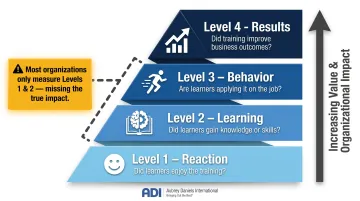
Most organizations measure only Levels 1-2, missing the defining question: are employees actually performing the trained behaviors three months later?
To evaluate training effectiveness, look at:
- Direct observation of trained behaviors in real work environments
- Pre/post behavioral observation comparing performance before and after training
- Supervisor reports of behavior change (not just knowledge acquisition)
- Follow-up reinforcement systems that support behavioral transfer
Accountability and Reinforcement Practices
Accountability in a healthy safety culture means reinforcing safe behaviors consistently — not simply punishing violations. Drawing on behavioral science principles, positive reinforcement builds and sustains safe habits, while punishment-only approaches suppress visible behavior without changing underlying attitudes.
Behavioral science evidence:
The data on Behavior-Based Safety (BBS) programs is consistent across multiple large-scale studies:
- A long-term BBS evaluation found an average 26% injury reduction in year one, growing to 69% by year five
- A Cambridge University study across 88 organizations with over 1.3 million data points found 25% injury reduction in year one and 34% by year two
Punishment-focused cultures create unintended consequences. As healthcare safety experts note, punitive cultures suppress error reporting, reduce safety, undermine psychological safety, increase staff burnout and turnover, and stifle learning.
Look for these reinforcement patterns in your organization:
- What happens when employees report near-misses or safety concerns
- How supervisors respond when they observe safe vs. unsafe behaviors
- Whether recognition systems celebrate proactive safety behaviors or only injury-free periods
- Balance between positive reinforcement, corrective coaching, and disciplinary action
How to Conduct a Health and Safety Culture Assessment: Step by Step
A safety culture assessment is most valuable when it is structured, multi-method, and followed by a clear plan for action. Organizations most often fail by treating the assessment as an endpoint — producing a report that generates no behavioral change.
Step 1: Define the Scope and Objectives
Start by clarifying which teams, sites, or functions will be assessed and what specific questions the process needs to answer:
- Why is incident reporting low in certain departments?
- Why do some teams show stronger safety participation than others?
- What leadership behaviors are most strongly associated with safety performance?
- Which training programs produce measurable behavior change?
A clear scope prevents data overload and keeps the process focused on actionable insights.
Step 2: Select the Right Assessment Methods
No single method tells the full story. Select a combination appropriate to your organization's size, industry, and objectives:
- Surveys — Provide breadth and statistical representation across large populations
- Behavioral observations — Deliver accuracy and ground truth about actual workplace behavior
- Interviews and focus groups — Offer depth and context for understanding beliefs and motivations
- Incident data analysis — Supply historical patterns and trends from OSHA 300 logs and near-miss records
Over-reliance on surveys alone is a common pitfall. Self-reported perceptions can diverge significantly from actual behavior, particularly in cultures where social desirability bias is strong. The HSE warns that when safety performance is tied to incident rates, employees may hide injuries to protect the score — rendering TRIR statistically invalid.
Step 3: Collect Data Systematically
Collect data from multiple stakeholder levels simultaneously:
- Executive leadership and senior management
- Middle managers and frontline supervisors
- Frontline employees and contractors
This multi-level approach identifies alignment gaps — where leadership believes safety is prioritized but frontline workers experience something different.
One factor determines whether employees give honest answers: confidentiality. Data collection must be clearly framed as non-punitive. Communicate upfront that the purpose is organizational learning, not individual fault-finding — otherwise responses will reflect what people think is safe to say, not what is true.
Step 4: Analyze Findings and Identify Behavioral Gaps
Compare results across departments, roles, and sites. Look specifically for three types of gaps:
- Perception gaps — Employees believe safety is a priority, but behaviors don't reflect it (or vice versa)
- Behavioral gaps — Observable actions diverge from stated norms and procedures
- Reinforcement gaps — Desired behaviors occur but aren't consistently reinforced, making them unsustainable
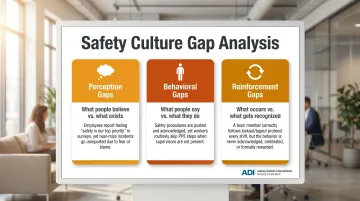
Benchmark against industry standards where relevant, but internal patterns carry more diagnostic weight — they reveal the specific culture drivers your organization actually needs to address.
Step 5: Share Findings Transparently
Present results to all stakeholder groups — not just leadership. When employees see that findings are shared openly, it signals the assessment was genuine rather than performative, and it builds the trust needed for follow-up initiatives to succeed.
Use clear visual summaries alongside narrative context:
- Charts showing perception vs. behavior gaps by department
- Heat maps identifying high-risk areas or strong performance pockets
- Quotes from focus groups illustrating key themes
- Comparison to industry benchmarks where relevant
Step 6: Build an Action Plan Focused on Behavior Change
Translate assessment findings into specific, observable actions:
- Which behaviors need to increase? (e.g., near-miss reporting, PPE use, pre-job hazard analysis)
- Which behaviors need to decrease? (e.g., taking shortcuts, silencing concerns, blame language)
- Who is responsible? (specific roles, not vague "everyone")
- How will progress be measured? (observable behaviors, not just injury rates)
Action plans that stop at new policies or added training rarely stick. The critical question is: what is currently reinforcing the unsafe behavior? Until you answer that and change the reinforcement pattern, the behavior won't change — regardless of how clear the policy is.
How ADI Can Help
Aubrey Daniels International (ADI) is a behavioral science consultancy with over 45 years of experience helping organizations build high-performance, high-safety cultures. ADI's approach to safety culture assessments is grounded in Applied Behavior Analysis — meaning assessments go beyond measuring perceptions to identify the specific behavioral patterns and reinforcement systems driving safety (or undermining it).
Judy Agnew, ADI's Senior Vice President and co-author of Safe by Accident?, has worked with organizations across manufacturing, energy, utilities, and healthcare to diagnose why their safety cultures look the way they do. Her work pinpoints the behavioral and leadership changes needed to move organizations toward a High Participation Culture.
ADI's consulting and assessment services include:
- Safety culture assessments — Multi-method evaluations combining surveys, behavioral observations, and leadership interviews to surface strengths and actionable gaps
- Expert consulting — Strategic and tactical planning grounded in behavioral science, from design through implementation
- Leadership coaching — Building visible safety leadership behaviors that model and reinforce safe practices
- Certification programs — Developing internal capability to sustain behavior-based safety improvements long-term

Ready to move beyond lagging indicators? Contact ADI to learn more about behavior-based safety culture assessment and consulting: 1-678-904-6140 or info@aubreydaniels.com.
Frequently Asked Questions
What is a health and safety culture assessment?
A health and safety culture assessment is a structured evaluation of the beliefs, behaviors, leadership practices, and organizational systems that shape how safety is actually practiced day-to-day. It goes beyond compliance audits and incident rate reviews to identify the behavioral and environmental factors driving safety performance.
What are the 4 C's of health and safety culture?
The 4 C's are Competence (ensuring staff capability and training), Control (establishing management responsibility and accountability), Co-operation (shared responsibility and workforce participation), and Communication (clear two-way information flow). All four elements, defined in HSE guidance, must be present for a culture to be genuinely effective.
What is an example of a health and safety culture assessment for an organization?
A manufacturing organization might combine employee surveys on safety climate perceptions, behavioral observations on the shop floor (PPE use, procedural adherence), and leadership interviews on supervisor safety modeling. Results are then analyzed across near-miss reporting rates, training transfer, and reinforcement patterns to identify improvements.
How do you measure the health and safety culture of an organization?
Measurement combines quantitative methods (surveys, incident data, observation checklists) with qualitative methods (interviews, focus groups, document review) to capture both perceptions and actual behaviors. Behavioral observation is the most reliable leading indicator — it reveals what employees actually do, not just what they report.
What is the difference between safety culture and safety climate?
Safety culture refers to the deep-rooted, stable values and behavioral norms embedded in the organization over time — the underlying "how we do things around here." Safety climate is the current snapshot of how employees perceive safety priorities at a given moment. Climate can shift quickly in response to recent events or management attention, but changing culture requires sustained behavioral reinforcement.
How often should an organization conduct a safety culture assessment?
Conduct a formal comprehensive assessment annually or biannually to track long-term culture change and validate improvement interventions. Supplement comprehensive assessments with shorter pulse surveys or targeted behavioral observations quarterly to catch emerging issues before they become incidents. The IAEA recommends follow-up assessments 18-24 months after initial assessments to gauge whether interventions have taken hold.