Introduction
Many organizations face a frustrating paradox: despite investing in comprehensive safety policies, mandatory compliance training, and sophisticated incident reporting systems, workplace injuries continue to happen. Safety often feels like a checkbox exercise rather than a core organizational value, creating a dangerous gap between being "safe on paper" and truly safe in practice.
According to the U.S. Bureau of Labor Statistics, private industry employers reported 2.5 million nonfatal workplace injuries and illnesses in 2024 — the lowest incident rate since 2003, yet preventable harm still persists across organizations with robust safety programs.
The issue isn't a lack of rules. Real safety culture transformation means changing the attitudes, habits, and daily choices of every person in an organization — and that requires a fundamentally different approach.
This article covers the types of safety culture, the core elements that make transformation sustainable, a step-by-step framework for change, and why behavioral science is the ingredient most organizations overlook.
Key Takeaways
- Safety culture is the shared set of beliefs and behaviors that determine how safety is practiced daily—not just what policies say
- Most safety programs stall because they rely on fear and compliance rather than positive reinforcement and shared ownership
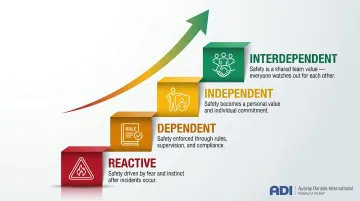
- Four safety culture types — Reactive, Dependent, Independent, Interdependent — help organizations identify where they stand
- Sustainable transformation requires leadership commitment, psychological safety, employee engagement, and behavior-based accountability
- Lasting culture change is built on behavioral science: what gets reinforced gets repeated
Why Safety Culture Transformations Stall (and What to Do Instead)
Organizations routinely mistake the presence of safety programs—training schedules, checklists, PPE compliance rates—for the presence of a safety culture. Programs are artifacts; culture is the behavior that happens when no one is watching. This confusion explains why so many safety initiatives fail to deliver lasting change.
Two failure modes account for most stalled transformations:
- The compliance trap: When safety is enforced through rules, penalties, and incident-based accountability, employees learn to minimize reported incidents rather than actual risk. Research shows 90% of EHS professionals say incidents, hazards, and near misses are underreported—up from 79% the prior year—and 45% of EHS leaders estimate a quarter of their workforce doesn't report incidents at all. Punishment suppresses behavior short-term; it doesn't build the discretionary effort required for a genuinely safe workplace.
- The siloed safety department: When safety is someone else's job, it competes with productivity instead of being woven into how work gets done. This structural separation undermines even well-resourced safety programs.
The solution requires moving from a reactive, compliance-led model to a proactive, behavior-based model where safe choices are understood, valued, and consistently reinforced at every level of the organization. Rules remain necessary, but rules alone won't close the gap between compliance and genuine safety ownership. That requires building the intrinsic motivation that sustains safe behavior even when no one is watching.
The 4 Types of Safety Culture: Identifying Where You Stand
The Safety Culture Maturity Model, based on the DuPont Bradley Curve framework developed in the 1990s, maps organizations across four stages. Identifying your current stage is the first diagnostic step—because you cannot design a transformation without knowing your starting point.
The Four Stages Defined
Reactive: Accidents are seen as inevitable, and safety action only follows an incident.
- No systemic accountability; blame drives the response
- Management support is minimal; employees rely on instincts
Dependent: Safety is rule-driven and management-led; compliance is required, not valued.
- Training meets only minimum regulatory requirements
- Penalties, not principles, shape behavior
Independent: Individuals take personal responsibility for their own safety—a significant step forward.
- Systematic protocols emerge and individual accountability takes hold
- Still lacks collective ownership and peer-to-peer influence
Interdependent: Safety is a shared value. Employees actively look out for one another, speak up proactively, and hold collective standards.
- Integrated into core values with continuous improvement built in
- This is where zero-harm cultures operate
These definitions give you a framework. The harder question is where your organization actually sits—and that requires looking at day-to-day behavior, not just stated values.
Practical Diagnostic Signals
Three signals reveal your organization's true maturity level:
- Near-miss reporting rates: High rates indicate psychological safety and higher cultural maturity—not failure
- Post-incident conversations: Do they center on blame, or on root cause analysis?
- Frequency of safety talk: Are safety conversations reactive (after incidents only) or part of daily operations?
Organizations at lower maturity stages typically see near-miss reports as evidence of failure. Higher-maturity organizations recognize them as valuable leading indicators that prevent serious incidents—a critical cultural distinction.
The 5 Core Elements of a Sustainable Safety Culture
Regardless of industry or organization size, sustainable safety cultures share five observable, behavioral characteristics. The absence of any one element creates a weak link that eventually shows up as incidents, underreporting, or cultural backslide.
Leadership Commitment That Goes Beyond Posters
Visible, consistent behavior is what defines genuine leadership commitment — participating in safety walks, responding seriously to near misses, allocating resources without hesitation, and modeling the behaviors expected of everyone else.
Research confirms that managers' commitment to safety directly shapes employees' perceptions of organizational safety culture. When leaders visibly prioritize safety through their daily actions, employees perceive safety as genuinely important rather than performative. Without visible, consistent leadership modeling of safety-first behaviors, employees feel less compelled to adhere to safety protocols themselves.
Psychological Safety and Open Reporting
Employees must feel safe to report near misses, admit errors, and raise concerns without fear of blame or punishment. Without this, organizations lose their most valuable source of leading indicator data.
A prospective cohort study of 2,755 workers found that workers whose companies gave inadequate response to near-miss reports had 53% higher odds of experiencing an occupational accident in the following year. Those whose companies gave no response had 75% higher odds. This demonstrates that psychological safety isn't just feel-good culture work — it's a critical accident prevention mechanism.
A high near-miss reporting rate is actually a positive cultural signal, not a failure metric. It indicates employees trust the organization enough to surface potential hazards before they cause harm.
Employee Engagement and Shared Ownership
Safety culture cannot be imposed top-down — it must be built collaboratively. When employees are involved in hazard identification, safety procedure design, and peer coaching, safety stops being "management's job" and becomes a shared identity.
Employees who help shape safety systems take ownership of them — acting as genuine safety advocates rather than passive rule-followers.
Behavior-Based Accountability (Not Blame)
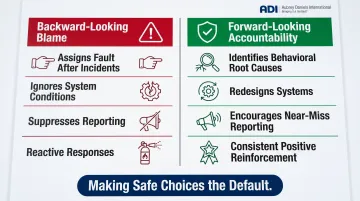
There's a critical distinction between backward-looking blame and forward-looking accountability:
- Backward-looking blame assigns fault after an incident without addressing the system conditions that enabled it
- Forward-looking accountability identifies behavioral root causes and builds systems that make the safe choice the default choice
Consistent, behavior-specific feedback — positive reinforcement for safe behaviors, not just consequences for unsafe ones — is the mechanism that drives real accountability. Most unsafe behaviors occur because organizational systems make them easier or more rewarding than safe alternatives. Changing those systems, not just the people, is what sustains progress.
Continuous Learning and Improvement
High-maturity safety cultures treat every incident, near miss, and audit finding as a learning opportunity rather than a liability. Organizations must build formal feedback loops — systematic incident reviews, regular safety audits, employee-led improvement teams — that translate data into behavioral changes, not just corrective paperwork.
The defining question shifts from "who caused this?" to "what system conditions allowed this, and how do we change them?" That shift is what separates organizations that improve from those that simply react.
How to Transform Your Safety Culture: A Step-by-Step Process
Frame your transformation as a behavioral change initiative, not a compliance overhaul. The goal is not to create better policies but to change the daily behaviors, decisions, and conversations that define how work actually gets done.
Step 1: Assess Your Current Culture Honestly
Meaningful culture assessment involves more than reviewing documentation and incident data. The real diagnostic comes from:
- Structured employee surveys that ask about actual safety behaviors, not just policy awareness
- Behavioral observations on the floor that reveal gaps between written policies and actual practice
- Conversations that uncover why people make the choices they make regarding safety
Leaders should specifically look for: the ratio of positive to negative safety feedback employees receive, whether safety conversations feel punitive or developmental, and how many employees can articulate why safety matters beyond avoiding punishment.
Step 2: Build the Business Case and Define the Target State
The National Safety Council estimated that work-related deaths and injuries cost the nation, employers, and individuals more than $1.3 trillion in 2023. More specifically, employers pay almost $1 billion per week for direct workers' compensation costs alone.
The ROI of effective safety investment is compelling: OSHA analysis shows companies implementing effective safety and health programs can expect a return of $4 to $6 for every $1 invested.
Define what success looks like behaviorally — not just as a target incident rate, but as specific observable changes:
- Supervisors delivering four positive safety observations for every corrective one
- Employees stopping work when they see hazards, free from production pressure
- Near-miss reports increasing as psychological safety improves across teams
Step 3: Engage Leaders Visibly and Specifically
Leaders drive culture change through specific, repeatable behaviors — not slogans. Define exactly what those behaviors look like in practice:
- Conducting safety rounds with genuine curiosity, not inspection checklists
- Asking behavioral questions: "What made that choice safer?" instead of "Did you follow the rule?"
- Celebrating near-miss reports publicly as examples of good judgment
- Removing barriers workers flag without defensiveness
Leadership behavior is the most powerful antecedent for employee behavior. Organizations looking to accelerate this step can engage ADI's expert consulting services to design behavior-based leadership development programs tailored to their culture.
Step 4: Shift from Punishment to Positive Reinforcement
Start by auditing your current reinforcement landscape: which behaviors are actually getting reinforced — or punished — in day-to-day operations. If production pressure consistently wins over safety behavior, that is the true culture, regardless of what policies say.
Design positive reinforcement systems that include:
- Behavior-specific recognition that describes exactly what the person did and why it mattered
- Peer acknowledgment programs where coworkers can recognize safe choices
- Supervisory coaching that catches people doing things right, delivered at a 4:1 ratio to corrective feedback
Step 5: Embed Feedback Loops and Measure Leading Indicators
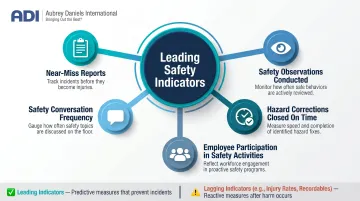
Shift from lagging indicators (injury rates, OSHA recordables) to leading indicators:
- Near-miss reports submitted and responded to
- Safety observations conducted
- Hazard corrections closed on time
- Safety conversation frequency
- Employee participation in safety activities
Regular, short feedback cycles — weekly team huddles, monthly trend reviews shared with employees, not just management — keep the transformation alive and signal that reporting and engagement are valued.
The Behavioral Science Behind Lasting Safety Culture Change
Human behavior is governed by consequences, not just intentions or knowledge. Knowing a behavior is safe is not sufficient to produce it reliably—people do what gets reinforced.
This is why safety training alone fails: a meta-analysis of 95 studies found that least-engaging training methods showed approximately 50% decay in effectiveness within one week to one year after training. Most-engaging training methods (behavioral modeling, hands-on practice) were approximately three times more effective than passive methods for knowledge acquisition.
Understanding why training decays is the first step toward fixing it. ADI has applied the principles of Applied Behavior Analysis to organizational performance for over 45 years, and Judy Agnew's Safe by Accident remains a foundational resource for leaders who want to go deeper—offering a framework to identify practices that seem reasonable but quietly block safety excellence.
The Practical Application
Supervisors and leaders must be coached to deliver behavior-specific positive feedback—not generic praise ("good job") but targeted recognition tied to what actually happened: "I noticed you stopped to verify lockout before starting that repair—that's exactly the standard we need." This specificity matters because it makes safe behavior more reinforcing than cutting corners, which is the core mechanism of culture change.
ADI's certification programs equip organizations to build this internal coaching capability so that transformation becomes self-sustaining rather than dependent on external support.
The Sustainability Challenge
Building the coaching capability solves the short-term problem. The harder challenge is what happens in month 13. Many organizations see strong results in the first year of a safety initiative only to watch gains erode within 18-24 months. The behavioral science explanation is straightforward: reinforcement schedules were not maintained.
Sustaining the reinforcement environment means:
- Ongoing behavioral observation programs where safe behaviors continue to be noticed and acknowledged
- Refreshed recognition systems that don't become stale or hollow
- Regular reassessment of whether new behaviors have truly become habits or are still being effortfully maintained
Organizations that build these mechanisms into their operating rhythm—rather than treating them as launch-phase activities—are the ones that sustain gains past year two and beyond.
Frequently Asked Questions
What is safety culture transformation?
Safety culture transformation is the process of shifting an organization's deeply held beliefs, behaviors, and norms around workplace safety — moving from compliance-driven rule-following to genuine, discretionary safe behavior. It requires changes at every level, from frontline workers to senior leadership, and is sustained through consistent reinforcement rather than one-time training.
What is the difference between a safety program and a safety culture?
A safety program is a set of procedures, rules, and training requirements. A safety culture is what people actually do when no one is watching. Programs can be mandated; culture has to be built through consistent leadership behavior, positive reinforcement, and shared values that make safe choices the default.
How long does safety culture transformation take?
Most organizations begin seeing measurable behavior change within 6–12 months of implementing a structured, behavior-based approach. Embedding that change as a self-sustaining culture typically takes 2–3 years. The timeline depends on leadership commitment, the consistency of reinforcement practices, and how deeply rooted existing habits are.
Why do so many safety culture initiatives fail?
Most initiatives fail because they focus on awareness and rules rather than behavior. Training alone doesn't change what people do under pressure. Without identifying what reinforces safe behavior — and actively using that knowledge — organizations revert to old habits. A science-based approach addresses the antecedents and consequences that actually drive behavior.
How does Aubrey Daniels International approach safety culture transformation?
ADI applies over 45 years of Applied Behavior Analysis to safety. Their approach identifies the specific behaviors that predict safe outcomes, equips leaders to reinforce those behaviors consistently, and builds internal capability so improvements sustain long after the engagement ends. It's grounded in data, not guesswork.