Introduction
Most organizations treat performance problems as motivation issues or attitude deficits. In reality, persistent underperformance almost always traces back to environmental factors — the conditions that either reinforce the wrong behaviors or fail to support the right ones. Understanding that distinction is where effective leadership begins.
Applied Behavior Analysis (ABA) has been applied to organizational settings for over four decades through the framework of Organizational Behavior Management (OBM). Despite this track record, most leaders still rely on gut instinct, one-size-fits-all training, or outdated performance reviews rather than behavioral science.
The consequences are predictable: change initiatives that don't stick, training that produces no lasting impact, and performance gaps that persist despite significant investment.
This guide explains what applying behavior analysis in organizations actually means, how the OBM process works, what factors shape outcomes, and where it delivers the most measurable value.
Key Takeaways
- OBM targets observable, measurable behaviors as the foundation for improving performance and culture — not assumptions about attitudes
- The process follows three stages: define behavioral pinpoints, design reinforcement-based interventions, and measure outcomes through ongoing data collection
- Positive reinforcement — consistently strengthening the behaviors that produce results — is the primary mechanism through which OBM drives sustainable change
- OBM is scientifically grounded and replicable, focused on what people do and why rather than who they are
- It applies across manufacturing, healthcare, financial services, logistics, energy, and any industry where human behavior drives results
What Is Applied Behavior Analysis in Organizations?
Applied Behavior Analysis, in an organizational context, is the science of how the environment shapes what people do — and Organizational Behavior Management (OBM) is its direct application to the workplace. OBM focuses on specific, observable actions rather than abstract concepts like "culture" or "engagement."
OBM is a scientific discipline that applies behavioral principles to improve individual and group performance. According to the Behavior Analyst Certification Board (BACB), OBM focuses on assessing and changing the work environment to improve employee performance and workplace culture.
Three Core Subdisciplines
OBM encompasses three distinct but interconnected areas:
- Performance Management (PM) — Managing individual or small-group behavior change to reach organizational goals through systematic application of behavioral principles
- Behavioral Systems Analysis (BSA) — Examining how broader organizational design, processes, and systems shape behavior at scale
- Behavior-Based Safety (BBS) — Applying these principles specifically to reduce workplace incidents and promote safe behavior
How OBM Differs from Traditional Organizational Behavior
OBM is distinct from general organizational behavior (OB) and traditional HR in several critical ways:
- Behavioral laws, not theories — Every OBM intervention is grounded in decades of research, making it testable and replicable rather than opinion-based
- Actions, not attitudes — OBM measures specific, observable behaviors instead of relying on personality assessments or engagement surveys
- Environment, not individual deficit — Performance problems are traced to antecedents (what triggers behavior) and consequences (what follows), not to character or motivation shortfalls
That environmental lens is what separates OBM from conventional management approaches — and what makes its results measurable and repeatable. ADI has applied these principles across more than 400 organizations globally, from manufacturing and mining to healthcare and financial services.
Why Organizations Turn to Behavior Analysis
Traditional management approaches focus on outcomes rather than the behaviors that produce them. Leaders track sales numbers, safety incident rates, or customer satisfaction scores — but rarely identify and systematically reinforce the specific employee behaviors that drive those metrics. This reactive stance means problems get addressed after the fact, when the damage is already done.
Behavior analysis shifts the lens from "what happened" to "what behaviors drive what outcomes." This proactive approach addresses performance at its source.
Specific Organizational Problems OBM Addresses
Organizations turn to behavior analysis when they face persistent performance gaps that resist traditional interventions:
- Low productivity and inconsistent quality output — when results vary widely despite standard procedures
- High employee turnover — 42% of employees who voluntarily leave say their manager or organization could have prevented it
- Inconsistent safety compliance — when policies exist but at-risk behaviors persist
- Training that doesn't transfer — when employees return from training but performance doesn't change
- Disengaged teams — global employee engagement fell to 20% in 2025, costing the world economy approximately $10 trillion in lost productivity
The Business Case for Behavior-Based Interventions
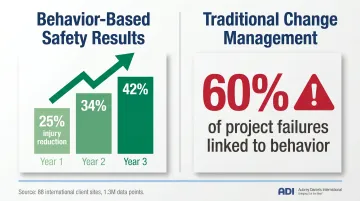
The financial impact of behavior-based approaches is substantial. A study of 88 international client sites (covering 1.3 million data points) found behavior-based safety programs produced an average 25% reduction in injuries in Year 1, 34% in Year 2, and 42% in Year 3.
Those safety gains reflect a broader pattern: approximately 60% of organizational change failures have "behavior" identified as the root cause. Traditional change management approaches that skip the behavioral dimension rarely deliver results that hold.
Why It Matters for Long-Term Sustainability
Those sustained injury reductions — improving year over year rather than plateauing — illustrate what separates behavior analysis from one-time training events or motivational programs. Rather than relying on periodic reminders or managerial prompts, OBM redesigns the work environment so reinforcement for the right behaviors is built directly into daily operations. The improvement compounds because the conditions producing it stay in place.
How the OBM Process Works
Applying behavior analysis in an organization is a continuous cycle: define, measure, intervene, and evaluate. The unit of analysis is always behavior — what people actually do — not attitude, intention, or personality.
Step 1: Define Pinpoints and Establish Behavioral Baselines
The process begins by identifying specific, observable, measurable behaviors (called "pinpoints") that are directly linked to critical business outcomes.
The Difference Between Vague Goals and Behavioral Pinpoints:
- Vague goal: "Improve customer service"
- Behavioral pinpoint: "Greet each customer within 10 seconds of entry and ask how you can help them"
Without precise behavioral definitions, measurement and intervention become impossible. Pinpointing gives performers clear direction — exactly which behaviors to increase, reduce, or change.
ADI's Precision Leadership methodology uses pinpoints as the foundation for aligning performance across all levels of an organization.
Step 2: Assess Antecedents and Consequences
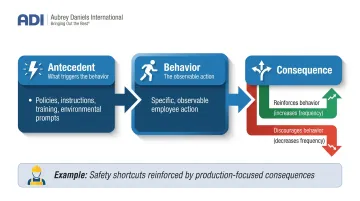
The ABC model (Antecedent–Behavior–Consequence) is the foundational analytical tool in OBM:
- Antecedent: The conditions that set behavior in motion — policies, instructions, training, environmental prompts
- Behavior: The specific, observable action an employee performs
- Consequence: What happens after the behavior, which either increases or decreases the likelihood it repeats
Analyzing this chain allows leaders to identify what is inadvertently reinforcing the wrong behaviors and what structural changes can redirect behavior toward desired outcomes.
Example:
Employees skip safety checks (Behavior) because management only notices when production falls behind (Consequence reinforcing speed over safety). The ABC analysis reveals that while safety policies exist (Antecedent), the consequence environment punishes compliance and rewards shortcuts.
Step 3: Design and Implement Targeted Interventions
Once the ABC analysis identifies where the system is breaking down, leaders can intervene directly. Interventions target either antecedents or consequences — and consequences consistently produce the stronger, more durable behavior change.
Antecedent-based interventions include:
- Redesigning workflows to make the right behavior easier
- Providing job aids or visual prompts
- Clarifying expectations through goal-setting
Consequence-based interventions include:
- Positive reinforcement — adding something desirable after the behavior to increase its frequency
- Feedback systems that make performance visible
- Recognition programs tied to specific behaviors
Research shows feedback alone is consistently effective in 47% of cases, while feedback combined with positive consequences is effective in 58% of cases.
ADI's Performance Management technology and Precision Leadership framework provide structured methodologies for designing and sustaining these intervention systems at scale across an organization.
Step 4: Measure, Evaluate, and Sustain
Behavior analysis is data-driven throughout. Leaders track both behavioral and outcome data continuously to assess whether interventions are working and modify them if not.
This ongoing measurement creates a feedback loop that prevents regression — keeping gains from eroding once the initial intervention ends. Because measurement is embedded in the system rather than bolted on at the end, performance improvements hold even as conditions change.
Key Factors That Shape Results
Not all OBM implementations deliver the same results. Several factors determine effectiveness.
Leadership Behavior as a Primary Variable
Leaders are among the most powerful antecedents and sources of reinforcement in any organization. If leaders do not model and reinforce the behaviors they want to see, interventions at lower levels will not hold.
Managers account for at least 70% of the variance in employee engagement scores across business units. The effectiveness of any OBM initiative is directly constrained by how consistently leadership behavior aligns with the desired culture.

Companies that increase their number of talented managers and double their rate of engaged employees achieve 147% higher earnings per share than competitors.
Quality of Behavioral Pinpoints
Results depend on how precisely desired behaviors are defined. Vague, unmeasurable targets produce inconsistent interventions and unreliable data.
Organizations frequently fail because they measure outcomes (sales numbers, injury rates) without identifying and shaping the specific behaviors that produce them. A team tracking "customer satisfaction scores," for example, may miss that the real driver is whether service reps acknowledge complaints within 30 seconds — a specific, observable behavior that can be shaped.
Measurement System Design
The quality, frequency, and accessibility of performance data directly affects the speed and accuracy of behavior change.
Poorly designed measurement systems — those that are infrequent, lagging, or not visible to the people whose behavior you're trying to shape — significantly weaken the reinforcement loop. Research shows that publicly posting graphic feedback three times per week improved customer service behaviors in retail settings.
In behavior-based safety programs, an optimal monthly observation rate of 16% to 65% of the employee population produced the greatest injury reduction.
Organizational Scale and System Complexity
Behavior analysts must account for how interconnected departments, management layers, and cross-functional processes affect behavior. Simple interventions applied to complex systems often fail.
At enterprise scale, a behavior change initiative in one department can be undermined by conflicting contingencies in another — such as a safety program rewarding caution while a production bonus rewards speed. Sustainable results require mapping how each layer of the organization reinforces or counteracts the target behaviors before an intervention is designed.
Common Misconceptions About Behavior Analysis in Organizations
"OBM is Manipulative or Coercive"
Behavior analysis grounded in positive reinforcement creates conditions where people perform well and are recognized for doing so. The goal is better performance outcomes, not behavioral control.
Traditional punitive management approaches are themselves forms of behavioral control, just less effective and more damaging to culture. Punishment may produce temporary compliance but creates negative side effects including avoidance, resentment, and disengagement.
"It's Only for Clinical Settings or Children with Autism"
Many practitioners confuse ABA's clinical applications with its organizational applications. OBM has a distinct, decades-long body of research and practice in business settings.
Aubrey Daniels International has applied behavioral science to organizational performance for over 45 years across industries including manufacturing, financial services, healthcare, and nuclear energy. The BACB explicitly classifies OBM as a subspecialty of ABA focused on workplace performance, not clinical intervention.
"Once Training is Delivered, Behavior Change Will Follow"
Training addresses antecedents only — it tells people what to do differently. That's the most costly gap in most organizational change efforts. Without a consequence environment where new behaviors are immediately and consistently reinforced, training-driven change rarely holds beyond a few weeks.
Research shows that only 10% of learning from training is transferred to the job without additional reinforcement systems in place.
Frequently Asked Questions
How does organizational behavior management apply behavior analysis to improve workplace culture and performance?
OBM identifies, measures, and reinforces specific employee behaviors using behavioral science principles. It shifts culture from one shaped by default consequences (often negative) to one deliberately engineered through positive reinforcement and data-driven feedback.
What are the five principles of behavior management?
The five core principles are positive reinforcement, negative reinforcement, punishment, extinction, and antecedent control. Of these, positive reinforcement is consistently recognized as the most effective and sustainable lever for changing behavior in organizational settings.
What is the difference between ABA and OBM?
ABA is the broader science of behavior, while OBM is its specific application to workplace and organizational performance. Both use the same foundational principles, but OBM tailors them to business outcomes like productivity, safety, and engagement.
What are the four types of behavior analysis?
The four branches are behaviorism, experimental analysis of behavior, applied behavior analysis (ABA), and professional practice guided by behavior analysis. Each operates at a different level — from foundational philosophy to direct service delivery.
What are the four models of organizational behavior?
The four classical models are autocratic, custodial, supportive, and collegial. OBM complements all of them by providing a testable, replicable technology for actually changing behavior — rather than just describing how an organization operates.
What is an organizational analysis report?
In a behavioral context, an organizational analysis report is a structured assessment of the antecedents, behaviors, and consequences at play within a system. It forms the diagnostic basis from which targeted interventions are designed and prioritized.
Applying behavior analysis in organizations means replacing guesswork with a repeatable system. When leaders understand what drives behavior — and deliberately shape the antecedents and consequences around it — performance improvements stick because the science behind them does.