Introduction
Construction remains one of America's deadliest industries. In 2024, construction and extraction occupations recorded 1,032 fatalities at a rate of 12.5 deaths per 100,000 full-time workers. Approximately one in five workplace deaths occurs in construction, with falls, slips, and trips accounting for 38.5% of those fatalities.
The financial toll compounds the human one. The average workers' compensation claim costs $47,316, with fall-related claims averaging $54,499. Factor in lost productivity, replacement training, project delays, and legal liability, and OSHA estimates total costs can reach 1.1 to 4.5 times direct medical expenses — a burden that can cripple firms operating on thin margins.
Those numbers point to a gap that rules-based compliance can't close on its own. Sustainable safety requires understanding and shaping worker behavior at the actual point of risk. This article outlines five science-backed keys to building a behavior-based safety program that delivers lasting results.
TLDR
- BBS targets the human behaviors causing most incidents, not just physical hazards
- Grounding BBS in behavioral science—the ABC model—makes programs measurable and sustainable
- Positive reinforcement builds lasting safe behaviors more reliably than correction or punishment alone
- Leadership visibility and engagement are as critical as worker participation
- Consistent observations, honest data, and a clear sustainability plan determine whether a BBS program lasts
What Is Behavior-Based Safety in Construction?
Behavior-based safety (BBS) is a proactive, science-grounded approach that identifies, observes, and reinforces safe behaviors before incidents occur. Unlike reactive programs that respond only after harm is done—reviewing injury reports, retraining workers, updating procedures—BBS intervenes upstream, targeting the daily actions that prevent accidents in the first place.
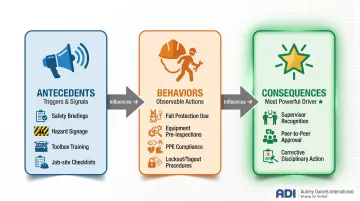
BBS applies the ABC model from behavioral science:
- Antecedents — triggers that prompt a behavior (safety briefings, signage, training, checklists)
- Behaviors — the observable actions workers take or skip (securing fall protection, conducting equipment inspections, wearing PPE)
- Consequences — what happens after the behavior, which reinforces or discourages repetition (recognition from a supervisor, peer approval, disciplinary action, or nothing at all)
Research shows that consequences are the most powerful driver of repeated behavior. Antecedents set the stage, but they rarely sustain behavior change without corresponding consequences. A rule posted on a trailer wall may prompt compliance the first day, but if no one acknowledges safe behavior—or if cutting corners saves time without negative outcomes—the rule loses its influence.
The "Blame the Worker" Misconception
A common critique of BBS is that it shifts responsibility from employers to workers—implying individuals are to blame for incidents. Poorly designed programs reinforce this perception by focusing narrowly on worker errors while ignoring systemic causes: inadequate training, supervisor time pressure, poorly designed site layouts, or conflicting production goals.
Well-designed BBS programs avoid this trap. They examine the system, the environment, and the reinforcement structure, not just individual choices.
When a worker skips a safety step, effective BBS asks why the unsafe behavior was easier or more rewarding than the safe one—and whether the training, site layout, or supervisory reinforcement made safe behavior practical in the first place. That's a systems lens, not a blame exercise.
The 5 Keys to a Successful Behavior-Based Construction Safety Program
Key 1: Root the Program in Behavioral Science, Not Just Common Sense
Intuition-based safety programs rely heavily on rules, warnings, and signage—antecedents that research shows have limited long-term impact without reinforcement. A poster reminding workers to wear hard hats may prompt compliance initially, but if supervisors don't model the behavior or acknowledge workers who comply consistently, the impact fades.
Applied Behavior Analysis (ABA) provides a more robust foundation. ABA-based BBS programs identify the specific behaviors that predict incidents—not just the outcomes (injuries)—and measure those leading indicators consistently. For example, instead of tracking only recordable injuries (a lagging indicator), an ABA-grounded program tracks observable behaviors: percentage of pre-task hazard assessments completed, frequency of proper fall protection use, or consistency of equipment lockout/tagout procedures.
Research consistently points to human behavior as a primary factor in construction incidents. While Heinrich's widely cited estimate—that 88% of industrial accidents involve unsafe acts—is a modeled figure from 1931 and has been critiqued for oversimplification, modern studies confirm the principle. One 2019 analysis found that "unsafe behavior is a critical factor leading to construction accidents," reinforcing the need to address behavioral root causes.
The distinction between leading and lagging indicators is critical. Research on construction prequalification surveys found that most rely on lagging indicators like injury rates, which tell you only what already went wrong. A 2020 study demonstrated that construction projects selecting subcontractors with higher scores on leading indicator assessments showed higher safety climate scores and lower injury rates at the worksite level.
That shift—from counting injuries after the fact to measuring the behaviors that prevent them—is what separates a BBS program from a traditional safety checklist.
Key 2: Make Positive Reinforcement the Engine of the Program
Positive reinforcement—providing meaningful recognition or reward immediately after a safe behavior—is the most powerful mechanism for increasing the frequency of that behavior. Contrast this with punishment-based approaches, which may suppress unsafe behavior in the short term but generate resentment, underreporting, and workers performing safety behaviors only when being watched.
A comprehensive review of 83 BBS studies found that 32 of 33 programs reporting injury data showed reductions, with reinforcement of safe behavior identified as a core element. One study within that review documented a 62.8% reduction in accidents maintained for three years using positive reinforcement.
What does positive reinforcement look like on a construction site?
- A supervisor specifically acknowledging a worker for completing a thorough pre-task hazard check: "I saw you walk the scaffold perimeter and check every tie-off point before starting—that's exactly the kind of inspection that prevents falls."
- Peer-to-peer recognition during toolbox talks: "Shout-out to the crew on Site B who maintained 100% lockout/tagout compliance this week."
- Small tangible rewards tied to observable behaviors: gift cards, extra break time, or public recognition boards highlighting specific safe actions

Immediacy and specificity matter more than the size of the reward. Generic praise like "good job" carries little weight. Specific recognition delivered close to the behavior reinforces the connection and increases the likelihood of repetition.
ADI's work in this area—including Judy Agnew's co-authored book Safe by Accident?—draws on decades of field application to explain why positive reinforcement outperforms fear-based management. Workers who experience positive, immediate consequences for safe behavior repeat those behaviors because doing so feels worthwhile, not because they're avoiding punishment.
The underreporting problem: Punishment-based approaches have a hidden cost. A 2009 Government Accountability Office report found that one-third to two-thirds of workplace injuries go unreported, with fear of reprisal and employer disciplinary programs identified as primary causes. When workers fear punishment for reporting near-misses or injuries, you lose the data you need to prevent future incidents. Positive reinforcement creates the opposite dynamic: workers feel safe reporting hazards and participating in observations because the program focuses on improvement, not blame.
Key 3: Engage Leadership at Every Level as Active Safety Models
Worker behavior reflects the behavioral norms modeled by supervisors and site leaders. If leadership bypasses PPE requirements, skips pre-task observations, or engages with safety only after an incident, workers will mirror that standard. A BBS program's credibility depends on whether leaders visibly practice what the program requires.
What does active leadership safety behavior look like?
- Supervisors conduct field observations regularly, not just when an audit is scheduled
- Managers participate in safety briefings rather than delegating them entirely to safety officers
- Executives set measurable safety behavior goals alongside production targets and hold themselves accountable to both
CPWR's Foundations for Safety Leadership (FSL) program, which has trained approximately one million frontline construction leaders since 2017, identifies demonstrating management commitment as a leading indicator of safety climate. Research published in the Journal of Safety Research evaluating the FSL intervention found that improving leadership practices directly improved jobsite safety climate and reduced negative safety outcomes.
BBS cannot be delegated entirely to a safety officer. The program's reach and credibility depend on every level of leadership visibly reinforcing the behaviors the program prioritizes. When a foreman stops work to acknowledge a crew member who flagged a hazard, or when a project manager opens a meeting by recognizing safe behavior data from the previous week, that sends a concrete signal about what the organization actually prioritizes.
Leadership engagement also addresses a core systems issue: if production pressure from supervisors makes unsafe behavior the path of least resistance, no amount of worker training will change outcomes. Leaders must align production goals with safety expectations and reinforce both consistently.
Key 4: Build a Structured Observation and Feedback System
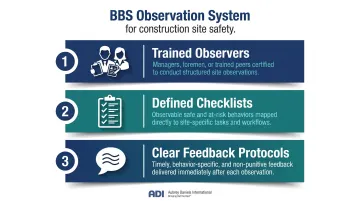
A structured BBS observation system requires three components:
- Trained observers — managers, foremen, or trained peers who understand what to look for and how to deliver feedback
- Defined checklists — observable safe and at-risk behaviors specific to the site's tasks (fall protection use, excavation shoring, electrical lockout procedures)
- Clear feedback protocols — guidelines for delivering timely, behavior-specific, non-punitive feedback in the moment
Effective feedback follows specific behavioral science principles:
- Behavior-specific: Not "good job," but "I noticed you double-checked the scaffold's load rating before stacking materials—that prevents overload failures."
- Timely: Delivered close to when the behavior occurred, ideally within minutes or hours
- Non-punitive for at-risk behaviors observed: The goal is to coach and improve, not catch and punish
Research analyzing over 1.3 million observational data points from 88 organizations found that:
- Having a limited number of dedicated observers is more effective than encouraging all employees to participate
- Monthly observations produce better results than more frequent check-ins, which can feel surveillance-like
- Using observers familiar with the tasks being observed is more effective than using unfamiliar observers
These findings challenge the assumption that universal participation is always best. Instead, quality and familiarity matter more than quantity.
The data integrity challenge: Observations must be recorded honestly and consistently. If workers sense the data is being used to discipline rather than improve, reporting becomes inaccurate. One systematic review confirmed extensive underreporting of workers' injuries across industries when punitive consequences are tied to reporting. A well-designed BBS program protects data integrity by separating observation from discipline and making it clear that the purpose is system improvement, not individual fault-finding.
Key 5: Plan for Sustainability, Not Just a Successful Launch
Many BBS programs generate early enthusiasm but fade because they were designed as a launch event rather than a continuous system. While specific timelines vary, the pattern is well-documented: programs that don't build in sustainability mechanisms lose momentum and credibility.
What does a sustainability plan include?
- Regular review of observation data to update behavior checklists as hazards and tasks change
- Refresher training for observers to maintain consistency and address drift
- Ongoing positive reinforcement for safety behavior at all levels, embedded in daily routines
- Visible leadership accountability tied to safety metrics as leading indicators—percentage of observations completed, positive reinforcement frequency—not just lagging indicators like injury rates
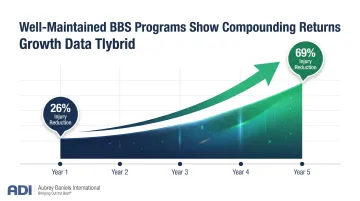
A meta-analysis of 73 facilities over five years demonstrated that well-maintained BBS programs show compounding returns: 26% injury reduction in Year 1, increasing to 69% by Year 5. This finding directly contradicts the notion that BBS effectiveness fades over time. The key difference is whether sustainability is built into the program from the start.
A study of 20 organizations identified a "Safety Success Triad" that predicts long-term effectiveness:
- Interpersonal trust between workers and management
- Management support demonstrated through actions, not just words
- Employee participation enabled by effective training and accountability
The study also found that mandatory participation led to higher involvement, trust, and satisfaction than voluntary programs—a signal that organizational commitment itself shapes how seriously workers take the program.
Working with an experienced behavioral science partner—such as ADI, which has spent over 45 years helping organizations apply behavioral science to performance improvement including workplace safety—can help construction firms design BBS programs built for long-term culture change, with sustainability mechanisms built in from day one.
Common Pitfalls That Undermine BBS Programs in Construction
The "Blaming the Worker" Trap
When BBS is implemented without a systemic lens, observers focus on individual errors while ignoring the antecedent conditions that make unsafe behavior the easiest choice. These conditions include:
- Poor site layout that funnels workers toward shortcuts
- Inadequate or rushed training before task assignment
- Time pressure from supervisors prioritizing production over safety
- Conflicting goals between project deadlines and safe work practices
Ignoring these factors destroys worker trust and buy-in. Effective BBS examines what shapes behavior, not just who performed it.
Relying on Lagging Indicators Alone
Programs that measure only injury rates and recordable incidents miss the leading behavioral data that actually predicts future incidents. Injury rates tell you what already went wrong; behavioral observations tell you what's likely to go wrong next. Programs focused solely on outcomes cannot course-correct before accidents happen.
Failure to Adapt to Construction's Unique Challenges
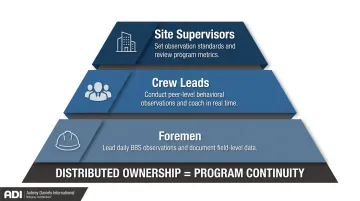
High workforce turnover and project-based site configurations mean BBS programs must be designed to onboard new workers quickly and maintain consistent observation standards across multiple crews. Programs that depend on one safety officer or one enthusiastic champion tend to collapse when that person leaves.
Sustainable programs distribute observation responsibilities across multiple trained personnel at every level — foremen, crew leads, and site supervisors — so the system continues functioning regardless of individual turnover.
Conclusion
A behavior-based construction safety program is not a one-time initiative or a checklist to complete. It is a continuous system grounded in behavioral science — one that shapes daily habits, reinforces the right actions at the right time, and makes safe behavior the default on every job site.
The five keys outlined here — behavioral science foundations, positive reinforcement, leadership engagement, structured observation, and program continuity planning — provide a repeatable framework for measurable, lasting improvement. Moving beyond compliance-driven safety to proactive behavioral strategies takes commitment. The organizations that make that shift typically see fewer injuries, lower incident costs, and a workforce that genuinely trusts the safety process. That trust compounds over time.
If you're looking to build or strengthen a behavior-based safety program, ADI's consultants have applied these principles across construction, manufacturing, and high-hazard industries for over 45 years — contact us to learn what a structured implementation looks like for your team.
Frequently Asked Questions
What is behavior-based safety in construction?
Behavior-based safety (BBS) is a proactive, science-based approach that identifies and reinforces safe worker behaviors before incidents occur. It uses systematic observation and feedback to shape daily actions, focusing on prevention rather than reacting only to injuries or violations.
What are some examples of behavior-based safety?
Common examples include:
- A supervisor giving specific verbal recognition to a worker who correctly secured fall protection
- A peer observer completing a behavior checklist during a routine task
- A crew reviewing observation data in a weekly toolbox talk to identify patterns and improvement opportunities
What is the 20-20-20 rule in construction safety?
The 20-20-20 rule is an ergonomic guideline for reducing eye strain: every 20 minutes, look at something 20 feet away for 20 seconds. While it addresses a specific physical hazard, BBS programs complement such rules by reinforcing the behaviors that ensure workers actually follow them consistently.
What are the biggest challenges of implementing BBS in construction?
Three obstacles come up most often:
- High workforce turnover makes consistent observation and reinforcement difficult
- Programs risk being perceived as blame-focused rather than system-focused
- Teams rely on lagging injury metrics instead of leading behavioral observations that predict future incidents
How is behavior-based safety different from traditional safety programs?
Traditional programs focus on rules, training, and enforcement (the antecedents) with punishments as the primary consequence. BBS adds systematic positive reinforcement to shape behavior proactively and continuously — intervening upstream rather than reacting after incidents occur.
Do BBS programs actually reduce injuries in construction?
Yes, when implemented well. A meta-analysis of 73 facilities showed injury reductions ranging from 26% in Year 1 to 69% by Year 5. A review of 33 studies found that 32 reported injury reductions. Results depend heavily on program quality—specifically whether positive reinforcement, structured observation, and leadership engagement are consistently applied.