Introduction
The construction industry faces a troubling paradox. Despite decades of investment in safety programs, protective equipment mandates, and regulatory compliance systems, fatality rates remain stubbornly high. According to the Bureau of Labor Statistics, construction workers accounted for 1,032 fatalities in 2024—representing 20.4% of all workplace deaths in the United States. Falls alone claimed 370 construction workers' lives, maintaining construction's position as the industry with the highest fatal fall rate.
This persistent gap between safety investment and incident reduction signals a fundamental systems problem, not a worker problem. Traditional safety culture frameworks were built on compliance and hazard recognition—addressing what workers should do while ignoring what actually drives the behavior they exhibit.
The revised framework presented here shifts from rules-based thinking to behavior-based science. Consequences, not instructions, determine whether safe behaviors are repeated or abandoned.
This article delivers three core elements: a clear revised framework grounded in behavioral science, the strategic pillars that make it work in construction settings, and practical guidance for translating it into daily site operations.
TLDR:
- Compliance-focused programs fail because they target rules, not behavioral consequences
- The revised framework applies Applied Behavior Analysis to all dimensions of safety culture
- Positive reinforcement drives durable behavior change; punishment undermines reporting
- Supervisors define safety culture through daily actions, not written policies
- Near-miss reports and observations predict incidents; TRIR and DART only confirm them
Why Traditional Construction Safety Culture Approaches Keep Falling Short
Compliance-focused safety programs dominate the industry: OSHA checklists, toolbox talks, PPE requirements, incident reporting systems. These tools address antecedents of behavior (rules and reminders that tell workers what they should do), but behavioral science identifies consequences as the primary driver of sustained behavior, not antecedents.
When organizations invest heavily in telling workers what to do while neglecting to manage what happens after they do it, compliance activities become "pencil whipping" exercises: forms filled out without meaningful observation or behavior change.
A comprehensive study of 1,283 Spanish construction companies over 11 years found that more hours of safety training were associated with more accidents, not fewer. Training volume without behavioral design is insufficient; what matters is training quality and consequence management.
The Production-Over-Safety Pressure Dynamic
Even in organizations that verbally prioritize safety, workers and supervisors receive daily behavioral signals that schedule and output matter more. When leadership rewards speed and punishes delays (even implicitly), safe behavior erodes regardless of posted policies. Research modeling production pressure in construction demonstrates that production pressure directly decreases safety levels and increases accident rates. Workers face a behavioral calculus: safe behaviors often produce immediate negative consequences (delays, extra effort, supervisor frustration) while at-risk behaviors produce immediate positive consequences (time savings, less physical effort, supervisor approval).
This conflict creates predictable outcomes. Supervisors who prioritize safety, even when it slows production, face quiet penalties unless senior leadership visibly reinforces their decisions. When the incentive structure punishes safety-first supervisors, the cultural erosion happens quietly — not through policy changes, but through daily behavioral choices that accumulate over time. This is precisely why lagging metrics rarely capture the problem until it's too late.
The False Picture of Incident-Based Measurement
Organizations can go months without a recordable event while unsafe behaviors accumulate invisibly. Lagging indicators like TRIR and DART measure outcomes, not the cultural conditions that produce them. They tell you what already happened, with no signal about whether conditions are improving or getting worse.
This measurement approach creates dangerous complacency. A site with zero incidents for six months looks safe on paper, but if workers routinely skip fall protection when supervisors aren't watching, the culture is fragile. The next incident is a matter of probability, not prevention. Mature safety cultures measure the behaviors and system responses that predict incidents, not just the incidents themselves.
A Behavioral Science Framework for Construction Safety: The Revised Components
A revised framework means moving from a hazard-recognition model—identify and control physical risks—to a behavior-based model that addresses psychological, behavioral, and organizational dimensions simultaneously. Academic research, including ASCE's construction safety culture model, supports this multi-level approach, distinguishing between management-level culture drivers and site-level climate.
Three Dimensions That Must Align
For genuine safety culture to emerge, three dimensions must work in concert:
1. Psychological Dimension: What workers and leaders believe about safety and risk
2. Behavioral Dimension: What people actually do on site, especially when no one is watching
3. Organizational Dimension: What systems, incentives, and leadership practices reinforce or undermine safe behavior
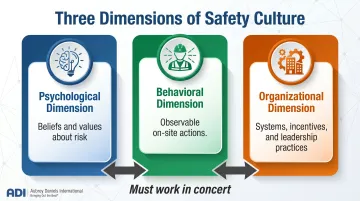
Most frameworks address only one or two of these dimensions. Compliance programs target the organizational layer—policies and procedures—but rarely shape what workers actually believe or do.
Safety training takes the opposite approach, targeting attitudes and knowledge. Yet it often fails to produce lasting behavioral change because it doesn't account for the consequences workers face when they try to act on that training.
The Behavioral Science Lens: Consequences Over Instructions
Applied Behavior Analysis teaches that behavior is a function of its consequences, not its instructions. To change what workers do, organizations must understand and strategically manage what happens after safe or unsafe behavior occurs. Antecedents can initiate behavior, but only consequences maintain it long-term. This reframes safety culture from a communication challenge to a performance management challenge.
Consider the concept of "Safe by Accident"—the reality that many construction workers stay injury-free not because of robust safety culture, but by chance or by avoiding certain high-risk conditions. ADI's Judy Agnew explores this distinction in Safe by Accident? Take the Luck out of Safety, laying out what deliberate, behavior-based safety looks like in practice—and why luck is not a strategy.
Subordinating Hazard Recognition Correctly
This framework does not abandon hazard recognition—it subordinates it correctly. Hazard identification is one input into a larger behavioral system, not the system itself. The revised framework adds the critical question: "Given this hazard, what behavior do we need from workers and leaders, and what conditions will reliably produce that behavior?"
When a fall hazard is identified, compliance thinking stops at installing guardrails and posting signage. Behavioral thinking goes further. It demands answers to questions like:
- What will cause workers to use the guardrails consistently?
- What happens—formally and informally—when they don't?
- What consequences do supervisors actually deliver when they observe safe versus at-risk behavior?
Without those answers, the guardrail is a physical fix to a behavioral problem. The hazard may be controlled on paper while the conditions that produce at-risk behavior remain unchanged.
The Behavioral Pillars: Antecedents, Behavior, and Consequences on Construction Sites
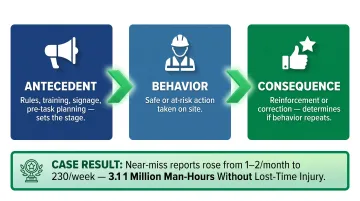
The ABC model (Antecedent-Behavior-Consequence) is the core mechanism of behavioral safety:
- Antecedents (rules, training, signage, pre-task planning) set the stage for behavior but do not reliably produce it
- Consequences (what happens after a behavior) determine whether that behavior is repeated, increased, or eliminated
Most safety programs invest heavily in antecedents and neglect consequences entirely. Organizations print safety manuals, conduct weekly toolbox talks, post warning signs, and distribute PPE—all antecedents. Then they wonder why compliance remains inconsistent.
The Power of Positive Reinforcement
Behavioral science shows that immediate, certain positive consequences are far more powerful behavior shapers than delayed or uncertain punishment. In construction, this means actively and specifically recognizing safe behavior—not just citing violations.
What does this look like at the supervisor level? Instead of generic "great job" statements, effective reinforcement is:
- Immediate: Delivered within seconds or minutes of the safe behavior
- Specific: "I noticed you took the time to set up the guardrail before starting that edge work—that's exactly what we need"
- Contingent: Tied directly to the behavior, not given indiscriminately
A construction power-plant case study demonstrated the impact of positive reinforcement: near-miss reporting increased from 1-2 per month to 230 per week after implementing recognition systems like "Crew of the Month," early-out privileges, and preferred parking. The project achieved 3.1 million man-hours without a lost-time injury and an OSHA recordable rate of 0.68.
Why Punishment-Based Approaches Backfire
Punishment suppresses behavior in the presence of the supervisor but does not build the values or skills that produce safe behavior when no one is watching. It also discourages near-miss reporting—one of the most valuable leading indicators of risk. Workers learn to hide problems rather than surface them.
Research on near-miss reporting barriers confirms this directly: fear of retaliation is the primary obstacle. When workers believe reporting will trigger blame, drug testing, or job loss, they stay silent—and the organization loses critical intelligence about accumulating risk.
Building Behavioral Fluency
Workers need to practice safe behaviors until they become automatic and habitual, not just understand them cognitively. Behavioral fluency—the fluid combination of accuracy and speed that characterizes competent performance—requires repetition, feedback, and reinforcement in context.
Knowledge transfer alone is insufficient. Training must build behavioral fluency through hands-on practice, immediate feedback, and positive reinforcement when skills are demonstrated correctly. A worker who can recite fall protection requirements but has never practiced donning a harness under supervision is not fluent—and fluency gaps become fatal under time pressure or distraction.
Trust as a Behavioral Outcome
Trust in safety systems develops when workers observe that their safety-related behaviors—reporting hazards, stopping work, raising concerns—consistently produce fair, constructive, and visible responses from leadership. Trust erodes when those behaviors are met with indifference, blame, or bureaucracy.
This is a consequence management problem with a direct behavioral solution: make reporting and concern-raising produce immediate, positive consequences. In practice, that means:
- Acknowledging the report promptly and without blame
- Investigating visibly so workers see action being taken
- Closing the loop with the reporter on what was found or changed
- Publicly recognizing workers who surface problems
Organizations that do this consistently find that concern-raising becomes self-sustaining—workers share problems because they've seen it lead to something real.
Leadership as the Primary Shaper of Safety Behavior
Leadership commitment to safety is not primarily about stated values or safety speeches. It shows up in the behavioral signals leaders send through daily actions: what they pay attention to, what they reinforce, and what they allow to pass without comment.
Workers are expert observers of what leadership actually rewards. A supervisor who praises a worker for identifying a safety issue and stops work sends a stronger signal than any policy document.
The Supervisor's Role as Consequence Manager
Supervisors are the most proximate source of reinforcement and correction for crew members. Their moment-to-moment responses, not the safety director's quarterly report, determine what behaviors get repeated. Longitudinal research on construction supervisors demonstrates that site managers' safety-specific contingent reward behaviors significantly predicted supervisors' subsequent safety leadership (beta = 0.22, p = 0.04). The study also found a reciprocal effect: supervisors' safety behaviors influenced site managers in return (beta = 0.26, p = 0.03).

When site managers model specific, positive feedback for safety behaviors, supervisors adopt the same approach with their crews — and those crews, in turn, reinforce the pattern upward. The behavioral signal travels in both directions.
What Behavior-Based Safety Leadership Looks Like in Practice
Effective safety leadership includes:
- Conducting observations that prioritize positive recognition over compliance audits — acknowledging safe behaviors builds engagement and surfaces concerns
- Explaining the "why" behind safety decisions in terms of worker well-being, not regulatory risk. Workers respond to genuine concern, not abstract policy
- Modeling expected behaviors directly: leaders who skip pre-task planning or bypass PPE teach crews that safety is negotiable
Aligning the Incentive Structure
Senior leadership must align the incentive structure so that supervisors who prioritize safety — even when it slows production — are recognized and rewarded, not quietly penalized. When supervisors face conflicting pressures between safety and schedule, the behavioral outcome is predictable: they choose the priority that produces positive consequences and avoids negative ones.
Resolving this conflict requires visible, consistent reinforcement from senior leadership and project managers. ADI's Precision Leadership framework is built around exactly this mechanism — equipping managers at every level with the behavioral skills to reinforce safe decisions consistently, so supervisors learn that protecting a worker is never the wrong call.
When a supervisor delays a pour to address a rebar hazard, the project manager's response is what actually determines the supervisor's behavior next time. Get that response right, and the right behaviors follow.
Putting the Revised Framework into Practice: Site-Level Strategy
Implementation starts by shifting from paper-based safety processes to behavioral observation and feedback systems. Replace checklist-based tools with structured conversations that surface what workers believe, what pressures they face, and what risks they're managing day to day.
The goal is behavioral intelligence — not documentation compliance.
Redesigning Near-Miss Reporting as Positive Reinforcement
Transform near-miss reporting from a punitive or bureaucratic process into a positive reinforcement system:
- Reduce friction with simple options: digital tools, verbal reports to supervisors, or anonymous drop boxes
- Acknowledge every report immediately, investigate within 24 hours, and close the loop with the reporter
- Recognize reporters publicly and track reporting volume as a positive metric — crews with high reporting rates deserve to be celebrated
These steps increase the volume and quality of leading indicator data. Construction organizations using near-miss reporting systems report stronger negative correlations between reporting volume and injury rates — more reporting predicts fewer incidents because problems get identified and corrected before they cause harm.
Integrating Safety into Daily Operational Rhythms
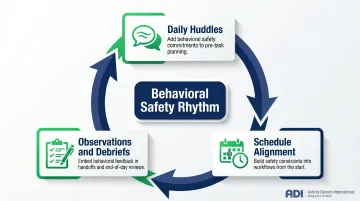
Build safety behavior into daily operational rhythms rather than treating it as a separate parallel track:
- Add behavioral commitments to daily huddles — for example, "I will stop work if I see a fall hazard" — as part of pre-task planning
- Set schedules with safety constraints in mind; when you don't, workers notice the gap between what leaders say and what workflows actually demand
- Work safety observations into handoffs and end-of-day debriefs so behavioral feedback becomes a routine part of operations, not an occasional audit
Measuring Safety Culture Change: From Lagging to Leading Indicators
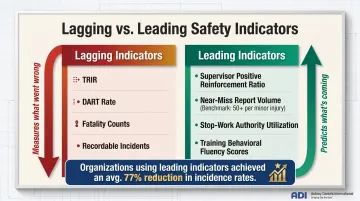
Lagging indicators—TRIR, DART rate, fatality counts—measure what already went wrong. Leading indicators—behavioral observations, near-miss report rates, corrective action closure rates, pre-task planning completion—measure the conditions that produce outcomes. Mature safety culture measurement depends heavily on leading indicators to give organizations real-time feedback on cultural health.
Behavioral Leading Indicators Aligned with the Revised Framework
Specific behavioral leading indicators include:
- Supervisor safety interactions — track the ratio of positive reinforcement to corrective feedback, not just observation counts
- Near-miss reporting volume — 50+ near-miss reports per minor injury is a benchmark for a healthy reporting culture
- Stop-work authority utilization — instances where workers halted operations for safety are positive metrics, not production disruptions
- Training behavioral fluency scores — measure whether workers perform safety-critical skills correctly under realistic conditions, not just who attended
Tracking System Responsiveness
Measuring safety culture requires tracking both behavior and system responses. Counting observations alone misses the picture. Organizations must also track:
- Whether observations led to action
- Whether reported hazards were resolved
- Whether workers perceive the system as responsive and fair
Research comparing organizations using both leading and lagging indicators found that those measuring proactively achieved an average 77% reduction in incidence rates within 3-12 years. A strong negative correlation (r = -0.86) exists between training hours (a leading indicator when measured for quality, not just volume) and incidence rates.
Those results show up in real performance data. The Construction Industry Institute reports that member companies achieve a median TRIR of 0.22 versus the U.S. construction industry average of 2.4—roughly 10 times better. Compliance-focused organizations rarely close that gap; the ones that do invest systematically in leading indicators, behavioral observation systems, and consequence management.
Frequently Asked Questions
What are the key components of construction safety culture in a revised framework?
A revised framework integrates three aligned dimensions: psychological (beliefs and values), behavioral (observable actions), and organizational (systems and incentives). Behavioral science principles then govern how those dimensions are strengthened through consequence management, not just rules and training.
What is the 20-20-20 rule in construction safety?
The 20-20-20 rule is an ergonomic guideline for reducing eye strain during sustained screen or close-focus work: every 20 minutes, look at something 20 feet away for 20 seconds. It's relevant for construction personnel in planning, BIM, or administrative roles but is a specific ergonomic tool, not a general safety culture principle.
What is the difference between safety culture and safety climate in construction?
Safety culture refers to deep, stable organizational values and systems that shape safety over time, while safety climate reflects workers' current perceptions of safety at a specific point. Climate is measurable through surveys and shifts quickly; culture changes slowly through sustained behavioral and leadership reinforcement.
How does positive reinforcement improve construction safety outcomes?
Positive reinforcement—immediate, specific recognition of safe behaviors—produces more durable behavior change than punishment because it builds intrinsic motivation and teaches workers what to do, not just what to avoid. It also encourages reporting and communication by making it safe to surface concerns without fear of blame.
Why do compliance-based safety programs fail to prevent incidents?
Compliance programs focus on antecedents that tell workers what they should do, but behavioral science shows that consequences are the primary determinants of whether a behavior is repeated. Without actively managing those consequences, compliance creates documentation without durable behavior change.
How long does it take to build a strong construction safety culture?
Measurable behavioral improvements can appear within weeks when reinforcement systems are applied consistently. A deeply embedded safety culture that holds under production pressure and leadership turnover typically takes one to three years, with the pace tied directly to leadership consistency and consequence management at the supervisor level.