Introduction
Fleet managers and safety directors face a relentless challenge: violations pile up month after month, BASIC scores creep higher, and the same corrective measures—retraining drivers, issuing warnings, updating policies—produce only temporary improvement before the pattern repeats. Despite documented procedures and disciplinary consequences, unsafe driving behaviors, hours-of-service violations, and maintenance defects continue to trigger roadside interventions and federal scrutiny.
The Federal Motor Carrier Safety Administration (FMCSA) uses a seven-category framework called BASICs (Behavior Analysis and Safety Improvement Categories) to evaluate carrier safety performance and determine when federal intervention is warranted. This guide explains what each BASIC measures, how FMCSA calculates scores, what triggers enforcement action, and why traditional compliance approaches fail to produce lasting change.
Sustainable improvement means addressing the behavioral root causes that make violations likely — redesigning work conditions so safe behavior becomes the default, not the exception.
TLDR:
- BASICs are seven FMCSA categories measuring carrier safety using 24 months of inspection and crash data, updated monthly
- Scores are percentile rankings; exceeding intervention thresholds (65% or 80% depending on category) triggers federal action
- Standard safety programs focus on rules and punishment — not the conditions that make safe behavior likely or unlikely
- Lasting improvement requires identifying what reinforces unsafe behavior and redesigning the environment so safe behavior becomes the consistent choice
What Are the BASICs? The FMCSA Framework Explained
BASICs—Behavior Analysis and Safety Improvement Categories—are seven measurement categories used by the FMCSA's Compliance, Safety, Accountability (CSA) program to assess commercial motor carrier safety performance through the Safety Measurement System (SMS). Scores are updated monthly from a rolling 24-month window of roadside inspection data, crash reports, and investigation findings.
"The BASICs incorporate violations of the Federal Motor Carrier Safety Regulations (FMCSRs) and the Hazardous Materials Regulations (HMRs), and are organized to focus on behaviors that may cause or increase the severity of crashes." — FMCSA SMS Methodology
Key Agencies and Terms
| Term | Full Name | Role |
|---|---|---|
| FMCSA | Federal Motor Carrier Safety Administration | DOT agency that enforces federal safety regulations for commercial motor vehicles and steps in when carriers fall below safety standards |
| CSA | Compliance, Safety, Accountability | FMCSA program that reduces CMV crashes through data-driven safety measurement and targeted intervention |
| SMS | Safety Measurement System | Converts inspection violations, crash data, and investigation results into percentile rankings, comparing each carrier against similarly-sized peers on a 0–100% scale |
Public vs. Private BASICs
Understanding which BASICs are visible — and to whom — matters for carriers managing their public safety profile.
Of the seven BASICs, five are publicly visible to anyone with a DOT number. Customers, brokers, insurers, and the general public can view these scores on the SMS public website:
- Unsafe Driving
- Hours-of-Service (HOS) Compliance
- Vehicle Maintenance
- Controlled Substances/Alcohol
- Driver Fitness
Two BASICs are private, accessible only to the carrier (when logged into their SMS account) and enforcement personnel: Crash Indicator and Hazardous Materials Compliance. This restriction was mandated by the FAST Act of 2015.
One exception: for passenger carriers, all seven BASICs remain publicly visible, reflecting the higher safety standards applied to passenger transportation.
The 7 BASIC Categories: What Each One Measures
Unsafe Driving
Covers dangerous or reckless operation of commercial motor vehicles. Common violations include:
- Speeding (6-10 mph over, 11-14 mph over, 15+ mph over)
- Improper lane changes
- Following too closely
- Texting or hand-held cell phone use while driving
- Inattention or distracted driving
- Failure to use seat belts
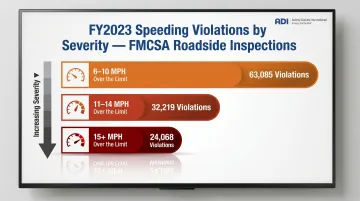
Speeding violations carry severity weights that scale with the degree of speed over the limit, making them among the most impactful violations in this category. According to the FMCSA 2024 Pocket Guide, FY2023 roadside inspections documented 63,085 violations for speeding 6-10 mph over, 32,219 for 11-14 mph over, and 24,068 for 15+ mph over.
Hours-of-Service (HOS) Compliance
Measures adherence to federal regulations governing maximum driving and on-duty time to ensure drivers are alert and rested. Common violations include:
- Operating while fatigued or ill
- Exceeding the 11-hour driving limit
- Violating the 14-hour on-duty window
- Missing or inaccurate electronic logging device (ELD) records
- False logs or records of duty status
HOS violations dominate driver out-of-service violations. During CVSA's 2025 International Roadcheck, HOS violations accounted for 32.4% of all driver out-of-service violations (1,076 out of 3,317), making it the number-one driver OOS category. Add false log violations, and HOS-related issues represented approximately 42.4% of all driver OOS violations during that inspection period.
Driver Fitness
Evaluates whether drivers are qualified to operate CMVs. Key qualification requirements include:
- Valid Commercial Driver's License (CDL) for the class and type of vehicle operated
- Current medical certification meeting FMCSA physical qualification standards
- Clean state driving record without disqualifying offenses
- Complete employment documentation and driver qualification files
These requirements place the compliance burden squarely on carriers. Expired medical certificates and incomplete qualification files are among the most common violations inspectors flag in this category.
Controlled Substances/Alcohol
Addresses operation of CMVs under the influence of alcohol, illegal drugs, or impairing prescription/over-the-counter medications. It also measures carrier compliance with all required testing programs, including:
- Pre-employment and random testing
- Post-accident and reasonable suspicion testing
- Return-to-duty and follow-up testing
This category carries the strictest standards. Violations are assigned severity weights on a 1-to-10 scale, with some carrying the maximum 10-point weight. The intervention threshold is 80% for general carriers (65% for passenger carriers), given the direct impairment risk to the driver and the public. Even possession of unopened alcoholic beverage containers in the cab constitutes a violation.
Vehicle Maintenance
Measures whether carriers maintain CMVs to federal safety standards, including cargo securement. Common areas of compliance include:
- Pre-trip and post-trip inspections
- Driver Vehicle Inspection Reports (DVIRs) and defect repairs
- Compliance with periodic inspection requirements
- Brake systems, lighting, tires, and coupling devices
- Proper cargo securement
Vehicle defects are the most visible trigger for roadside inspection. The FMCSA 2024 Pocket Guide reports a national vehicle out-of-service rate of 22.6% (450,477 OOS violations out of 1,994,946 vehicle inspections in FY2023). The most common vehicle violations were inoperable required lamps (336,623 violations), operating without proof of periodic inspection (190,975), and brake-out-of-adjustment (125,372).
Hazardous Materials Compliance (Private)
Evaluates proper packaging, marking, labeling, placarding, loading, and transport of hazardous materials requiring a placard under 49 CFR Part 172. Because this BASIC is not public, it is accessible only to the carrier logged into their SMS profile or enforcement personnel. Only carriers who transport placardable quantities of hazardous materials receive a score in this category.
Crash Indicator (Private)
Aggregates state-reported crash data over 24 months to identify patterns of high crash frequency and severity. Crashes are counted when they result in:
- Fatalities
- Injuries requiring immediate medical treatment away from the scene
- Tow-away incidents where any vehicle required towing due to disabling damage
Unlike the other BASICs, Crash Indicator captures outcomes rather than inspection violations. It is private — visible only to the carrier and enforcement personnel — and calculated differently, using carrier average power units and a utilization factor rather than the inspection-based methodology applied to violation BASICs.
How BASIC Scores Are Calculated and When FMCSA Intervenes
Percentile Rankings, Not Raw Scores
BASIC scores are not raw tallies—they are percentile rankings from 0 to 100 that compare a carrier against peers with similar fleet size and mileage exposure. A score of 75% in Unsafe Driving means the carrier performs worse than 75% of similarly-sized carriers, not that they scored 75 points out of 100.
Severity Points and Time Weighting
Each violation adds 1 to 10 severity points depending on the infraction's crash risk. According to the SMS Methodology, "violation severity weights have been converted to a scale from 1 to 10 for each BASIC, where 1 represents the lowest crash risk and 10 represents the highest crash risk."
Recent violations weigh more heavily:
- Months 0-6: Violations carry a 3x time weight
- Months 7-12: Violations carry a 2x time weight
- Months 13-24: Violations carry a 1x time weight
This means a violation from last month has three times the impact of an identical violation from 18 months ago. Violations drop off entirely after 24 months.
Intervention Thresholds
Carriers exceeding these percentile thresholds are prioritized for FMCSA intervention:
| BASIC Category | General Carriers | Passenger Carriers |
|---|---|---|
| Unsafe Driving | 65% | 50% |
| Crash Indicator | 65% | 50% |
| HOS Compliance | 65% | 50% |
| Vehicle Maintenance | 80% | 65% |
| Controlled Substances/Alcohol | 80% | 65% |
| Driver Fitness | 80% | 65% |
| HM Compliance | 80% | 80% |
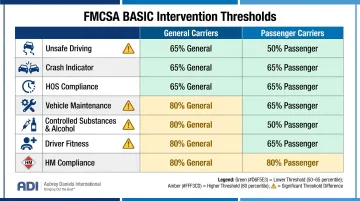
Exceeding a threshold does not automatically trigger enforcement action, but it places the carrier in the pool of companies FMCSA prioritizes for intervention.
Intervention Escalation Path
Once flagged, FMCSA moves through a three-tier escalation process — though carriers with multiple BASICs above threshold or severe violation patterns may skip directly to investigation or enforcement without working through each step in order.
Early Contact — Warning letters notifying carriers of safety performance problems; targeted roadside inspections focused on specific BASICs
Investigation — Offsite document review, onsite focused investigation for specific problems, or a full onsite comprehensive safety operation review
Follow-On — Options include a Cooperative Safety Plan (voluntary), Notice of Violation (corrective action required, no penalties), Notice of Claim (civil penalties), or an Operations Out-of-Service Order (immediate cessation of all operations)
Why Safety Violations Keep Happening: The Behavior Gap
Most organizations build safety programs around rules, policies, and consequences for non-compliance. Violations trigger retraining. Repeat offenses escalate to warnings or termination. Safety meetings emphasize what workers should not do. Yet the same violations recur, incident rates stay stubbornly high, and the cycle continues.
The core problem is the behavior gap—the disconnect between what safety programs demand and what the work environment actually reinforces.
Why Unsafe Behavior Wins the Competition
Behavior is a function of its antecedents (cues, instructions, environmental prompts) and its consequences (what happens immediately after the behavior). When unsafe behaviors produce immediate positive results — getting the job done faster, avoiding physical discomfort, or earning peer approval for "getting it done" — unsafe behavior wins the competition every time, regardless of what policies say.
Safe behavior, by contrast, often produces no immediate reward and may even feel inconvenient.
A worker who skips a pre-task checklist gets on with the job faster. The potential negative consequence — an injury or a regulatory citation — is delayed, uncertain, and may never occur. The immediate consequence shapes behavior far more powerfully than the distant one.
Traditional Interventions Rely on Punishment After the Fact
Most safety interventions—retraining after a violation, disciplinary action, safety posters warning of consequences—rely on negative consequences after the fact. Behavioral science research consistently demonstrates that **punishment-based approaches produce only temporary behavior suppression** that reverts when monitoring ceases.
According to research published in behavioral science literature, "Punishment is based on coercion and usually only results in temporary changes." When the person enforcing punishment is no longer present, "the unwanted behavior is likely to return." The use of positive reinforcement in changing behavior is "almost always more effective than using punishment."
An FMCSA-sponsored synthesis on safety culture found that a "culture of fear" is "neither positive nor effective" for safety management and emphasized that safety cultures rewarding accident reporting—rather than punishing it—are more effective at identifying hazards before they cause crashes. The report also identified production pressure from supervisors as a primary driver of unsafe behavior across worksites.

The Path to Sustainable Improvement
Sustainable safety improvement requires understanding what currently reinforces unsafe behavior in your operation and redesigning the work environment so that safe behavior is consistently prompted, performed, and positively reinforced. This means:
- Identifying the antecedents (production pressure, tight schedules, inconvenient safety procedures) that prompt unsafe shortcuts
- Examining what consequences currently follow both safe and unsafe behavior
- Redesigning systems so safe behavior is easier, more socially accepted, and more frequently recognized than unsafe behavior
When those reinforcement structures change, safe behavior stops requiring willpower — it becomes the natural path of least resistance.
Using Applied Behavior Analysis to Improve Each BASIC Score
Applied Behavior Analysis (ABA) is a scientific discipline with decades of research showing that behavior can be reliably shaped through systematic identification of antecedents, observation of behavior, and strategic use of consequences—particularly positive reinforcement. In workplace safety, this means building systems where safe behavior becomes the default, not the exception.
Evidence: Behavior-Based Safety Produces Sustained Results
A meta-analysis of 73 companies by Krause, Seymour, and Sloat (1999), cited by Aubrey Daniels International, found an average 26% reduction in incidents in year one of behavior-based safety implementation, rising to 69% by year five—demonstrating that effectiveness increases over time with sustained implementation.
ADI's behavior-based safety work—including Judy Agnew's co-authored book Safe by Accident—gives organizations a practical framework for designing and sustaining the positive reinforcement environments that drive these results.
Unsafe Driving and HOS Compliance
Behavior-based approaches start by examining what environmental cues currently prompt drivers toward speeding or hours manipulation:
- Are dispatch schedules realistic, or do they require cutting corners to meet deadlines?
- Do drivers receive immediate recognition for clean inspections, or only negative feedback when violations occur?
- Is there dispatcher pressure—explicit or implicit—to prioritize delivery time over compliance?
Redesigning these antecedents, combined with positive reinforcement for clean roadside inspections and on-time compliance, makes safe behavior the default. Research shows that incentivizing drivers specifically for clean roadside inspections positively affects HOS, Vehicle Maintenance, Controlled Substances, and Driver Fitness scores simultaneously. Drivers who expect to be inspected—and rewarded for compliance—are more likely to maintain complete documentation, conduct thorough pre-trips, and avoid substance violations.
Vehicle Maintenance
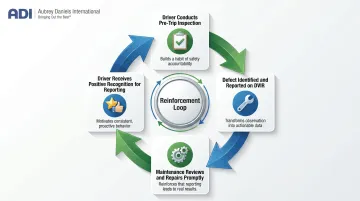
Proactive, behavior-based maintenance programs establish observable behavioral standards for drivers and maintenance staff:
- DVIRs are reviewed and acknowledged promptly, with positive recognition for identifying defects
- Defect reporting is reinforced, not punished (eliminating the "don't report it or you'll be delayed" consequence)
- Maintenance staff receive feedback and recognition for timely repairs
This replaces a culture of "ignore it until it fails" with one where inspection and reporting are consistently reinforced—producing fewer roadside out-of-service violations and lower Vehicle Maintenance BASIC scores.
Driver Fitness and Controlled Substances
The behavioral approach focuses on what carriers can do to reinforce complete documentation habits systematically:
- Build positive reinforcement schedules around on-time credential renewals
- Recognize drivers and compliance staff for maintaining current medical certificates and qualification files
- Use checklists and reminder systems (antecedents) to prompt timely renewals before expiration
Supervisory behavior is a key target here. Supervisors trained to observe and positively reinforce safe behaviors at the driver level—rather than only correcting failures—are a primary driver of cultural change. When supervisors consistently recognize drivers for compliance behaviors, those behaviors increase in frequency.
Using BASIC Data as a Behavioral Feedback Tool
Carriers should analyze violations for behavioral patterns rather than treating each event as isolated:
- Is the same driver repeatedly cited for the same violation?
- Do violations cluster on the same route or time of day?
- Is there a pattern with a specific dispatcher or customer?
This root-cause behavioral analysis identifies the antecedents and consequences maintaining the problem behavior. That's what separates an improvement plan with staying power from one that fades after the first quarterly review.
How to Build a Safety Culture That Sustains BASIC Score Improvements
One-time interventions—even well-designed ones—revert when the surrounding culture doesn't reinforce safe behavior day-to-day. A safety culture that sustains improvement has three characteristics:
1. Leaders Model and Reinforce Safe Behavior Consistently
Leaders who visibly prioritize safety, recognize safe behavior in real time, and hold themselves accountable to the same standards create a culture where safety is non-negotiable. ADI's Performance Management approach provides the framework to design and sustain exactly this kind of positive reinforcement environment.
2. Peer Norms Make Safe Behavior Socially Expected
When the majority of drivers consistently demonstrate safe behavior and that behavior is recognized and celebrated, new drivers quickly learn that "this is how we do things here." Social consequences are among the most powerful behavioral influences; peer norms speed cultural change when used deliberately.
3. Measurement Systems Track Leading Indicators
Leading indicators—observable safe behaviors, inspection pass rates, documentation completion rates—predict future performance. Lagging indicators—violations, crashes, BASIC scores—only tell you what already happened. Effective safety cultures track both, but emphasize leading indicators to prevent problems before they occur.
Practical Steps Carriers Can Take Immediately
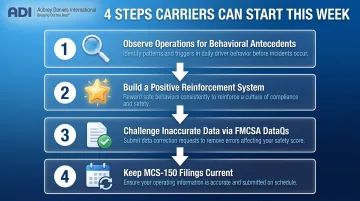
These culture principles translate into concrete actions carriers can start this week:
Observe operations for behavioral antecedents. Identify the three most common triggers behind violations in your highest-risk BASIC — unrealistic schedules, dispatcher pressure, inconvenient inspection procedures, or lack of recognition for compliance.
Build a simple positive reinforcement system. Recognize clean inspections, on-time compliance documentation, and thorough DVIRs. Immediate supervisor recognition, public acknowledgment in safety meetings, or small measurable incentives all work.
Challenge inaccurate data via FMCSA's DataQs. If a citation was dismissed or changed in court, submit a Request for Data Review with certified court documentation. Changes typically appear in the next monthly SMS snapshot.
Keep MCS-150 filings current. FMCSA requires updates at least every two years, but annual updates are recommended. The SMS uses Power Units and Vehicle Miles Traveled from the MCS-150 to calculate scores — outdated information can inflate your percentile ranking.
Monitor and Adjust
These steps won't produce overnight results, which is why consistent measurement matters. BASIC scores update monthly and reflect 24 months of data. Carriers implementing behavioral interventions should track leading indicators monthly — inspection pass rates, documentation completion, observation scores — alongside their BASIC percentiles.
That parallel tracking reveals whether behavior changes are moving the needle and where further intervention is needed.
Frequently Asked Questions
What are the Behavior Analysis and Safety Improvement Categories (BASICs)?
BASICs are seven categories the FMCSA's CSA program uses to evaluate carrier safety: Unsafe Driving, HOS Compliance, Driver Fitness, Controlled Substances/Alcohol, Vehicle Maintenance, Hazardous Materials Compliance, and Crash Indicator. Each category scores carriers on a 0–100% percentile scale relative to similarly-sized peers.
How many Behavior Analysis and Safety Improvement Categories (BASICs) are in the CSA program?
The CSA Safety Measurement System includes seven BASICs. Five are publicly visible: Unsafe Driving, HOS Compliance, Vehicle Maintenance, Controlled Substances/Alcohol, and Driver Fitness. The remaining two—Crash Indicator and Hazardous Materials Compliance—are accessible only to the carrier and enforcement personnel.
What are the four components of the FMCSA CSA program?
The CSA program runs on four components:
- Data collection — roadside inspections, crash reports, and investigation results
- Measurement — the Safety Measurement System converts data into BASIC percentile rankings
- Intervention — escalating actions from warning letters to out-of-service orders
- Outreach and education — helping carriers understand and improve their safety performance
What is considered a bad CSA score?
A "bad" BASIC score exceeds FMCSA's intervention thresholds: 65% for Unsafe Driving, Crash Indicator, and HOS Compliance; 80% for Vehicle Maintenance, Controlled Substances, Driver Fitness, and HM Compliance. Passenger carriers face lower thresholds. Crossing these cutoffs flags the carrier for federal intervention.
How do I look up my CSA score?
Carriers access full BASIC data—including private scores—by logging into the FMCSA Safety Measurement System via an FMCSA Portal account tied to a Login.gov username. Public scores are visible to anyone using a DOT number or carrier name on the SMS public site, but private BASICs are hidden from that view.