It rarely comes down to the quality of their safety procedures. Both organizations probably have solid written programs. The difference is almost always leadership behavior — specifically, whether leaders have built a culture where safety is a personal value or just a set of rules to avoid getting written up.
That distinction is what transformational leadership addresses directly. Decades of research confirm that how leaders behave, communicate, and motivate has a measurable effect on whether safety becomes genuinely lived or just technically followed. This guide covers the four dimensions of transformational leadership, the research linking them to safety culture, the behavioral science behind lasting change, and practical steps leaders can take starting now.
Key Takeaways
- Transformational leadership builds intrinsic commitment to safety — not just compliance with rules.
- The four dimensions (Idealized Influence, Inspirational Motivation, Intellectual Stimulation, Individualized Consideration) each directly shape safety culture.
- Research consistently links safety-specific transformational leadership to measurable reductions in incidents and stronger safety climate scores.
- Behavioral science explains the mechanism: intrinsic motivation drives sustained safe behavior far better than fear of punishment.
- These behaviors can be developed intentionally through practice — transformational leadership is a learned skillset, not an innate trait.
What Is Transformational Leadership?
James Downton coined the term "transformational leadership" in 1973, but it was James MacGregor Burns' 1978 work that developed it into a full leadership theory. Bernard Bass then built the foundational academic framework in his 1985 book Leadership and Performance Beyond Expectations, establishing the contrast between transactional and transformational approaches that still guides research today.
Transactional leadership operates on a simple exchange: meet targets, get rewarded; miss them, face consequences. It can drive short-term compliance — but it cannot change what employees actually value or how they behave when no one is watching.
That gap is where transformational leadership takes over. Rather than depending solely on rewards and consequences, it aligns followers' values and goals with the organization's mission — building intrinsic motivation that holds even without external pressure.
The Four Dimensions (The "4 I's")
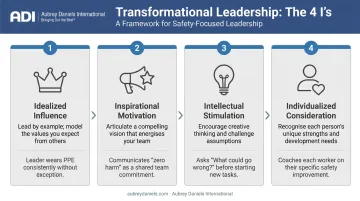
Bass and Avolio defined four components that distinguish transformational leaders from transactional ones:
- Idealized Influence — The leader operates as a credible role model whose values followers want to emulate, not just comply with.
- Inspirational Motivation — The leader articulates a compelling vision that elevates goals beyond individual self-interest.
- Intellectual Stimulation — The leader encourages followers to question assumptions, challenge "how we've always done it," and contribute new ideas.
- Individualized Consideration — The leader treats each person as a whole individual, actively investing in their growth and well-being.
The research base behind this framework is substantial. A 2025 cross-cultural meta-analysis aggregated 519 field studies, 121,385 participants, and 39 nations to examine transformational leadership's impact on performance outcomes — and found consistent positive effects on performance, commitment, and motivation across cultures and industries.
How Transformational Leadership Shapes Safety Culture
Safety culture cannot be mandated. A genuine safety culture — where employees proactively identify hazards, report near-misses, and hold each other accountable — requires employees to believe that safety is truly valued. That belief is shaped almost entirely by what leaders do, not what safety policies say.
Here's how each of the 4 I's maps onto safety culture outcomes:
Idealized Influence → Role-Modeling Safety Values
Leaders who visibly demonstrate personal commitment to safety build trust and model the values they want followers to adopt. This means never bypassing protocols under production pressure, treating safety standards as non-negotiable regardless of the schedule, and being seen doing the things they ask of others.
When employees observe a leader consistently choosing safety over convenience, they internalize that priority. When they observe the opposite, no written policy compensates.
Inspirational Motivation → Safety Vision That Means Something
Most employees already know they're supposed to wear PPE. What transformational leaders do differently is help people connect safety practices to something larger — protecting their families, protecting their colleagues.
Frameworks like Vision Zero — the International Social Security Association's workplace prevention strategy aimed at zero accidents and healthy work — give leaders an aspirational anchor that goes well beyond "follow OSHA requirements." When people understand why safety matters — not just the rule, but the reason — compliance becomes commitment.
Intellectual Stimulation → Learning Culture Over Blame Culture
Leaders who encourage employees to question assumptions about risk create environments where near-misses get reported instead of buried, where "we've always done it this way" is a reason to examine a practice rather than protect it.
The stakes are real. The most dangerous hazards in most workplaces are the ones that haven't surfaced yet. A culture that punishes the messenger ensures those hazards stay hidden.
Individualized Consideration → Genuine Care Drives Discretionary Effort
Leaders who genuinely care about their people's well-being naturally extend that care to physical safety. Employees who feel seen, valued, and supported as individuals generate something no compliance program can mandate: discretionary effort.
ADI defines discretionary effort as "the level of effort people could give if they wanted to, but above and beyond the minimum required." In safety terms, this is the difference between an employee who follows the checklist and one who actively coaches a peer on safe technique, flags a near-miss before anyone gets hurt, or genuinely engages in safety meetings rather than just showing up.
What the Research Shows
The empirical evidence is consistent. Barling, Loughlin, and Kelloway (2002) tested safety-specific transformational leadership with 174 restaurant workers and 164 young workers, finding it predicted occupational injuries through perceived safety climate, safety consciousness, and safety-related events. Kelloway, Mullen, and Francis (2006) found that transformational and passive safety leadership had opposite effects on safety climate — passive leadership didn't just fail to help; it actively made safety outcomes worse.
Ree and Wiig (2020) found that transformational leadership alone explained 35.7% of variance in patient safety culture, making it the strongest predictor in their full model (β = .30, p < .001).
The consistent finding across studies: safety-specific transformational leadership strengthens safety climate, safety consciousness, and the participation behaviors that reduce incidents over time.
The Behavioral Science Behind Transformational Safety Leadership
Most compliance-driven safety programs rely heavily on negative reinforcement — employees follow the rules to avoid getting disciplined. The problem is structural: behavior maintained by the desire to avoid punishment is inherently fragile. People comply when watched and cut corners when they're not.
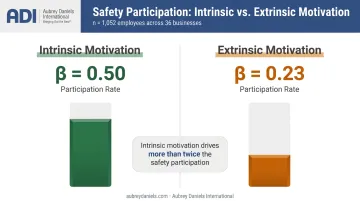
A Self-Determination Theory study of 1,052 employees across 36 small businesses found that intrinsic safety motivation had the strongest relationship with safety participation (β = 0.50), compared to extrinsic motivation (β = 0.23). Employees driven by genuine internal commitment participate in safety at more than twice the rate of those driven by external pressure alone.
Why Transformational Leadership Produces Intrinsic Motivation
Each of the 4 I's functions as a source of positive reinforcement for safe behavior:
- Recognition and modeling from Idealized Influence make safe behavior socially rewarding
- Shared vision from Inspirational Motivation gives safe behavior personal meaning
- Inclusion in decision-making from Intellectual Stimulation makes safety feel like ownership, not imposition
- Personalized coaching from Individualized Consideration makes safe behavior feel supported
Together, these mechanisms explain why ADI's methodology is direct on the point: "the only way organizations can earn discretionary effort is through the effective use of positive reinforcement." Organizations that manage by exception — only responding when performance falls below the minimum — suppress that effort. When there's nothing to gain by going beyond the minimum, most people won't.
From Compliance to Genuine Engagement
ADI's Safety Engagement framework draws a clear distinction between compliance and real participation:
"Many employees work hard, follow safety rules, and have good safety records. By most measures, they are excellent employees. But if those employees don't actively take part in safety meetings, report near misses, and provide feedback to a peer on safety behavior, then they are not fully engaged in safety."
This is the difference between an organization that is safe on paper and one that is genuinely safe. ADI's Safe by Accident? Take the Luck Out of Safety — co-authored by Judy Agnew and Dr. Aubrey Daniels — makes the case that many organizations are safe due to luck rather than systematic behavioral management. The book identifies seven common safety leadership practices that don't work and what to do instead — drawing on principles ADI has applied across more than 400 organizations worldwide.
ADI's Behavior-Based Safety programs (BBS Prime® and BBS Quick-Launch®) operationalize this through structured observations, real-time feedback, and positive reinforcement. The goal is consistent safe behavior at every organizational level, not just on the frontline.
Practical Steps Leaders Can Take to Strengthen Safety Culture
Step 1 — Model the Way
Leaders must make their personal safety values explicit and visible. This means:
- Never bypassing safety protocols under production pressure, even once
- Speaking about safety in terms of values ("This matters because you matter"), not just compliance ("OSHA requires...")
- Conducting safety walkthroughs to learn and improve, not to catch people doing things wrong
Inconsistency here is expensive. Employees notice when leaders treat safety as optional for themselves. A single shortcut at the leader level signals clearly what the real priority is.
Step 2 — Build Feedback Loops That Reinforce Safe Behavior
Most safety management systems are designed to catch problems. Transformational safety leaders design systems that catch people doing things right.
Practical approaches include:
- Structured safety conversations focused on reinforcing observed safe behaviors, not just correcting violations
- Peer recognition programs that make positive safety behavior socially visible
- Safety behaviors integrated into regular performance discussions
ADI's Precision Leadership® framework supports this directly. The PIC/NIC Analysis® method identifies the behavioral root causes of incidents and maps the consequences currently driving behavior. ADI's 2-day Safety Leadership Training then gives leaders the coaching skills to deliver meaningful, engagement-building feedback in the moment.
Step 3 — Cultivate a Learning Culture Around Safety
Reactive safety cultures focus on what went wrong after an incident. Proactive safety cultures surface risks before they become incidents. The shift requires leaders to:
- Treat near-miss reports as valuable intelligence, not admissions of failure
- Conduct regular safety conversations that explore assumptions ("Why do we do it this way?" rather than "Follow the procedure")
- Empower frontline workers to contribute safety improvements, not just receive safety instructions
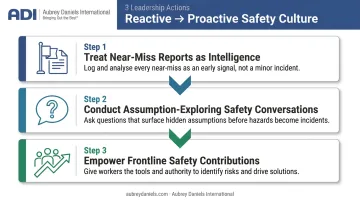
This is Intellectual Stimulation — the third I — applied as a daily leadership habit. ADI's Safety Culture Change service embeds this into organizational leadership through behavioral roadmapping, structured coaching, and follow-up support — replacing reactive patterns with learning-oriented ones that stick.
A railroad division that implemented ADI's behavior-based safety strategies achieved a 36% drop in injury rate and a 60% decrease in lost time days due to injury severity within one year — and subsequently maintained a 0.00% injury rate for an entire month, unprecedented in that organization's history. Results like these are what a behavior-based leadership culture, built systematically, actually produces.
Frequently Asked Questions
What is the difference between transformational and transactional leadership in safety?
Transactional safety leadership drives compliance through rewards and punishments — employees follow the rules to avoid discipline or earn incentives. Transformational safety leadership builds genuine commitment by aligning employee values with safety goals, producing behavior that goes beyond the minimum and continues when no one is watching.
How does transformational leadership improve workplace safety culture?
Transformational leaders shape safety culture by modeling safe values, articulating a meaningful safety vision, creating psychological safety for open reporting, and demonstrating genuine care for employee well-being. Research consistently links each of these behaviors to stronger safety climate and reduced incident rates.
What are the four components of transformational leadership relevant to safety?
The four dimensions are Idealized Influence (role modeling), Inspirational Motivation (shared safety vision), Intellectual Stimulation (encouraging learning and challenge), and Individualized Consideration (genuine care for individual well-being).
Can transformational leadership actually prevent workplace accidents?
Research by Barling, Loughlin, and Kelloway (2002) found that safety-specific transformational leadership predicted occupational injuries through safety climate, safety consciousness, and safety-related events. Passive or absent safety leadership doesn't produce neutral results; research associates it independently with worse safety outcomes.
What is safety-specific transformational leadership?
Safety-specific transformational leadership applies the four dimensions of transformational leadership directly to safety contexts. The leader's vision, role modeling, intellectual challenge, and individual concern are explicitly directed at workplace health and safety — rather than organizational goals generally.
How do you measure the impact of transformational leadership on safety culture?
Organizations can track safety climate surveys, near-miss reporting rates, employee participation in safety initiatives, behavioral observation data, and incident trends over time. The most meaningful indicators are leading (proactive) rather than lagging (reactive) — OSHA defines leading indicators as proactive, preventive measures that signal safety health before incidents occur.