Introduction
Most organizations claim safety is their top priority. Yet in 2024, workplace injuries cost U.S. businesses $181.4 billion—a staggering figure that includes $54.9 billion in lost wages and productivity alone. Despite decades of safety programs, policies, and posters, 2.5 million nonfatal workplace injuries were reported by private industry employers in 2024, alongside 5,283 fatalities in 2023. The paradox is clear: leaders say safety matters, but workplace injuries persist.
Leaders who want real change need to examine their behavior, not just their messaging. Building a genuine safety culture requires that shift to be visible and consistent. Behavioral science offers a proven framework for getting there—moving organizations beyond compliance programs to cultures where safety is a shared value, demonstrated daily through the actions leaders take when no one is watching.
TLDR
- Leaders shape safety culture through daily actions, not meeting announcements
- Most safety programs fail because stated values don't match leadership behavior under pressure
- Real commitment means modeling safe practices, allocating resources, and reinforcing—not just penalizing
- Middle managers convert top-level commitment into daily norms by how they respond to unsafe shortcuts
What Safety Culture Really Means—and Why Leadership Sets the Tone
Safety culture is the shared set of beliefs, attitudes, and behaviors around safety demonstrated at every level of an organization. It's fundamentally different from safety compliance, which is following rules when supervised. Culture is doing the right thing when no one is watching, because the organization has internalized safety as a core value.
OSHA's Recommended Practices for Safety and Health Programs identifies management leadership as the first core element of effective safety programs, stating explicitly: "Always set safety and health as the top priority" and "reinforce management commitment by considering safety and health in all business decisions."
Without this top-level commitment, safety will always compete—and lose—against production pressures and profitability targets.
That distinction matters because safety culture isn't an initiative with a launch date or a program that runs for six months. It's shaped daily by the behaviors leaders choose to reinforce or ignore. Research from The Campbell Institute at the National Safety Council defines organizational commitment as "the level of demonstrated prioritization of safety as a core value...reflected in a positive attitude toward safety despite fluctuations in economic success or operational capacity."
When operations fall behind schedule or budgets tighten, safety climate—the measurable snapshot of employee perceptions—can weaken as teams rush to catch up. The underlying culture is revealed in those moments: Do leaders still prioritize safety, or does the rhetoric fade when pressure mounts?
The Leadership Behavior Gap: Why Saying "Safety First" Isn't Enough
The Say-Do Gap Reveals True Priorities
Employees don't read mission statements—they read behavior. Leaders who verbally champion safety but approve shortcuts, ignore near-miss reports, or reward production over safe practices send the workforce a clear message about what truly matters. This is the "say-do gap," and it's the primary reason safety programs fail.
Research from The Campbell Institute identifies a persistent problem: "Some leaders prioritize production metrics over safety, often due to pressures to meet operational goals," creating "a perception that safety is secondary."
The data bears this out. A study published in Safety and Health at Work found that the link between top-management safety climate and actual safety performance is significantly stronger when employees perceive that supervisors' words align with their actions — what researchers call behavioral integrity.
Behavioral Reinforcement Shapes Future Actions
When a safety concern is raised and ignored, or when a worker who cuts corners to meet a deadline receives praise, leaders are sending a reinforcement signal. Behavioral science explains that consequences—not policies—shape future behavior. If reporting a hazard results in delays, paperwork, and no visible action, workers learn not to report. If meeting a tight deadline by skipping safety protocols earns recognition, workers learn what's truly valued.
Punitive Cultures Suppress Critical Data
Organizations that respond to incidents with blame rather than inquiry teach employees to hide problems instead of reporting them. A systematic review published in BMC Public Health found that 20-91% of workers did not report injuries or illnesses, with 29-50% citing fear of employer retaliation. In one study, 91% of nursing home workers did not file workers' compensation claims for low back pain.
This underreporting actively undermines the data leaders need to prevent serious harm.
The scale of the problem is reflected in OSHA's Whistleblower Protection Program, which enforces provisions of more than 25 federal laws protecting employees from retaliation for raising safety concerns. In FY2023 alone, OSHA docketed 2,309 complaints under Section 11(c) of the OSH Act — a signal that fear-based cultures remain widespread, not isolated.
The Production-vs.-Safety Tension
When employees stay silent about hazards, the problem doesn't disappear — it goes underground. The true test of leadership commitment comes when tight deadlines, budget pressure, or customer demands collide with safety protocols. How leaders respond in those moments reveals what is actually valued, and the workforce is watching every time.
Research shows that leaders often self-report strong safety commitment even in organizations with high incident rates. The gap isn't usually intentional — it's a visibility problem. Leaders see the policy; workers see the decision made under pressure. Those decisions are the real signal.
What Real Leadership Commitment to Safety Looks Like
Visible, Consistent Behavioral Signals
Genuine commitment shows up in specific, observable actions:
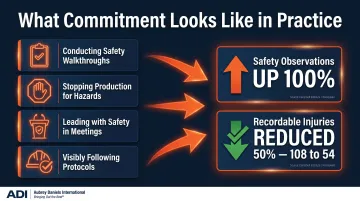
- Conducting regular safety walkthroughs where leaders engage directly with frontline workers
- Stopping production to address hazards without waiting to be asked
- Bringing safety as the first agenda item in operational reviews—not the last
- Following safety protocols visibly even when it's inconvenient or slows work down
Case studies from The Campbell Institute show this in action. At Fluor, when management participated in field orientations and site safety walks, "management in action became the highest scoring category" in safety metrics. At Honeywell, shifting to an accessible Safety Observation System increased safety observations nearly 100% while reducing recordable injuries from 108 in 2010 to 54 in 2013—a 50% reduction.
Asking Questions, Not Issuing Directives
Leaders who ask open-ended questions during safety interactions—"What's the biggest hazard you're dealing with today?" or "What would help you do this more safely?"—signal that employee input is valued. This creates psychological safety for honest reporting and moves conversations from compliance to collaboration.
Allocating Real Resources
Words cost nothing. Resource decisions reveal true priorities:
- Budgeting for safety improvements
- Approving time for training without cutting it when schedules tighten
- Following through on corrective actions reported by workers
Leaders who consistently fund safety initiatives under budget pressure make their priorities visible in the clearest possible way. That consistency also shapes how teams respond when systems are tested — including how they handle incidents.
Responding to Incidents with Curiosity, Not Blame
The shift from "Who did this?" to "What in our system allowed this to happen?" changes what workers do next. Leaders who model curiosity over blame treat every near-miss as valuable data rather than an embarrassment to suppress. The Campbell Institute emphasizes that "employees should be empowered to report hazards and share concerns without fear of blame or reprisal."
Recognizing Safe Behaviors Positively
Leaders who actively recognize safe behaviors—not just the absence of incidents—build a culture where safety is associated with positive outcomes rather than solely with fear of punishment. ADI's behavior-based approach, detailed in Judy Agnew and Aubrey Daniels' book Safe by Accident? Take the Luck out of Safety: Leadership Practices that Build a Sustainable Safety Culture, identifies positive reinforcement as the key mechanism separating organizations that sustain safety culture from those that cycle through programs without lasting change.
Recognition should be specific. "I noticed you took the time to secure that load properly even though we were running behind—that's exactly the kind of decision that prevents injuries." That specificity reinforces the behavior and makes it more likely to happen again.
The Science of Why Top-Down Commitment Shapes Safety Culture
Social Modeling: Employees Follow What Leaders Do
Behavioral science demonstrates that employees observe what leaders do and use it to calibrate what is actually acceptable. A 2025 study published in Frontiers in Psychology explicitly grounds this principle in Bandura's Social Learning Theory: "Employees observe and imitate leaders' safe behavior, internalize safety standards, and implement them in daily activities."
When leaders visibly follow safety protocols—stopping to put on PPE, conducting pre-task hazard assessments, or pausing work to address unsafe conditions—they activate a powerful observational learning dynamic that no training program can replicate.
Antecedents vs. Consequences: The ABC Model
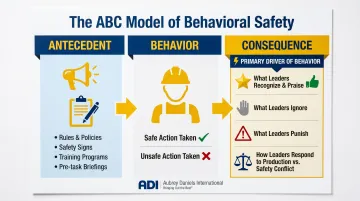
Most safety programs focus heavily on antecedents—rules, signs, training sessions, and briefings. These tell workers what to do. But behavioral science demonstrates that consequences—what happens to a person after they behave safely or unsafely—are the true drivers of sustained behavior change.
As Geller (2005) argues in Behavior Modification, "Activators are only as powerful as the consequences supporting them." Leaders shape that consequence environment more than anyone else in the organization. What they do — or don't do — sends a signal every time:
- What they recognize and praise
- What they ignore
- What they punish
- How they respond when safety and production conflict
Why Punishment-Based Cultures Fail
Negative reinforcement and punishment-based safety cultures create compliance without commitment. Workers follow rules when supervised but revert to risky shortcuts when unobserved, because the behavior is driven by avoidance rather than internalized value.
Geller's research notes that negative consequences "can backfire and activate more calculated risk-taking, even sabotage, theft, or interpersonal aggression." Positive reinforcement works differently: it moves behavior from externally driven to genuinely habitual. Workers follow safe practices because doing so feels right — not because someone is watching.
The numbers bear this out. A meta-analysis by Krause et al. found that injury rates dropped by 26% when organizations applied behavioral observation and feedback processes grounded in positive reinforcement — a result that punitive-only approaches consistently fail to match. (Publication details available upon request; link to be added when source verified.)
ADI's Behavioral Science Framework
ADI's approach provides a structured methodology for leaders who want to move beyond abstract culture change to measurable safety improvement. The framework trains leaders to:
- Identify specific safe behaviors that reduce risk in their environment
- Observe and measure those behaviors systematically
- Reinforce desired behaviors through recognition and positive consequences
- Track progress using both leading and lagging indicators
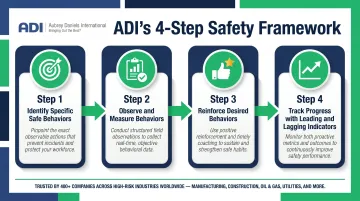
This creates a sustainable system rather than relying on motivation alone. The methodology draws on nearly a century of applied behavioral science research and has delivered measurable results in more than 400 companies across manufacturing, energy, mining, utilities, and other high-risk industries.
Cascading Safety Culture Through Middle Management
Middle Managers Are the Critical Link
Middle managers and frontline supervisors are the primary transmitters of safety culture. They are the leaders workers interact with daily, and their behavioral choices (how they respond to unsafe shortcuts, whether they recognize safe practices, how they handle the production-safety tension) either reinforce or erode the commitment expressed at the top.
Research published in Safety and Health at Work found that lack of supervisor support independently increased the likelihood of physical injuries at work. The Peker et al. study demonstrated that the positive effect of top-management safety climate on worker behavior is significantly stronger when employees perceive high supervisor behavioral integrity.
What Support for Middle Managers Must Include
Safety rules training is only the starting point. Middle managers also need behavioral coaching on:
- How to conduct meaningful safety conversations that build trust
- How to give effective recognition for safe practices
- How to navigate the production-safety tension in real time without defaulting to production
- How to respond to near-misses and incidents with curiosity rather than blame
Research in Frontiers in Psychology identified three critical dimensions of supervisor safety leadership:
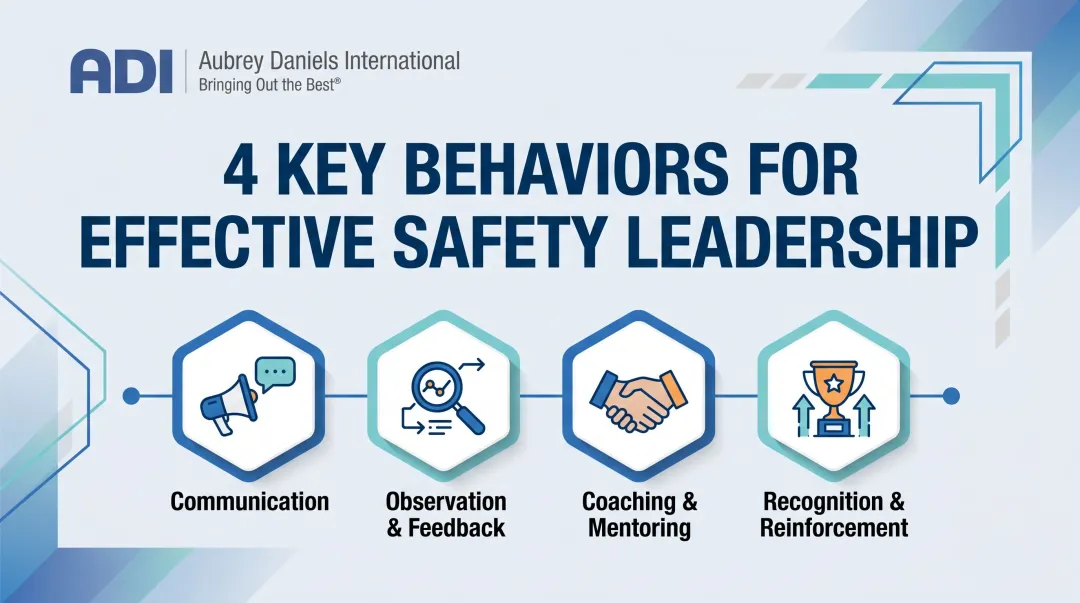
- Safety Controlling — setting clear regulations and monitoring that they're followed consistently
- Safety Coaching — role modeling safe behavior, involving workers in decisions, and building motivation
- Safety Caring — showing genuine concern for employee well-being and earning trust through it
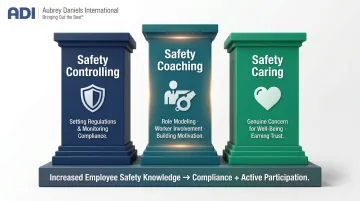
All three dimensions drive safety outcomes by increasing employee safety knowledge, which then drives both compliance and active safety participation.
Alignment Between Levels Is the Test
These supervisor behaviors don't emerge in a vacuum — they reflect what supervisors see above them. When frontline supervisors watch senior leaders consistently prioritize safety under pressure, it gives them the backing they need to hold that line with their own teams. Misalignment, where senior leaders preach safety but reward production while still expecting supervisors to enforce the rules, creates cynicism and erodes trust.
Alignment means:
- Senior leaders and middle managers use the same language and framework
- Both levels model the same behaviors
- Recognition and consequences are consistent across levels
- Supervisors feel supported when they stop work for safety reasons
Frequently Asked Questions
What does leadership commitment to workplace safety actually look like in practice?
Leadership commitment is visible through specific behaviors: conducting regular safety walkthroughs, asking open-ended questions about hazards, allocating budget for safety improvements, and publicly recognizing safe practices. It's demonstrated in resource decisions and how leaders respond when safety conflicts with production deadlines.
Why do safety programs fail even when leadership says safety is a priority?
Programs fail because of the say-do gap. When leaders' actual decisions under pressure prioritize production over safety, the workforce reads behavior over rhetoric. Employees observe whether leaders stop work to address hazards, whether they fund safety improvements, and whether they reward safe practices or results achieved by cutting corners.
What is the difference between a safety culture and a safety compliance program?
Compliance is following rules when supervised; culture is behaving safely because it's a shared value. Compliance relies on enforcement and monitoring; culture is sustained through behavioral reinforcement systems where employees internalize safety standards and act on them even when no one is watching.
How do you build a safety culture in an organization where one doesn't currently exist?
Building culture starts with senior leadership visibly modeling safe behaviors, then training managers to reinforce those behaviors through positive consequences. Track both leading indicators (safety observations, near-miss reporting) and lagging indicators (incident rates) to sustain the effort over time.
What role do middle managers play in sustaining a safety culture?
Middle managers are the daily reinforcers of cultural norms. Their response to safety concerns, near-miss reports, and unsafe shortcuts either propagates or undermines the commitment set at the top. Employees take cues from their direct supervisor's behavior far more than from executive communications.
How can leaders measure whether their safety culture efforts are working?
Track lagging indicators (incident rates, lost-time injuries) alongside leading indicators (near-miss reporting rates, safety observation frequency, behavioral observation scores). An increase in near-miss reporting typically signals a healthier culture where employees feel safe speaking up—not a deteriorating safety environment.