Introduction: What Transformational Leadership Really Looks Like in Practice
Picture two teams. Both hit their quarterly targets. One does exactly what's asked—no more, no less. The other surfaces problems before they escalate, proposes solutions nobody requested, and covers for each other without being told.
Same company, different results. The difference isn't luck or hiring. It's the leader.
Most people assume that gap comes down to personality—that some leaders just have "it." That assumption is wrong, and it's costly.
Research from Stanford's Jeffrey Pfeffer shows that framing leadership as a fixed trait gives leaders a convenient excuse to avoid the behavioral changes that actually move teams.
Transformational leadership isn't a personality type. It's a set of observable, learnable behaviors — specific things a leader does. This article breaks down seven of them: behaviors you can develop, practice, and measure to drive real, lasting change in the teams you lead.
TLDR
- Transformational leadership is behavior-based, not trait-based—anyone can develop these skills
- Seven core behaviors map to Bernard Bass's Four I's framework, giving each one a research-backed foundation
- Specific, timely reinforcement—not generic praise—is what actually sustains high performance
- Only one in three U.S. workers strongly agree they received recognition in the past seven days
- Organizations that build these behaviors into daily practice—not just leadership offsites—see lasting performance gains
Why Leadership Is About Behaviors, Not Fixed Traits
The "born leader" narrative persists partly because it's comfortable. If leadership is innate, nobody has to change.
But behavioral science has argued the opposite since the 1950s, when researchers shifted focus from inborn traits to observable leader behaviors. That shift matters because behaviors—unlike personality—can be observed, practiced, reinforced, and measured.
A meta-analysis of 70 managerial studies found that leadership training produced positive behavioral changes and measurable objective outcomes across personality types. Traits may correlate with leadership emergence, but behaviors are what mediate actual effectiveness. Traits set a baseline. They don't determine outcomes.
ADI's approach to leadership development reflects this distinction directly. The company's Precision Leadership methodology focuses on behavior and impact—not personality style or trait profiles. The measure of a leader's effectiveness, in ADI's framework, is visible in the behavior of their team: whether people are engaged, taking initiative, and bringing discretionary effort to their work.
Stop asking "what kind of leader am I?" Start asking "what am I doing—and what should I do differently?"
The 7 Transformational Leadership Behaviors to Develop
These behaviors draw from the Four I's framework developed by researcher Bernard Bass, but rendered here as concrete, repeatable actions rather than abstract categories.
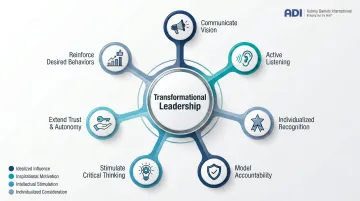
Behavior 1: Communicate a Clear, Emotionally Resonant Vision
Transformational leaders don't just share strategic plans—they connect work to purpose in a way that creates buy-in.
In practice, this means:
- Telling stories that illustrate the why behind organizational goals
- Consistently linking individual roles to team and company impact
- Repeating the vision across formats—meetings, one-on-ones, written updates—so it becomes familiar, not just known
Consistency matters here. A vision communicated once in an all-hands and then never mentioned again fades fast. Leaders who make "why we do this" part of daily conversation build teams that care about outcomes, not just outputs.
Behavior 2: Listen Actively and Create Space for Every Voice
Active listening is a skill, not a disposition. It involves asking open-ended questions, paraphrasing to confirm understanding, withholding judgment, and following up on ideas raised in previous conversations.
Leaders build or destroy psychological safety through their listening patterns. A meta-analysis of 94 studies found psychological safety positively associated with employee innovation behavior (r = .299) and team innovation behavior (r = .435).
Teams where people feel safe to speak up innovate more. Teams where people fear being dismissed or ignored stop contributing.
Leaders who respond to new ideas with immediate critique—even well-intentioned critique—train their teams to stop surfacing ideas. The fix isn't softer criticism; it's better questions first.
Behavior 3: Provide Individualized Recognition and Coaching
Generic praise ("great job this week") does almost nothing. Behavior-specific recognition—delivered promptly, tied to a specific action—is what actually reinforces performance.
The numbers are clear:
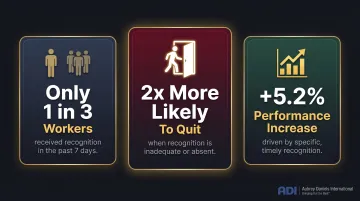
- Only 1 in 3 U.S. workers strongly agree they received recognition or praise in the past seven days (Gallup)
- Employees who feel inadequately recognized are twice as likely to quit within the next year
- A field experiment found that specific recognition increased performance by 5.2% in the measured task
ADI's behavioral science framework emphasizes that effective leaders observe individual strengths and development gaps, then tailor their feedback accordingly. What motivates one person often doesn't move another. Individualized consideration isn't a soft skill—it's a precision tool.
Behavior 4: Model Accountability and Ethical Conduct
Leaders who publicly acknowledge mistakes, follow through on commitments, and make decisions transparently build credibility over time. Their teams become more receptive to guidance—and more honest when problems arise.
This is sometimes called "idealized influence" in the research literature, but the behavioral reality is simple: teams watch what their leaders do far more than what they say. When a leader's stated values and daily actions align, trust accumulates. When they diverge, cynicism sets in fast.
Accountability modeled at the top sets the standard for how the entire team handles setbacks — and whether people feel safe enough to surface problems before they escalate.
Behavior 5: Stimulate Critical Thinking and Challenge Assumptions
Intellectually stimulating leaders regularly ask "what if" questions, reward employees who surface problems, and visibly engage with ideas regardless of where they originate.
Concrete ways this shows up:
- Opening meetings with a question rather than an agenda item
- Responding to dissenting opinions with curiosity, not defensiveness
- Publicly crediting team members when their ideas change your thinking
When people see that challenging assumptions is safe—even valued—they stop self-editing, and the quality of organizational thinking improves.
ADI's Applications of Behavioral Leadership workshop uses a 5-step change process that teaches leaders to analyze performance problems behaviorally rather than defaulting to surface-level explanations. That kind of structured questioning is what intellectual stimulation looks like in practice.
Behavior 6: Extend Trust Through Meaningful Autonomy
Trust is demonstrated through actions, not announcements. "I trust my team" means nothing if you're checking in three times a day and reversing decisions without explanation.
Behavioral trust looks like:
- Delegating decisions that actually matter, not just administrative tasks
- Setting clear outcomes and letting people define their own path to them
- Resisting the urge to course-correct before someone has a real chance to try
Gallup's research shows top-quartile business units achieve 23% higher profit than bottom-quartile units, with engagement metrics—including autonomy and being heard—as key differentiators. Empowering leadership also predicts psychological safety with a large effect size (r = .63 in CIPD research), creating conditions where people bring their full effort.
Behavior 7: Reinforce the Behaviors You Want to See More Of
Of all seven behaviors, this one is skipped most often—and it's the one that determines whether everything else sticks.
Transformational leaders don't just inspire; they systematically reinforce the discretionary effort, collaboration, and innovation they want to sustain. In behavioral science terms: what gets reinforced gets repeated.
ADI defines discretionary effort as "the level of effort people could give if they wanted to, but above and beyond the minimum required." That effort cannot be mandated. It has to be earned through positive reinforcement that is:
- Specific — tied to the exact behavior you want repeated
- Immediate — delivered close in time to the behavior, not weeks later
- Meaningful — relevant to what the individual actually values
A leader who ends every team meeting with a genuine, specific acknowledgment of one person's contribution is doing something simple and powerful. Over time, that pattern shapes what the team believes is valued—and what they choose to prioritize.
The Science Behind These Behaviors: The 4 I's Framework
Bernard Bass formalized the Four I's in his 1985 book Leadership and Performance Beyond Expectations, building on James MacGregor Burns's earlier work. The framework identifies four dimensions of transformational leadership:
| The Four I's | What It Describes | Corresponding Behaviors |
|---|---|---|
| Idealized Influence | Role modeling and moral authority | Behaviors 4 (accountability) |
| Inspirational Motivation | Communicating compelling vision | Behavior 1 (vision), Behavior 6 (autonomy) |
| Intellectual Stimulation | Encouraging critical thinking | Behavior 5 (challenging assumptions) |
| Individualized Consideration | Personalized coaching and recognition | Behaviors 2, 3, and 7 |
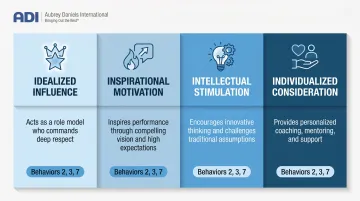
The Four I's are diagnostic categories, useful for understanding the types of transformational influence at play. The seven behaviors in this article translate those categories into specific, repeatable actions leaders can actually practice.
That distinction between categories and behaviors matters most when you consider what separates transformational leadership from its transactional counterpart.
Transactional leadership works through contingent rewards and compliance-based expectations. Transformational leadership works through intrinsic motivation, shared purpose, and positive reinforcement of behaviors that go beyond minimum requirements. That difference isn't just philosophical — it shows up in measurably different engagement and performance outcomes.
How These Behaviors Affect Performance and Business Results
The organizational evidence for transformational leadership behaviors is substantial:
- A meta-analysis found a mean weighted correlation of –0.35 between positive leadership and turnover intention (k = 69, N = 24,627)—meaning stronger transformational leadership consistently reduces intent to leave
- Transformational leadership shows a positive relationship with quality of working life and a negative relationship with burnout
- Psychological safety—driven largely by leader listening and empowerment behaviors—correlates with team innovation at r = .435
The concept of discretionary effort sits at the center of these outcomes. Employees who experience consistent positive reinforcement for high-effort behavior don't just perform—they want to perform. The result is sustained output that compliance-based management simply cannot produce.
That shift in motivation is visible at scale. When ADI implemented a behavioral leadership approach across Norfolk Southern's 25,000+ employees, Executive Vice President Mark Manion noted: "There is no question that it's a more engaged workforce. And in some cases it has been really dramatic."
One caveat worth carrying into practice: transformational leadership behaviors that are inconsistently applied—or unsupported by organizational systems—can produce burnout or cynicism rather than engagement. Inspiration without follow-through signals that stated values aren't real. Structural reinforcement, not just individual leader behavior, is what makes the difference.
How to Build Transformational Leadership Behaviors That Stick
Most leadership development programs fail for a specific reason: they focus on awareness—knowing what good leadership looks like—rather than behavior change. Insight alone rarely changes what someone does on a Monday morning.
Start With Deliberate Practice
Pick one or two target behaviors. Set observable goals:
- "I will ask a clarifying question before responding in every team meeting this week."
- "I will give one specific, behavior-based recognition at the end of each one-on-one."
Track whether you do it. Evidence from structured deliberate practice programs shows they outperform passive learning in producing lasting skill acquisition.
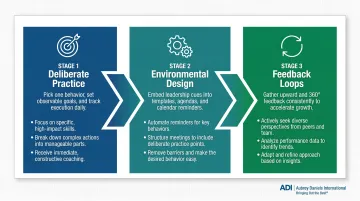
Use Environmental Design
Structure your environment to prompt the behaviors you want to build:
- Add a coaching question to your one-on-one template
- Build a "recognition moment" into your team meeting agenda
- Set a calendar reminder to follow up on an idea someone raised in conversation
These aren't tricks. They're applications of a basic behavioral science principle: context shapes behavior. Design better context, get more consistent behavior.
Build Feedback Loops
ADI's Precision Leadership Survey gives leaders upward feedback from direct reports, surfacing which practices are working and which are getting in the way of performance. ADI also offers 360° surveys and Stop-Start-Continue surveys that reveal behavioral blind spots leaders can't see from inside their own experience.
Organizations that sustain transformational leadership cultures don't rely on annual reviews to catch behavioral drift. They build feedback into the management operating system: regular, specific, and tied to real performance data.
That's the structural shift ADI's behavior-based performance management consulting helps organizations make — embedding feedback at every level so improvement is continuous, not episodic.
Frequently Asked Questions
What behaviors are included in transformational leadership?
The core behavioral categories are communicating vision, active listening, individualized coaching, modeling accountability, stimulating critical thinking, extending trust through autonomy, and reinforcing desired behaviors. These map directly to the Four I's framework developed by Bernard Bass.
What are the 4 transformational leadership behaviors?
The Four I's—Intellectual Stimulation, Individualized Consideration, Inspirational Motivation, and Idealized Influence—are foundational categories developed by Bernard Bass. Each maps to specific observable behaviors leaders can practice and measure in daily interactions.
What are the five behaviors of a transformational leader and explain each?
Some frameworks cite five qualities: self-awareness, authenticity, humility, collaboration, and understanding of interdependence (Georgetown University). These overlap with several behaviors covered here, especially modeling accountability and active listening.
What are the 7 principles of transformational leadership?
Principles are the guiding values—trust, accountability, purpose—while behaviors are the observable actions that put those values into practice. The seven behaviors in this article translate those principles into specific, repeatable actions leaders can develop and measure.
What are the 8 leadership behaviors?
Different frameworks enumerate leadership behaviors differently—some use the Four I's, others list 7 or 8 distinct behaviors. What matters most is whether the behaviors are observable, measurable, and developable—those three criteria are the real test of any framework's practical value.