Introduction
Organizations invest millions in safety programs—detailed procedures, extensive training, compliance audits—yet still experience preventable incidents driven by leadership failures. The real problem isn't a lack of rules. It's a gap in how leaders actually behave every day.
According to research by Barling, Loughlin, and Kelloway, safety-specific transformational leadership behaviors predicted safety climate improvements and reduced near-miss events and injuries across multiple studies. Traditional safety audits measure compliance outputs, but they miss the leader behavior inputs that truly shape how workers actually behave around safety.
How do you know whether your safety leaders are genuinely transforming safety culture or just enforcing compliance?
The answer is a transformational safety leadership survey—a diagnostic tool that measures the specific leadership behaviors driving safety culture. This article covers what it measures, the behavioral dimensions it captures, how to run one, and how to turn insights into lasting behavior change.
TLDR:
- Traditional safety audits track lagging indicators (injury rates, compliance scores); transformational safety leadership surveys measure the leader behaviors that actually prevent incidents
- The survey assesses four behavioral dimensions: idealized influence (role modeling), inspirational motivation (vision-setting), intellectual stimulation (challenging assumptions), and individualized consideration (coaching)
- Leaders and direct reports both rate behaviors, exposing blind spots between self-perception and worker experience
- High-impact organizations re-survey every 12-18 months and use positive reinforcement-based coaching to close gaps
Why Standard Safety Audits and Surveys Miss the Point
Most traditional safety surveys focus on lagging indicators: injury rates, near-miss counts, compliance scores. These metrics tell you what happened, not why it happened or how to prevent it next time.
Large-scale analysis by Hallowell et al. concluded that Total Recordable Injury Rate (TRIR) is 96-98% random, shows no clear association with fatalities, and requires approximately 300 million worker-hours to report a TRIR of 1.0 with ±0.1 precision. The report recommends shifting to leading indicators measured at high frequency—specifically, the behaviors that drive safety outcomes.
The Transactional Leadership Trap
When leaders rely primarily on rules, penalties, and rewards to drive safety, compliance may increase but genuine safety culture does not. Workers follow the minimum required behaviors to avoid punishment or earn incentives. They never develop the intrinsic motivation to:
- Identify hazards proactively before incidents occur
- Speak up about unsafe conditions without fear of reprisal
- Challenge long-held assumptions about how work gets done
Research by Kelloway, Mullen, and Francis demonstrated that passive leadership—where supervisors are hands-off or transactional—had unique negative effects on safety climate and safety consciousness beyond the absence of transformational leadership. Passive leadership degraded climate with a beta coefficient of approximately -.41, while safety-specific transformational leadership improved climate with a beta of approximately .44.
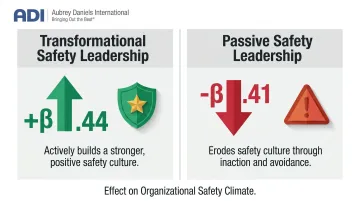
Transformational safety leadership surveys fill this gap by shifting measurement focus from safety outputs to leader behavior inputs: the behaviors that shape how workers think and act around safety every day.
What Is a Transformational Safety Leadership Survey?
A transformational safety leadership survey is a structured assessment designed to measure how consistently safety leaders demonstrate transformational leadership behaviors: inspiring, coaching, and developing workers around safety rather than enforcing compliance alone.
How It Differs from a General Safety Culture Survey
A general safety culture survey captures workforce-wide beliefs, perceptions, and reported behaviors. It tells you how workers feel about safety overall. A transformational safety leadership survey, by contrast, zooms in on the specific behaviors leaders exhibit and how those behaviors are perceived by direct reports.
Academic Grounding
That distinction is backed by decades of research. These surveys are grounded in the Full Range Leadership Model developed by Bernard Bass and Bruce Avolio, adapted for safety contexts. Barling et al. (2002) validated a safety-specific adaptation of transformational leadership that predicted safety climate, near-miss events, and injuries across two studies. Reported reliabilities included safety-specific transformational leadership alpha = .94/.95 and climate alpha = .84/.88.
Zohar (2000) found that group-level safety climate, shaped by supervisory practices, predicted objective micro-accidents across 53 work groups within the same company. Leadership behavior variance exists even inside a single organization. Only granular measurement can reveal it.
Who Uses These Surveys
- HSE managers diagnosing leadership behavior gaps across sites or departments
- Organizational development teams driving safety culture change initiatives
- Safety leadership consultants working with frontline supervisors, plant managers, and executives
- Frontline supervisors and senior leaders completing self-assessments alongside direct-report ratings
The dual-perspective design generates actionable gap analysis, revealing where leader self-perception diverges from worker experience — and that gap is often where the most important coaching opportunities hide.
What a Transformational Safety Leadership Survey Measures
A well-designed transformational safety leadership survey typically has two components:
Part A: Traditional Safety Culture Constructs
This section captures foundational safety culture factors:
- Management commitment to safety — How consistently leaders prioritize safety over competing production pressures
- Communication quality — Clarity, frequency, and openness of safety dialogue
- Safety rules and procedures — Perceived adequacy and practicality
- Worker involvement — Degree of participation in safety decision-making
- Perceived risk environment — Workers' assessment of hazard exposure and control effectiveness
Reliability Benchmarks:
Validation of the NOSACQ-50 safety climate questionnaire reported strong internal consistency (Cronbach's alpha) across all dimensions, confirming that each dimension measures a coherent construct:
| Dimension | Cronbach's Alpha |
|---|---|
| Total scale | .942 |
| Management safety commitment & empowerment | .940 |
| Worker participation & communication | .785 |
| Risk nonacceptance | .716 |
Part B: Leadership-Specific Behavioral Dimensions
This section measures transformational safety leadership behaviors:
- How visible and inspiring leaders are around safety
- Whether leaders challenge assumptions versus enforce compliance
- Whether leaders show genuine concern for individual worker well-being
Kelloway et al. (2006) measured safety-specific transformational leadership and passive leadership with high reliability (transformational leadership alpha = .94; passive leadership alpha = .81; safety climate alpha = .90). The study demonstrated that transformational and passive leadership had divergent effects on safety outcomes, with transformational leadership improving climate and passive leadership degrading it.
Demographic Slicing Reveals High-Risk Pockets
When survey data is broken down by:
- Workgroup
- Role level (frontline worker, supervisor, manager)
- Department
- Shift
Organizations can identify pockets where leadership visibility is low or where workers perceive management commitment as inconsistent—areas of disproportionately high behavioral risk.
Zohar (2000) found significant between-workgroup differences in safety climate within the same company, attributable to supervisory practices. Group climate predicted micro-accidents using objective clinic records, demonstrating that unit-level data slicing surfaces real differences in perceived leadership effectiveness.
Internal Validity Filters Ensure Data Integrity
Robust survey tools filter out random or disengaged responders to ensure data reflects genuine perceptions, not noise. NOSACQ-50 Persian validation excluded 257 of 661 returns for incomplete or patterned responses before analysis — a clear illustration of response integrity screening in practice. Action planning built on unreliable data wastes resources and erodes workforce trust in the survey process itself.
Customizable Site-Specific Metrics
Organizations can incorporate contextual data — site-specific hazards, recent incident trends, or regional regulatory focus — without compromising the statistical integrity of the core instrument. ADI's behavior-based safety assessments take this further by combining validated survey data with direct behavioral observation and leader coaching protocols, all grounded in over 45 years of Applied Behavior Analysis practice.
The Four Leadership Behaviors That Define Transformational Safety Leaders
Transformational safety leadership is built on four behavioral dimensions. Each is measured through scaled statements rated by both the leader (self-assessment) and direct reports (perception ratings). The resulting gap analysis reveals where leader self-perception diverges from worker experience.
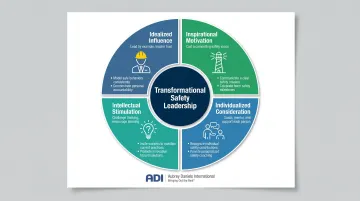
Idealized Influence: Role Modeling Safety as a Core Value
Transformational safety leaders model the behavior they expect. They personally demonstrate safety as a core value, not a competing priority against production.
What This Looks Like:
- Leaders wear PPE consistently, even during short tasks
- Leaders stop work when they observe unsafe conditions, regardless of schedule pressure
- Leaders visibly participate in safety meetings and walkthroughs
Barling et al. (2002) found that safety-specific transformational leadership predicted higher safety climate and fewer injuries — with leader example-setting operationalized through safety-specific items. Kelloway et al. (2006) showed the flip side: passive, hands-off leadership degrades safety climate. Workers who see leaders cut corners or prioritize production over safety internalize that behavior — regardless of what policies say.
Survey Measurement: Items assess whether leaders "walk the talk," demonstrate visible commitment, and are trusted by workers to prioritize safety genuinely.
Inspirational Motivation: Painting a Compelling Safety Vision
These leaders articulate what exceptional safety looks like—"zero harm is achievable"—and connect individual workers to that vision. This differs from compliance-based messaging, which generates minimum acceptable behavior. Inspirational motivation drives discretionary effort.
What This Looks Like:
- Leaders use stories, symbols, and recognition to reinforce the safety vision
- Leaders connect daily safe behaviors to long-term outcomes (e.g., "You go home to your family every night")
- Leaders celebrate safety milestones and near-miss reporting as learning opportunities
Meta-analysis by Clarke (2013) found that transformational leadership relates more strongly to discretionary safety participation than to compliance, aligning with inspiring a shared safety vision and extra-role behaviors.
Survey Measurement: Items assess whether leaders articulate a clear safety vision, inspire enthusiasm, and make workers feel their safety contributions matter.
Intellectual Stimulation: Challenging Assumptions and Encouraging Learning
Transformational leaders challenge long-held safety assumptions, encourage workers to surface near-misses without fear of blame, and promote innovative solutions to hazards rather than rote rule-following. This builds the learning culture that underpins proactive safety behavior.
What This Looks Like:
- Leaders ask "why" during incident investigations, not "who"
- Leaders encourage workers to propose better ways to control hazards
- Leaders reward near-miss reporting and treat it as valuable data, not evidence of failure
Multilevel climate research by Zohar & Luria (2005) showed that group climates shaped by supervisors drive safety behavior — consistent with leaders who encourage learning and problem-solving about hazards. Tucker et al. (2008) found that social context support predicts willingness to speak up about hazards. In a study of bus drivers (N=213), organizational support increased safety voice by working through coworker support — reinforcing that leaders who welcome questioning raise the odds workers will surface hazards early.
Survey Measurement: Items assess whether leaders encourage workers to challenge unsafe norms, promote learning from mistakes, and support innovative hazard controls.
Individualized Consideration: Coaching and Listening to Each Worker
These leaders show genuine interest in each worker's safety and well-being. They listen, follow up, and tailor coaching rather than applying blanket enforcement.
What This Looks Like:
- Leaders conduct one-on-one safety conversations, not just scripted walk-throughs
- Leaders know workers by name and understand their specific job hazards
- Leaders follow up on safety concerns raised by individual workers
Zohar (2000) found that supervisor practices at the group level drive climate and micro-accidents — suggesting that leader attention, coaching, and follow-up materially affect outcomes. Tucker et al. (2008) reinforced this: interpersonal support — particularly at the local level — is a critical driver of reporting behavior. When workers trust that concerns will be heard and acted on, they speak up.
Survey Measurement: Items assess whether leaders show personal concern for workers' safety, provide tailored coaching, and follow up on individual safety issues.
How to Design and Administer a Transformational Safety Leadership Survey
Use a Validated Base Instrument
Don't build from scratch. Use a validated base instrument adapted from the Multifactor Leadership Questionnaire (MLQ) or safety-specific scales like Kelloway et al. (2006), which measured safety-specific transformational leadership and passive leadership with high reliability (transformational leadership alpha = .94).
Validated instruments have established psychometric properties—reliability, validity, and predictive power. Building your own risks measuring noise instead of signal.
Ensure Anonymity to Encourage Honest Responses
Workers must trust their feedback is confidential. Third-party administration increases candor. Clear pre-survey communication and explicit confidentiality assurances — as recommended in NBAA's safety culture survey guidance — are essential for improving participation and candor.
Include Both Leader and Direct-Report Perspectives
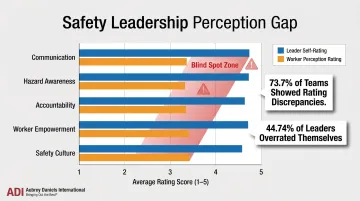
The most actionable output is the gap analysis between leader self-assessment and direct-report perception ratings. This reveals blind spots.
The research makes a strong case for multi-source data:
- Aarons et al. (2017) found 73.7% of teams showed discrepancies between leader self-ratings and follower ratings — and 44.74% of leaders overrated themselves. Larger gaps correlated with more defensive cultures.
- Lee & Carpenter (2018) confirmed only moderate self-other agreement, with leaders consistently inflating ratings on relation-oriented behaviors.
Delivery Considerations
- Onsite group administration yields higher completion rates and better data validity than email-only approaches
- Multi-language capability matters in diverse workforces
- Typical completion time: 25-35 minutes
NBAA guidance recommends surveys not exceed 25 minutes (approximately 100 or fewer statements).
Pre-Survey Communication Is Critical
Before launch, each stakeholder group needs a clear brief:
- Leaders: understand the purpose is development, not surveillance
- Workers: receive explicit assurance of anonymity
- Organization: has a clear plan for sharing and acting on results
Surveys that aren't followed by visible action erode trust more than no survey at all.
NBAA guidance outlines an 8-10 week process with 2-3 weeks of pre-survey communication to build buy-in and improve participation and candor.
Turning Survey Insights Into Lasting Behavior Change
Behavioral gap analysis, leadership dimension scores, and demographic data slices are what the survey produces. What happens next determines whether any of it matters.
Prioritize Gaps Where Leader Self-Ratings Exceed Worker Ratings
Focus first on dimensions where leader self-ratings are significantly higher than worker ratings. This blind-spot gap represents the highest-risk area because leaders believe they're doing well, but workers disagree.
Example: A plant manager rates himself 4.5 out of 5 on "I listen to workers' safety concerns." His direct reports rate him 2.8. This 1.7-point gap signals a critical blind spot requiring immediate attention.
Behavioral Coaching, Not Generic Training
Specific, observable leadership behaviors—conducting genuine safety conversations rather than scripted walk-throughs, recognizing safe behavior in real time—need to be practiced and reinforced, not just discussed in a training session.
A safety leadership training study by Moon (2024) in three wood-processing companies added manager coaching to an existing safety program — safe behaviors rose from 80.38% to 95.68%, and safety climate scores improved from 3.2 to 3.47 in an AB multiple-baseline design.
This is the work ADI's Precision Leadership® framework is built for. Grounded in over 45 years of Applied Behavior Analysis, ADI's behavioral consulting identifies which specific leader behaviors are driving gaps — then uses targeted coaching to shape those behaviors and build habits tied to measurable safety results.
Positive Reinforcement as the Change Mechanism
Research in behavioral science shows that leaders who learn to consistently reinforce safe behaviors—rather than only reacting to unsafe ones—produce more durable safety culture improvements. OSHA program guidance explicitly recommends acknowledging and providing positive reinforcement to workers who participate, as part of effective safety management programs.
What This Looks Like in Practice:
- Leaders provide specific, immediate recognition when they observe safe behaviors
- Leaders ask workers what helped them work safely and reinforce those practices
- Leaders celebrate near-miss reporting as proactive learning, not evidence of failure

These individual leader behaviors compound into organizational-level outcomes. A systematic review by Dyreborg et al. (2022) found that organizational and group-level interventions — including climate and management practices — show stronger injury prevention effects than purely individual behavior modification. Leadership practices and system reinforcement are the mechanism.
Re-Survey at Regular Intervals
Re-survey every 12-18 months to:
- Measure behavior change and demonstrate progress to workers
- Identify new gaps as the organization evolves
- Turn the survey from a one-time event into a continuous improvement loop
NBAA guidance recommends incorporating periodic perception surveys into safety management systems at a minimum of three-year intervals, though higher-performing organizations often survey more frequently to maintain momentum.
Frequently Asked Questions
What is a transformational safety leadership survey?
A transformational safety leadership survey is a validated assessment tool measuring the degree to which safety leaders demonstrate transformational behaviors—such as inspiring vision, individualized coaching, and intellectual challenge—that drive genuine safety culture rather than mere compliance. It captures both leader self-perception and direct-report ratings to identify blind spots.
How is a transformational safety leadership survey different from a standard safety culture survey?
A standard safety culture survey captures workforce-wide beliefs, perceptions, and reported behaviors. A transformational safety leadership survey specifically measures leader behavior dimensions and compares leader self-perception against direct-report ratings to surface perception gaps—something a culture survey alone cannot do.
What dimensions does a transformational safety leadership survey typically measure?
The survey measures four core dimensions: idealized influence (role modeling), inspirational motivation (vision-setting), intellectual stimulation (challenging assumptions and encouraging learning), and individualized consideration (coaching and listening)—all applied specifically to safety contexts. These dimensions are grounded in the Full Range Leadership Model adapted for safety.
Who should complete a transformational safety leadership survey?
Both leaders (self-assessment) and their direct reports (perception ratings) should complete the survey to generate meaningful gap analysis. Including senior leaders, frontline supervisors, and workers across departments captures the full range of variance in leadership effectiveness.
How often should organizations conduct a transformational safety leadership survey?
Organizations should re-survey every 12-18 months to allow enough time for behavior change interventions to take effect while maintaining momentum. Results should always be communicated back to participants to demonstrate progress and reinforce accountability.
What should organizations do if survey results reveal low scores in transformational leadership?
Low scores indicate specific leadership behavior gaps, not personal failings. The right response is targeted behavioral coaching, leader development grounded in positive reinforcement, and structured observation and feedback—not generic safety training. Prioritize closing perception gaps where leader self-ratings exceed worker ratings.