This guide provides a practical framework for measuring organizational culture using proven tools and a behavioral science lens that connects cultural data to real performance outcomes. The stakes are significant: healthy organizations deliver 3x the total shareholder returns of unhealthy organizations over the long term, with companies that improve organizational health realizing an 18% increase in EBITDA after one year, according to McKinsey's 2024 Organizational Health Index study of 1,500 companies across 100 countries.
Key Takeaways
- Organizational culture assessment evaluates the behaviors and reinforcement patterns actually driving how people work — not just stated values
- Effective measurement combines quantitative methods (surveys, metrics) with qualitative methods (interviews, focus groups, and direct observation)
- Common tools include the OCAI, Denison Survey, and engagement surveys — each revealing different cultural layers
- A behavior-based approach pinpoints which actions are being reinforced — the diagnostic layer most surveys miss
- Measurement only matters when it drives action — behavioral changes, leadership alignment, and sustained follow-through
What Is Organizational Culture Assessment?
Organizational culture assessment is a structured process for evaluating the values, behavioral norms, beliefs, and practices that shape how employees work together and pursue business goals.
The critical distinction is between stated culture — what leaders say the organization values — and lived culture — what behaviors are actually reinforced day-to-day through recognition, promotions, resource allocation, and consequences.
Edgar Schein's framework, documented in NIH research, identifies three levels where culture operates:
Edgar Schein's framework, documented in NIH research, identifies three levels where culture operates:
- Visible artifacts — structures, processes, and observable behaviors
- Espoused values — stated strategies and philosophies
- Basic underlying assumptions — unconscious beliefs that ultimately drive behavior
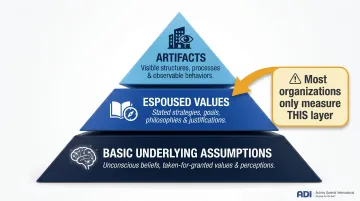
Most organizations measure only the middle layer. The deepest layer remains invisible — and unaddressed.
Why Surveys Alone Aren't Enough
An organizational culture assessment is the comprehensive diagnostic of overall cultural health, while an organizational culture survey is one specific data collection tool within that broader process. Denison Consulting distinguishes between their Core Survey (a 48-item instrument capturing data) and the Denison Model Assessment (the full solution encompassing discovery interviews, surveys, advanced analytics, and expert consultation). Surveys collect perception data. Assessments interpret that data, identify gaps, and build action plans.
Three Methods for Measuring Culture
Organizations typically use three approaches:
- Quantitative methods — surveys, metrics, scorecards providing breadth across populations
- Qualitative methods — interviews, focus groups, ethnographic observation providing depth and context
- Integrated approaches — combining both for complete, reliable cultural pictures
In practice, quantitative data tells you what employees report; qualitative methods reveal why they behave that way. Integrated approaches are the only way to close that gap reliably.
Why Measuring Organizational Culture Matters
Without accurate assessment, leaders make decisions based on assumptions about culture that may be entirely disconnected from what employees actually experience. Deloitte's 2023 Well-being at Work Survey revealed that 89% of executives believe their company advances human sustainability, while only 41% of employees agree — a perception gap of 48 percentage points. Culture gaps — the distance between desired and actual behavior — are among the most common hidden drivers of turnover, disengagement, and stalled change initiatives.
Core Benefits of Regular Culture Assessment:
- Identifies the specific behaviors and reinforcement patterns actually driving performance (or undermining it)
- Surfaces engagement, communication, and leadership gaps before they become costly
- Creates a data-backed foundation for change initiatives rather than relying on gut instinct
- Enables tracking whether culture change efforts produce measurable behavioral shifts over time
- Supports recruitment and onboarding by clarifying values and behaviors genuinely reinforced
The cost of neglected culture is measurable. Gallup's 2026 State of the Global Workplace report found that low employee engagement cost the global economy approximately $10 trillion in lost productivity in 2025, equivalent to 9% of global GDP.
Gallup research on turnover adds another dimension: 42% of employees who voluntarily left reported their exit was preventable, with 70% of preventable departures traced to daily management issues. Those management behaviors are precisely what culture assessment is designed to surface.
How to Measure Organizational Culture: A Step-by-Step Process
Culture assessment is most effective when following a deliberate, phased process — not a one-time survey deployment. A common mistake: jumping straight to tool selection before defining what the organization is actually trying to understand and why.
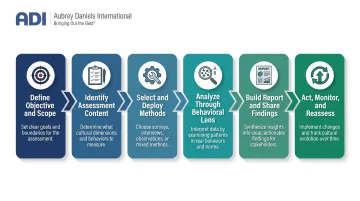
Step 1 – Define the Objective and Scope
Specify what the organization wants to learn. Are you diagnosing a current-state baseline? Identifying root causes of turnover or disengagement? Tracking progress on a culture change initiative?
Clarify which teams, levels, or departments will be included, and align with leadership on what a successful outcome looks like. Without clear objectives, you'll collect data but gain no actionable insight.
Step 2 – Identify What to Include in the Assessment
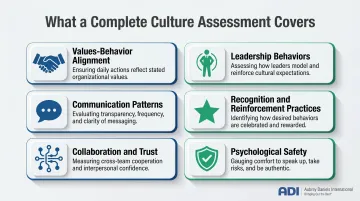
A comprehensive cultural assessment should cover:
- Alignment between stated values and observed behaviors
- Leadership behaviors and their impact on team norms
- Communication patterns (upward, downward, peer-to-peer)
- Employee recognition and reinforcement practices
- Collaboration and trust levels
- Psychological safety
Focusing exclusively on satisfaction or engagement scores misses the behavioral root causes underneath them. SHRM's culture audit toolkit recommends gathering baseline data including engagement survey results, turnover rates, and absenteeism figures alongside survey responses.
Step 3 – Select and Deploy Assessment Methods
Choose methods appropriate to your objective:
- Quantitative surveys for breadth across large populations
- Qualitative focus groups and interviews for depth and root-cause understanding
- Behavioral observation or performance metrics to capture actual behavioral data rather than perception data
Research by Yauch & Steudel found that combined methods produce results that are "more robust" than any single approach, with triangulation across methods strengthening overall validity.
Step 4 – Analyze Results Through a Behavioral Lens
Analysis should go beyond scoring. The key question: what behaviors are being reinforced, and are those behaviors aligned with the culture the organization wants?
Look for patterns between what employees report in surveys and what leaders visibly model. Scott et al.'s research recommends assessing congruency between observed artifacts and survey-reported values to "unlock unspoken assumptions." Flag gaps between current and desired state as priority areas for action.
Step 5 – Build a Cultural Report and Share Findings
Present findings in an actionable format — not just a summary of scores. A culture report should include:
- Current-state summary
- Identified behavioral gaps
- Root-cause hypotheses
- Prioritized recommendations
Share findings transparently with employees — not just leadership — to maintain trust and drive buy-in for change. Gallup's culture assessment framework recommends final executive presentations with recommendations alongside stakeholder communication.
Step 6 – Act, Monitor, and Reassess
Culture assessment is not a one-time event. Sustainable change requires translating insights into specific behavioral targets, assigning accountability, and scheduling follow-up assessments (e.g., pulse surveys or annual reassessments) to track whether targeted behaviors have actually shifted over time. Without measurable behavioral targets and a reassessment cycle, the assessment produces insight — but not change.
Organizational Culture Assessment Methods and Tools
No single tool captures the full picture of organizational culture. Tool selection should be driven by assessment objectives, organization size, and whether the goal is to benchmark, diagnose root causes, or track change over time.
Quantitative Methods
Three quantitative instruments are most widely used in practice:
Organizational Culture Assessment Instrument (OCAI) — Developed by Kim Cameron and Robert Quinn at the University of Michigan, the OCAI maps culture across four types (Collaborate, Create, Compete, Control) using a 100-point distribution format. Respondents allocate points across competing values, generating a current-versus-preferred culture profile.
Denison Organizational Culture Survey — A 48-item survey measuring four traits (Mission, Adaptability, Involvement, Consistency) across 12 sub-indexes. Built on 25+ years of research with more than 8,000 organizations, it directly links culture traits to performance outcomes including ROE, customer satisfaction, and employee retention.
Employee Engagement Surveys — Likert-scale instruments measuring employee perceptions across dimensions. Gallup's Q12 Meta-Analysis (11th Edition, 736 studies, 347 organizations) found top-quartile engaged units showed 81% less absenteeism, 43% less turnover, and 23% higher profitability than bottom-quartile units.
One limitation applies across all three: quantitative tools capture what employees report, not what they do. As Scott et al. note, surveys often reflect the "public face" of culture — espoused values that may not match the behaviors driven by underlying assumptions.
Qualitative Methods
Where quantitative tools measure perceptions at scale, qualitative methods surface the reasoning, norms, and gaps that numbers alone can't explain.
Structured focus groups surface the "why" behind survey scores and reveal unspoken norms. Skilled facilitators create psychological safety and draw out authentic responses that surveys rarely capture.
One-on-one leadership interviews expose how leaders perceive versus actually reinforce culture. The gap between what executives believe they model and what employees experience is often the most revealing data point in any assessment.
Direct behavioral observation is frequently skipped in formal assessments — and that's a mistake. Watching which behaviors get recognized, rewarded, and repeated in daily operations reveals more than any survey response. Ethical Systems research identifies ethnography (direct on-the-job observation) as a valid method for surfacing hidden cultural factors that structured instruments miss.
Together, these three approaches access cultural layers that quantitative tools cannot reach — and they provide the context needed to act on what surveys find.
Behavioral and Performance Metrics as Cultural Indicators
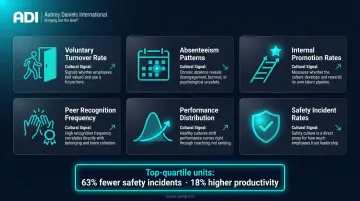
Certain organizational metrics function as indirect culture indicators:
- Voluntary turnover rate (signal of engagement and belonging)
- Absenteeism patterns
- Internal promotion rates
- Frequency and nature of peer recognition
- Performance distribution across teams
- Safety incident rates
These metrics reveal what culture is actually producing — not what employees say about it. Gallup Q12 research found top-quartile units experienced 63% fewer safety incidents and 18% higher productivity, showing how behavioral data validates (or challenges) what survey results suggest. Used alongside quantitative and qualitative methods, performance metrics complete the picture.
How ADI Can Help
ADI is a strategic partner for organizations that want to move beyond surface-level culture surveys and understand the behavioral science behind their culture. Grounded in over 45 years of Applied Behavior Analysis in business settings, ADI's approach focuses on identifying what behaviors are actually being reinforced — and whether those behaviors are driving the performance outcomes the business needs.
That focus connects cultural data directly to performance management, something survey-only approaches rarely do.
What ADI Offers:
- Expert consulting to design and interpret culture assessments grounded in behavioral science
- Surveys and assessments that reveal which reinforcement patterns are actually driving behavior
- The Applications of Behavioral Leadership workshop, which teaches a behavioral roadmapping process linking business results to critical behaviors at every level
- Certification programs that build internal capability, so culture improvement becomes an ongoing competency rather than a one-time project
One documented case study shows what behavioral science application looks like in practice: a distribution center implementing ADI's Performance Management approach improved from 70% to 90% network accuracy (generating $250,000 in annual savings), achieved 95% attendance versus the company norm of 88–90%, and reduced lost-time accidents by 45% — all while setting new throughput records.
Measuring culture is only the beginning. The real leverage comes from using what you find to redesign the reinforcement patterns shaping daily behavior. That's where ADI's work begins.
Frequently Asked Questions
What is organizational culture assessment?
Organizational culture assessment is a structured process for evaluating the values, behavioral norms, and practices shaping how an organization actually operates. It helps leaders identify gaps between desired and current culture and determine where to focus improvement efforts.
What is an organizational culture survey?
An organizational culture survey is one quantitative tool within the broader assessment process. It typically uses Likert-scale or forced-ranking questions to measure employee perceptions of culture across dimensions like communication, values alignment, leadership, and collaboration.
What is an example of an organizational culture assessment?
A practical example: deploying the OCAI to map current versus preferred culture across the four Competing Values Framework types, combining results with focus group sessions to identify root causes, then creating a prioritized action plan targeting specific behavioral changes.
What should be included in a cultural assessment?
A thorough cultural assessment covers:
- Values-behavior alignment and leadership behavioral patterns
- Communication norms, feedback practices, and psychological safety
- Employee recognition, reinforcement practices, and cross-functional collaboration
- Performance metrics that reveal cultural outcomes in measurable terms
What are examples of qualitative methods for organizational culture assessment?
Focus groups, one-on-one leadership interviews, direct behavioral observation, and ethnographic research surface the "why" behind quantitative scores and reveal deeply embedded norms that surveys often cannot detect.
What are the 4 types of organizational culture?
The Competing Values Framework identifies: Clan (collaborative, people-focused), Adhocracy (creative, entrepreneurial), Market (results-driven, competitive), and Hierarchy (structured, process-oriented). Most organizations exhibit a blend of all four types.