Introduction
Organizations today face a paradox: robust sustainability goals exist on paper, yet 84% of employees believe their organization lacks a strong sustainability culture, with lack of employee engagement consistently cited as the primary barrier to achieving these targets. Leaders launch programs, write policies, and deliver training—but employee behavior rarely changes in any lasting way.
This disconnect creates real consequences. Sustainability initiatives stall. ESG targets are missed. Purpose-driven talent walks away. The core problem isn't that employees don't care about sustainability—67% rate it as highly important. The problem is that most organizations haven't engineered the behavioral environment to sustain the actions that matter.
What follows is a behavioral science-grounded look at why standard engagement approaches fall short—and what it actually takes to turn sustainability commitments into consistent, everyday employee behavior.
Key Takeaways
- Most sustainability programs fail because the behavioral environment isn't designed to reinforce new behaviors long-term
- Top-down mandates create compliance; lasting engagement requires positive reinforcement tied to specific, controllable behaviors
- Ownership, targeted recognition, and visible impact feedback are the highest-leverage engagement tools
- Measuring leading indicators (daily behaviors) rather than lagging indicators (annual outcomes) sustains momentum
- Behavioral science makes sustainability a shared value, not just a compliance requirement
The Sustainability Engagement Gap: Why the Numbers Don't Add Up
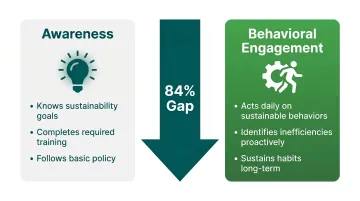
The awareness-action gap reveals the core problem. While 67% of employees rate sustainability as highly important, only 16% say their organization has the knowledge, mindset, and behaviors needed for a strong sustainability culture. Even more telling: 45% of employees have never spoken with their managers about sustainable practices at work.
That gap carries a measurable business cost. Organizations that close it see real returns:
- Sustainability cultures improve employee engagement by up to 43%
- Top-performing organizations on human sustainability emit 50% less CO2 per dollar of revenue
- Approximately 25% of employees have considered switching jobs to work for a more sustainable employer
That last figure makes disengagement a direct threat to retention and employer brand—not just a culture problem.
The distinction that matters most: there's a difference between employees who are aware of sustainability goals and those who are behaviorally engaged. Only the latter drives measurable organizational impact. Awareness campaigns, policy announcements, and annual training produce awareness. Designing the right behavioral consequences produces engagement.
Why Top-Down Sustainability Programs Fail
Compliance vs. Commitment: The Fatal Flaw
When sustainability is presented as a mandate or policy directive, it triggers rule-following behavior. Employees do what's required — nothing more. Discretionary effort — actively contributing ideas, spotting inefficiencies, sustaining green behaviors over time — is a different thing entirely.
Top-down programs produce compliance at best. They rarely unlock the behaviors that drive real environmental impact.
Poor Consequence Design Undermines Engagement
In most organizations, sustainable behaviors go unrecognized while the "old way" of working faces no real consequences. The behavioral environment actually reinforces inaction. Behavior is a function of its consequences. If an employee takes extra time to reduce waste but receives no acknowledgment — while a colleague who skips the process gets praised for efficiency — the message is clear: sustainability doesn't pay off.
The "Someone Else's Problem" Effect
When sustainability is owned entirely by a dedicated team or leadership, other employees psychologically opt out. Research shows that globally, only 1 in 4 employees strongly agree their opinions count at work. Organizations that double this ratio realize a 22% reduction in turnover and a 10% productivity increase. Employees who aren't included in goal-setting are far less likely to feel ownership over outcomes—a principle that applies directly to sustainability engagement.
The One-Size-Fits-All Problem
Generic sustainability training ignores that different employees respond to different reinforcers. What motivates a frontline manufacturing worker is often nothing like what drives a finance professional. Programs that ignore this distinction lose both. Effective engagement means identifying what actually matters to each individual:
- Recognition formats (public vs. private acknowledgment)
- Autonomy and decision-making authority
- Visible social or environmental impact
- Skill development and growth opportunities
Reinforcement designed around these factors produces lasting behavior change. Generic training does not.
Information Alone Doesn't Change Behavior
Traditional sustainability programs are designed to inform, not to change behavior. Behavioral research demonstrates that providing information or raising awareness does not alter the contingencies that maintain existing behavior. To change behavior, the environmental consequences that reinforce current actions must be rearranged. This is why posters, emails, and annual training sessions—all antecedents—fail to produce lasting change without corresponding consequence structures.
Behavioral Science: The Missing Link in Sustainability Engagement
Applied Behavior Analysis (ABA) provides the scientific foundation for sustainable engagement. ADI has spent over 45 years applying the science of behavior to business performance, and the core principles apply directly to sustainability. Behavior is shaped by antecedents (prompts and cues) and consequences (what happens after the behavior). Most sustainability programs over-invest in antecedents while neglecting consequences entirely.
Positive Reinforcement: The Most Powerful Tool
Positive reinforcement—providing something valued immediately after a desired behavior—builds habits far more durably than rules, fear of penalties, or one-time campaigns. Consider a team that finds a way to reduce material waste on a production line. Immediately recognizing that team, publicly sharing their innovation, and giving them time to develop the solution further creates a reinforcement loop.
The behavior (finding waste reduction opportunities) is followed by valued consequences—recognition, autonomy, visible impact—making it far more likely to recur.
Discretionary Effort Unlocks Sustainability Innovation
Engaged employees don't just comply with recycling policies—they proactively identify inefficiencies, champion sustainable practices with peers, and innovate. Discretionary effort is unlocked when employees are positively reinforced for going above and beyond, not just for meeting minimums. This is the behavioral difference between a sustainability program that exists on paper and one that becomes embedded in daily operations.
Individual Reinforcers Matter
Discretionary effort at scale depends on recognizing that what motivates one employee may be irrelevant to another. Leaders who invest time understanding what genuinely matters to their people—recognition formats, autonomy, social impact visibility, skill development—can design reinforcement strategies that work at the individual level. This requires moving beyond generic rewards to personalized, meaningful consequences tied to specific behaviors.
ADI's Performance Management Technology Applied to Sustainability
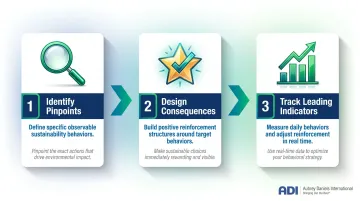
The same behavioral science approach ADI uses to drive measurable business performance improvements—connecting business results to critical behaviors at all organizational levels—applies directly to sustainability engagement. Building that engagement involves three core steps:
- Identify specific, observable sustainability behaviors (performance pinpoints)
- Design positive consequence structures around those behaviors
- Track leading indicators to adjust reinforcement strategies in real time
Practical Strategies to Drive Genuine Employee Engagement in Sustainability
Anchor Sustainability to Personal Purpose, Not Corporate Policy
Engagement deepens when employees see a genuine connection between their own values and the organization's sustainability mission. Leaders can facilitate this through:
- Purpose conversations during onboarding and ongoing one-on-ones
- Storytelling that connects individual actions to larger environmental or social outcomes
- Onboarding integration that weaves sustainability into the company's identity from day one
44% of Gen Zs and 40% of Millennials have rejected potential employers based on negative environmental impact, and 20% of Gen Zs and 19% of Millennials have already changed jobs to align with their environmental values. Authentic purpose alignment is both an engagement strategy and a talent strategy.
Give Employees Ownership Through Green Committees and Bottom-Up Ideation
Real ownership requires real authority. Effective green committees or sustainability working groups have:
- Cross-functional roles representing diverse organizational perspectives
- Genuine budget authority to propose and fund initiatives
- Leadership backing to implement changes without bureaucratic barriers
When employees design sustainability initiatives themselves, they're far more likely to sustain associated behaviors. The reinforcement is built directly into the activity — agency, peer recognition, visible impact. That's a fundamentally different proposition from a suggestion box: it's an actual delegation of decision-making power.
Recognize Behaviors, Not Just Outcomes
Behavior-specific recognition is immediate and precise. "Your suggestion to consolidate shipments reduced our carbon footprint by 15% this month — thank you for thinking through the logistics" reinforces the exact behavior you want repeated. Generic recognition ("Great job on sustainability this quarter") doesn't. The specificity is what makes it behaviorally effective, far more so than annual sustainability awards or delayed, vague praise.
Build Feedback Loops So Employees See Their Impact
When employees can see how their collective behaviors are reducing waste, cutting emissions, or contributing to ESG targets, the data itself becomes a form of reinforcement. Practical examples include:
- Real-time dashboards showing energy consumption, waste diversion rates, or carbon savings by department
- Team-level scorecards tracking specific behaviors (digital document usage, carpool participation, energy-saving actions)
- Monthly updates that close the feedback loop by connecting behaviors to outcomes
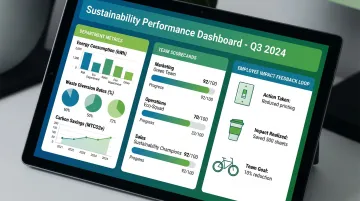
Visible progress data functions as a natural reinforcer — it closes the gap between behavior and consequence, which is precisely what keeps sustainable habits from fading after the initial launch enthusiasm wears off.
Making Sustainability Engagement Last: Measurement and Momentum
Shift from Lagging to Leading Indicators
Most organizations measure sustainability outcomes—tons of CO2 reduced, percentage of waste diverted—which are only visible long after the behaviors have occurred. Leading indicators track the frequency of specific sustainable behaviors, giving leaders real-time data to adjust reinforcement strategies before engagement erodes.
Examples of leading indicators include:
- Number of waste-reduction ideas submitted per week
- Percentage of teams conducting sustainability audits
- Frequency of employees using sustainable commuting options
- Daily instances of energy-saving behaviors
Leading indicators allow organizations to manage behavior in the moment rather than react to lagging outcomes months later.
Audit the Behavioral Environment Periodically
Identify which sustainable behaviors are currently being reinforced (and by what), which are being inadvertently punished (for example, green actions that add complexity without any recognition), and which have no consequence structure at all. This behavioral audit provides the starting point for sustainable engagement redesign.
Key questions for a behavioral audit:
- What happens immediately after an employee demonstrates a sustainable behavior?
- Are managers trained to recognize and reinforce sustainability actions?
- Do sustainable behaviors compete with other priorities that are more visibly rewarded?
- Are there inadvertent punishments (extra time, complexity, criticism) associated with green behaviors?
ADI's consulting and assessment services help organizations identify these behavioral barriers directly — pinpointing the gaps between what leaders expect and what the consequence environment actually reinforces. That analysis creates a structured path from one-time sustainability campaigns to lasting cultural change.
Frequently Asked Questions
Why is employee engagement important for sustainability?
Engaged employees move beyond compliance to actively drive sustainable practices, contribute innovative ideas, and model green behaviors for peers. Without that engagement, sustainability goals tend to stay in policy documents rather than showing up in daily decisions and habits.
How to get employees engaged in sustainability?
Start by connecting sustainability to personal values so it feels meaningful, not mandatory. Then give employees real ownership — committees with actual authority, recognition tied to specific behaviors, and feedback loops that show the impact of their actions.
What does sustainable engagement mean?
Sustainable engagement is lasting, behavior-embedded, and reinforced through positive consequences over time—not one-time campaign participation.
What are some examples of employee engagement programs for sustainability?
Effective programs include cross-functional green committees with real authority and budgets, behavior-specific recognition programs tied to visible sustainability actions, sustainability skills training designed for on-the-job application, and real-time impact dashboards that close the feedback loop.
What are the 4 pillars of employee engagement?
The commonly cited pillars are connection to purpose, clear communication, recognition and reward, and empowerment. In sustainability programs, these translate to linking personal values to environmental impact, clarifying which behaviors matter, reinforcing those behaviors positively, and giving employees real authority to act.