Introduction
Senior leaders face a defining paradox: the tactical execution skills that earned their promotion—solving problems directly, managing hands-on, delivering results through personal effort—become the very behaviors that limit their effectiveness at the executive level.
A study by McKinsey found that roughly 70% of transformation efforts fail, not because of flawed business cases, but because senior leaders lack the behavioral skills to lead change effectively.
Strategic leadership demands fundamentally different behaviors — moving from optimizing what exists to anticipating and shaping what should exist. Yet most organizations promote leaders for tactical excellence without developing the strategic capabilities that the role actually requires.
Research shows that 46% of leadership transitions underperform, and new CEOs face failure rates as high as 50%.
This guide covers:
- What strategic leadership actually demands from senior leaders
- The core capabilities that must be built at the executive level
- Why most development efforts fail to produce lasting behavior change
- How to build a development plan that works
Key Takeaways
- Strategic leadership is a behavioral shift, not just a knowledge upgrade — it demands systems thinking, influence skills, and long-horizon decision-making
- Most development programs fail by treating leadership as a knowledge problem, ignoring what actually drives behavior change and reinforces new habits
- Effective plans combine formal learning (10%), developmental relationships (20%), and challenging assignments (70%) to create sustainable change
- Measure success through behavioral indicators and business outcomes, not just training completion or participant satisfaction
What Strategic Leadership Actually Requires from Senior Leaders
Tactical leaders optimize what exists. Strategic leaders anticipate, align, and shape what should exist. Most senior leaders earn promotion through tactical excellence — delivering results, solving immediate problems, executing plans effectively — yet organizations rarely provide explicit development for strategic thinking, creating a capability gap at the level where it matters most.
Only 20% of HR leaders say they have leaders ready to fill their most critical roles, and internal candidates can fill just 49% of critical positions immediately. This gap reveals a hard truth: tactical competence does not automatically translate to strategic capability.
The behavioral shift required is significant. Senior leaders must move from solving problems directly to creating environments where others solve problems well. Leading through others — not just delegating tasks — is what separates strategic leadership from tactical management.
In practice, that means developing a different set of behaviors:
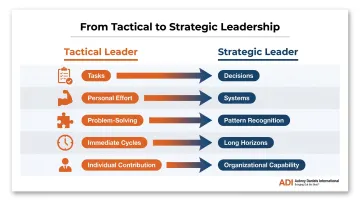
- Delegating decisions, not just tasks
- Building systems that enable performance rather than driving it through personal effort
- Shifting from hands-on problem-solving to pattern recognition
- Thinking in long horizons instead of immediate execution cycles
- Building organizational capability rather than individual contribution
According to research by Rich Horwath, who has worked with over 250,000 managers, the tactical-versus-strategic distinction has historically been "a subjective guess based on job titles, instinctual hunches, and cherry-picked observations." This ambiguity contributes to development failures: leaders don't know precisely which behaviors to change, and organizations don't measure the right indicators of strategic capability.
That measurement problem makes the following obstacles harder to address:
What makes this transition particularly challenging:
- Current environments reward tactical behaviors — urgency, visible action, quick wins
- Strategic behaviors often feel uncomfortable initially — they require patience, ambiguity tolerance, and delayed gratification
- Without deliberate reinforcement, leaders naturally revert to what worked before
A failed leadership transition can cost more than 2x the executive's annual compensation, and 90% of new CEOs wish they had handled their transition differently. The cost of leaving this gap unaddressed is concrete — and avoidable.
The Core Capabilities Senior Leaders Must Develop
Strategic Thinking: From Reaction to Direction
Strategic thinking is the ability to scan the external environment, recognize patterns, challenge assumptions, and connect near-term decisions to long-term organizational direction. This is a learnable behavior, not an innate trait.
What strategic thinking looks like in practice:
- Asking "why" before "how"—understanding the purpose and context before jumping to solutions
- Monitoring the external environment—tracking industry trends, competitive dynamics, and emerging technologies
- Questioning assumptions that underlie current strategy—"What if our core premise is wrong?"
- Connecting tactical decisions to strategic outcomes—"How does this choice advance our long-term direction?"
Research from the Center for Creative Leadership identifies strategic perspective as one of 16 critical leadership competencies, specifically within the "Leading the Organization" domain. Leaders develop this capability through deliberate practice, not passive learning.
Systems Perspective: Understanding Ripple Effects
Strategic leaders view the organization as an interconnected system rather than a collection of silos. Decisions in one area create downstream effects in others—understanding these ripple effects prevents reactive, short-sighted choices.
Developing systems perspective requires:
- Mapping organizational interconnections—understanding how functions depend on each other
- Analyzing second and third-order consequences—"If we optimize this metric, what happens elsewhere?"
- Balancing competing priorities across functions—revenue growth versus cost control, innovation versus efficiency
- Recognizing feedback loops—how today's decisions shape tomorrow's constraints
This capability directly addresses one of CCL's identified career derailers: "too narrow a functional orientation." Leaders who expand their view beyond their own domain make faster, better-informed decisions when cross-functional tradeoffs are unavoidable.
Influence and Stakeholder Alignment
Senior leaders achieve results through people and functions outside their direct authority. This requires building trust, communicating a compelling "why," and aligning diverse stakeholders—not issuing directives.
Korn Ferry's 2025 research emphasizes that senior executives must master strategic communication, active listening, and cross-functional influence to collaborate effectively in complex organizations.
Key influence behaviors:
- Framing proposals in terms of stakeholder priorities—"Here's why this matters to your goals"
- Building coalitions before formal decisions—engaging key voices early
- Listening to understand resistance—not just to respond
- Demonstrating credibility through follow-through—influence requires trust
Decisiveness Under Ambiguity
Strategic leaders face decisions with incomplete information and time pressure. Good decision-making at senior levels means using clear criteria, accepting calculated risk, and communicating decisions with confidence while remaining open to new information.
Effective decision-making practices:
- Establishing decision criteria upfront—"What factors will guide this choice?"
- Setting information thresholds—"What do we need to know versus what would be nice to know?"
- Distinguishing reversible from irreversible decisions—adjusting speed and rigor accordingly
- Communicating the rationale transparently—helping others understand the "why" behind the choice
CCL research identifies decisiveness as a critical competency within the "Leading the Organization" domain, particularly important as ambiguity increases at senior levels.
Emotional Intelligence: How Leaders Stay Effective Under Pressure
In high-stakes situations, the quality of a leader's thinking depends heavily on how well they manage their own reactions—and how accurately they read others. Emotional intelligence determines whether strategic capabilities get deployed effectively or get undermined by stress, blind spots, and strained relationships.
Core EI behaviors for strategic leaders:
- Recognizing your own triggers and biases before they shape a decision under pressure
- Pausing before reacting in high-stakes conversations—especially when the instinct is to defend
- Reading unspoken concerns in meetings, not just what's said aloud
- Adapting your communication style to the person, not just the message
CCL's research identifies self-awareness and compassion/sensitivity as critical competencies, noting that problems with interpersonal relationships represent a primary career derailer for senior leaders.
Why Most Leadership Development Programs Don't Create Lasting Change
Despite companies spending an estimated $400 billion annually on leadership training, 75% of organizations rate their programs as not very effective. The core reason is simple: development investments treat leadership as a knowledge problem rather than a behavior change problem.
Training provides information and frameworks, but information alone rarely changes what leaders do under pressure. Knowing you should delegate strategically doesn't mean you will when a critical deadline hits. Under pressure, most leaders default to what's familiar — tactical firefighting takes over, and long-term thinking waits.
The Training-Whirlwind Problem
After attending a workshop, senior leaders return to environments that immediately reward old behaviors. Urgency dominates, short-term pressures intensify, and existing organizational norms actively compete against newly learned strategic habits. Without deliberate reinforcement, old patterns win.
ADI's behavioral science foundation, built on over 45 years of applied behavior analysis, reveals why this happens: behavior change requires more than exposure to new ideas. It requires understanding what reinforces current behaviors and engineering environments where strategic habits actually take hold.
What sustains behavior:
- Immediate consequences: positive reinforcement makes behaviors stick
- Environmental cues: familiar workplaces trigger familiar patterns automatically
- Social norms: when peers and superiors model tactical behavior, strategic behavior feels risky
- Measurement systems: what gets measured and rewarded is what gets done
Research from MIT Sloan Management Review found that 70% of leadership development program directors settle for measuring participant satisfaction rather than actual capability improvement. Zero percent could link their programs to changes in career trajectories or organizational outcomes.
What Behavioral Science Tells Us About Sustained Change
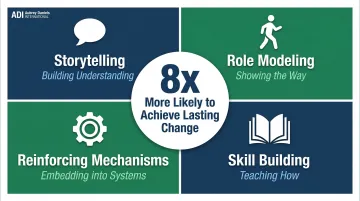
McKinsey's research identifies four levers for behavioral change: storytelling (building understanding), role modeling (showing the way), reinforcing mechanisms (embedding into systems), and skill building (teaching how). Using all four levers makes organizations more than 8x more likely to achieve lasting behavior change.
Most programs focus exclusively on skill building — the workshops, training sessions, and formal education. They neglect the other three levers entirely. Leaders return to workplaces where:
- Peers and managers aren't modeling the new strategic behaviors
- Systems still measure and reward tactical execution above all else
- No shared narrative explains why the change matters to begin with
ADI's approach targets all four levers. By identifying what actually reinforces leader behavior and redesigning the environment around it, organizations move beyond temporary training effects to behavioral change that holds.
The Self-Awareness Gap
Many senior leaders don't realize which current behaviors work against strategic goals. Without structured assessment — including 360 feedback and behavioral observation — leaders can't change what they can't see.
Meta-analytic research shows executive coaching produces significantly stronger effects on behavioral outcomes (effect size g = 0.73) than on attitudes (g = 0.34). Coaching works because it provides the mirror leaders need — revealing blind spots, challenging assumptions, and offering real-time feedback on behavioral impact.
How to Build a Behavior-Based Strategic Leadership Development Plan
Start with a Capability Audit, Not a Curriculum
Effective development begins with honest assessment of where the leader currently stands across each strategic capability—not just self-reported skills, but observed behaviors and organizational impact.
Assessment approaches:
- Behavioral 360 feedback—gathering structured input from peers, direct reports, and supervisors
- Performance data analysis—examining business outcomes tied to leader-owned goals
- Behavioral observation—watching how leaders run meetings, make decisions, communicate strategy
- Structured interviews—exploring how leaders approach strategic challenges
This baseline establishes where development effort should focus and creates a measurement point for tracking progress.
Apply the 70-20-10 Principle
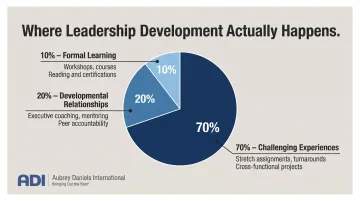
Research from the Center for Creative Leadership, validated across 30+ years in four countries, shows that roughly 70% of leadership development comes from challenging assignments, 20% from relationships and feedback, and 10% from formal learning.
Why this distribution matters:
Most organizations invert it—over-investing in formal training (workshops, seminars, courses) and under-investing in the experiential and relational components where real learning happens.
How to apply it:
- 70% challenging experiences: Stretch assignments, turnarounds, new initiatives, increases in scope, cross-functional projects
- 20% developmental relationships: Executive coaching, mentoring, peer accountability groups, structured feedback
- 10% formal learning: Workshops, courses, reading, shared knowledge base
DDI's Global Leadership Forecast found that internal promotions are 3.7x more successful when leaders participate in cohort development programs and 3.2x more successful with sequential leadership learning—demonstrating the power of combining structured learning with peer relationships.
Design Stretch Experiences Intentionally
The most powerful development happens when senior leaders face real challenges requiring new strategic behaviors—not safe, comfortable assignments.
What makes a stretch experience effective:
- Tied to organizational priorities—the assignment advances real business goals, not just the leader's individual growth
- Meaningful stakes—outcomes affect teams, results, or the organization in visible ways
- Feedback mechanism—regular input on what's working and what isn't
- Reflection time—structured opportunities to process learning, not just execute
Examples of strategic stretch assignments:
- Leading a cross-functional transformation initiative
- Opening a new market or business line
- Turning around an underperforming division
- Integrating an acquisition
- Developing a three-year strategic plan for a major function
CCL's research identifies turnarounds, increases in job scope, horizontal moves, and new initiatives as universal sources of leadership learning across cultures.
Leverage Executive Coaching and Peer Accountability
A coach grounded in behavioral science does more than offer perspective—they help senior leaders pinpoint what's actually reinforcing old behavior patterns and build deliberate replacement habits. That specificity is what separates behavioral coaching from general executive mentoring.
Research analyzing 20 randomized controlled trials shows executive coaching yields moderate-to-large effects on behavioral outcomes (g = 0.73)—significantly stronger than its impact on attitudes alone. Coaching drives behavior change, not just mindset shift.
Peer advisory groups or accountability partnerships add social reinforcement that formal programs cannot provide. When senior leaders commit to development goals publicly among trusted peers, follow-through increases measurably.
ADI's coaching engagements are built on this behavioral science foundation—using applied behavior analysis to identify what maintains current leadership patterns and redesign the conditions that shape new ones.
Build in Reinforcement and Feedback Loops
New strategic behaviors don't stick through intention alone. They require consistent reinforcement through regular cadences built into how leaders work—not just surfaced during annual reviews.
Effective reinforcement structures:
- Weekly check-ins—brief conversations with coach or accountability partner on what worked, what didn't
- Monthly reflection practices—structured time to review progress against development goals
- Quarterly 360 pulse checks—lightweight feedback from key stakeholders on observed behavior change
- Real-time recognition—acknowledging when strategic behaviors appear, not waiting for formal reviews
What gets reinforced gets repeated. The cadence matters as much as the content.
Creating a Culture That Sustains Strategic Leadership at Every Level
Individual leader development is not enough if the organizational environment doesn't reinforce strategic behavior. Senior leaders must model, communicate, and reward strategic thinking throughout their teams—making it visible and valued, not reserved for the C-suite.
How senior leaders build strategic culture:
- Demonstrate horizon-scanning and systems thinking in visible forums, not just behind closed doors
- Explain the reasoning behind major decisions so others understand how they connect to long-term direction
- Recognize team members who challenge assumptions, spot patterns, or think beyond their immediate scope
- Carve out regular time for teams to discuss trends, scenarios, and long-term positioning
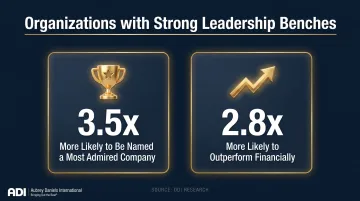
Organizations with strong leadership benches are 3.5x more likely to be rated as most admired companies and 2.8x more likely to outperform financially. Building that bench requires deliberately developing strategic capability at every level.
Develop the Next Generation Intentionally
Senior leaders build future strategic leaders through:
- Ask strategic questions in coaching conversations rather than handing over tactical answers
- Delegate decisions that genuinely shape direction, not just decisions that are safe to hand off
- Invite high-potential leaders into planning processes early, before the execution phase begins
- Give specific feedback when emerging leaders show systems thinking or long-term orientation—name it, reinforce it
Succession planning that starts at vacancy is already too late. Senior leaders who build a bench of strategically capable people before they need it aren't just reducing risk—they're compounding competitive advantage over time.
Measuring Whether Strategic Leadership Development Is Working
Activity metrics—training completion rates, hours spent in development, satisfaction scores—measure inputs, not change. Effective measurement focuses on observable shifts in leadership behavior and business outcomes.
Behavioral Indicators (Leading Indicators)
- Are leaders asking more strategic questions in meetings—encouraging diverse viewpoints and focusing on long-term implications?
- Are decisions better aligned with strategic priorities, made with clearer criteria, and communicated more effectively?
- Are leaders delegating strategic decisions, not just tactical tasks?
- Are 360 scores on strategic competencies improving over time?
These leading indicators reveal whether behavior is actually changing before business results appear.
Business Outcomes (Lagging Indicators)
- Team engagement scores — do direct reports report a more motivating, high-accountability environment?
- Retention of high performers — is regrettable attrition declining in leader-owned teams?
- Execution rate on strategic initiatives — are priorities landing on time and within scope?
- Business results tied to leader-owned goals — revenue growth, margin improvement, market share, and innovation output
The Kirkpatrick Model offers a four-level framework for measuring training effectiveness: reaction, learning, behavior, and results. Most organizations stop at Level 1 (satisfaction) and Level 2 (knowledge gained). Strategic leadership development requires measurement at Levels 3 (behavior change) and 4 (business impact).
Baseline-to-Benchmark Measurement
Establish a clear behavioral baseline before development begins—using 360 feedback, performance data, and stakeholder interviews. Reassess at defined intervals (90 days, 6 months, 12 months) to track whether change is real, sustained, and translating into organizational results.
Without that baseline, there's no way to distinguish genuine behavioral change from the appearance of it—and no way to justify continued investment in development that isn't delivering results.
Frequently Asked Questions
What is the 70 20 10 rule for leadership?
The 70-20-10 model allocates leadership development across three sources: 70% from challenging on-the-job experiences, 20% from coaching and developmental relationships, and 10% from formal training. Most organizations over-invest in that 10% while neglecting the experiential and relational components where real learning happens.
What are the 5 P's of a strategic leadership model?
Henry Mintzberg's Five Ps for Strategy give leaders five distinct lenses: Plan (deliberate strategy), Ploy (competitive maneuver), Pattern (consistent behavior), Position (market placement), and Perspective (organizational worldview). Together, they capture how strategic leaders both interpret and shape organizational direction.
What are the 5 C's of leadership development?
The 5 C's cover five foundational leadership dimensions: Character (integrity and self-awareness), Competence (skill mastery), Commitment (sustained effort), Compassion (empathy), and Communication (influence). These map directly to the behavioral capabilities senior leaders must demonstrate consistently.
What is the difference between strategic leadership and tactical leadership?
Tactical leadership focuses on executing plans, solving immediate problems, and optimizing current operations. Strategic leadership focuses on setting direction, anticipating the future, aligning stakeholders, and creating conditions for long-term organizational success. The shift requires fundamentally different behaviors, not just different knowledge.
How do senior leaders develop strategic thinking skills?
Strategic thinking develops through deliberate practice: seeking cross-functional exposure, engaging with stretch assignments that require systems perspective, working with a coach who challenges assumptions, and building habits of environmental scanning and pattern recognition into daily routines. Any senior leader willing to practice these habits can develop it.
Why do leadership development programs fail to create lasting change?
Most programs fail because they treat leadership as a knowledge problem rather than a behavior change challenge. Without reinforcing new behaviors in the work environment—through role modeling, measurement systems, recognition, and accountability—leaders revert to old patterns despite excellent training content.