Introduction
Most organizations invest heavily in leadership development, yet behavioral change rarely sticks. Companies spend $165 per learning hour on training—a 34% increase from the previous year—but struggle to see lasting impact. The problem is the approach itself.
Only 10% of training typically transfers to the job and is maintained over time. Leaders attend workshops, receive feedback, and make commitments to change—then return to old habits within weeks. The gap between understanding what needs to change and actually changing behavior is where most leadership development investments disappear.
This guide covers the science of behavioral change, why common coaching methods underdeliver, and a practical process for lasting shifts in leadership behavior. Sustainable change requires addressing what actually drives behavior—consequences and reinforcement—not just insight or motivation.
TLDR:
- Most leadership training fails because it targets insight rather than the behavioral science of what sustains change
- Behavioral coaching focuses on specific, measurable actions and the consequences that reinforce them
- The ABC Model (Antecedent → Behavior → Consequence) provides the diagnostic framework for lasting change
- Stakeholder follow-up is the strongest predictor of sustained behavioral improvement
- Effective coaching spans 12–18 months, with frequent early reinforcement tapering to variable schedules as habits solidify
Why Traditional Leadership Coaching Falls Short on Behavioral Change
The Insight Trap
Leaders who intellectually understand what needs to change still fail to change. They attend workshops, receive 360-degree feedback, and gain clarity about their gaps—yet three months later, they're still micromanaging, avoiding difficult conversations, or dominating meetings.
The reason: awareness is an antecedent, not a consequence. Antecedents—goals, training sessions, feedback reports—set the occasion for behavior but rarely sustain it.
A leader might leave a workshop genuinely intending to delegate more effectively, but when they return to an environment where delegation leads to mistakes, delays, or loss of control, the insight vanishes. The old behavior returns because the consequences haven't changed.
Only 7% of senior managers believe their companies develop leaders effectively, despite massive investment. The insight trap explains why: organizations confuse understanding with change.
The One-Time Training Event Problem
Workshops and seminars deliver short-term inspiration but no lasting behavioral shift. Adults retain only about 10% of what they hear in classroom lectures, compared to approximately 66% when they learn by doing. Even well-designed programs fail without reinforcement structures.
U.S. companies spend nearly $14 billion annually on leadership development, yet 71% of organizations say their leaders aren't ready to lead into the future. The gap isn't a lack of effort—it's a lack of the reinforcement structures that turn awareness into action.
The Missing Accountability Loop
Without visible, ongoing follow-through and real-world feedback, even sincere behavioral commitments are overtaken by habit, pressure, and competing priorities. Leaders return to work environments that punish new behaviors or simply ignore them.
When a leader starts delegating but receives no recognition for doing so—or worse, gets blamed when delegated tasks fail—the new behavior extinguishes quickly. Several conditions accelerate this pattern:
- No positive reinforcement when the new behavior occurs
- Immediate negative consequences (blame, rework, delays) tied to the change
- Peer or manager behavior that signals the old approach is still expected
- No structured check-ins to track progress after the program ends
The accountability loop must be external and structured, not dependent on the leader's self-discipline alone.
What Leadership Coaching for Behavioral Change Actually Means
Leadership coaching for behavioral change is a structured, ongoing process focused on producing observable, measurable shifts in how leaders act—not just how they think or feel. It targets specific behaviors that affect team performance and organizational outcomes, then systematically reinforces those behaviors until they become habitual.
This differs fundamentally from other coaching types:
- Strategic coaching helps leaders think through business challenges and make better decisions
- Life planning coaching addresses career goals, work-life balance, and personal fulfillment
- Skills training teaches technical competencies like financial analysis or project management
Behavioral coaching zeroes in on actions: how often a leader recognizes team contributions, whether they follow through on commitments, how they handle conflict in meetings. These behaviors are observable, countable, and directly linked to team effectiveness.
Who Benefits Most
Leaders at any level who are genuinely motivated to improve—and whose behavioral patterns are limiting their effectiveness or their team's performance—are strong candidates. Motivation, not rank or external pressure, is the strongest predictor of coaching success.
Behavioral coaching applies across organizational levels:
- Frontline supervisors learning to give consistent, specific positive feedback
- Mid-level managers struggling to delegate without micromanaging
- Senior executives whose communication style creates bottlenecks for the teams below them
Leaders at any level who are genuinely motivated to improve—and whose behavioral patterns are limiting their effectiveness or their team's performance—are strong candidates. Motivation, not rank or external pressure, is the strongest predictor of coaching success.
Behavioral coaching applies across organizational levels:
- Frontline supervisors learning to give consistent, specific positive feedback
- Mid-level managers struggling to delegate without micromanaging
- Senior executives whose communication style creates bottlenecks for the teams below them
What each of these situations has in common: the behaviors are visible, measurable, and changeable with the right structure in place.
The Behavioral Science Framework That Makes Change Stick
The ABC Model: Antecedent → Behavior → Consequence
The ABC Model is the diagnostic foundation for understanding why leaders behave as they do—and how to systematically change it. Most coaching programs only address antecedents (goals, training, feedback) but ignore consequences, which is why change doesn't last.
How it works:
- Antecedent: A meeting invitation, a direct report's question, a deadline—the trigger that sets the occasion for action
- Behavior: What the leader actually does—delegates a task, interrupts, schedules a follow-up
- Consequence: What follows immediately—recognition, criticism, relief, visibility, or nothing at all
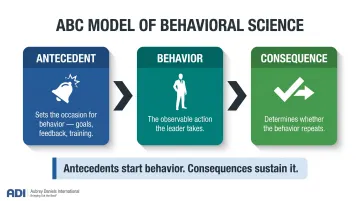
Antecedents get behavior started. Consequences determine whether it continues.
A leader might receive training on active listening (antecedent) and genuinely try it in their next one-on-one (behavior). But if the team member interprets the new approach as disengagement, or if the leader's calendar penalizes them for longer meetings, the behavior won't stick. Consequences, not antecedents, control whether behavior repeats.
The Critical Role of Consequences
Behavior is shaped and sustained by what follows it—specifically, whether the consequence is positive, negative, immediate, or delayed. Leaders whose new behaviors are ignored or punished will revert, no matter how well-intentioned they are.
Research shows that consequences drive behavior more powerfully than antecedents. When a leader receives recognition for delegating effectively, they're far more likely to delegate again than if they simply attended a delegation workshop.
Unfortunately, most organizational environments are better at punishing new behaviors than reinforcing them. A leader who starts giving more autonomy might face short-term mistakes, triggering stress and criticism as immediate negative consequences.
The long-term benefits (team growth, reduced workload) are delayed and invisible, making it easy for the leader to revert to micromanaging.
Positive Reinforcement: The Engine of Lasting Change
A meta-analysis of 72 behavioral management studies found an overall average 16% improvement in task performance when positive reinforcement was applied. Individual reinforcer effects varied:
- Money: 23% performance improvement
- Social recognition: 17% improvement
- Feedback: 10% improvement
When all three reinforcers were combined, performance improved by 45%—a compounding effect 21% greater than the sum of individual effects.
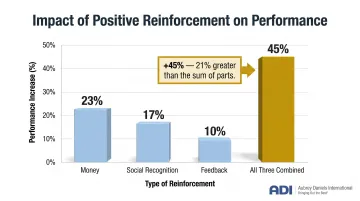
Positive reinforcement—consequences that increase the likelihood a behavior is repeated—is the primary driver of sustained behavioral change. Without it, new behaviors extinguish even when leaders are well-intentioned.
For over 45 years, ADI has applied behavioral science to business performance built on this principle: identifying what genuinely reinforces each leader and structuring their environment accordingly. Reinforcers aren't universal. What motivates one leader (public recognition) may actively demotivate another who prefers private acknowledgment. Effective coaching individualizes reinforcement.
Discretionary Effort: Beyond Problem Correction
That data points to something broader than performance metrics. When behavioral coaching is working, it doesn't just correct problems — it creates conditions where leaders and teams choose to contribute more than the minimum required. This is Discretionary Effort: the additional engagement employees willingly bring beyond their job requirements.
When leaders experience positive consequences for new behaviors—respect from their teams, visible progress, autonomy—they invest more energy and creativity. This compounds across the organization, fueling performance from the inside out.
Timing and Frequency of Reinforcement
Immediate, frequent reinforcement early in the change process is critical. A leader trying to give more positive feedback needs recognition and encouragement after their first few attempts, not three months later during a performance review.
As the new behavior becomes habitual—research shows this takes an average of 66 days, with a range of 18 to 254 days depending on complexity—reinforcement can shift to variable schedules that maintain the behavior long-term without constant external input.
Early-stage coaching typically involves weekly check-ins with immediate feedback. Six months in, monthly stakeholder surveys and peer recognition are often sufficient. The reinforcement schedule evolves with the leader — fading external support as internal motivation and habit take over.
A Step-by-Step Leadership Coaching Process for Lasting Behavioral Change
Step 1 — Define Specific, Observable Target Behaviors
Work with the leader and relevant stakeholders to identify 1–3 high-priority behaviors to change. Specificity is non-negotiable.
Not specific enough: "Communicates more clearly"
Specific and observable: "Summarizes key decisions and next steps at the end of each team meeting"
The behavior must be something you can see and count. If you can't observe it happening, you can't coach it or reinforce it.
Examples of well-defined target behaviors:
- Provides positive feedback to at least one team member daily
- Delegates tasks with clear success criteria and check-in dates
- Asks at least two open-ended questions before offering solutions in one-on-ones
- Sends meeting agendas 24 hours in advance with clear objectives
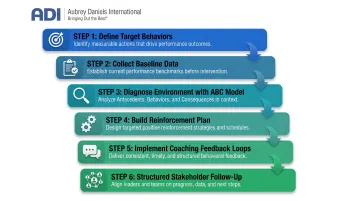
Step 2 — Identify Key Stakeholders and Collect Baseline Data
Select stakeholders who are directly impacted by the leader's behavior and can provide honest, contextual input: direct reports, peers, the leader's manager, cross-functional partners.
Use structured 360-degree feedback or direct interviews to establish a behavioral baseline before coaching begins. Approximately 90% of Fortune 500 companies use 360-degree feedback, though its effectiveness depends entirely on what happens next.
Baseline data should measure:
- Frequency: How often does the leader currently demonstrate the target behavior?
- Perception: How do stakeholders currently experience the leader's effectiveness in this area?
- Context: Under what conditions does the behavior occur or fail to occur?
Only 33% of companies require participants to use 360 results to create a development plan with their manager. Without structured follow-through, collecting baseline data is wasted effort.
Step 3 — Diagnose the Environment Using the ABC Model
Before designing any intervention, map the antecedents triggering the problem behavior and the consequences reinforcing it. This reveals why the behavior persists — and what must change environmentally to shift it.
Consider a leader who consistently interrupts team members during meetings:
- Antecedent: Someone starts explaining a problem the leader has already thought through
- Behavior: Leader interrupts with the solution
- Consequence: Meeting moves faster (immediate positive for the leader); team stops contributing ideas (delayed negative, often invisible to the leader)
The environment is reinforcing the interrupting behavior through immediate time savings while punishing listening behavior through perceived inefficiency. Step 4 addresses exactly that.
Step 4 — Build a Reinforcement-Based Action Plan
Create a coaching plan that pairs new target behaviors with identified reinforcers — recognition, meaningful feedback, autonomy, or progress visibility. The plan must be individualized because reinforcers are not universal.
For one leader, weekly written summaries of stakeholder feedback might be highly reinforcing. For another, a brief verbal comment delivered right after the meeting — "I noticed you summarized next steps; your team responded well" — carries more weight than any written report.
The action plan should specify:
- What new behavior the leader will practice
- What specific reinforcement will follow the behavior, and when
- Who will deliver the reinforcement
- How progress will be tracked
Step 5 — Implement Continuous Coaching and Feedback Loops
Coaching sessions work best as brief, frequent check-ins focused on real-world application — not lectures. Each session should reinforce progress immediately and set up the next practice opportunity.
A typical session might include:
- Review of the leader's self-tracked behavioral frequency since last session
- Debrief of one specific situation where the leader practiced the target behavior
- Role-play of an upcoming scenario where the behavior will be tested
- Identification of what reinforcement the leader experienced (or didn't) when they practiced the behavior
- Agreement on next week's focus
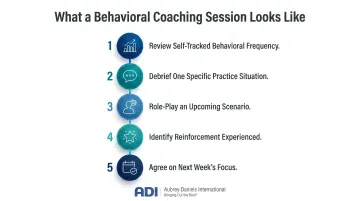
Early in the coaching process, weekly sessions are ideal. As behaviors stabilize, sessions can shift to bi-weekly or monthly.
Step 6 — Conduct Structured Follow-Up with Stakeholders
Stakeholder follow-up is not an evaluation — it is the mechanism that keeps behavioral change visible, social, and accountable. Mini-surveys or structured check-ins every 4–6 weeks allow the leader to track perceived change and adjust course.
Research on 86,000 raters and 11,000 leaders found that the degree of follow-up was highly predictive of perceived improvement. Leaders who followed up and involved co-workers were seen as improving; those who didn't were not.
Marshall Goldsmith's Stakeholder Centered Coaching uses monthly mini-surveys where stakeholders rate the leader's change on a -3 to +3 scale. After one year of structured follow-up in one documented case, 85% of stakeholder responses were +3 or above, with 40% at the maximum +5 and 0% negative scores.
How to Measure and Sustain Behavioral Change in Leaders
Leading Indicators vs. Lagging Indicators
Measuring behavioral change requires tracking leading indicators (frequency of target behaviors) separately from lagging indicators (team engagement, retention, performance metrics).
Leading indicators are proactive and preventive—they tell you whether the behavior is happening. Lagging indicators tell you whether it's working. Both matter, but leading indicators come first.
Example:
- Leading indicator: Number of times this week the leader provided specific positive feedback to team members
- Lagging indicator: Team engagement score on next quarter's survey
Organizations that track behavioral leading indicators create dozens to thousands of data points daily, versus infrequent lagging measures like annual engagement surveys. This volume of data enables faster course corrections when behaviors drift.
The Behavioral Scorecard
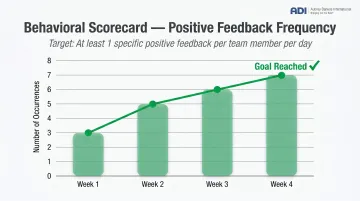
A behavioral scorecard is a simple tracking tool that records frequency and consistency of the 1–3 target behaviors over time, reviewed in coaching sessions to reinforce progress and identify patterns.
It might include:
Target behavior: Provides specific positive feedback to at least one team member daily
Weekly tracking:
- Week 1: 3 occurrences
- Week 2: 5 occurrences
- Week 3: 6 occurrences
- Week 4: 7 occurrences
The scorecard makes progress visible, which is itself reinforcing. It also surfaces patterns—maybe the leader consistently forgets on Fridays, revealing an environmental trigger to address.
The Sustainability Challenge
Behavioral change regresses when reinforcement disappears. Sustaining change requires embedding reinforcement into the leader's daily environment—not just the coaching relationship.
This is where internal coaching capability becomes critical. Organizations building this at scale can explore ADI's consulting and certification programs, which equip internal coaches and managers with behavior-based tools to maintain and expand the impact of leadership coaching.
Organizational Culture and Individual Change
Sustained individual change depends on the environment around it. If the organization consistently punishes new behaviors—a leader who starts delegating more but gets penalized when outcomes slip will revert to doing the work themselves.
Coaching must account for systemic barriers, including:
- Whether the leader's manager models the desired behaviors
- Whether performance reviews reinforce or contradict those behaviors
- Whether peers are making similar changes, or the leader is isolated in the effort
The most effective coaching interventions address environmental redesign alongside individual skill-building—because behavior that isn't reinforced by the surrounding culture won't hold.
Common Pitfalls in Leadership Behavioral Coaching
Pitfall 1 — Coaching Leaders Who Aren't Genuinely Motivated to Change
No coaching process can substitute for the leader's own commitment. Motivation to improve—not rank or external pressure—is the strongest predictor of success.
Research on coaching readiness distinguishes individual coachability from systemic readiness. Even coachable clients fail if readiness is missing: poor timing, lack of organizational support, or misalignment between the intervention and the leader's actual needs.
Leaders coerced into coaching rarely change. Leaders who recognize their behavioral patterns are holding them back—and want to do something about it—are ideal candidates.
Pitfall 2 — Focusing on Too Many Behaviors at Once
Spreading attention across five or more behavioral goals dilutes reinforcement and effort. Research on goal-setting shows that overly specific or excessive goals create systematic side effects, including:
- Narrow focus that neglects non-goal areas
- Distorted risk preferences and reduced intrinsic motivation
- Unethical behavior driven by target pressure
The most effective coaching programs focus on 1–3 behaviors with high leverage on leadership effectiveness. McKinsey recommends focusing on 2 to 3 specific competencies rather than an "alphabet soup" of dozens of leadership capabilities.
One behavior practiced consistently and reinforced thoroughly will transform a leader's effectiveness far more than ten behaviors practiced sporadically. Focused repetition builds the reinforcement history that makes change stick.
Pitfall 3 — Treating Follow-Up as Optional
Most coaching programs invest heavily in diagnosis and planning, then underinvest in follow-through. Without structured, ongoing follow-up with stakeholders, even well-designed coaching plans lose their impact within weeks.
Follow-up creates accountability, makes progress visible, and provides the social reinforcement that sustains new behaviors. Skipping it doesn't just slow results — it erases them. 72% of respondents in a recent study acknowledged a strong correlation between coaching and increased employee engagement, but only when coaching includes continuous feedback loops.
Build follow-up into the coaching design from day one — not as an afterthought, but as a core delivery mechanism.
Frequently Asked Questions
What is leadership coaching for behavioral change?
Leadership coaching for behavioral change is a structured process focused on producing observable, measurable shifts in specific leadership behaviors. Distinguished from insight-based or skills-only coaching, it emphasizes consequences, reinforcement, and stakeholder accountability to create change that is verifiable, repeatable, and sustained over time.
How is behavioral coaching different from traditional leadership coaching?
Traditional coaching often relies on reflection and insight, while behavioral coaching uses the science of behavior—specifically antecedents, consequences, and reinforcement—to create change. It targets specific, countable actions and structures the environment to reinforce them, making change verifiable and sustained rather than dependent on willpower alone.
How long does it take to see lasting behavioral change from coaching?
Research and practitioner experience suggest 12–18 months of structured coaching with regular stakeholder follow-up is needed for reliable, lasting behavioral change. Early observable shifts can occur within weeks when reinforcement is in place, but sustained change requires continuous support across multiple cycles.
What role does positive reinforcement play in leadership coaching?
Positive reinforcement—consequences that increase the likelihood a behavior is repeated—is the primary driver of sustained behavioral change. Without it, new behaviors extinguish even when leaders are well-intentioned. Reinforcement must be immediate, frequent, and individualized.
How do you measure behavioral change in leaders?
Change is measured through two lenses: self-tracked behavioral frequency (leading indicators) and structured stakeholder perception data from mini-surveys or interviews. Leading indicators confirm the behavior is occurring; stakeholder data confirms it's making a difference.
Can leadership behavioral coaching work at all levels, not just senior executives?
Yes. Behavioral change principles apply universally across organizational levels. The process scales in intensity and investment, but the core framework applies equally to frontline managers, mid-level leaders, and high-potential employees as it does to senior executives.