Traditional leadership training focuses on knowledge transfer: frameworks, competencies, mindsets. Participants leave with new ideas, but when they return to their daily environment, learning evaporates. Research shows that 62% of trainees apply learning immediately after training, but that drops to 44% at six months and just 34% at one year. The reason is simple: training programs teach concepts, not behaviors. They build awareness, not habit. Without practice, reinforcement, and environmental support, new knowledge competes with old habits — and habits almost always win.
Behavioral Modeling Training (BMT), grounded in Applied Behavior Analysis, offers a fundamentally different approach. It treats leadership development as an engineering problem: identify the specific behaviors leaders need to demonstrate, design the conditions that produce those behaviors, practice them to fluency, and reinforce them consistently in the work environment. This article explains why behavioral modeling works when conventional training fails — and exactly how to design leadership development that sticks.
Key Takeaways
- BMT changes observable on-the-job behaviors, not just awareness or knowledge
- Leaders are the most powerful behavioral models — what they do shapes what employees do, regardless of what they say
- Effective BMT combines behavior descriptions, rationale, demonstration, practice, and contrasting examples
- Modeling prompts behavior; reinforcement sustains it. Design both, or change won't stick.
- Leadership development is behavior engineering: define target behaviors, create conditions that produce them, and reinforce consistently
Why Most Leadership Training Fails to Make Change Stick
The knowing-doing gap explains most training failure. Leaders leave workshops with new frameworks but lack behavioral fluency — the practiced, automatic skill required to apply those frameworks under pressure. Knowledge acquisition is not habit formation.
When a leader faces a difficult conversation, a tight deadline, or a team conflict, instinct takes over. Without repetition and reinforcement, the new approach stays theoretical.
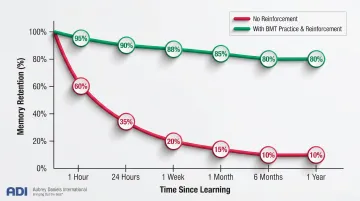
The Ebbinghaus forgetting curve illustrates why passive learning evaporates quickly. While the commonly cited figures (50% forgotten in one hour, 70% in 24 hours, 90% in one week) are approximations, the principle holds: without active retrieval, practice, and reinforcement, most content is lost within days. Research confirms that students who did not engage in repetition activities scored significantly lower on long-term retention, and medical practitioners show skills declining around two weeks post-training, with knowledge drops within one to six months.
Three deeper failures compound the forgetting problem:
- The environment goes unchanged. Training is a one-time event; the work environment is permanent. If the contingencies, feedback loops, and consequences driving daily behavior stay the same, the environment wins. Leaders return to workplaces that still reward speed over deliberate quality, and authority over collaboration. Change is expected but never engineered.
- Leader behavior doesn't shift visibly. When leaders attend training but fail to change what they actually do, employees read the signal clearly: this initiative is symbolic. Over 40 years of research identifies the top characteristics of admired leaders as Honest, Competent, Inspiring, and Forward-looking, with credibility defined behaviorally as "Do What You Say You Will Do." Research confirms that authentic leadership significantly predicts flourishing via trust in the leader. When words and actions diverge, trust erodes — and lasting change goes with it.
- Competency models replace behavioral precision. Describing what a leader should be is not the same as defining what a leader must do. Competency frameworks identify traits; behavioral science specifies actions.
Dr. Aubrey Daniels recognized early that managing performance is nearly impossible without understanding behavior. ADI's approach treats leadership development as a behavior-engineering challenge: precise definition, systematic practice, and environmental reinforcement working together.
What Is Behavioral Modeling in Leadership Training?
Behavior Modeling Training (BMT) is a structured method for changing observable job behaviors. It rests on four core elements:
- Describing specific target actions with rationale
- Demonstrating those actions through credible models
- Providing structured time for mental and physical practice
- Delivering feedback and encouragement to reinforce learning
BMT originates from Bandura's social learning theory, which explains that people acquire behaviors by observing and imitating others — especially credible models who face similar challenges. In organizational settings, leaders are the primary models employees observe. What leaders do under pressure, how they respond to mistakes, and which behaviors they reward set the unspoken standard for the entire team.
Traditional leadership training teaches competencies, mindsets, or frameworks in the abstract. BMT takes a different approach — it defines behaviors with precision and trains them directly. "Demonstrating empathy" is vague; "Ask one open-ended question before offering a solution" is behavioral. That precision enables practice, measurement, and reinforcement.
BMT is also most effective when trainees receive not just a description of what to do, but a rationale for why it works. Consider: "Listen fully before responding — it reduces defensiveness and increases the quality of information you receive." Pairing behavior with rationale helps trainees recall the right action under real-world pressure, which is where most training methods break down.
BMT is a deliberate, structured training design grounded in behavioral science — with specific elements proven to drive skill acquisition and on-the-job transfer.
The Science Behind Why Behavioral Modeling Works
A meta-analysis of 117 studies involving over 4,200 participants shows that BMT improves knowledge, skill, on-the-job behavior, and work performance. Notably, BMT has stronger effects on knowledge and skill than on behavior alone — which is why environmental conditions matter. Training builds capability; the environment sustains it.
Social learning operates continuously in organizations. Employees watch leaders navigate conflict, respond to mistakes, handle pressure, and make decisions — and these observations function as behavioral templates. What leaders do becomes the implicit standard, regardless of what the organization says it values. If a leader says "we value collaboration" but consistently makes unilateral decisions, employees learn that unilateral decision-making is what works here.
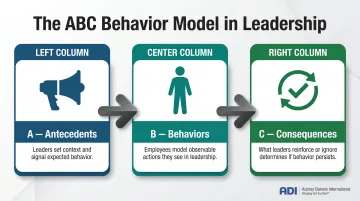
The antecedent-behavior-consequence (ABC) model explains why training alone fails. Each element plays a distinct role:
- Antecedents (leaders): Set the context and signal what behavior is expected
- Behaviors: The observable standard employees model from watching leadership in action
- Consequences: What leaders reinforce or ignore — this determines whether behavior persists
Training that targets only the behavior, without designing antecedents and consequences to support it, produces temporary results. Sustainable change requires all three elements working together.
Designing Leadership Training That Uses Behavioral Modeling Effectively
Define Specific, Observable Target Behaviors
Begin by identifying the precise behaviors leaders need to change or adopt. Avoid abstract outcomes like "improve communication." Define pinpoints — specific, observable behavioral targets: "During team meetings, paraphrase a team member's concern before responding to it." The more specific the behavior, the more effectively it can be modeled, practiced, and reinforced.
Use Rule Codes to Pair Behavior with Rationale
Understanding the "why" behind a behavior accelerates learning and improves skill transfer. Rule codes are concise action + outcome statements trainees can recall under pressure:
- "Acknowledge mistakes openly — it builds psychological safety and speeds problem-solving"
- "Deliver feedback within 24 hours — immediacy strengthens the behavior-consequence link"
- "Ask for input before deciding — it increases buy-in and surfaces better solutions"
Build in Mental and Behavioral Rehearsal
Practice is the mechanism through which knowledge becomes fluency. It is not optional. Mental practice has a positive, significant effect on performance, with an overall mean effect size of d = 0.48. Effects are larger for cognitive tasks (d = 0.69) than motor tasks (d = 0.34). Mental rehearsal — imagining the behavior in realistic scenarios — and physical role-play are distinct but complementary practice methods.
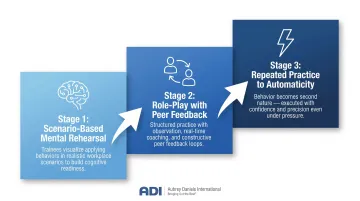
Effective practice structures include:
- Scenario-based mental rehearsal where trainees visualize applying the behavior in real workplace situations
- Role-play exercises with peer feedback
- Repeated practice until the behavior becomes automatic
Show Contrasting Examples
Showing both positive examples (correct behavior) and negative examples (what not to do) sharpens behavioral discrimination — a finding consistent across BMT research. Training with both examples and non-examples produces the highest classification accuracy. Contrast helps trainees recognize the target behavior in ambiguous real-world situations and avoid common errors.
Design for Transfer Back to the Job
The most common reason behavioral training fails is the absence of post-training support structures. Three transfer mechanisms dramatically improve on-the-job application:
- Pre-return goal-setting: Leaders commit to one or two specific behaviors to practice immediately, with visible application targeted within the first week — ideally documented with their manager before they leave training.
- Peer accountability check-ins: Pairs of leaders connect weekly to share what's working, what's hard, and what they're observing. This sustains motivation when manager reinforcement is inconsistent.
- Specific recognition systems: Reward new behaviors in context. Recognition must name the behavior and the outcome — "I noticed you paused and asked for input before deciding — that led to a better solution" — not just "good job."
ADI's Precision Leadership approach applies this full framework across an organization's leadership pipeline — built for companies that need behavioral fluency embedded into everyday practice, not just covered in a workshop.
How Leaders Can Model Behaviors That Drive Lasting Change
Close the Word-Action Gap
When leaders communicate one set of values but behave in ways that contradict them, employees trust the behavior — not the words. Behavioral research defines credibility as "Do What You Say You Will Do," and authentic leadership predicts employee flourishing through trust. Consistency between messaging and action builds that credibility. Inconsistency destroys it fast.
The First 90 Days Are the Most Critical Window
Organizational change is fragile in the early stages. Leader behavior during this window either validates or invalidates the change. Leaders who model new behaviors publicly — including admitting uncertainty and adjusting in real time — reduce employee anxiety and accelerate adoption. Silence or inconsistency signals that the change isn't serious.
What Leaders Do After Mistakes Shapes Team Culture
When leaders openly acknowledge errors, seek feedback, and course-correct without defensiveness, they create the psychological safety conditions teams need to experiment and adopt new behaviors. The opposite is equally powerful — leaders who deflect blame teach their teams that mistakes must be hidden, not learned from. The behavioral pattern at the top becomes the behavioral norm throughout.
Three specific actions reinforce this during any change initiative:
- Acknowledge errors publicly — even small ones — to normalize learning over blame-avoidance
- Seek feedback visibly, not just in private channels, to signal that input is genuinely valued
- Adjust course in real time rather than defending original plans when evidence suggests otherwise
Building a Reinforcement-Rich Environment to Sustain Change
Modeling without reinforcement produces temporary change. Behavioral science distinguishes between antecedents (what prompts behavior) and consequences (what maintains it). Modeling functions as an antecedent — it signals what to do. But only reinforcement ensures the behavior becomes a lasting habit. Most leadership training designs the antecedent and neglects the consequence.
Positive reinforcement — delivering a meaningful, immediate consequence following a desired behavior — builds discretionary effort rather than minimum-required performance. Research shows that managerial behavioral training grounded in behavioral principles improves goal setting (d = .20), performance feedback (d = .20), and employee engagement (d = .27).
Punishment-based compliance approaches produce temporary compliance but erode trust and engagement over time.
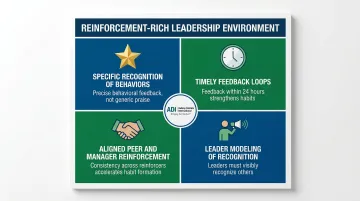
A reinforcement-rich leadership environment includes:
- Consistent recognition of specific behaviors — not generic praise, but precise feedback: "When you paused to ask for input before deciding, it surfaced a solution we wouldn't have considered."
- Timely feedback loops — Feedback delivered within 24 hours strengthens the behavior-consequence link.
- **Peer and manager reinforcement aligned to the same target behaviors** — When peers and managers reinforce the same behaviors trained in the program, consistency accelerates habit formation.
- Leadership modeling of recognition behaviors — Leaders must visibly recognize others to signal that recognition is valued and expected.
Frequently Asked Questions
What are the 4 behavioral leadership styles?
Behavioral leadership theory identifies two foundational axes: task-oriented and people-oriented behaviors, derived from the Ohio State leadership studies. Common style frameworks (democratic, coaching, authoritarian, affiliative) build on this axis. The practical takeaway: effective leaders select behaviors based on the situation, not a fixed personal style.
How to model leadership behaviors?
Identify specific, observable target behaviors; demonstrate them visibly and consistently; explain the rationale behind each behavior; create structured opportunities for practice; and follow up with reinforcement and feedback to make modeled behaviors stick on the job.
Why does leadership training so often fail to create lasting behavior change?
Training focuses on knowledge transfer rather than behavioral practice, the work environment is not redesigned to reinforce new behaviors, and leaders fail to visibly model the behaviors they expect from their teams — resulting in learned concepts that never become sustained habits.
What is the difference between behavioral modeling and behavioral leadership theory?
Behavioral leadership theory is a framework explaining that leadership effectiveness depends on learned, adaptable behaviors rather than inborn traits. Behavioral modeling training (BMT) is a specific methodology that develops those behaviors through demonstration, practice, and reinforcement.
How does positive reinforcement make behavior change stick after leadership training?
Positive reinforcement converts a trained behavior into a maintained habit. Without it, new behaviors compete with old habits — and typically lose. That's why designing reinforcement systems back on the job matters as much as the training itself.
What role do leaders play in organizational change initiatives beyond communication?
Leaders' most powerful change role is behavioral, not communicative. Employees watch what leaders do under pressure, how they respond to mistakes, and whether their actions align with stated priorities. This behavioral signal shapes cultural norms more powerfully than any announcement or strategy deck.