Introduction
Leaders invest heavily in change initiatives, training programs, and leadership development—yet most fail to produce lasting results. Multiple studies show only 26-30% of transformations succeed at both improving and sustaining performance. The missing ingredient is rarely strategy or resources. It's a deeper understanding of human behavior itself.
Without a behavioral lens, even well-designed initiatives stall because they don't account for why people actually do what they do at work.
This guide gives organizational development practitioners and business leaders an evidence-based framework for creating sustainable performance improvement. It covers core principles of behavioral science, Organizational Behavior Management (OBM) methodology, the OD process, and practical implementation steps.
Key Takeaways
- Applied behavioral science uses empirical research to design interventions that produce measurable, lasting organizational change
- OBM applies behavioral science directly to workplace performance, systems, and culture
- The 7 phases of OD practice improve measurably when grounded in behavioral principles
- Sustainable OD outcomes depend on understanding what reinforces employee behavior — process design alone won't get you there
What Is Applied Behavioral Science in Organizational Development?
Applied behavioral science (ABS) is the practical application of knowledge from psychology, sociology, and behavior analysis to understand, predict, and modify human behavior in real-world settings. Unlike pure psychology, which focuses on theory, ABS emphasizes measurable, observable behavior change in specific contexts.
Organizational development (OD), as scholar W. Warner Burke defined it, is "a planned process of change in an organization's culture through the utilization of behavioral science technologies, research, and theory." That definition puts behavioral science at the center of OD work — not as a supporting tool, but as its operating logic.
Why this matters for business leaders:
Organizations that treat performance problems as purely structural — through process redesign or policy changes — consistently miss the behavioral drivers underneath them. Two realities make this gap costly:
- When line managers and frontline employees aren't engaged, only 3% of change efforts succeed (McKinsey)
- Structural fixes don't address why people behave the way they do — or what environmental conditions will sustain different behavior long-term
ABS gives leaders the framework to answer both questions.
Core Principles of Applied Behavioral Science That Drive Organizational Development
The ABC Model: Antecedent-Behavior-Consequence
The Antecedent-Behavior-Consequence (ABC) model is the foundational framework. Antecedents set the stage for behavior—policies, training, instructions, cues. But consequences—what happens after the behavior—are the primary drivers of whether that behavior will repeat.
In organizational settings, most leaders over-invest in antecedents (memos, training, goal-setting) and under-invest in consequences. Behavioral diagnostic tools like the Performance Diagnostic Checklist help sort influences into antecedents, equipment/processes, knowledge/skills, and consequences.
Reinforcement: The Engine of Sustained Change
Positive reinforcement—providing a valued consequence following a desired behavior—is the most powerful and ethical mechanism for strengthening performance. A meta-analysis of 72 studies found behavioral management interventions improved performance by an average of 16%. Breaking that down by reinforcer type:
- Money: 23% performance improvement
- Social recognition: 17% performance improvement
- Feedback: 10% performance improvement
- All three combined: 45% performance improvement
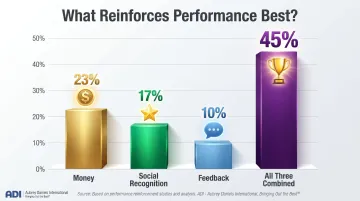
Reinforcement differs from generic reward programs: True reinforcement is immediate, specific, and contingent on the desired behavior. Most reward programs are too delayed, generic, or inconsistent to function as effective reinforcers.
Pinpointing: Translating Goals Into Observable Behaviors
Pinpointing is the practice of describing behaviors in specific, observable, and measurable terms. Vague goals like "be more collaborative" or "show initiative" cannot be reinforced or measured. Pinpointing translates organizational objectives into concrete behavioral definitions that managers can actually observe and respond to.
Discretionary Effort: Where Competitive Advantage Lives
Discretionary effort is the difference between the minimum an employee must do to keep their job and the maximum they're capable of doing. Research shows employees vary significantly in the effort they choose to contribute beyond minimum requirements. Applied behavioral science identifies the specific reinforcers and environmental conditions that shift employees from compliant to committed—and that gap is where sustainable competitive advantage is built.
Culture Change Through Behavioral Reinforcement
Organizational culture is the sum of what behaviors are actually reinforced day to day. A culture that claims to value innovation but penalizes failed experiments will reliably produce risk aversion—regardless of what the mission statement says.
Applied behavioral science provides diagnostic tools to surface which behaviors the current environment is actually reinforcing, and then redesign those contingencies to support the culture leadership intends to build.
Organizational Behavior Management: The Behavioral Science Lens for OD
What OBM Is
Organizational Behavior Management (OBM) is the subfield of behavior analysis that applies behavioral science principles specifically to improving individual and organizational performance in workplace settings. OBM practitioners work at the intersection of systems analysis and individual behavior, diagnosing problems through observation and data, not gut feeling or organizational politics.
OBM vs. I/O Psychology
While both use scientific methods to improve workplace outcomes, I/O psychology focuses on individual-level factors like selection, personality, and motivation. OBM focuses on the organizational system — the antecedents, consequences, and feedback loops that shape collective behavior — and on designing environments where desired performance is reliably produced.
| OBM | I/O Psychology | |
|---|---|---|
| Primary focus | Organizational systems & behavior | Individual traits & motivation |
| Core tools | Antecedents, consequences, feedback | Selection, assessment, personality |
| Goal | Reliable, measurable performance | Fit, satisfaction, individual output |
OBM vs. Traditional Management Consulting
Traditional consulting diagnoses problems and prescribes solutions, assuming that knowing what to do leads to doing it. OBM recognizes that telling people what to change isn't enough: behavior change requires altering the consequences and contexts in which they work.
ADI's founder, Dr. Aubrey Daniels, introduced the term "Performance Management" to describe this science-based approach to motivating people to do what the business needs them to do — addressing the gap between knowledge and action through behavioral consequence design.
When OBM Works Best
OBM is best suited to address:
- Performance improvement (individual and team)
- Leadership development
- Behavior-based safety
- Culture transformation
- Sustainability of change initiatives
Data-Based Accountability
OBM uses direct observation, behavioral measurement, and performance data to design, implement, and evaluate interventions. That accountability is concrete: outcomes are defined by the specific behaviors that changed and the business results that followed, not survey sentiment or self-report.
The 7 Phases of Organizational Development and the Role of Behavioral Science
W. Warner Burke outlined seven phases of OD practice, each of which behavioral science principles can strengthen:
- Entry
- Contracting
- Diagnosis
- Feedback
- Planning Change
- Intervention
- Evaluation
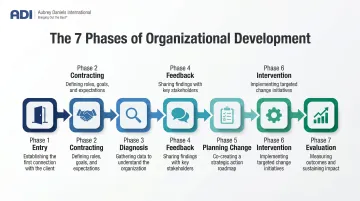
While these phases apply to all OD work, two of them offer the clearest opportunities to see behavioral science in action: Diagnosis and Evaluation.
Diagnosis: Where Behavioral Science Adds Immediate Value
Traditional OD diagnosis surfaces symptoms—low engagement, poor communication, high turnover. A behavioral science lens goes deeper, using the ABC model and data analysis to identify which antecedents and consequences in the environment produce problem behaviors. This root-cause precision prevents organizations from implementing the wrong interventions.
Evaluation: Where Behavioral Science Distinguishes Good OD from Great OD
Evaluation in behavioral OD is tied to observable, measurable behavior change over time—not just post-program satisfaction scores. Ongoing measurement and feedback loops sustain the gains made during the intervention phase and prevent regression to previous patterns.
How to Apply Applied Behavioral Science in Your Organization for Lasting Change
Step 1: Start with Behavioral Diagnosis, Not Solutions
Before designing any intervention, map the current behavioral environment using the ABC framework:
- What antecedents are in place?
- What consequences (intended and unintended) are actually driving current behavior?
A behavioral audit reveals why people do what they do—and what to change.
Step 2: Pinpoint the Behaviors That Matter
Work with leadership teams and frontline managers to translate strategic goals into specific, observable behaviors.
Example of proper pinpointing:
- ❌ Vague: "Improve customer service"
- ✅ Pinpointed: "Greet customers within 10 seconds of entering the store, make eye contact, and ask how you can help"
Step 3: Redesign the Consequence Environment
Identify which consequences currently reinforce the wrong behaviors. A common example: a culture that rewards individual performance while penalizing transparency about mistakes. From there, design consequence systems that consistently and immediately follow desired behaviors at both the team and individual level.
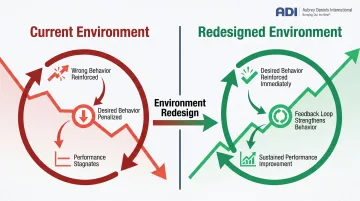
Key elements:
- Positive reinforcement schedules that strengthen desired behaviors
- Immediate feedback tied to specific actions
- Consequences aligned with strategic objectives
Step 4: Build Behavioral Fluency in Leaders
Managers are the most powerful behavior-change agents because they control the most immediate consequences for their teams. Invest in developing managers' ability to:
- Observe behavior accurately
- Deliver specific positive reinforcement
- Give behavioral feedback
ADI's consulting services and certification programs are built to develop this behavioral expertise inside your organization. Leaders leave with practical tools they can apply immediately, making performance gains sustainable rather than dependent on outside support.
Step 5: Measure, Adjust, and Sustain
Establish behavioral metrics alongside business outcomes:
- Track whether targeted behaviors occur at the desired frequency
- Monitor whether those behaviors produce anticipated results
- Treat any deviation as behavioral data: input for adjusting antecedents and consequences
- Avoid blaming employee failure; analyze the system instead
Frequently Asked Questions
What are the 7 phases of organizational development?
The seven phases are entry, contracting, diagnosis, feedback, planning change, intervention, and evaluation. Each phase uses behavioral science tools to assess readiness, gather performance data, and sustain change by identifying what drives behavior at each stage.
What is the difference between OBM and ABA?
ABA (Applied Behavior Analysis) is the broader science of applying behavior analytic principles to socially significant behavior. OBM is a specific subfield of ABA that applies those principles to improve performance and systems within organizational and workplace settings.
Which is a behavioral science contributing to OB?
Several behavioral sciences contribute to organizational behavior, including psychology, sociology, social psychology, and anthropology. Behavior analysis is the discipline most directly applied through OBM, focusing on how consequences shape and sustain observable workplace behavior.
Is organizational behavior an applied science?
Yes. Organizational behavior draws on research from behavioral and social sciences and applies that knowledge to understand, predict, and improve human behavior in organizational contexts. It uses empirical methods to solve real-world workplace problems.
What are the 5 principles of ABA?
The core principles are reinforcement (positive and negative), punishment, extinction, stimulus control (antecedents), and generalization. In organizational settings, leaders use these principles to design environments where desired behaviors become habitual, counterproductive ones fade out, and performance gains hold up over time.