Introduction
Management leadership is the single most critical factor in whether a safety program succeeds or fails. Not the policy documents, training materials, or safety posters on the wall. Whether leaders at every level own safety as a core value determines whether your program protects workers or becomes compliance theatre.
The responsibility falls across every leadership tier: business owners set the vision and allocate resources, senior managers integrate safety into operational decisions, and frontline supervisors model safe behaviors daily.
When leadership is absent or inconsistent, employees treat safety as optional. Hazards go unreported and near-miss data disappears. Programs become paperwork exercises designed to satisfy audits rather than prevent injuries.
OSHA's Recommended Practices for Safety and Health Programs establishes management leadership as the first of seven core elements. Without this foundation, no other program component functions effectively. Companies in OSHA's Voluntary Protection Program STAR level—where management commitment is non-negotiable—achieve lost workday rates 53% below national averages. That gap represents the difference between leadership that states commitment and leadership that demonstrates it.
Key Takeaways
- Management leadership is OSHA's first and most foundational element—without it, every other safety program component fails
- Responsibilities span written safety policy, measurable goals, resource allocation, defined accountability, and modeling safe behaviors
- Employee participation is mandatory, not optional—programs without worker involvement underperform and fail faster
- Positive reinforcement builds lasting safety culture; punishment-focused approaches do not
- Leading indicators—hazard reports, training completion, safety inspections—drive improvement better than lagging metrics like injury rates
Why Management Leadership Is the Foundation of Any Safety Program
OSHA's Framework Puts Leadership First
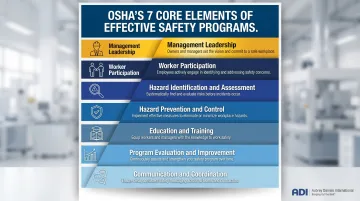
OSHA identifies seven core elements for effective safety programs: Management Leadership, Worker Participation, Hazard Identification and Assessment, Hazard Prevention and Control, Education and Training, Program Evaluation and Improvement, and Communication and Coordination. Management Leadership sits at the top because it sets the tone for all others. Without visible, sustained commitment from leadership, hazard assessments go incomplete, training becomes check-box exercises, and worker participation evaporates.
Safety as Value Versus Safety as Compliance
Organizations that treat safety as a core value integrate it into resource decisions, vendor selection, facility design, and daily operational choices. Safety appears in budget discussions alongside revenue targets. Equipment purchases include safety specifications from the start, not as afterthoughts. Performance reviews include safety metrics.
Compliance-focused organizations, by contrast, treat safety as a separate function delegated to the safety department. They implement programs to avoid citations, not to genuinely reduce risk. Research by Dekker (2025) published in Professional Safety shows this approach can mask systemic risk: organizations with exemplary injury records have experienced catastrophic events because low lagging indicators provided false security while hazards accumulated undetected.
Employees Follow Actions, Not Policies
If a supervisor skips a safety check to hit a production deadline, workers draw conclusions about what the organization truly values. When managers walk past obvious hazards without comment, employees notice. If safety meetings consistently get rescheduled but production meetings never do, the message is clear.
Research by McGonagle et al. (2016) involving 446 hospital workers found that management commitment to safety operates indirectly—through building teamwork and collaborative culture—rather than through top-down mandate alone. The direct path from stated commitment to injury reduction was statistically non-significant. What mattered was whether leadership built the infrastructure for employees to act on safety concerns together.
The Financial Case for Management-Led Safety Programs
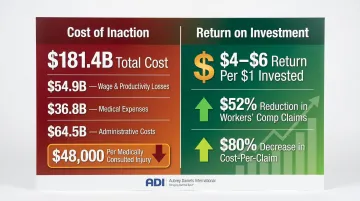
Those behavioral gaps carry a measurable price tag. Work-related injuries cost the U.S. economy $181.4 billion annually, broken down as follows:
- $54.9 billion in wage and productivity losses
- $36.8 billion in medical expenses
- $64.5 billion in administrative costs
- $1,120 average cost per worker; $48,000 per medically consulted injury
Organizations that invest in effective safety programs see the opposite trend. OSHA's Office of Regulatory Analysis estimates a return of $4 to $6 for every $1 invested. Small employers in Ohio's SHARP program saw workers' compensation claims fall 52%, cost per claim decrease 80%, and lost time per claim drop 87%.
OSHA also estimates indirect costs—lost time, replacement training, property damage—run at least 2.7 times direct costs. The numbers make the case: sustained leadership commitment to safety is one of the highest-return operational decisions an organization can make.
How to Implement Management Leadership in a Safety and Health Program
Implementation follows a logical sequence: establish commitment → communicate it → resource it → assign accountability → measure it. Each step builds on the last; organizations that skip ahead typically discover the missing foundation later, at a higher cost.
Establish a Written Safety Policy
The written safety policy is the formal declaration of management's commitment. It should be signed by top leadership, describe the organization's intent to protect worker health and safety, and be communicated to all workers, contractors, temporary staff, vendors, and visitors.
The policy must include:
- A clear statement of commitment signed by the highest-ranking executive
- Acknowledgment that safety is equal in priority to productivity, profitability, and quality
- A pledge to maintain the safety program continuously, not as a one-time initiative
- A statement that safety is a core organizational value
Communicate the policy during onboarding, post it in visible locations, reference it in meetings, and reinforce it through management actions. The policy sets expectations; leadership behavior proves whether those expectations are genuine.
Set Measurable Goals and Assign Accountability
Goals should focus on prevention activities—conducting hazard assessments, completing training, reporting near misses—rather than lagging indicators like injury counts. OSHA's leading indicators guidance warns that injury-rate goals can inadvertently suppress reporting when workers feel pressured not to "ruin" a safety streak.
Effective leading indicators include:
- Number of hazards identified and reported
- Percentage of hazards abated within specific timeframes
- Number of safety inspections completed monthly
- Percentage of workers completing required training on schedule
- Number of near-miss reports submitted
- Hours management spends on the shop floor discussing safety
Assign specific safety roles to named individuals with clear timeframes. Build safety performance into management reviews alongside financial and operational KPIs. A Campbell Institute survey of world-class organizations found that "lack of leadership commitment" was rated as the most significant barrier to implementing leading indicators—scoring 4.07 out of 5.0.
Research by Dekker (2025) found that zero-harm programs can backfire: projects with zero-harm policies showed a slight increase in fatality likelihood because incentives tied to low incident rates led to underreporting, creating a "culture of secrecy" that hides hazards.
Allocate Real Resources
How an organization allocates resources tells workers more about its safety priorities than any written policy. Dedicated staff time, training budgets, access to expertise, and protected participation time all signal whether the commitment is real. Workers notice quickly when safety investments are the first line item cut during budget pressure.
Key resource categories:
- Staff time: Allow employees time to participate in inspections, training, and safety committees without production penalties
- Budget: Fund personal protective equipment, engineering controls, training programs, and safety technology
- Expertise: Provide access to safety professionals, including OSHA's free On-site Consultation Program
- Tools: Implement tracking systems for hazards, incidents, and corrective actions
Lead by Example in Daily Operations
Managers and supervisors must follow the same safety procedures required of workers. Include safety considerations in business decisions—vendor selection, equipment purchasing, facility changes. Visibly participate in safety inspections, incident investigations, and training sessions.
The behaviors leaders model set the standard for everyone else. Specific actions that shift worker expectations include:
- Wearing required PPE without exception — every time, in every area
- Stopping work when unsafe conditions are observed, regardless of schedule pressure
- Opening every project review with a safety question before discussing timelines or costs
Moon et al. (2024) found that safety leadership training increased safety compliance from 80.38% to 95.68%—a 15.3% improvement—by modifying how leaders engaged with safety behaviors.

Using Behavioral Science to Sustain Safety Behaviors
Most safety programs overlook a core behavioral principle: antecedents (rules, policies, training) can prompt behavior, but consequences—positive reinforcement—determine whether behaviors are repeated and sustained.
Reinforcement Versus Punishment
Punishment-focused safety cultures create environments where workers avoid getting caught rather than genuinely engaging with safety. Programs that only discipline unsafe acts generate fear, suppressed reporting, and workarounds.
Reinforcement-focused cultures recognize and positively reinforce safe behaviors, building intrinsic commitment. Workers report hazards because they're recognized for it. They follow procedures because doing so earns visible acknowledgment—and they engage in safety committees because their contributions actually matter.
The research supports this approach. A review by Sulzer-Azaroff and Austin (2000) examined 33 peer-reviewed studies and found behavioral safety programs reduced injuries in 32 of them. Spigener et al. (2022), drawing on DEKRA client data, found an average 25% injury reduction in year one and 34% by year two.
Practical Applications of Positive Reinforcement
Management can apply positive reinforcement by:
- Publicly acknowledging near-miss reports during safety meetings
- Recognizing workers who identify hazards before incidents occur
- Celebrating safety milestones (days without incidents, training completion rates, hazard correction cycles)
- Treat safety participation as visible performance, not as separate "extra" work
For deeper application of these principles, Safe by Accident? by Judy Agnew (ADI's Senior Vice President) and Aubrey Daniels provides a comprehensive resource grounded in Applied Behavior Analysis.
The Role of Feedback Loops
Positive reinforcement only sticks when workers know what they did right. Managers who provide timely, specific behavioral feedback—not just annual reviews—create conditions where workers understand exactly what safe performance looks like and feel recognized for it.
Effective feedback shares four characteristics:
- Occurs immediately after the observed behavior
- Describes the specific behavior, not generic "good job" statements
- Explains the safety impact of the behavior
- Reinforces the behavior you want repeated
Generic: "Nice work on safety this week."
Specific: "I noticed you stopped the line when you saw the guard was loose. That prevented a potential hand injury. Thank you for prioritizing safety over production pressure."
Common Management Leadership Failures — and How to Fix Them
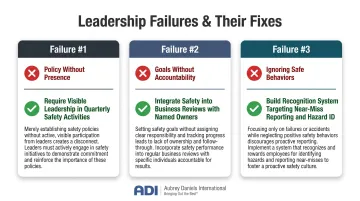
Most safety program failures trace back to gaps in management leadership—not lack of policy, but lack of consistent behavior from leaders.
Policy Without Presence
Management signs a safety policy, then disappears from safety activities entirely. This happens when leadership treats safety as a compliance function delegated to the safety team rather than an ownership responsibility.
The fix is straightforward: require senior leaders to participate visibly in at least one safety activity per quarter — an inspection, an incident review, a safety meeting. Track this participation and include it in leadership dashboards so it carries real accountability.
Goals Without Accountability
Leaders set safety goals, then never revisit them. No one owns the outcome, and missing targets carries no consequence. The root cause is almost always structural: safety metrics don't appear in management performance reviews or business planning cycles.
Fixing this requires three changes:
- Integrate safety objectives into regular business reviews alongside financial and operational KPIs
- Assign individual owners with named deadlines
- Include safety performance in compensation and promotion decisions
Rewarding Compliance, Ignoring Safe Behaviors
When management only responds to safety incidents and violations, employees learn that safe behavior goes unnoticed. Corrective action becomes the default tool — and that's a problem, because it tells people what not to do without reinforcing what they should do.
Build a simple recognition system targeting proactive safety behaviors:
- Near-miss reporting
- Hazard identification
- Training completion and application on the job
Train supervisors to deliver specific, timely positive reinforcement — not generic praise, but recognition tied to the exact behavior observed. Track recognition frequency as a leading indicator of safety culture health.
Pro Tips for Effective Safety Leadership
Integrate safety into existing operational rhythms. High-performing safety cultures treat safety goals the same way they treat production or quality goals—they have owners, timelines, regular reviews, and visible leadership interest. Embed safety into existing management routines—production meetings, project reviews, budget cycles, performance evaluations—rather than running it as a separate program that competes for attention.
Create two-way communication channels. Communicating commitment downward matters, but workers also need clear paths to report concerns upward—without fear of retaliation. Consider multiple channel types to surface issues before they become incidents:
- Anonymous reporting systems for low-barrier hazard reporting
- Safety suggestion programs that acknowledge and act on worker input
- Regular safety roundtables where leadership listens without defensiveness
Evaluate your program regularly. Evaluate annually at minimum—quarterly in high-hazard environments. Each review should cover:
- Which goals were achieved and where gaps remain
- What new hazards have emerged since the last review
- Whether leadership behaviors are being demonstrated in practice
- How workers perceive leadership commitment (employee surveys are the most reliable measure)
Adjust the program based on what the data reveals, not what you hope is happening.
Frequently Asked Questions
When implementing a safety and health program, management leadership does not need employee participation. True or false?
False. OSHA's recommended practices explicitly identify worker participation as a separate core element that works in tandem with management leadership. Programs without employee involvement consistently underperform because workers possess frontline knowledge of hazards that management doesn't see.
What is a good example of management leadership in a safety and health program?
Consider a plant manager who participates in monthly safety walkthroughs, publicly recognizes workers who report near misses, and includes safety goal progress in every operations review. That's active management leadership in practice — visible and consistent, not delegated entirely to the safety department.
When implementing a workplace safety and health program, OSHA recommends which of the following actions?
OSHA recommends a structured set of leadership actions:
- Establish a written safety policy signed by top leadership
- Set measurable goals focused on prevention, not just injury rates
- Allocate resources including staff time and budget
- Define clear roles and accountability for safety performance
- Lead by example through visible participation in safety activities
What are the benefits of implementing a safety and health program?
Benefits include reduced workplace injuries and illnesses, lower workers' compensation costs (small employers in Ohio's SHARP program saw an 80% decrease in cost per claim), improved employee morale and retention, greater productivity, and reduced regulatory liability. OSHA estimates effective programs deliver a $4 to $6 return for every $1 invested.
What resources should management allocate to a safety and health program?
Effective programs require four core resource commitments:
- Staff time: Workers participate in training and safety activities without production penalties
- Budget: Funding for PPE, engineering controls, and hazard abatement
- Expertise: Access to safety knowledge, including OSHA's free consultation services
- Tracking tools: Systems for logging hazards, incidents, and corrective actions
How does management leadership affect employee participation in safety programs?
When employees observe consistent management commitment — through resource allocation, visible participation, and positive recognition — they are significantly more likely to report hazards, engage with the program, and adopt safe behaviors as part of their daily routine. In organizations where leaders model safety visibly, employee participation rates and near-miss reporting both tend to increase measurably.