Introduction
Leaders face a persistent, costly frustration: despite massive investment in engagement surveys, recognition programs, wellness perks, and culture initiatives, only 20% of employees worldwide were engaged in 2025, costing the global economy nearly $10 trillion in lost productivity. In the US, engagement averaged 31% in 2025, unchanged from 2024—representing roughly 8 million fewer engaged employees than the 2020 peak of 36%.
What if the problem isn't the investment, but the approach?
Most engagement strategies treat disengagement as a morale problem requiring motivational fixes. That framing leads to the wrong solutions. Behavioral science is clear: sustainable employee engagement isn't a feeling to be cultivated through one-time initiatives—it's a pattern of behavior maintained by the right management conditions. This article lays out a behavioral framework that shifts focus from what employees feel to what managers do every day to shape, reinforce, and sustain discretionary effort.
Key Takeaways
- Engagement programs fail because they focus on surveys and perks (antecedents) rather than manager behaviors that deliver consequences
- Behavioral science shows engagement is maintained or lost based on whether managers reinforce engaged behaviors daily
- At least 70% of variance in team engagement traces back to managers—they control the consequence environment every employee experiences
- Five manager competencies sustain engagement: pinpointing, positive reinforcement, frequent feedback, barrier removal, and shaping progress
Why Employee Engagement Programs Don't Stick
Most organizations treat engagement as an HR function, deploying annual surveys, mission statements, recognition platforms, and workplace perks. These are antecedents—stimuli designed to prompt behavior. The problem: antecedents can initiate behavior temporarily, but only consequences determine whether a behavior is repeated.
This is the antecedent trap. Companies invest heavily in what prompts engagement (inspiring town halls, wellness programs, branded values posters) while neglecting the consequences—reinforcement, feedback, coaching—that actually sustain it. When engaged behaviors (going above and beyond, contributing ideas, taking initiative) receive no meaningful consequence from managers, those behaviors gradually disappear. This isn't a motivation problem; it's a consequence problem.
Gallup's data proves the point: despite more than two-thirds of organizations conducting annual engagement surveys, global engagement has barely budged in over a decade. The barrier to lasting improvement isn't lack of data—it's failure to change what managers do with that data. Research on survey follow-up processes confirms that the top barrier to sustaining engagement gains is failure to follow through on execution, followed by lack of executive attention and insufficient time, training, and funding.
The consequence environment matters more than the survey. When managers ignore employee effort, micromanage instead of coach, or fail to clarify expectations, they actively select for disengagement. Common failure modes include:
- Ignoring employee ideas until the behavior stops
- Micromanaging execution instead of coaching toward outcomes
- Leaving expectations vague, so effort feels pointless
Consider what happens when an employee proposes a process improvement, receives no acknowledgment, and watches the idea disappear. The behavior wasn't punished. It was extinguished through non-reinforcement. Over time, the employee learns that discretionary effort produces no meaningful outcome, so they stop offering it.
Research from Gallup shows managers account for at least 70% of the variance in employee engagement scores across business units. Based on 27 million employees and more than 2.5 million work units measured over two decades, the data is unambiguous: engagement is built or broken at the daily manager-employee interaction level, not in the boardroom or HR department.
What Sustainable Engagement Actually Looks Like Through a Behavioral Lens
Sustainable employee engagement is not a score on a survey. It's a consistent pattern of discretionary behaviors—going beyond the minimum, taking initiative, supporting colleagues, applying creativity—that employees maintain over time because doing so is reinforcing.
Discretionary Effort is the behavioral signal of genuine engagement. Every employee controls a spectrum from minimum acceptable performance (just enough to keep the job) to maximum potential (fully engaged capability). Sustainable engagement means employees voluntarily close that gap consistently because the environment makes engaged performance the most rewarding option.
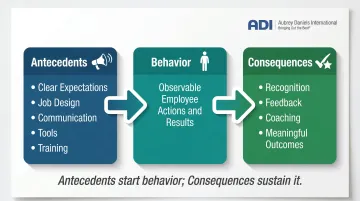
The ABC model (Antecedent → Behavior → Consequence) provides the lens managers need:
- Antecedents set the stage: clear expectations, job design, communication, tools, and training
- Behavior is what employees actually do: the observable actions that produce results
- Consequences determine whether the behavior persists: recognition, feedback, coaching, meaningful work outcomes, or lack thereof
Antecedents get behavior started; consequences keep it going. A manager who sets crystal-clear goals (strong antecedent) but never acknowledges progress (absent consequence) will watch initial performance gains fade within weeks.
The type of consequence a manager delivers also determines the type of engagement that results. Positive reinforcement-driven engagement occurs when employees engage because the work itself and the manager's response make it intrinsically and extrinsically rewarding.
Compliance-driven engagement is different: employees appear engaged to avoid negative consequences—criticism, micromanagement, being labeled "not a team player."
A 2024 study of 273 healthcare professionals found that contingent rewards have no significant direct effect on performance—they improve performance only when they first generate employee engagement. The relationship is fully mediated: rewards work through engagement, not around it. Compliance may look like engagement on a survey, but it collapses when monitoring decreases.
What managers control, then, is not engagement itself—it's the behavioral environment that determines which type of engagement they get.
The Behavioral Framework: Manager Competencies That Drive Sustainable Engagement
Sustainable engagement requires specific, observable manager behaviors—not traits or attitudes. Research funded by CIPD and conducted by Affinity Health at Work identified five manager competency dimensions comprising 54 behavioral indicators that sustain engagement without burning out employees. ADI's 45+ years of consulting across diverse industries aligns with this finding: manager behavior is the primary lever.
Competency 1: Behavioral Pinpointing—Setting Clear Expectations
Engagement cannot be sustained without behavioral clarity. Managers must define expectations in pinpointed terms: specific, observable, and measurable behaviors—not vague directives.
Contrast these examples:
- Not pinpointed: "Be more proactive"
- Pinpointed: "Flag potential project risks to the team lead by end of day on Friday"
Unclear expectations are antecedent failures that block engagement before it can begin. Employees don't know what success looks like, so they can't deliberately produce it. Managers can't reinforce behavior they haven't defined.
Locke and Latham's 35-year meta-analysis across 100+ tasks and 40,000+ participants confirms that specific, difficult goals outperform "do your best" exhortations with effect sizes of d = .42 to .80. One applied example: unionized truck drivers given specific loading goals increased efficiency from 60% to 90% of legal allowable weight, saving the company $250,000 in nine months.
Competency 2: Delivering Positive Reinforcement Consistently
Positive reinforcement is the most reliable tool managers have for sustaining engaged behavior. To be effective, reinforcement must be:
- Immediate: Delivered close to the behavior, not weeks later
- Certain: Predictable and consistent, not random
- Meaningful: Individualized to what matters to the specific employee
Generic praise doesn't count. "Good job" delivered in passing has minimal impact. Effective reinforcement is specific: "Your analysis identified the cost driver we missed—that insight just saved us three weeks of rework."
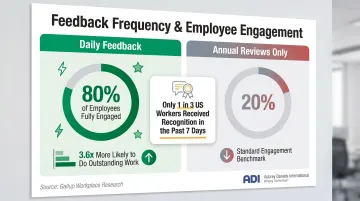
Only 1 in 3 US workers strongly agree they received recognition or praise for doing good work in the past seven days. Employees who do not feel adequately recognized are twice as likely to say they will quit within the next year. The most meaningful recognition comes from the immediate manager (28%), high-level leaders (24%), and the manager's manager (12%).
What reinforces one employee may not reinforce another. Public recognition motivates some; others find it uncomfortable and prefer private acknowledgment. Managers who apply one-size-fits-all recognition programs consistently underdeliver.
Competency 3: Providing Frequent, Behavior-Focused Feedback
Feedback functions as both an antecedent (showing employees what to do next) and a consequence (signaling whether current behavior is on track). Whether feedback changes behavior depends on three factors: specificity, timeliness, and observability.
Effective feedback:
- Tied to specific, observable actions
- Delivered within days, not months
- Focused on what the employee did, not who they are
Ineffective feedback:
- Annual reviews with vague ratings
- Generic comments disconnected from specific behaviors
- Delayed so long the employee can't remember the context
Gallup research shows 80% of employees who received meaningful feedback in the past week are fully engaged. Employees are 3.6 times more likely to do outstanding work when they receive daily feedback versus annual reviews alone.
Frequent feedback also creates the foundation for Competency 4: when employees trust that their manager will respond constructively, they're more willing to raise obstacles and risks early.
Competency 4: Removing Barriers and Building Psychological Safety
Negative reinforcement and punishment in the work environment—unclear processes, bureaucratic obstacles, inconsistent management responses—suppress engagement behaviors. Employees who face barriers when they take initiative or speak up learn to stop taking initiative and speaking up.
Effective managers actively identify and remove environmental barriers:
- Eliminating unnecessary approval steps that slow decision-making
- Clarifying who owns what when roles overlap
- Addressing interpersonal conflicts that create avoidance behavior
- Ensuring employees have the tools and information they need
Harvard's Amy Edmondson defines psychological safety as "a shared belief that it's OK to take risks, express ideas and concerns, speak up with questions, and admit mistakes—all without fear of negative consequences." Without it, employees operate in survival mode (amygdala-driven fight-or-flight), which shuts down the prefrontal cortex responsible for analytical thinking and innovation.
Google's Project Aristotle identified psychological safety as the top factor distinguishing high-performing teams. That doesn't mean avoiding hard conversations—it means creating conditions where tough feedback and difficult discussions don't trigger defensive reactions, withdrawal, or retaliation.
Competency 5: Recognizing Progress and Shaping Improvement
Shaping is the behavioral principle of reinforcing successive approximations toward ideal performance. Sustainable engagement is built incrementally, not by waiting for perfection.
Managers who only recognize exceptional outcomes miss the majority of engagement-building opportunities. An employee who has historically turned in reports late but now submits one on time deserves immediate recognition—even if the report isn't perfect yet. Reinforcing the on-time behavior increases the likelihood it will be repeated, creating a foundation to then shape quality improvements.
Practical example: A new team member struggles with client presentations. Instead of waiting until they deliver a flawless presentation, the manager reinforces progress:
- First week: acknowledges the employee's preparation and clear opening statement
- Second week: reinforces improved slide clarity and eye contact
- Third week: recognizes effective handling of a tough client question
Meta-analysis of Organizational Behavior Modification found an average 17% improvement in task performance (d = .51) across 19 organizational studies. In service settings, social recognition combined with feedback (d = .53) outperformed money alone (d = .42).
Turning the Framework Into Daily Manager Actions
The critical gap isn't between knowing engagement competencies and understanding their importance—it's between understanding them and consistently executing them. Research shows managers grasp that recognition, feedback, and clarity matter. But under time pressure and competing priorities, these behaviors are the first to disappear.
Sustainable engagement requires manager behaviors that are habitual and measured—built into the system, not left to good intentions.
Implementation looks like this:
- Set defined behavioral goals for their own engagement-building practices
- Deliver at least three specific, individualized reinforcement interactions per week per direct report
- Conduct a behavior-focused check-in conversation weekly with each team member
- Identify and remove one barrier flagged by the team each month
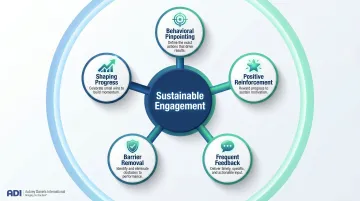
Executing these behaviors consistently requires more than training. ADI's Performance Management technology and Precision Leadership approach give organizations a science-based structure for building and sustaining these manager behaviors at scale—creating accountability, measurement, and reinforcement for the manager's own behavior, not just the team's.
Measuring manager engagement behaviors as the leading indicator of sustainable engagement outcomes is essential. Organizations that track only lagging indicators—survey scores, turnover rates, productivity metrics—discover disengagement too late to prevent the performance cost.
Research from Gallup and Workhuman shows employees who receive both feedback and recognition from their manager at least once a week have an engagement rate of 61%, compared to 38% for those receiving weekly feedback but less frequent recognition.
That measurement gap points to a deeper structural problem—not a motivational one. Gallup finds companies fail to choose the candidate with the right management talent 82% of the time. Only 1 in 10 people possess high-level management talent; another 2 in 10 exhibit basic talent that can be developed with coaching. Most managers, in other words, need structured systems far more than they need another training session.
Frequently Asked Questions
What are the 10 C's of employee engagement?
The 10 C's is a management framework developed by Gerard H. Seijts and Dan Crim encompassing Connect, Career, Clarity, Convey, Congratulate, Contribute, Control, Collaborate, Credibility, and Confidence. Each represents a dimension of the employee experience that managers must actively address to sustain engagement.
What is sustainable employee engagement?
Sustainable engagement means employees consistently demonstrate above-minimum effort over time because their environment reliably reinforces that behavior. Unlike temporary satisfaction spikes from one-time initiatives, it persists because the conditions managers create make engagement the rational, rewarding choice.
Why do most employee engagement programs fail to produce lasting results?
Most programs rely on antecedents—surveys, perks, mission statements—that prompt behavior temporarily but ignore the consequences that sustain it. Without reinforcement, feedback, and coaching built into daily manager behavior, gains extinguish within weeks as employees learn that going beyond the minimum produces no meaningful outcome.
How much impact does a manager's behavior have on team engagement?
Gallup's research across 27 million employees found that managers account for at least 70% of the variance in employee engagement scores across business units. This is because managers control the immediate consequence environment employees experience every day—the recognition, feedback, clarity, and support that make engagement sustainable or unsustainable.
What is Discretionary Effort, and how does it relate to engagement?
Discretionary Effort is the behavioral gap between the minimum an employee must do to keep their job and the maximum they are capable of contributing. Sustainably engaged employees voluntarily close this gap because the environment—shaped by manager behavior—reinforces going beyond the minimum with meaningful consequences.
How can behavioral science help organizations build a more engaged workforce?
Applied Behavior Analysis gives managers a scientific framework for identifying the antecedents and consequences that drive engaged behavior. It enables organizations to design environments where engagement is the reinforced, rational choice—replacing intuition-based management with practices that produce consistent, measurable outcomes.