Introduction
Many leaders face a familiar frustration: they announce a new set of values, post them on the wall, and expect culture to follow. Months or years later, little has actually changed. Employees still operate the same way, performance remains flat, and the gap between stated culture and daily reality feels wider than ever.
Culture change stalls because most organizations treat it as a communication problem. What leaders do consistently, reward visibly, and tolerate silently shapes culture far more than any mission statement. According to a 2025 Harvard Business Review study, when senior leaders model the behavior they want to see, transformation is 5.3 times more likely to succeed.
This article covers the four things leaders need to understand to make culture change stick:
- Why leadership behavior — not messaging — is the real driver of culture
- What behavioral science reveals about how culture actually forms
- Which specific leadership actions accelerate transformation
- How to sustain change well beyond the initial announcement
Key Takeaways
- Culture is the sum of repeated behaviors—leaders shape those behaviors through what they reinforce, ignore, and model every day
- Declaring a new culture is not enough; leaders must change the behavioral environment so new behaviors are consistently rewarded
- Culture change most often fails because leaders keep reinforcing old behaviors while announcing new ones
- Sustainable change requires leaders to focus on observable, measurable behaviors—not just attitudes or values
- Lasting change takes systems of positive reinforcement built into daily work—not mandates from the top
Why Organizational Culture Change Starts (and Stalls) with Leadership
Organizational culture is not the values poster in the lobby. It's the shared patterns of behavior that have developed because those behaviors have been reinforced over time—through promotions, recognition, resources, and leadership attention. This behavioral definition stands apart from the abstract, values-centric definitions common in most leadership frameworks.
Leaders hold disproportionate power over culture because their actions set the behavioral standard. When a leader responds to failure with blame, employees learn to hide mistakes. When a leader rewards speed over quality, quality suffers. Culture follows what leadership pays attention to and reinforces—not what it espouses.
Most culture change failures trace back to a single problem: the culture gap—the distance between the stated culture (what leaders say the organization values) and the actual culture (what behaviors get rewarded and repeated). Gallup's 2024 research found that only 20% of U.S. employees strongly agree they feel connected to their organization's culture. Those who do feel connected are 4.3 times more likely to be engaged at work.
That gap persists because leaders focus on changing mindsets or attitudes—internal states that are hard to observe—rather than changing the behavioral conditions that actually drive how people act. The root causes are consistent:
- Incentives stay the same: Old behaviors remain the path of least resistance
- Feedback is absent or delayed: Employees don't know what "right" looks like in practice
- Reinforcement is inconsistent: Desired behaviors go unrecognized while the old ones still get rewarded
Without changing what gets rewarded, the old culture persists regardless of new messaging or stated values. Less than one-third of organizational transformations succeed, according to a 2021 McKinsey survey of over 1,000 participants.
If leaders want a different culture, they have to behave differently first—and build an environment where desired behaviors are consistently prompted, practiced, and reinforced at every level. Culture doesn't change through announcements. It changes through what leaders do next.
The Behavioral Science of Culture: What Leaders Reinforce, They Create
Behavior is a function of its consequences. People repeat behaviors that are reinforced and stop behaviors that produce no consequence or negative outcomes. This isn't a management theory—it's grounded in decades of research in Applied Behavior Analysis, a field formalized in 1968 by Baer, Wolf, and Risley and built on B.F. Skinner's foundational work on operant conditioning from 1938.
The Power of Positive Reinforcement
Positive reinforcement is the most powerful tool leaders have for culture change. When leaders consistently and specifically recognize the behaviors that reflect the desired culture—not just outcomes, but the actual behaviors—those behaviors become more frequent and eventually become the norm. This contrasts with cultures that rely on correction, threat, or compliance to drive behavior.
Dr. Aubrey Daniels, founder of Aubrey Daniels International (ADI), pioneered the application of this science to organizational performance through his ABC Model:
- Antecedent (A): Events that prompt behavior (instructions, goals, policies)
- Behavior (B): Observable, measurable actions
- Consequence (C): Events after the behavior that determine whether it will recur
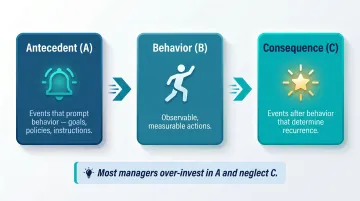
Most managers spend too much time on Antecedents—setting goals and giving instructions—and neglect Consequences. This is the primary mechanism by which organizations fail to sustain culture change.
Unintentional Reinforcement Undermines Change
Leaders often reinforce the behaviors they are trying to eliminate. Three patterns show up repeatedly:
- Praising employees who escalate every decision trains dependency — and kills the autonomy leaders say they want.
- Celebrating long hours, even when inefficiency is the real driver, signals that effort matters more than results.
- Letting meetings get derailed by interruptions without consequence reinforces exactly the disrespect for others' time that erodes culture.
Gallup research from 2024 found that only one in three U.S. workers strongly agree they received recognition or praise for doing good work in the past seven days. This means the vast majority of desired behavior goes unreinforced—creating conditions where undesired but attention-getting behavior persists simply because it produces a consequence.
Structuring the Environment for Change
Through this behavioral science lens, "leading by example" means more than leaders demonstrating desired behaviors themselves. It means structuring the environment—through feedback, recognition, consequences, and systems—so that desired behaviors are supported and undesired behaviors are not reinforced at any level of the organization.
ADI's science-based Performance Management methodology gives leaders a concrete framework for identifying which behaviors need to change, measuring current behavior patterns, and designing reinforcement strategies that produce results you can track. Culture change becomes something you engineer — not something you announce.
Key Leadership Behaviors That Drive Cultural Transformation
Culture is changed through leadership behavior, not leadership announcements. The following framework focuses on specific, observable actions leaders must consistently perform.
Modeling the Target Behaviors
Visible, consistent behavior from leaders is what signals the desired culture — not memos or town halls. The key is deliberate focus: which specific behaviors reflect the culture you're building, and are you performing them often enough for employees to recognize the pattern? Inconsistency erodes cultural credibility faster than almost anything else.
When a leader says they value transparency but holds closed-door meetings and shares information selectively, employees learn that transparency is rhetoric, not reality.
Giving Specific, Timely Positive Reinforcement
Recognition matters for culture change—but not generic praise. Behavior-specific feedback tells people exactly what they did and why it matters to the organization's direction.
Generic: "Great job on that project."
Specific: "The way you asked for input from operations before finalizing the plan reflects exactly the collaborative culture we're building. It prevented rework and built buy-in."
Specificity accelerates culture change because it teaches employees which behaviors to repeat. Research from Gallup and Workhuman found that when weekly feedback is paired with recognition, engagement reaches 61%. Without frequent recognition, engagement drops to 38%.
Holding Consistent Accountability
Accountability in culture change is about reinforcing the right behaviors and addressing behaviors that undermine the direction — promptly and consistently. When some people are excused from cultural expectations, employees read that as confirmation the new culture is optional.
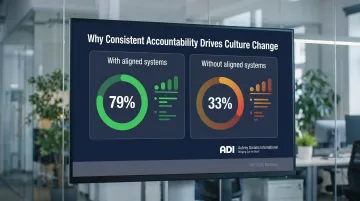
Cultural standards must apply across all levels, including to senior leaders themselves. When organizations align systems — performance management, promotion criteria, and resource allocation — with the desired culture, success rates can reach 79%.
Communicating the "Why" Behind Behavioral Expectations
Connecting behavioral expectations to business outcomes is what separates instructions from purpose. Employees adopt new behaviors faster when they understand not just what's expected, but why it matters to the organization.
Unlike communicating values broadly, this means tying observable behavioral norms to real business results — innovation rates, safety records, customer experience scores, or speed to market. That specificity gives employees a reason to change, not just a directive to follow.
Creating Psychological Safety for Behavior Change
Behavior change requires a safe environment. Employees will not try new behaviors—especially those involving risk, transparency, or challenge—if they fear punishment for mistakes.
Leaders create psychological safety by:
- Responding to honest mistakes with curiosity and learning, not blame
- Inviting dissent and rewarding it when it's constructive
- Rewarding initiative even when it doesn't succeed
Google's Project Aristotle, which studied 180 teams, found that psychological safety was the most important of five key dynamics predicting team effectiveness.
Dr. Amy Edmondson's The Fearless Organization (cited over 4,700 times) identifies three specific leader behaviors that build this safety:
- Frame the work as a learning problem, not an execution mandate
- Acknowledge your own fallibility openly
- Model curiosity by asking questions rather than issuing verdicts
Common Mistakes Leaders Make When Trying to Change Culture
Focusing on Values Instead of Behaviors
Leaders often launch culture initiatives built around abstract values like "integrity," "innovation," or "collaboration" without defining what those values look like in observable, daily behavior. Without behavioral specificity, employees don't know what is actually expected, and leaders can't recognize or reinforce progress.
Patrick Lencioni's 2002 Harvard Business Review article opened with Enron's values: "Communication. Respect. Integrity. Excellence." His point: 55% of Fortune 100 companies claimed "integrity" as a core value, rendering it undifferentiating and behaviorally meaningless. "Empty values statements create cynical and dispirited employees, alienate customers, and undermine managerial credibility."
Treating Culture Change as a One-Time Event
Culture is reinforced daily through thousands of small interactions — not a single launch event. Off-sites, all-hands announcements, and new vision statements don't stick because they change the message without changing the behavioral environment. Leaders who announce and move on find the old culture reasserting itself within weeks.
Underestimating Middle Management
Middle managers are where culture change either takes hold or quietly dies. They translate leadership intent into daily behavioral norms — and if they aren't aligned, equipped, and reinforced for the right behaviors, culture change stops at the executive level and never reaches the frontline.
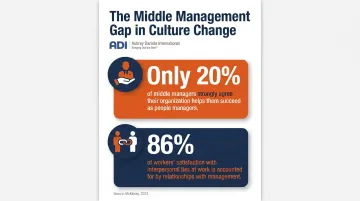
A 2023 McKinsey survey of nearly 1,000 participants found that only 20% of middle managers strongly agree their organizations help them be successful people managers. Previous McKinsey research found that relationships with management account for 86% of workers' satisfaction with interpersonal ties at work.
Sustaining Cultural Change: Embedding New Behaviors Over Time
Culture change is sustained not by maintaining a sense of urgency, but by embedding new behaviors into the systems, processes, and daily routines of the organization. That means rethinking how performance is measured, how decisions get made, how meetings are run, and how leaders respond to both success and failure.
Making Culture Change Measurable
Tracking behavioral indicators—not just attitudes or engagement scores—determines whether the desired culture is actually taking hold. Behavioral indicators include:
- Frequency of specific target behaviors (e.g., how often leaders give behavior-specific recognition)
- Consistency of recognition and accountability practices across teams
- Observed changes in daily interaction patterns (e.g., speaking up in meetings, cross-functional collaboration)
Gallup's Global Indicator for Organizational Culture measures whether employees "strongly agree they feel connected to their organization's culture"—currently at 20% in the U.S. This metric links directly to measurable business outcomes including 62% reduction in burnout and 47% improvement in retention.
ADI's consulting and behavioral assessment tools help organizations build the internal capability to measure and sustain culture change long-term, using behavioral data rather than lagging sentiment scores.
Developing Behavioral Leaders at Every Level
Measurement alone doesn't sustain culture — people do. Sustainable culture change requires leaders throughout the organization, not just at the top, to understand and practice the behaviors that reinforce the desired culture. That means investing in leadership development grounded in behavioral science, not just general management skills.
Organizations that build internal expertise in behavior-based leadership create a self-reinforcing culture that outlasts any individual leader. When managers at every level know how to identify, measure, and reinforce key behaviors, the results speak for themselves:
- Culture becomes embedded in daily work — not a program requiring constant executive sponsorship
- New leaders inherit functional systems rather than abstract values statements
- Behavioral norms persist through turnover, restructuring, and organizational growth
Frequently Asked Questions
What is the relationship between leadership and organizational culture?
Leaders shape culture primarily through the behaviors they model, reinforce, and tolerate. Culture is the accumulation of behavioral patterns that have been rewarded or allowed to persist over time, making leadership behavior the single most powerful driver of cultural norms.
Why do most organizational culture change efforts fail?
Most efforts fail because they focus on changing values or attitudes (which are internal and hard to observe) rather than changing the behavioral environment—specifically, what behaviors leaders consistently reinforce, recognize, and hold accountable across the organization.
What behaviors do leaders need to model to change organizational culture?
Leaders must consistently demonstrate the target culture in their own actions, give specific positive reinforcement to employees who exhibit desired behaviors, apply accountability consistently, and create psychological safety for behavior change.
How long does it take for leadership to change an organizational culture?
Meaningful shifts in behavioral norms typically require sustained leadership attention over 12 to 24+ months, depending on organization size and the depth of change needed. Progress accelerates when leaders apply systematic reinforcement strategies rather than one-off initiatives.
What is the first step a leader should take to change organizational culture?
Start by identifying the specific observable behaviors that define both the current culture and the desired culture. Then assess which behaviors existing systems, leadership responses, and organizational routines are actually reinforcing — so the gap can be addressed at the behavioral level.
How can leaders measure whether culture change is actually happening?
Effective measurement goes beyond engagement surveys. Track behavioral indicators — frequency of target behaviors, consistency of recognition and accountability practices, and observable shifts in daily interaction patterns — to get actionable data rather than lagging sentiment scores.
Ready to make culture change measurable in your organization? Aubrey Daniels International has helped 400+ organizations globally accelerate business performance through positive, practical approaches grounded in over 45 years of applied behavioral science. Contact ADI at 1-678-904-6140 or info@aubreydaniels.com to learn how our Performance Management methodology and Precision Leadership technology can make culture change measurable and sustainable in your organization.