Introduction
Safety leaders face a frustrating paradox: by the time a workplace injury shows up in their data, the unsafe behavior that caused it has likely occurred dozens or hundreds of times undetected. Traditional safety metrics—injury rates, lost-time incidents, recordable cases—are lagging indicators that measure failure after it happens. They tell you what went wrong, but they don't prevent the next incident.
Instead of waiting for accidents to reveal weaknesses, measuring the behaviors that prevent incidents lets organizations intervene before injuries occur. This shift — from reactive incident tracking to proactive behavioral observation — moves the point of control upstream, where it can actually make a difference.
This article explains what a safety behavior assessment is, why it's critical for workplace safety, and how to develop, validate, and implement one effectively in your organization.
Key Takeaways
- Safety behavior assessments measure whether employees perform specific, observable safe behaviors—before accidents happen
- Effective tools focus on behaviors employees control, not outcomes or attitudes
- Development follows a proven process: identify critical behaviors, build the tool, validate it, and refine continuously
- Validation ensures your assessment predicts real safety performance, not just theory
- Paired with positive reinforcement, assessments surface gaps and strengthen safety culture over time
What Is a Safety Behavior Assessment?
A safety behavior assessment is a systematic, structured method for observing and recording whether employees perform specific, observable behaviors associated with safe task completion. Unlike lagging indicators such as injury counts or incident rates, behavioral assessments capture what people are actually doing in the moment—before those actions lead to harm.
These assessments are used across high-hazard industries—manufacturing, construction, utilities, healthcare, and transportation—where human behavior directly influences risk. They're equally valuable in lower-risk environments, providing objective data on how safety practices are actually being executed on the floor rather than how they're assumed to be.
Types of Safety Behavior Assessments:
- Observation-based checklists – Structured forms used by supervisors or peers to record safe or at-risk behaviors during live task performance
- Self-report surveys – Validated questionnaires where employees evaluate their own safety habits and identify practice gaps
- Performance monitoring tools – Ongoing tracking of behavioral indicators tied to specific tasks, roles, or operational conditions
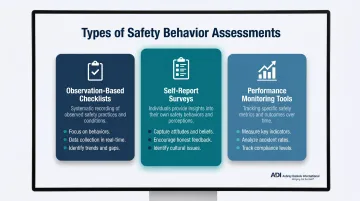
The most rigorous programs layer behavioral observation with validated survey instruments—giving safety leaders both real-time data and employee-reported context to target interventions more precisely.
Professional Safety journal defines behavior-based safety as "the process of observing a worker's safe or at-risk behaviors," noting that observations provide "direct, measurable information on employees' safe work practices." The UK Health and Safety Executive similarly emphasizes that effective behavioral safety programs involve "the definition of safe/unsafe behaviours, observations of behaviours and feedback/reinforcement of behaviours."
Why Safety Behavior Assessments Are Critical for Workplace Safety
The core problem with relying solely on lagging indicators is timing: by the time an injury appears in your data, the unsafe behavior that caused it has already occurred repeatedly. While specific percentages attributing workplace incidents to unsafe behaviors have been questioned by researchers, the HSE acknowledges that "a significant number of accidents reportedly caused by inappropriate behaviour."
The issue isn't whether behavior matters—it's that traditional metrics only capture the consequences, not the behaviors themselves.
Safety behavior assessments shift safety management from reactive to proactive. Regular behavioral data reveals at-risk patterns before they escalate, supports targeted coaching, and enables leaders to reinforce safe behaviors in real time rather than responding only after someone gets hurt.
Key operational benefits organizations see from rigorous safety behavior assessments:
- Identifies high-risk behavior patterns before incidents occur
- Gives supervisors objective coaching data instead of post-incident blame
- Improves employee engagement through feedback that's specific, timely, and behavior-focused
- Establishes a measurable baseline for tracking real safety culture progress
- Closes the gap between safety programs and what actually happens on the floor
A 2022 study of 88 international sites implementing behavior-based safety found an average 25% reduction in injuries in year one, 34% by year two, and 42% by year three. After six years, organizations showed a full standard deviation improvement in overall safety culture survey scores.
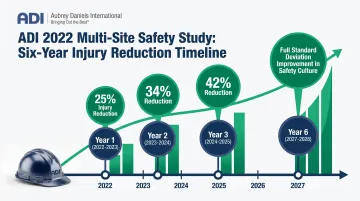
Those results reflect exactly what OSHA defines leading indicators as: "proactive and preventive measures that can shed light about the effectiveness of safety and health activities." Safety behavior assessments deliver that proactive data — giving EHS leaders the evidence they need to intervene, coach, and correct course before the next injury happens.
How to Develop a Safety Behavior Assessment — Step by Step
Developing an effective safety behavior assessment requires a systematic process. The most common failure points are vague behavior definitions, skipping the validation stage, and building tools that sit unused. This section walks through each step with specific guidance on avoiding these pitfalls.
Step 1 – Identify and Define Target Behaviors
Effective assessments start by identifying the specific, observable behaviors most closely linked to incident risk in a given job role or work area. Source these from incident investigations, near-miss reports, job hazard analyses, and input from subject matter experts who know the work intimately.
Behavioral specificity is what separates a checklist that drives change from one that collects dust. "Wears PPE correctly" is too vague to assess. "Positions hard hat brim forward with chin strap fastened before entering overhead work zone" is observable, measurable, and actionable.
Research on behavior-based safety development found that "involving employees in the development of an intervention tool and protocol had prominent beneficial effects on actual implementation." Engage frontline workers in defining what safe performance actually looks like for their tasks—they often identify critical details supervisors miss.
Step 2 – Build the Assessment Instrument
Design decisions matter. You'll need to choose:
- Rating format: Binary yes/no vs. frequency scale (always/sometimes/never)
- Number of items: Comprehensive enough to be meaningful, short enough to complete in the field (typically 10-20 items)
- Scope: Role-specific versions vs. universal tool
Trade-offs to consider: Role-specific tools are more precise but require more development and maintenance effort. Universal tools are simpler to manage but may miss critical role-specific behaviors. Frequency scales provide richer data but take longer to complete than binary checklists.
Items should focus exclusively on behaviors the employee controls, not environmental conditions or outcomes. This keeps assessments fair, actionable, and legally defensible. "Operator inspects guardrails before use" is controllable; "guardrails are in good condition" is not.
Step 3 – Pilot and Test for Reliability
If two observers watch the same behavior and score it differently, your tool has a reliability problem — and your data will mislead every decision downstream. Inter-rater reliability testing catches this before rollout: have two trained observers independently score the same work sessions, then compare results.
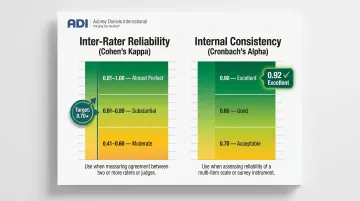
Studies on observational assessment methods use Cohen's kappa to measure agreement. Values of 0.41-0.60 represent moderate agreement; 0.61-0.80 is substantial; 0.81-1.00 is almost perfect. Target kappa values above 0.70 for workplace safety tools.
For survey-type tools, check internal consistency: items measuring the same behavioral domain should correlate with one another. Recent validation research achieved Cronbach's alpha of 0.92 for a 22-item safety behavior scale—values above 0.70 are acceptable, above 0.80 are good, above 0.90 are excellent. When items don't hang together, revise wording, retest, or remove inconsistent items.
Step 4 – Validate Against Real Safety Outcomes
Two validity checks matter most here. First, scores should be higher for workers and teams with better safety records, and lower where incidents cluster — this is convergent validity. If that pattern doesn't hold, you're measuring the wrong behaviors.
Second, and more valuable, is predictive validity: baseline scores should forecast future incident rates.
Research confirms that "workplace inspection scores are significantly predictive of lost-time injury rates." A study of over 27,000 mines found that prior-year near misses significantly predicted the probability of a mine experiencing a fatality the following year, supporting the predictive value of leading behavioral indicators.
Test your tool against known outcomes before rolling it out organization-wide. If scores don't correlate with actual safety performance, revisit your behavior definitions.
Step 5 – Implement, Monitor, and Refine
Once your tool clears validation, deployment is the beginning — not the finish line. Assessment tools should never be static.
As job tasks evolve, new hazards emerge, or data shows certain items aren't discriminating between safe and at-risk performance, update the tool. Build in a scheduled annual review process.
Assessments used repeatedly over time provide the trend data organizations need to identify whether coaching interventions, training changes, or reinforcement strategies are actually moving behavioral performance. This measurement-based monitoring is what transforms assessments from compliance paperwork into strategic improvement tools.
How to Validate and Refine Your Safety Behavior Assessment — Best Practices
Best Practice 1 — Anchor Assessments in Applied Behavioral Science
The most durable safety behavior assessments are designed using the ABC (Antecedent-Behavior-Consequence) model. Ensure the behaviors you assess have clear antecedents that prompt them, and that the assessment process itself is paired with meaningful positive consequences for safe performance—not just corrective feedback for gaps.
Behavioral safety research emphasizes that "antecedents and related negative reinforcement contingencies (e.g., rules, regulations) will help hold people accountable and get certain behaviors to occur, but leaders are responsible for utilizing positive consequences so that good things happen when people are safe."
The ABC model identifies what triggers behaviors and what reinforces them — so you can design environments where safe behavior becomes the natural choice.
Best Practice 2 — Use Multiple Data Sources
No single instrument captures the full picture. Combine observational checklists with periodic employee self-report surveys to cross-validate findings and surface discrepancies between observed behavior and workers' own perceptions of their safety habits.
When observation data shows 90% PPE compliance but self-reports show only 70%, that gap reveals either observer bias or employee misperception — both worth investigating.
Best Practice 3 — Build in Leadership Involvement
Assessments conducted only by frontline supervisors on hourly employees create a top-down compliance dynamic that undermines trust. Research on peer-to-peer observation programs found that "having a limited number of 'dedicated observers' is more effective than processes that encourage all employees to participate," with optimal participation at 4-8% of workforce.
Design your process so employees at all levels participate as observers. When leadership is involved supportively—not directively—it signals that safety observation is about organizational learning, not individual surveillance.
Best Practice 4 — Separate Assessment from Discipline
One of the most common reasons behavior-based safety programs fail is that employees treat observations as surveillance rather than support. Multi-site focus group research found that "Trust" was the #1 person-based key ingredient for success (cited by 14 groups), while "Lack of Trust" was the #1 obstacle (cited by 7 groups).
Design your program so assessment data identifies systemic behavioral patterns and drives coaching conversations — not individual wrongdoers.
When workers fear punishment, observation accuracy plummets and the data becomes worthless.
Best Practice 5 — Close the Loop with Reinforcement
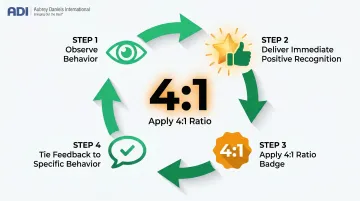
Assessment data is only valuable if it informs timely and specific positive feedback when safe behaviors are observed. Behavioral research consistently shows that "positive reinforcement is the optimal choice for sustained behavior change." Without reinforcement, even the most carefully validated tool won't drive lasting change.
Build structured feedback loops into your assessment process by following these guidelines:
- Observers provide immediate positive recognition when safe behaviors are performed
- Apply the 4:1 ratio — four positive comments for every corrective one
- Tie feedback to specific observed behaviors, not general praise
- Deliver recognition close in time to the behavior for maximum impact
How ADI Can Help
Aubrey Daniels International (ADI) has spent over 45 years applying Applied Behavior Analysis to organizational performance. Safety leaders across manufacturing, mining, utilities, and other high-hazard industries rely on ADI to design, validate, and implement behavior-based assessment tools grounded in the same science that drives measurable improvement.
ADI's services cover the full implementation cycle:
- Custom assessment design — building observation tools aligned to specific roles and hazard profiles
- Internal capability training — developing coaching and observation skills in supervisors and safety teams
- Reinforcement strategy design — ensuring assessment data drives behavioral change, not just more paperwork
Judy Agnew's co-authored resource Safe by Accident? demonstrates ADI's expertise in behavioral workplace safety, showing how leadership practices build sustainable safety culture through systematic application of behavioral principles.
To explore how a validated safety behavior assessment framework can be integrated into existing safety culture work, contact ADI at 1-678-904-6140 or info@aubreydaniels.com.
Frequently Asked Questions
What are the 7 steps in the behavior-based safety process?
Step counts vary by model — some use 5, others use 8 — but effective BBS processes share the same core elements: identifying target behaviors, determining root causes, creating and evaluating corrective actions, developing and implementing the program, and measuring outcomes. The count matters less than ensuring each element is addressed.
What are examples of behavioral assessments?
Common types include observation checklists (PPE compliance checks, body positioning audits), structured peer safety observations, supervisor coaching forms, and validated self-report surveys measuring frequency of safe practices. The best programs combine multiple types to cross-validate findings and reduce bias.
What is the difference between a safety behavior assessment and a safety audit?
Safety audits evaluate whether systems, procedures, and physical conditions meet compliance standards — periodic checks of the safety management system. Behavioral assessments focus on what people are actually doing in the moment, measuring real-time performance against defined expectations. Behavioral assessments are leading indicators; audits typically capture lagging conditions.
How do you ensure a safety behavior assessment is reliable and valid?
Reliability is established through inter-rater testing (ensuring different observers score the same behavior consistently, targeting Cohen's kappa above 0.70) and internal consistency checks (Cronbach's alpha above 0.70 for multi-item scales). Validity is confirmed by testing whether assessment scores correlate with known safety outcomes and predict future incident rates.
How often should safety behavior assessments be conducted?
Frequency depends on risk level and program maturity: high-hazard environments may need daily or weekly observations, while lower-risk settings can use monthly or quarterly cycles. The key is consistency — assessments must be frequent enough to generate trend data and support timely coaching. Research suggests monthly observation rates of 16–65% of total employees prove most effective.
How do you use safety behavior assessment data to drive improvement?
Review data at team and individual levels to identify behavioral patterns, inform coaching conversations, and guide positive reinforcement. The goal is not to find who is non-compliant but to understand what systemic antecedents and consequences are shaping behavior across the organization. Adjust those conditions so safe behavior becomes the natural, reinforced choice.