Introduction
Most organizations believe they have a safety culture — but few can describe what it looks like, where it's strong, and where it's failing. According to the NSC MSD Solutions Lab, safety leaders consistently rate their workplace culture more positively than frontline employees do. Nearly 30% of workers who experience pain at work don't report it, revealing a dangerous disconnect between management's perception and workers' daily reality.
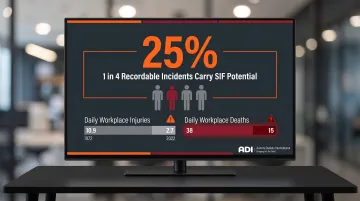
The numbers tell a troubling story: U.S. workplace injuries dropped from 10.9 to 2.7 daily incidents between 1972 and 2022, yet daily workplace deaths only fell from 38 to 15. Organizations have reduced total recordable rates while serious injury and fatality (SIF) exposure remains largely unaddressed.
DEKRA research reveals that 25% of all recordable incidents carry SIF potential — meaning one in four injuries could have been life-threatening or life-altering.
Without systematic assessment, safety investments can feel active while critical risk gaps go undetected. This article covers:
- What to prepare before an assessment
- Which methods to use and when
- How to run the process step by step
- How to interpret what the data reveals
- Common mistakes to avoid along the way
Key Takeaways
- Measure what employees believe, what leaders reinforce, and what behaviors occur at the point of risk — injury rates alone miss critical gaps
- Combine perception surveys, behavioral observations, leadership evaluations, and leading metrics for a complete picture
- Communicate purpose clearly, ensure anonymity, and include all shifts and levels before collecting data
- Translate findings into specific behavior change actions by comparing stated priorities against actual observed behavior
What to Establish Before You Begin a Safety Culture Assessment
The goal of your assessment must be positioned clearly as improvement-seeking, not fault-finding. Sites that skip pre-assessment communication report guarded responses and distorted data. When employees perceive surveys as compliance exercises or blame-finding tools, they provide less honest responses and disengage from future assessments.
Leadership should communicate three things before data collection begins:
- Explain why the assessment is happening and what it aims to improve
- Describe how responses will be kept confidential and what safeguards are in place
- Confirm that findings will drive actionable improvements, not punitive measures
Define Scope Across All Levels and Shifts
Safety culture isn't uniform across an organization. Subcultures exist by shift, trade, tenure, and location. Research shows that group-level safety climate can vary significantly across teams within the same organization, driven largely by direct supervisor behavior.
Night shift workers often perceive higher injury risk than day shift workers, and different departments may operate at different maturity levels despite sharing the same corporate safety programs.
Define your scope clearly:
- Which organizational levels will participate (executives, managers, supervisors, frontline workers)?
- Which shifts will be included (day, swing, night)?
- Which departments, trades, or functions?
- Which geographic locations or facilities?
Failing to account for subcultures leads to misleading averages that hide critical gaps. Aggregate scores can mask the reality that one shift operates proactively while another remains reactive.
Review Baseline Documentation
The assessment begins before you interview anyone. Review three to five years of documentation to anchor your evaluation and guide where to focus:
Key baseline documents:
- Incident and near-miss records (conduct a Pareto analysis to identify patterns)
- Current safety policies and programs
- Past audit findings and corrective action closure rates
- Incident investigation reports
- How safety roles and responsibilities are defined for leadership
Patterns in this data tell you where to probe deeper during interviews and surveys. If near-miss reporting has declined over three years while injury severity increased, that gap warrants targeted questions about reporting culture and psychological safety.
Core Methods to Assess Safety Culture
No single method captures the full picture of safety culture. Reliable assessments triangulate across multiple data streams: what people believe, what leaders and teams actually do, and what the system produces in terms of exposure and outcomes. The most effective assessments combine four methods.
Safety Perception Surveys
Perception surveys are the primary tool for measuring safety climate and cultural drivers at scale. Well-designed surveys measure:
- Leadership commitment and credibility
- Psychological safety (willingness to report and speak up)
- Reporting culture and feedback quality
- Communication effectiveness
- Risk awareness and shared values
Surveys must guarantee anonymity to be valid. Group results should only be reported above a defined minimum size (typically 5-10 respondents) to protect individual confidentiality. Generic off-the-shelf instruments often miss site-specific dynamics — customized surveys tied to actual organizational context yield more actionable data.
The Nordic Safety Climate Questionnaire (NOSACQ-50) is a validated 50-item instrument covering seven dimensions, used in over 750 studies with 100,000+ respondents in 45+ languages. The UK's Health and Safety Executive also offers a 40-question Safety Climate Tool widely referenced for benchmarking. Both provide validated frameworks, but typically need customization to fit your specific operational context.
How to field surveys effectively:
- Share results quickly with participants — delayed feedback erodes trust
- Report findings at appropriate group levels to maintain anonymity
- Facilitate conversations around findings, don't just circulate a report
- Take visible action on results — employees track whether their input drives change
Research shows that when organizations fail to act on survey results, employees perceive surveys as "meaningless exercises," leading to reduced honesty and participation in subsequent rounds. Follow-through determines whether future survey participation remains credible.
Behavioral Observations and Leadership Assessments
Surveys capture perceptions, but observations reveal what actually happens at the point of risk. Structured safety walks and behavior-based observations show whether critical controls are being applied, how workers respond to hazards in real conditions, and whether safety behaviors are practiced or performed only when someone is watching.
ADI's behavioral science approach — rooted in Applied Behavior Analysis — distinguishes between behaviors maintained by positive reinforcement versus those driven by fear of punishment. This distinction reveals whether safety culture is genuinely strong or merely compliant on the surface. Where safe behaviors disappear the moment supervision lifts, the underlying risk exposure is far greater than incident rates suggest.
Structured observation methods:
- Use checklists to identify both safe and at-risk behaviors
- Provide immediate, specific feedback to workers
- Track trends over time to measure behavior change
- Conduct peer-to-peer observations to build ownership
Leadership behavior assessments — including 360-degree feedback — measure what signals leaders actually send, not just what they intend. Culture follows what leaders pay attention to and reinforce. The gap between leader self-perception and frontline experience is substantial: safety leaders consistently rate their commitment higher than frontline employees do, and many workers lack understanding of safety programs despite awareness they exist.
Tools like Krause Bell Group's Safety Leadership 360 evaluate leaders across six dimensions: Vision for SIF Prevention, Credibility (alignment between words and actions), Value for SIF Prevention, Listening to Learn, Collective Intelligence, and Inviting Dialogue. Comparing leader self-perception against feedback from direct reports reveals where leadership behaviors need recalibration.
Leading and Lagging Indicators
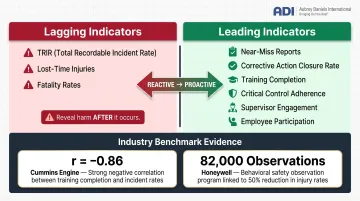
Lagging indicators — Total Recordable Incident Rate (TRIR), lost-time injuries, fatality rates — reveal weaknesses only after harm occurs. Leading indicators are proactive measures that signal risk exposure before incidents happen, giving organizations time to intervene.
Relying solely on lagging metrics is insufficient. Injury rates can appear stable while exposure and behavioral risk quietly increase. As the Campbell Institute notes, "sole focus on lagging metrics is not as effective in promoting continuous improvement as using leading indicators to anticipate and prevent injuries."
Leading indicators to track:
- Near-miss and hazard report frequency and quality
- Corrective action closure rate (target 90% completion)
- Training completion and field verification rates
- Critical control adherence through behavioral observation
- Supervisor engagement in safety conversations
- Employee participation in safety initiatives
Real-world benchmarks from Campbell Institute research:
- Cummins: Strong negative correlation (r = -0.86) between training hours and incidence rates
- Honeywell Building Solutions: 82,000 safety observations in 2013 (approximately 8 per employee per year); recordable injuries reduced 50% while observations increased nearly 100%
The pattern across these indicators — not any single number — reveals cultural health. High near-miss reporting combined with rapid corrective action closure signals a learning culture. Low reporting combined with rising severity signals underreporting and unaddressed exposure.
A Step-by-Step Process for Conducting a Safety Culture Assessment
These steps apply whether you're running a first-time assessment or an annual review. Follow the sequence — it protects data integrity and builds workforce trust at each stage.
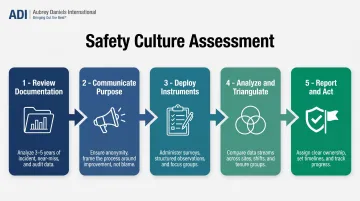
Step 1: Review Documentation and Baseline Data
Begin before interviewing anyone. Review three to five years of incident reports and perform a Pareto analysis to identify patterns — specific tasks, times of day, tenure levels, or environmental conditions where incidents concentrate. Review current safety programs, past audit findings, and how safety responsibilities are documented for leadership roles.
This step defines where to focus and what questions to bring into the field. If incident investigations consistently identify "failure to follow procedure" but never examine why the procedure wasn't followed, that gap warrants deeper exploration during interviews.
Step 2: Communicate the Process to All Levels
Communicate the assessment's purpose to the entire workforce — from executive leadership to frontline employees. Key messages to emphasize:
- Anonymous participation is guaranteed and verifiable
- Sessions are conducted by peer group to protect candor
- The objective is identifying improvement opportunities, not assigning blame
In unionized organizations, engage union leadership as partners from the start. ISO 45001 Clause 5.4 requires organizations to remove barriers to worker participation, including language and literacy barriers, and to involve workers in determining communication needs and hazard identification processes.
Step 3: Deploy Assessment Instruments
Combine customized perception surveys, structured site observations, and group and individual interviews.
Survey deployment: Field surveys online or on paper, depending on workforce access. Ensure anonymity through third-party administration or encrypted platforms. Average response rates for well-executed safety culture surveys are approximately 66.5%.
Site observations: Conduct walk-throughs of active work areas during different shifts. Observe whether critical controls are applied, how workers respond to hazards, and whether safety conversations occur naturally.
Focus groups and interviews: Conduct focus groups by level and shift to protect anonymity. Use standardized questions but allow facilitators to probe deeper where responses warrant. One-on-one interviews with key individuals provide depth on issues the survey surfaces.
Step 4: Analyze and Triangulate the Data
Compare perception survey results against behavioral observation data and operational KPIs. Look for divergences — high survey scores on psychological safety paired with low near-miss reporting may indicate underreporting rather than genuine safety.
Always analyze by site, function, shift, and tenure — not just at the aggregate level. Organizational averages hide critical variation. A site-level breakdown might reveal that one shift scores 20 points lower on leadership commitment than another, signaling a supervisor-level culture gap rather than an organization-wide one.
Step 5: Report Findings and Build an Action Plan
Deliver findings promptly before momentum fades. Structure the report around internally actionable recommendations, not a comprehensive list of every gap. Prioritize the findings with the greatest potential to reduce incidents and shift leadership behavior.
Present findings in an exit meeting with key stakeholders before issuing the final report. Every recommendation in that report should:
- Assign clear ownership to a named role or team
- Define measurable outcomes with a target timeline
- Include a mechanism for tracking progress
Most organizations stall at this stage. Assessment results rarely self-execute without deliberate action planning and accountability structures in place.
How to Interpret Your Safety Culture Assessment Results
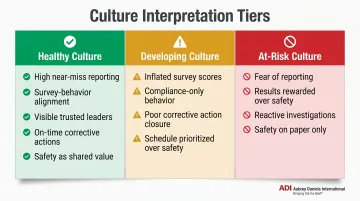
Healthy Culture Signals
Organizations with genuinely strong safety cultures show consistent patterns across assessment methods:
- High near-miss and hazard reporting rates — workers report freely because they trust the system will respond constructively
- Alignment between survey responses and observed behaviors — what people say matches what they actually do
- Leaders who are visible and trusted in the field — frontline workers describe leaders as credible and supportive
- Corrective actions completed on time and verified for effectiveness — the system closes the loop
- Safety described as a shared value, not a compliance obligation — employees speak about safety as "how we work," not "what we're told to do"
These organizations typically exhibit a High Participation Culture where safety activity and adoption are both high. Workers actively participate because they see their input drive real improvements.
Warning Signals (Developing Culture)
Patterns indicating a culture in transition or with significant gaps:
- Survey scores inconsistently high (particularly on leader commitment) while lagging injury metrics trend upward or near-miss reporting remains low
- Behavioral observations show safe behaviors practiced primarily when management is present
- Corrective action lists are long but closure rates are poor
- Leaders speak about safety as a priority, but operational decisions consistently prioritize schedule and cost over risk controls
These signals suggest safety activity without genuine cultural ownership. The infrastructure exists — policies, programs, procedures — but behavior hasn't changed at the point of risk.
Critical Gaps (At-Risk Culture)
Indicators of a fragile or at-risk safety culture require immediate action:
- Employees express fear of reporting incidents — research shows that 20-91% of workplace injuries go unreported, with fear of job loss, retaliation, and being labeled a "troublemaker" as major barriers
- Leadership behaviors reward results over safety — production pressures routinely override safety protocols
- Reactive investigations rather than proactive learning — incidents trigger blame and discipline, not system improvements
- Disconnect between formal programs and actual behavior — safety exists on paper but not in practice
Studies show that inadequate company response to near-miss reports is associated with higher odds of subsequent occupational accidents. When companies respond inadequately, workers stop reporting, creating a dangerous cycle.
Translating Findings Into Behavior Change
Whether your assessment reveals a culture in transition or one with critical gaps, the pattern is consistent: findings don't translate into change on their own. Most organizations stall at this handoff.
ADI's behavioral science approach addresses this directly — identifying which behaviors need to change, what currently reinforces the wrong ones, and how to redesign the environment so safe behaviors are sustained because they're valued, not just required.
Workshops like Applications of Behavioral Leadership and the Supervisor's Guide to Safety Leadership give leaders the tools to act on assessment findings: behavioral coaching techniques, positive accountability processes, and roadmapping that connects safety behaviors to business outcomes at every level of the organization.
Common Mistakes That Undermine Safety Culture Assessments
Over-Relying on Lagging Metrics
Treating injury rates as the primary measure of safety culture is one of the most common and costly errors. TRIR can appear stable — or even improve — while exposure to serious incidents quietly increases.
DEKRA research shows that 25% of all recordable incidents have SIF potential. In utilities, that rate jumps to 32%; in water utilities, 42%. Organizations focused on reducing total recordable rates may miss that a quarter of their incidents carry life-threatening potential.
Between 1972 and 2022, the U.S. reduced daily workplace injuries from 10.9 to 2.7 — a 75% improvement. But daily workplace deaths only dropped from 38 to 15 — a 60% improvement that still left 5,283 fatalities in 2023. TRIR improvements do not proportionally reduce SIF events.
Organizations that manage to the recordable rate rather than to actual risk miss early warning signals until harm occurs. Leading behavioral indicators surface those signals before an incident does.
Conducting the Assessment as a One-Time Event
Safety culture is a moving target that shifts with turnover, market cycles, and leadership changes. A single point-in-time assessment provides a snapshot but can't track drift or confirm whether interventions are working.
Industry guidance emphasizes that "pulse checks beat postmortems." Regular assessments calibrate leadership's view to current realities and detect where "work as imagined" diverges from "work as done."
Sustainable cadence:
- Deep assessments (surveys, interviews, observations combined): annually or every two years
- Pulse surveys: after major organizational changes
- Leading indicator tracking: monthly throughout the year
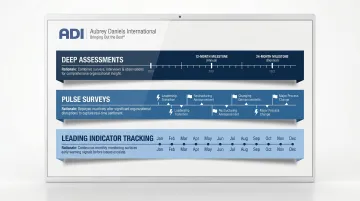
Skip ongoing measurement, and you're flying blind between crises rather than steering away from them.
Failing to Close the Loop with Employees
If employees participate in surveys and interviews but never see results communicated or actions taken, they will either disengage from future assessments or provide distorted responses.
Research confirms that lack of visible action erodes trust and reduces future response honesty. When surveys become "meaningless exercises," participation quality declines.
What closing the loop looks like:
- Share synthesized findings promptly (not individual quotes that could identify participants)
- Host team-level discussions to interpret results and solicit input on solutions
- Assign visible actions with named owners and timelines
- Publicly acknowledge when employee input drove a change
This follow-through builds credibility, engagement, and ownership — and ensures future assessments yield honest, high-quality data.
Frequently Asked Questions
Frequently Asked Questions
How to evaluate safety culture?
Evaluating safety culture requires triangulating data across perception surveys, behavioral observations, leadership assessments, and operational KPIs. Look for alignment or divergence between what people say, what leaders reinforce, and what behaviors actually occur in the field. That gap — or absence of one — reveals whether safety culture is genuine or performative.
What are the 5 levels of safety culture?
The Hudson/Parker model describes five maturity levels: Pathological (safety is a burden), Reactive (we act after accidents), Calculative (we have systems in place), Proactive (leadership drives continuous improvement), and Generative (safety is how we do business). Most organizations sit at Tier 3 with an average maturity index of 51%, where compliance is active but genuine cultural ownership is still developing.
What are the 4 pillars of a safety management system?
The FAA's SMS framework defines four components: Safety Policy (leadership commitment and structure), Safety Risk Management (hazard identification and control), Safety Assurance (evaluating effectiveness through audits and reporting), and Safety Promotion (training and communication). Safety culture assessment evaluates whether these pillars are reflected in actual employee behavior and organizational norms, not just documented policies.
What is the difference between safety culture and safety climate?
Safety climate is a snapshot of current employee perceptions at a point in time: how workers feel about safety right now based on recent experiences. Safety culture is the stable, long-term pattern of shared beliefs, norms, and behaviors that shape those perceptions over time. Climate surveys are faster to administer, but culture diagnostics require multiple methods to surface underlying drivers.
How often should an organization assess its safety culture?
Conduct deep assessments — surveys, interviews, and observations combined — annually or every two years to track long-term trends. Supplement with pulse surveys after major changes like leadership transitions, and track leading indicators monthly to catch early signals between formal cycles.