The missing piece isn't in your procedures—it's in the unobserved behavioral patterns and cultural norms that standard audits don't capture. Research shows that 80-90% of serious workplace injuries trace back to human error or unsafe behavioral choices, rather than equipment failure. This points to a fundamental truth: safety culture is ultimately the product of what people actually do, day in and day out, and what the organization reinforces—not just what it says it values.
This article presents five concrete, behaviorally-grounded elements that leaders can assess to get an honest picture of where their safety culture stands. Each element is observable, measurable, and actionable.
Key Takeaways
- A strong safety culture is revealed through observable behaviors, not policies or incident rates alone
- Five critical assessment elements: leadership visibility, employee voice, accountability systems, communication quality, and learning from incidents
- Each element has specific behavioral indicators you can observe and measure
- Effective assessment means examining what is actually reinforced, not just what is officially required
Element 1: Leadership Behavior and Visibility
What to Look For (Not Just What Leaders Say)
Leadership "commitment" often appears as a stated value in safety policies and mission statements. But leadership behavior is something observable—and only the latter shapes culture. Employees watch what leaders do far more closely than what they say.
Research analyzing 33 studies found that transformational safety leadership correlates with employee safety participation at r = 0.456, significantly stronger than transactional leadership approaches. A time-lagged study demonstrated that when managers consistently encourage safe behaviors and interrupt risky ones, employee safety voice increases measurably over the following months.
Assessing What Leaders Actually Do
When a manager walks past an unsafe act without addressing it, that silence functions as implicit approval. This phenomenon—known as normalization of deviance—describes how deviation from correct behavior becomes normalized when no immediate negative consequences result. Over time, these unaddressed behaviors shift the cultural baseline.
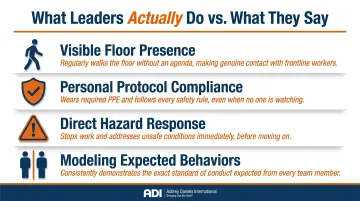
To assess whether leadership behavior is actually driving safety culture, look beyond stated commitments. Ask:
- Do senior leaders conduct regular, visible safety interactions on the floor—not just attend quarterly reviews?
- Do they personally follow safety protocols, or treat those rules as applying only to frontline workers?
- When leaders spot an unsafe condition, do they address it directly or hand it off to the safety team?
- Can frontline employees point to specific examples of leaders modeling the behaviors they expect from others?
The Assessment Pitfall to Avoid
Relying on leader self-reports or surveys creates a false picture. A behavioral approach closes this gap by focusing on what leaders actually do in observable situations. Case studies from organizations like Fluor show that when leadership engagement becomes measurable—requiring managers to walk sites weekly and visit crews twice per week—previously weak safety areas can become top-performing categories within six months.
Element 2: Employee Voice and Psychological Safety
The Behavioral Signal That Tells You More Than Any Survey
Near-miss and hazard report volume reveals more about your safety culture than any survey or policy review. A culture where employees report freely signals psychological safety; chronic under-reporting signals fear or apathy.
The National Safety Council's research found that workers who felt psychologically unsafe were 80% more likely to report having been injured at work, and workplaces that discourage reporting see injury rates increase by 2.4 times.
What a non-punitive response looks like in behavioral terms:
NIOSH identifies "Non-Punitive Response to Error" as a measurable element of safety culture, defined as staff feeling that their mistakes and event reports are not held against them. This must be assessed through behavior patterns, not policy documents.
After implementing Just Culture principles that changed management responses to errors, incident reporting increased by 37%, and positive staff responses to "Leadership Response to Error" doubled from 30% to over 60%.
How to assess genuine employee empowerment:
- Observe who participates in safety meetings—do frontline workers raise issues in managers' presence?
- Track whether employee suggestions lead to visible action
- Look for behavioral evidence of follow-through after employee input
When raising a safety concern results in extra paperwork, being labeled a "troublemaker," or no visible response, speaking up drops off. The behavior follows the consequence — always.
A study of 400 nurses found that after implementing Just Culture training for managers, staff silent behavior dropped and error reporting increased significantly. The management response is the variable that changes everything.
Assessment questions:
- What percentage of safety reports in the last quarter came from frontline employees versus supervisors?
- When was the last time a frontline suggestion changed a safety procedure, and was the employee recognized?
- Can managers describe specific examples of how they responded to the last three employee-reported concerns?
Element 3: Accountability and Behavioral Consequences
Are You Measuring the Right Things—and Responding to Them?
There's a critical distinction between accountability as blame versus accountability as clear expectations plus consistent consequences. Behavioral science reveals that punitive-only accountability systems tend to drive unsafe behavior underground rather than eliminate it.
Direction of accountability:
True accountability flows in all directions—not just downward. Are frontline workers held accountable? Are supervisors? Are senior leaders? Research confirms that inconsistent application of accountability undermines safety culture and significantly deters voluntary reporting of safety events.
The Just Culture framework:
David Marx's Outcome Engineering model categorizes behaviors and appropriate responses:
- Human Error (inadvertent slips/lapses): Console and support; redesign systems
- At-Risk Behavior (risk believed insignificant): Coach the individual
- Reckless Behavior (conscious disregard of risk): Disciplinary action
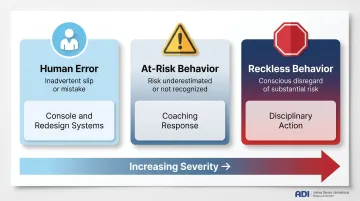
A just culture shifts focus from errors and outcomes to system design and management of behavioral choices across all employees.
Consequence patterns:
Most organizations inadvertently reinforce unsafe shortcuts (faster completion, less effort, immediate reward) while consequences for safe behavior are delayed, uncertain, or absent. Behavioral science offers a diagnostic lens here: assessing the antecedents and consequences surrounding safety behaviors reveals whether your system is actually structured to sustain the culture you want.
Behavioral assessment indicators:
- Is praise, recognition, or reinforcement ever delivered for safe behaviors—not just for absence of incidents?
- What actually happens when someone follows a slow-but-safe procedure versus takes a shortcut that "works out"?
- Do employees describe safety compliance as something that makes their work easier or harder?
These questions point to a systemic reality that James Reason's Swiss Cheese Model makes explicit: most accidents result from latent failures—managerial decisions, design flaws, maintenance failures—that exist long before an active error occurs at the "sharp end." Your accountability system should reflect that reality, focusing on the conditions that produce behavior rather than defaulting to individual blame.
Element 4: Safety Communication and Information Flow
Communication quality in a safety culture isn't just about frequency—it's about whether the right information reaches the right people and prompts action. One-way compliance communication (posting rules) differs fundamentally from two-way behavioral communication — safety conversations, feedback loops, and direct dialogue.
Behavioral indicators to assess:
- Are safety expectations communicated before tasks, not just after incidents?
- Does the team track and share leading indicators — or is communication limited to lagging indicators like injury rates?
NIOSH identifies "Communication Openness" (staff freely speak up if they see something harmful) and "Handoffs and Transitions" (staff transfer information across units and shifts) as measurable elements of safety culture.
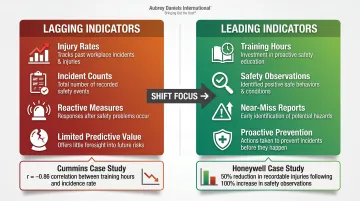
What gets communicated matters as much as how often. Leading versus lagging indicators:
The Campbell Institute found broad EHS consensus that sole reliance on lagging metrics is less effective than using leading indicators to anticipate and prevent injuries. Organizations that shifted to leading indicator systems saw measurable improvements:
- Cummins found a strong negative correlation (r = -0.86) between training hours and incidence rate
- Honeywell achieved a 50% reduction in recordable injuries while reporting a 100% increase in safety observations reported
Assessment questions:
- Can frontline employees accurately describe the top two or three safety priorities for their role right now?
- Is safety discussed in pre-shift meetings, or only after something goes wrong?
- When employees receive safety information, does it tell them what to do differently tomorrow?
Element 5: Organizational Learning and Continuous Improvement
A learning-oriented safety culture treats every near-miss, incident, and unsafe condition as a data point—not a cause for punishment. The key assessment question is whether the organization changes its systems and behaviors as a result of what it learns, or whether investigations end in individual blame.
Behavioral evidence of organizational learning:
- Are corrective actions from past incidents tracked to completion?
- Are employees informed of changes made as a result of their reports?
- Is safety training updated based on observed behavioral patterns—or only when regulations change?
A documented 4-year transformation at a mid-sized U.S. utility demonstrates the measurable impact of shifting from blame to learning:
- 13-percentage-point increase in perception that investigations focus on finding facts rather than assigning blame
- 7-percentage-point increase in belief that it's OK to bring bad news to supervisors
- 4.5-percentage-point increase in belief that safety lessons are communicated across the organization
The shift from "Who failed?" to "What failed?" allowed the organization to build system defenses preventing recurrence.
Assessment indicators:
That same research offers a practical diagnostic: review the last five incident investigations and ask whether root cause analysis identified systemic or environmental factors, or landed solely on individual error. Systems-focused investigation approaches reduce repeat incidents far more effectively than individual-blame approaches — and the pattern across investigations reveals which approach your organization actually uses.
The differentiator isn't whether an organization documents lessons learned — most do. It's whether those lessons visibly change procedures, training, or equipment before the next incident occurs.
From Assessment to Action: Making the Data Work
Assessing these five elements creates a diagnostic picture—but the picture alone doesn't change culture. The next step is prioritizing which elements show the greatest gap and designing targeted behavioral interventions, not just policy updates.
What a behavior-based action plan looks like:
- Identify specific behaviors to increase or decrease
- Pinpoint the antecedents and consequences that currently drive those behaviors
- Establish a reinforcement strategy that makes safe behavior the path of least resistance over time
That action plan is straightforward on paper—but translating assessment findings into lasting culture change is where most organizations stall. For organizations that need structured support through that transition, ADI's behavioral consulting and safety culture work draws on over 45 years of applied behavioral science, including frameworks developed in Judy Agnew's Safe by Accident, to build systems where safe behavior is consistently reinforced across every level of the organization.
ADI's approach centers on three interconnected outcomes: employees who recognize and report hazards early, leaders who actively reinforce that reporting, and organizational learning embedded in daily operations. Across manufacturing, energy, mining, and utilities sectors, this methodology has produced measurable results—including 45% reductions in lost-time accidents and sustained improvements in safety participation rates.

Frequently Asked Questions
What are the 5 C's of culture change?
The 5 C's framework includes Clarity, Commitment, Communication, Consistency, and Consequences. Each maps directly to a behavioral element of safety culture—from ensuring employees understand expectations to making certain that actions and reinforcement align with stated values.
What is the difference between safety climate and safety culture?
Safety climate refers to employees' current perceptions and attitudes toward safety—a snapshot of how safe the workplace feels right now. Safety culture is the deeper, more durable set of shared values and behavioral norms that shape those perceptions over time and persist even when conditions change.
How do you measure safety culture in an organization?
Safety culture is best measured through behavioral observation, leading indicators (near-miss reports, participation rates, safety conversations), and targeted surveys—not injury statistics alone. The focus should be on what people actually do and what the organization reinforces, not just what policies say.
What are the warning signs of a weak safety culture?
Key behavioral warning signs include low near-miss reporting, incidents met with blame rather than systemic analysis, safety compliance that drops when supervisors aren't watching, and a visible gap between stated values and observed management behavior. Employees who hesitate to speak up or who perceive safety as "someone else's job" signal deeper cultural issues.
How long does it take to change a safety culture?
Meaningful culture change typically takes several years, with pace driven primarily by the consistency of leadership behavior and the reinforcement systems in place. Organizations with clear accountability structures often see measurable improvements within months—but lasting transformation requires that consistency to hold over time.