Introduction
Most organizations believe they have a solid safety program. They've documented procedures, conducted training, posted safety policies, and hired dedicated EHS staff. Yet incidents still happen. Near-misses go unreported. Employees follow the rules only when someone's watching.
The problem is rarely process — it's culture. Research shows that 20-91% of workers don't report their injuries to management or workers' compensation programs, primarily due to fear of negative consequences on their employment status. Organizations can have excellent statistics while critical hazards remain unmanaged.
A safety culture maturity assessment gives leaders a clear diagnostic picture — not just compliance status, but the behavioral drivers that determine whether your safety culture is sustainable or fragile. Understanding where your organization stands on that spectrum is the starting point for real improvement.
This article walks through each of the five maturity levels so leaders can pinpoint where their organization stands — and what it takes to move forward.
TLDR
- A safety culture maturity assessment measures how deeply safety is embedded in values, behaviors, and leadership—not just whether rules are followed
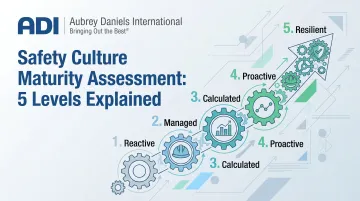
- The five levels (Pathological, Reactive, Calculative, Proactive, Generative) trace a clear progression from treating safety as a burden to making it a core organizational identity
- Most organizations sit at Reactive or Calculative levels—managing safety through rules while missing the behavioral drivers underneath
- Moving up a level requires changing what leaders reinforce daily, not just adding new policies
- Results should drive a concrete improvement roadmap built around observable behavior change
What Is a Safety Culture Maturity Assessment?
A safety culture maturity assessment is a diagnostic process that measures how an organization's collective values, attitudes, and behaviors toward safety compare against a defined progression model. The output is a "maturity level" that signals current cultural reality—not just compliance status.
This differs fundamentally from a standard safety audit or compliance check. An audit measures whether rules are followed: Are procedures documented? Are workers wearing PPE? Are inspections completed on schedule? A maturity assessment examines why people behave the way they do, what leaders reinforce, and how deeply safety is embedded as a shared value.
Organizations can pass audits while maintaining dangerous cultures. The gap shows up in daily behavior:
- Workers wear hard hats during inspections, then remove them when supervisors leave
- Incident reports get filed only after employees are coached on what not to say
- Systems exist on paper, but the behavioral environment quietly undermines them
ADI's behavior-based approach to safety assessment specifically examines the antecedents (what triggers safety behavior), the consequences (what gets reinforced or punished), and the balance of positive to negative reinforcement in the safety environment. This produces a clear, actionable picture of where culture actually lives: in the daily interactions between leaders and frontline workers, not just in the safety manual.
Why Safety Culture Maturity Matters
Organizations with immature safety cultures experience higher rates of incidents, near-misses, and regulatory violations — not because procedures are missing, but because employees lack intrinsic motivation to apply those procedures.
A 2023 National Safety Council study found that workers who felt psychologically unsafe had an injury rate of 36.5%, compared to 20.2% for those who felt psychologically safe. That gap doesn't close with more training or better equipment alone.
What Goes Wrong Without a Maturity Framework
Without a maturity assessment, leadership invests in new training, equipment, or compliance initiatives, but results plateau. The underlying cultural issues — blame, fear of reporting, production pressure overriding safety — go undiagnosed and unaddressed.
Consider what happens in organizations stuck at lower maturity levels:
- Near-miss reporting rates remain low because employees have learned that raising concerns leads to punishment rather than improvement
- Actual occupational injuries may be three times higher than reported, masked by fear of discipline or job loss
- Safety activity spikes after incidents then fades, creating a reactive cycle
- Leadership consistently rates workplace culture more positively than frontline employees, revealing a dangerous perception gap
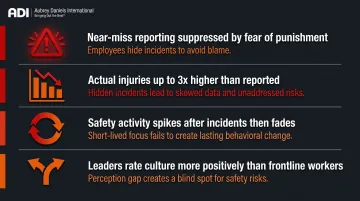
The UK Health and Safety Executive notes that "an organization's culture can have as big an influence on safety outcomes as the safety management system." When culture is ignored, even sophisticated safety systems fail.
Creating a Shared Language for Improvement
Maturity assessments create a shared language for safety improvement. They help leaders:
- Prioritize interventions based on where the organization actually is, not where leaders assume it is
- Set realistic goals grounded in cultural readiness
- Measure progress in cultural terms rather than just lagging indicators like TRIR or lost-time rates
- Identify which leadership behaviors need to change to advance to the next level
Organizations that apply maturity assessments stop treating incidents as isolated events. Instead, they examine the reinforcement patterns — what leaders are rewarding, ignoring, or inadvertently encouraging — that produce the behaviors driving those numbers.
The 5 Levels of Safety Culture Maturity
The five-level maturity model represents a progression developed from decades of organizational safety research, notably Hudson and Parker's safety culture ladder published in 2006. Each level reflects a fundamentally different leadership mindset and behavioral norm around safety.
Level 1: Pathological — "Who Cares As Long As We're Not Caught"
At the pathological level, safety is viewed as a burden, a cost, or a regulatory nuisance. Leadership focuses on avoiding penalties rather than preventing harm. Incidents are hidden or minimized to protect production targets and bonuses.
Fear-based reinforcement dominates. Employees learn that reporting problems leads to blame and punishment, so they stop reporting. The consequence environment reinforces unsafe behavior and punishes transparency — exactly backwards from what a safe workplace requires.
Organizations at this level exhibit:
- Information hoarding and blame as default responses to incidents
- No genuine commitment to worker wellbeing
- Compliance only when regulators are present
- Active concealment of safety issues to avoid scrutiny
Research confirms the impact: underreporting was specifically higher in working environments with punitive safety climates, with an average of 2.48 unreported accidents for every accident reported.
Level 2: Reactive — "Safety Is Important Every Time We Have an Accident"
Organizations at the reactive level begin acknowledging safety after incidents occur. New rules, procedures, and investigations are triggered by events rather than proactive risk assessment. "Point and blame" remains the default response when something goes wrong.
What keeps organizations stuck here is narrow data. Lagging indicators — injury rates, incident counts — are the only measurement tools in use. Safety improvement efforts fade once the immediate crisis passes, and leaders inadvertently reinforce reactive behavior by engaging with safety only when something breaks.
Key characteristics include:
- Safety receives attention only following accidents
- Incident investigations focus on worker fault rather than systemic causes
- Training and safety meetings increase temporarily after events
- Leadership demonstrates concern in the moment but fails to sustain focus
The problem with reactive cultures is clear: low injury rates do not logically equate to a safe workplace. Critical hazards can remain unmanaged while statistics look acceptable.
Level 3: Calculative — "We Have Systems to Manage All Hazards"
At the calculative level, organizations have formal safety management systems, regular audits, documented procedures, and metrics. Safety appears well-managed on paper. This level is often mistaken for a mature culture because it looks sophisticated from the outside.
The gap that's easy to miss: systems and checklists are followed out of compliance obligation, not genuine commitment. Employees engage in "safety theater," performing compliance for audits rather than internalizing safety as a value.
When obsession with metrics replaces genuine care for people, the trap is set. Organizations at this level exhibit:
- Comprehensive safety documentation and procedures
- Regular audits and compliance tracking
- Data-driven dashboards and safety metrics
- Comfort with systems and numbers as evidence of safety excellence
Yet beneath the surface, safety procedures often "exist primarily on paper" and fail to prevent accidents. A lack of operational discipline becomes normalized to the point where compliance-based checks no longer recognize risk. As DEKRA notes, it is often "only luck" that prevents incidents from becoming catastrophes.
The distinction matters because calculative organizations often score well on audits right before a serious incident. Systems create the appearance of control — not the reality of it.
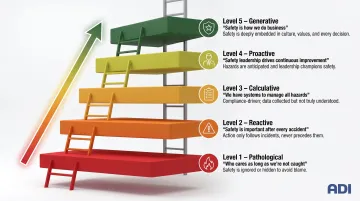
Level 4: Proactive — "Safety Leadership and Values Drive Continuous Improvement"
Leadership at the proactive level genuinely commits to preventing incidents before they happen. Both leading and lagging indicators are used. Workers feel empowered to raise concerns without fear of reprisal, and near-miss reporting is encouraged and rewarded.
What distinguishes this level behaviorally is how reinforcement works. Leaders recognize safe behaviors, not just punish unsafe ones. The shift from compliance-driven to values-driven safety becomes visible: employees begin exercising discretionary effort, going beyond minimum requirements because they're personally invested in outcomes.
Proactive organizations demonstrate:
- Leadership anticipates problems before they occur
- Worker involvement in hazard identification and solution development
- Near-miss reporting increases (a positive sign of trust)
- Recognition systems emphasize safe behaviors, not just outcomes
- Supervisors conduct frequent safety conversations with frontline workers
Research validates this approach: increasing supervisory safety-oriented interactions led to significant increases in workers' safety behavior and positive changes in safety climate scores. One study showed that organizations applying aggressive EHS targets with targeted leadership assistance achieved an average reduction in incidence rates by 77% within 3-12 years.
That 77% reduction doesn't happen through better paperwork. It happens when leaders make safe behavior the path of least resistance — and worth choosing.
Level 5: Generative — "Safety Is How We Do Business Around Here"
At the generative level, safety is fully integrated into every operational decision, at every level of the organization. There is collective accountability, continuous learning from near-misses, and a "chronic unease" — leaders remain vigilant even when metrics look good, knowing that complacency is itself a risk.
Intrinsic motivation governs safety behavior at this level. Employees make safe choices because they are personally invested, not because someone is watching. This is discretionary effort in its fullest form.
Generative organizations demonstrate:
- Safety deeply embedded in organizational identity
- High standards that the organization actively seeks to exceed
- Learning culture where near-misses are treated as gifts
- Chronic unease — healthy skepticism about what statistics show
- Deference to expertise regardless of hierarchy
Professor James Reason introduced the term "chronic unease" in 1997 as a wariness toward risks — the opposite of complacency. Organizations at this level don't believe everything is fine just because injury rates are low. They recognize that "the absence of reported incidents may simply mean employees have stopped reporting, not that hazards have disappeared."

Research on High Reliability Organizations (HROs) validates this approach. A study of 124 Veterans Health Administration facilities found HRO implementation associated with a 52% decrease in staff burnout rates and improved safety climate.
At Level 5, the question leaders ask isn't "Are we compliant?" It's "What are we missing?" That shift in question is what separates generative organizations from every level below.
How to Conduct a Safety Culture Maturity Assessment
Conducting a meaningful safety culture maturity assessment requires more than sending out a survey. Follow these steps to ensure your assessment captures cultural reality.
Step 1: Define Scope and Form a Cross-Functional Team
Form a team that includes safety, operations, HR, and frontline leadership—not just the EHS department. A representative team ensures the assessment captures cultural reality across departments, shifts, and levels of the hierarchy.
Include:
- Safety and EHS professionals who understand systems
- Operations leaders who manage daily production
- HR representatives who understand organizational dynamics
- Frontline supervisors who interact with workers daily
- Frontline workers who experience the culture directly
Step 2: Gather Data Using Multiple Methods
The Canada Energy Regulator recommends using at least three specific methods: questionnaires/surveys, document reviews, work observations, interviews, and focus groups. Data from different methods should be triangulated to avoid the "facade effect" where organizations look good on paper but have underlying cultural gaps.
Employee surveys and focus groups: Capture perceptions and reported experiences, but recognize that surveys measure climate (perceptions) rather than culture (ingrained behaviors). With 220+ safety culture surveys identified across industries, select tools carefully.
Direct observation of leader behaviors: Observe what leaders actually do during safety conversations, incident investigations, and production-versus-safety conflicts — not just what they say they do.
Analysis of incident reporting trends: Review near-miss reporting patterns, investigation quality, and how concerns are raised and resolved — not just incident rates. Rising near-miss reports typically signal cultural health, not failure.
Document reviews: Examine policies, procedures, investigation reports, and meeting minutes to understand what systems exist and how they're actually used.
Because self-report data only tells part of the story, behavioral observation is what distinguishes a surface assessment from a genuine cultural diagnosis.
Step 3: Interpret Findings Against Maturity Levels
Map observed behaviors and attitudes against the five maturity levels. Look for both the dominant level across the organization and any "split personality" patterns where safety culture varies significantly by site, shift, or department.
Ask diagnostic questions:
- Do employees report problems without fear?
- Do investigations focus on system failures or individual blame?
- Are leading indicators tracked and acted upon?
- Do leaders recognize safe behaviors or only respond to incidents?
- Is safety viewed as a compliance burden or a shared value?
Step 4: Document Findings in a Maturity Profile
Produce a maturity profile that:
- Assigns a current level with supporting evidence
- Identifies specific behavioral and leadership gaps preventing advancement
- Prioritizes targeted interventions
- Distinguishes between structural gaps (missing systems) and behavioral gaps (what gets reinforced day-to-day)
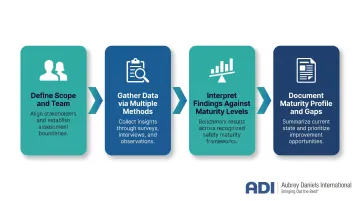
The path forward differs by gap type: structural gaps call for new procedures or tools, while behavioral gaps require leaders to change how they show up for safety every day.
Common Pitfalls That Keep Organizations Stuck
Even well-intentioned organizations make predictable mistakes that prevent cultural advancement.
Treating Assessment as a One-Time Event
The most common trap: conducting the assessment, producing a report, and shelving it. The behaviors that produced the current culture continue unchanged.
Maturity assessments should inform a continuous improvement roadmap. Use findings to:
- Establish baseline measures for each maturity dimension
- Design targeted interventions tied to specific gaps
- Reassess progress at regular intervals (quarterly or biannually)
Over-Reliance on Systems at the Expense of Behavior
Organizations at Level 3 (Calculative) often believe that adding more procedures, audits, or training programs will produce cultural advancement. They invest in documentation and metrics while overlooking what actually drives behavior.
Advancing from Calculative to Proactive requires a fundamental shift in what leaders reinforce — not a thicker procedures manual. Systems create the structure, but culture is built in daily interactions between supervisors and workers, not in what's written in a binder.
Confusing Positive Metrics with Positive Culture
A period of low incident rates can create false confidence. The Deepwater Horizon disaster (2010, 11 deaths) occurred despite declining personal injury rates — the organization ignored catastrophic process risks while celebrating good statistics.
This is called normalization of deviance: the gradual process by which warning signs are reinterpreted as acceptable because nothing bad has happened yet. Low injury numbers can mask serious systemic risk if leaders aren't actively looking beneath the surface.