Introduction
Most organizations invest heavily in performance management systems—annual reviews, goal-setting frameworks, KPI dashboards—yet performance remains maddeningly inconsistent. The reason is simple but overlooked: these systems measure outcomes while ignoring what actually produces them—behavior.
When managers don't understand what drives behavior or how to reinforce it, performance interventions become reactive, short-lived, and often resented.
Employees receive feedback on results they can't always control—market conditions, supply chain disruptions, seasonal demand—while the specific actions within their control remain unexamined and unchanged.
This guide breaks down the science, structure, and practical steps behind behavior-based performance management—so you can build a system that actually changes what people do.
Key Takeaways
- Behavior-based performance management uses Applied Behavior Analysis (ABA) to identify, measure, and reinforce the specific employee behaviors that drive results
- Observable actions—not vague traits or outcomes alone—are the focus, letting managers intervene where performance is actually shaped
- Positive reinforcement sustains high performance; punitive approaches produce compliance but not discretionary effort
- The approach targets both what employees do and the conditions that influence them to do it—something traditional systems miss
- Effective implementation means pinpointing critical behaviors, measuring them consistently, and tying reinforcement to real business outcomes
What Is Behavior-Based Performance Management?
Behavior-based performance management is a systematic approach to improving organizational results. It works by identifying specific, observable behaviors that drive performance, measuring how frequently those behaviors occur, and using reinforcement and feedback to increase or sustain them.
The goal is a work environment where employees consistently choose high-performance behaviors because doing so is meaningful and rewarding — not because it's mandated.
How It Differs From Other Approaches
Most performance frameworks fall into one of two camps — and both have blind spots:
| Approach | What It Measures | The Problem |
|---|---|---|
| Competency-based | Traits like "strategic thinking" or "emotional intelligence" | Difficult to observe, hard to measure, and impossible to coach in the moment |
| Results-only | Outputs like sales numbers, error rates, or production targets | You cannot directly manage a result — only the behaviors that produce it |
| Behavior-based | Specific, observable actions | Targets the only level where sustainable change can actually occur |
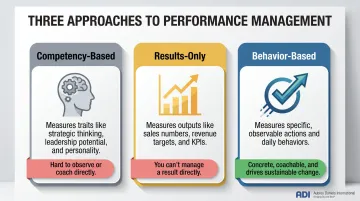
Behavior-based performance management closes that gap. By focusing on the actions employees take — not the traits they possess or the numbers they hit — organizations gain something neither alternative offers: a concrete, coachable path from current performance to desired results.
Why Behavior-Based Performance Management Outperforms Traditional Approaches
The Scientific Foundation
Behavior-based performance management is rooted in Applied Behavior Analysis (ABA), a discipline backed by nearly a century of research. Its organizational application—Organizational Behavior Management (OBM)—has been applied in business settings for decades.
Dr. Aubrey C. Daniels, founder of Aubrey Daniels International (ADI), is widely credited with introducing the term "Performance Management" to describe the systematic application of these behavioral science principles to the workplace.
The Problem With Results-Only Management
You cannot directly manage a result. When managers focus exclusively on outcomes, they identify problems after the fact but have no lever to pull that changes what employees actually do.
A sales manager who only tracks closed deals can tell you performance is down. A behavior-based manager can tell you that prospecting calls dropped 40%, follow-up emails are inconsistent, and discovery questions are being skipped—all behaviors that can be observed, coached, and reinforced immediately.
The ABC Model: How Behavior Actually Works
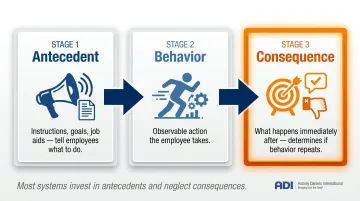
The ABC (Antecedent–Behavior–Consequence) model explains how behavior is shaped:
- Antecedents (instructions, goals, job aids) tell employees what to do
- Behavior is the observable action the employee takes
- Consequences—what happens immediately after—determine whether that behavior is repeated
Most management systems invest heavily in antecedents (training, policies, goal-setting) while neglecting the consequence side of the equation. The result: employees know what they're supposed to do, but the environment doesn't reinforce doing it.
Positive Reinforcement vs. Punitive Management
Positive reinforcement doesn't just encourage repetition of a behavior—it builds the discretionary effort that separates average performance from exceptional performance.
Two landmark meta-analyses by Stajkovic and Luthans covering 72 studies and 13,301 participants found that behavioral management interventions produced a 17% improvement in task performance. When reinforcers were combined—money, feedback, and social recognition together—performance improved by 45%, a synergistic effect 21% greater than if the reinforcers simply added together.
Punitive management produces short-term compliance. It doesn't produce discretionary effort—the gap between the minimum employees do to keep their jobs and the maximum they're capable of. Making high performance rewarding, rather than merely required, is how behavior-based management closes that gap. And when organizations fail to close it, the cost shows up in engagement data.
The Engagement Crisis
Gallup's 2026 State of the Global Workplace report found only 20% of employees globally were engaged in 2025, costing the world economy approximately $10 trillion (9% of global GDP). This isn't a motivation problem—it's a consequence design problem. When high performance goes unrecognized and low performance goes unaddressed, disengagement is the predictable result.

Core Components of a Behavior-Based Performance Management System
Pinpointing: Identifying Critical Behaviors
Pinpointing is the foundation. It means identifying the "critical few" behaviors—specific, observable, measurable actions—that most directly drive the results the organization cares about.
A pinpointed behavior must be described precisely enough that two independent observers watching the same employee would agree on whether it occurred.
Examples:
- ❌ "Be more customer-centric" (vague, subjective)
- ✅ "Review the client history and their company profile prior to calling" (observable, specific)
Why it matters: Without precise behavioral definitions, managers and employees interpret expectations differently. Pinpointing eliminates ambiguity and creates alignment.
Measurement: Tracking What Actually Happens
Behaviors, unlike traits, can be counted and tracked:
- Frequency: How many times did the behavior occur?
- Rate: How many times per hour or per customer interaction?
- Duration: How long did the behavior last?
- Accuracy: Was the behavior performed correctly?
Establish baselines before any intervention begins. If you don't know how frequently target behaviors currently occur, you can't objectively assess progress.
Behavioral measurement serves a diagnostic purpose — understanding what's happening before deciding what to change, the same way a doctor checks vital signs before prescribing treatment.
Reinforcement System Design
Reinforcement in the workplace must be:
- Contingent on the target behavior — delivered only when the desired behavior occurs
- Immediate — as close to the behavior as practical
- Meaningful to the individual — what reinforces one employee may not reinforce another
Effective positive reinforcement requires knowing what each employee actually finds motivating — and that answer differs from person to person.
Research insight: Studies show that employee preferences shift within 2-4 weeks, meaning reinforcement strategies must be reassessed on a regular cycle, not set once and left alone.
Reinforcement schedules matter. Continuous reinforcement accelerates learning new behaviors. Intermittent reinforcement sustains behaviors over time and makes them more resistant to extinction.
Behavior-Specific Feedback
Feedback in a behavior-based system differs from traditional performance reviews:
- Frequent — delivered in days or weeks, not once a year
- Timely — close to when the behavior occurred
- Tied to observed behaviors — not impressions or personality judgments
- Aimed at shaping future behavior — not rendering a verdict on past performance
Annual review cycles are too delayed to influence the behaviors they assess. By the time feedback arrives, the context has dissolved and the behavior has been repeated hundreds of times, often incorrectly.
Data and Continuous Improvement
That ongoing feedback loop produces something equally valuable: behavioral data. Managers can use it to:
- Identify trends before they become problems
- Remove organizational barriers to high-performance behavior
- Adjust reinforcement strategies based on what's working
- Sustain gains over time rather than letting performance revert after an initial push
How to Implement Behavior-Based Performance Management
Step 1: Identify and Pinpoint Critical Behaviors
Work with managers and subject-matter experts to map which behaviors most directly drive key results in each role.
Prioritize the "critical few" — the small number of high-leverage behaviors that account for the majority of performance variance.
Write behavioral definitions precise enough to be observable and measurable. A useful test: would two people watching the same employee independently agree on whether the behavior occurred?
Example application: A distribution center identified specific behaviors (proper lifting technique, checklist completion, accurate labeling) that drove accuracy, productivity, and safety. By focusing on these behaviors rather than abstract goals, the facility shortened its learning curve by a full year.
Step 2: Establish Baselines and Set Behavioral Targets
With your critical behaviors defined, measure how frequently they currently occur before any intervention begins. These baselines let you set realistic improvement targets — and without them, you can't evaluate whether the system is working. A 20% increase sounds impressive; without a starting point, it tells you nothing.
Step 3: Design and Deliver a Positive Reinforcement Strategy
With baselines in hand, build a reinforcement plan that specifies:
- What reinforcers will be used (social recognition, developmental opportunities, tangible rewards)
- Who delivers them (immediate supervisor, peer, senior leader)
- Under what conditions (contingent on which behaviors)
- On what schedule (continuous for new behaviors, intermittent for established ones)
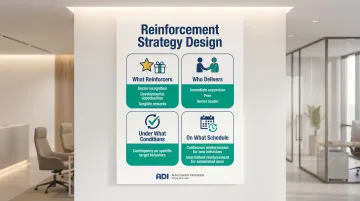
Designing an effective reinforcement strategy requires behavioral expertise that most organizations build over time. ADI's consulting services and certification programs are structured to develop this capability internally, so teams aren't dependent on outside support indefinitely.
Step 4: Build Feedback Loops and Develop Leadership Coaching Capability
Once reinforcement is flowing, the system needs consistent feedback to sustain it. Establish regular, brief interactions between managers and employees tied to observed behaviors — not calendar-driven review cycles.
Train managers to deliver behavior-specific feedback confidently:
- Reinforcing feedback that acknowledges exactly what the employee did well and why it matters
- Corrective feedback that targets changeable actions rather than personality or intent
Coaching in action: Instead of "You need to improve your attitude," a behavior-based coach says, "I noticed you didn't ask discovery questions on the last three calls. Let's walk through what those questions are and practice them."
Common Misconceptions About Behavior-Based Performance Management
"It's Just About Praising Employees"
Behavior-based performance management is a rigorous, data-driven discipline—not a feel-good program.
It requires systematic pinpointing, measurement, baseline data, and deliberate consequence design. Organizations that reduce it to "catch people doing things right" without the underlying structure often see little lasting change.
"Behavior Is Too Subjective or Soft to Measure"
Observable behaviors are more directly measurable than many outcome metrics.
Results are influenced by factors outside employee control: market conditions, supply chain disruptions, seasonal variation, economic shifts. Behaviors—the specific actions employees take—are countable, trackable, and directly actionable in ways that outcomes rarely are.
A sales manager can't control whether a prospect's budget got cut. But they can observe and record whether the rep:
A sales manager can't control whether a prospect's budget got cut. But they can observe and record whether the rep:
- Asked budget-qualifying questions during discovery
- Sent a follow-up proposal within the agreed timeframe
- Scheduled a second meeting before closing the call
That's measurable. That's coachable. Outcomes tell you what happened; behaviors tell you why—and what to change.
"This Is Just Performance Improvement Plans and Discipline"
Many managers associate "behavioral" approaches with performance improvement plans and disciplinary action—likely because "behavioral issues" in HR usually means someone's already in trouble.
Behavior-based performance management is primarily proactive and positive. It's designed to build and sustain high performance before problems arise, not to document failure after the fact. The consequence system it relies on is anchored in reinforcement, not punishment.
Conclusion
Behavior-based performance management works because it operates at the only level where sustainable change is actually possible—the specific actions employees take every day.
By pinpointing those behaviors, measuring them, and reinforcing them consistently, organizations can achieve performance improvements that outlast any single initiative.
Understanding behavior—what antecedents set it up, what consequences sustain it, and what reinforcement looks like for each individual—is not a soft management skill. It is the foundational competency for any leader who wants to produce results that last.
Nearly a century of behavioral science research backs these principles. ADI has spent over 45 years helping organizations across manufacturing, healthcare, financial services, and beyond put them into practice—with measurable results. The leaders who close the gap between knowing and doing are the ones who build performance cultures that hold.
Frequently Asked Questions
What is behavior-based performance management?
Behavior-based performance management is a science-based approach to managing employee performance by identifying observable, measurable behaviors that drive results and using reinforcement and feedback to increase those behaviors consistently over time.
How do you measure behavior-based performance?
Behavioral measurement focuses on observable actions—frequency, rate, duration, or accuracy of specific behaviors—tracked against a baseline. Unlike measuring outcomes influenced by external factors, behavioral measures focus on what employees directly control.
What are examples of behavior-based performance management?
Examples include tracking how often a sales rep follows a defined prospecting sequence, measuring whether a safety technician completes a checklist correctly, or counting the frequency of behavior-specific coaching conversations a manager holds per week.
What is the behavioral method in performance appraisal?
Behavioral methods in appraisal evaluate employees on specific, observable actions rather than traits or results alone. Tools like Behaviorally Anchored Rating Scales (BARS) and Behavioral Observation Scales (BOS) are common instruments. Behavior-based performance management extends this principle beyond review events into day-to-day management.
What is the difference between ABA and OBM?
Applied Behavior Analysis (ABA) is the broader scientific discipline studying how behavior is influenced by the environment. Organizational Behavior Management (OBM) applies those ABA principles specifically to workplace performance, productivity, and safety. OBM is the direct scientific foundation of behavior-based performance management.
What is the difference between BARS and BOS in performance appraisal?
BARS (Behaviorally Anchored Rating Scales) uses behavioral examples to define each point on a rating scale, anchoring performance levels qualitatively. BOS (Behavioral Observation Scales) measures how frequently an employee demonstrates specific behaviors, producing quantitative frequency counts. BARS emphasizes descriptive anchors; BOS emphasizes measurable frequency.