Mining consistently ranks among the most hazardous industries globally. The International Labour Organization reports that mining accounts for approximately 1% of the global workforce but approximately 8% of fatal workplace accidents. In the U.S., the mining fatality rate was 14.2 per 100,000 full-time employees in 2021—nearly four times the all-industry average of 3.8.
Mining leaders face a dual challenge: keeping people physically safe in high-risk conditions while maintaining the morale and engagement needed to sustain that safety long-term. These two goals aren't separate—they're deeply connected. This article explores how workplace culture, behavioral science, and leadership practice intersect to create safer, more engaged mining teams, and what leaders can do differently starting today.
TLDR
- In mining, safety culture and morale rise or fall together — behavioral science explains why and how to fix both
- Rules get minimum compliance; behavior-based approaches build habits workers carry onto every shift
- Specific, genuine recognition keeps workers engaged far more effectively than generic praise or perks
- What leaders do daily shapes culture and safety outcomes more than any written policy
- Measure leading indicators (near-miss reports, peer feedback frequency) — not just lagging injury stats
The Unique Cultural Challenges Mining Workers Face
Mining workers operate under environmental and psychological stressors that make culture uniquely difficult to build and sustain. Remote or isolated worksites, rotating shift schedules (such as 21-on/7-off or 2-weeks-on/1-week-off patterns), physical fatigue, and limited access to family and social support significantly elevate mental health risk.
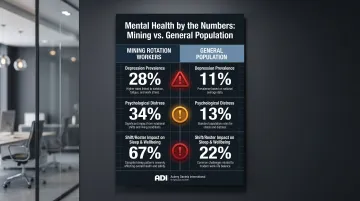
Research on onshore rotation workers in mining reveals a stark contrast with the general population:
- Depression prevalence: 28.3%–32.3% among mining rotation workers vs. 4.1%–6.2% in the general population
- Psychological distress: 10.0%–36.3% for rotation workers vs. approximately 7.6%–13% in the general population
- Shift length impact: Workers on shifts longer than 12 hours had 1.61× higher odds of psychological distress
- Roster impact: Those on 2-weeks-on/1-week-off schedules faced 2.4× higher odds
The Macho Culture Problem
A "toughness" culture pervades many mining operations—one that frowns on weakness and upholds hard work above all else. This masculine norm suppresses reporting of near-misses, physical symptoms, and mental health concerns, directly undermining both safety performance and morale.
The impact is measurable and severe. Workers stressed by fear of workplace stigma attached to mental health were 23.5 times more likely to experience high or very high psychological distress compared to those not stressed by stigma. When one manager in a male-dominated industry disclosed his own mental health struggles, 70% of workers subsequently admitted to suffering from poor mental health—versus 0% before the disclosure.
This culture creates a dangerous silence. Workers won't report hazards, won't admit fatigue, and won't seek help until a crisis occurs. The very behaviors needed for a strong safety culture—speaking up, reporting near-misses, asking for support—are actively discouraged by peer norms.
That silence doesn't just threaten safety outcomes. It drives people out the door.
The Retention Challenge
Experienced miners are in high demand, and companies that fail to build genuine cultures of respect and psychological safety lose institutional knowledge and operational continuity. By 2029, more than half the current U.S. mining workforce will be retired—approximately 221,000 workers—creating a massive skill and knowledge gap.
Pay alone rarely decides retention. Research across three Ghanaian mining companies found that occupational health and safety management quality—specifically safety facilities/equipment, planning, monitoring, and training—significantly predicted turnover intention, independent of compensation. Workers stay when they feel valued, safe, and recognized.
Why Safety Culture and Morale Are Two Sides of the Same Coin
Safety performance and morale are driven by the same underlying mechanism: whether workers experience their workplace as one where behavior is positively reinforced or negatively controlled. When safety is enforced through fear of punishment, it generates minimum compliance, not genuine care.
Gallup's meta-analysis of 183,000+ business units across 54 industries found that top-quartile engaged teams experience 63% fewer safety incidents than bottom-quartile teams. The same analysis revealed that managers account for 70% of the variance in team-level engagement, making leadership behavior the most influential safety driver.
Discretionary Effort: The Difference Between Compliance and Commitment
There's a critical difference between a miner who follows the safety checklist because they have to and one who proactively identifies a hazard their colleague missed because they care about the team. The second behavior (discretionary effort) is what actually prevents accidents.
High morale unlocks discretionary safe behavior. Workers who feel psychologically safe enough to speak up about hazards also tend to work in environments where morale is higher, because psychological safety is a precondition for both engagement and effective hazard reporting.
The National Safety Council found that workers who feel their employer discourages reporting are 2.4 times more likely to have experienced a work injury. Physical safety and psychological safety are directly correlated — and both deteriorate under the same leadership conditions that suppress morale.
The False Choice Between Production and Safety
Many mining leaders treat morale as a secondary concern — a cultural nicety that yields to production targets and safety metrics when pressure mounts. The data argues otherwise. Organizations that integrate culture with operational goals consistently outperform those that treat them as separate tracks.
The feedback loop tells the story clearly. Sites that rely on blame-and-discipline after incidents suppress reporting and drive risk underground. Sites that use curiosity-and-learning approaches get workers surfacing problems early, when they're still fixable. One approach hides risk; the other makes it visible and manageable.
A NIOSH study of 1,955 mine workers found that supervisor communication directly predicted 28.7% of behavioral safety compliance variance. Leadership communication isn't soft: it's a measurable, trainable safety lever.
How Behavior-Based Safety Creates a Lasting Mining Culture
What Behavior-Based Safety Actually Means
Behavior-based safety (BBS) differs fundamentally from compliance-based safety. Compliance relies on rules, procedures, and penalties. BBS focuses on identifying specific observable behaviors that either prevent or contribute to incidents, then systematically reinforcing safe behaviors rather than punishing unsafe ones.
BBS is grounded in Applied Behavior Analysis: decades of scientific research on what actually changes human behavior for good. The approach doesn't assume workers are careless or need more discipline. It assumes behavior is shaped by consequences—and that organizations can engineer those consequences to make safe behavior the natural, habitual choice.
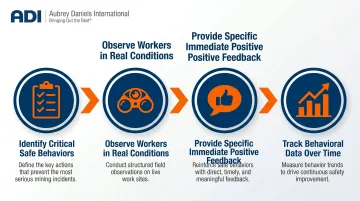
The core BBS cycle works like this in practical terms for mining:
- Identify critical safe behaviors for a given task or work area (proper lockout/tagout, equipment inspection protocols, hazard communication)
- Observe workers performing those behaviors in real-world conditions
- Provide specific, immediate, positive feedback when safe behaviors are observed
- Track behavioral data over time to measure improvement and identify trends
Westmoreland Coal's Rosebud Mine achieved a 50% reduction in incident rates over 14 years with 30% employee participation as observers, accumulating 15,657 observations. The behavioral approach produced measurable, sustained improvement because it focused on what people actually do, not just what they're told to do. Traditional post-incident models wait for something to break. BBS works before it does.
Building Psychological Safety Alongside Physical Safety
A well-designed BBS program creates psychological safety as a byproduct. When workers are observed in a positive, non-punitive context and receive genuine recognition for correct behavior, they become more likely to voluntarily report near-misses and hazards.
In a mature safety culture, workers surface problems voluntarily. They trust that speaking up leads to problem-solving, not blame. That shift from reactive to proactive reporting is the most reliable indicator that the culture has taken root.
When that foundation is in place, BBS programs tend to produce a self-reinforcing cycle:
- Near-miss reporting increases, giving teams earlier warning of hazards
- Peer observations become collaborative rather than evaluative
- Safe behaviors become habitual rather than rules workers follow when supervised
- Leadership spends less time on incident response and more on prevention
ADI's approach to behavior-based safety, applied in high-hazard industries for over 45 years, goes beyond peer observation checklists to engineer the reinforcement environment itself. The goal is to build safe behavior into daily routines rather than relying on periodic campaigns. Judy Agnew's co-authored book Safe by Accident provides practical frameworks grounded in this science, helping organizations move from luck-based safety to evidence-based safety leadership.
Boosting Morale Through Positive Reinforcement, Not Just Recognition
Most mining companies confuse recognition with reinforcement. Generic recognition—"great job this week"—has limited behavioral impact. For reinforcement to durably change behavior, it must meet three criteria:
- Targeted to a specific behavior: "I noticed you stopped to check the ground conditions before entering that area—that's exactly the kind of hazard awareness that prevents incidents"
- Delivered immediately after the behavior, not days or weeks later
- Meaningful to the individual receiving it, not just convenient for the supervisor giving it
Targeted reinforcement shapes habits. Generic praise doesn't.
Why Most Morale Initiatives Underperform
Mining companies often rely on lagging rewards—annual bonuses, safety milestone celebrations, quarterly recognition events. These rewards are too distant from the daily behaviors they're meant to reinforce. A worker who demonstrates excellent hazard communication on Monday won't connect that behavior to a celebration six weeks later.
An effective reinforcement schedule in a high-hazard, shift-based environment looks different. It requires frequent, low-cost, supervisor-delivered recognition of specific safe and high-performance behaviors. The investment isn't in expensive programs. It's in equipping supervisors to recognize the right behaviors, consistently, every shift.
The Role of Autonomy and Voice
Miners who have input into safety procedures, problem-solving, and team decisions report higher engagement and ownership of outcomes. Involving workers in designing safety practices—rather than handing them down from leadership—changes how those practices are perceived and followed.
When a crew helps identify the critical behaviors for a new task and participates in observation and feedback, they're not just following someone else's rules. They're protecting a system they helped build.
ADI's Performance Management consulting gives mining supervisors practical, science-based tools to build reinforcement into their daily leadership—creating environments where both safety performance and morale improve together.
The Role of Leadership in Shaping Mining Culture
Leadership behavior—not stated values or posted policies—is the primary driver of workplace culture. Workers closely observe what supervisors do when no one is watching, how they respond to near-miss reports, and whether they model the safety behaviors they demand from the crew.
A meta-analysis of 15,749 employees found that safety leadership's effect on safety participation was significantly stronger in high-risk industries like mining (PE=0.465) compared to low-risk sectors (PE=0.080). Leadership development ROI is highest where risk is highest.
Modeling: The Behavioral Science Principle That Defines Culture
When leaders visibly demonstrate the behaviors they expect—wearing full PPE, stopping work for a safety concern, admitting a mistake—they establish those behaviors as the norm. Leaders who are inconsistent or exempt themselves from safety standards erode trust and morale simultaneously.
Consistency and authenticity matter far more than perfection. A supervisor who says "I forgot to complete that inspection yesterday, and that's exactly the kind of shortcut that creates risk" builds more trust than one who never acknowledges a behavioral slip.
Three Leadership Behaviors That Disproportionately Affect Mining Culture
1. Conducting regular individual check-ins. Go beyond toolbox talks. One-on-one conversations give workers space to raise concerns, flag fatigue, or surface operational challenges. These check-ins signal that workers are valued as individuals, not just production units.
2. Responding to hazard reports with curiosity, not blame. The supervisor's first words after a near-miss report set the tone for everything that follows. "Tell me what you observed" invites information. "Why didn't you follow procedure?" shuts it down.
3. Delivering specific behavioral recognition daily. Don't wait for formal review cycles. Notice and name safe behaviors as they happen: "I saw you inspect that equipment thoroughly before startup—that's exactly the kind of diligence that prevents failures."
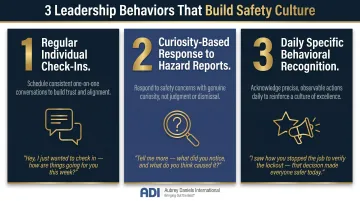
These behaviors don't require budget approval. They require discipline and practice.
Measuring What Matters: Leading Indicators of a Healthy Mining Culture
Injury rates and lost-time incidents only confirm what already went wrong. By the time lagging indicators worsen, the behavioral and cultural conditions driving that outcome have been in place for months — sometimes longer.
Leading indicators are behavioral and cultural data that predict future safety performance. They surface problems while there's still time to course-correct.
Practical Leading Indicators Mining Organizations Should Track
Near-miss and hazard report rates — Higher is better. An increase in near-miss reporting signals psychological safety and early hazard identification, not worsening conditions.
Participation rates in safety conversations and observations — Track how many workers are actively involved in behavioral observations, safety discussions, and hazard analysis. Engaged participation predicts sustained safety performance.
Frequency of supervisor-delivered positive feedback — Measure how often supervisors provide specific, timely recognition for safe behaviors. This metric reveals whether reinforcement is happening at the frequency needed to build habits.
Employee engagement scores specifically around safety voice and autonomy — Survey workers on whether they feel comfortable speaking up about safety concerns and whether they have input into safety procedures. These perceptions drive discretionary effort.
NIOSH research documented that effective near-miss management systems increased reporting 100-fold—from 0.005 to 0.6 reports per employee—demonstrating that leading indicator improvement is achievable with the right systems.
Acting on Leading Indicator Data
Tracking leading indicators requires both a data collection system and a cultural commitment to act on what the data reveals. Without that commitment, the numbers get reported up the chain and nothing changes on the floor.
A continuous improvement loop looks like this:
- Collect leading indicator data weekly (near-miss reports, observation counts, recognition frequency)
- Review data at the team level in short huddles where trends are visible
- Identify one or two specific behavioral improvements to focus on
- Adjust reinforcement and feedback practices based on what the data reveals
- Track improvement over the next cycle and celebrate behavioral wins
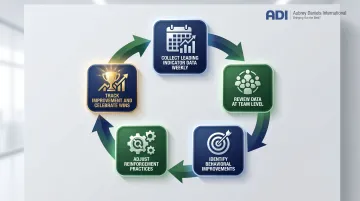
When teams see their own data and have a say in what changes, leading indicators become a genuine performance tool — one that builds trust rather than eroding it.
Frequently Asked Questions
What is behavior-based safety in mining?
Behavior-based safety (BBS) is an approach grounded in Applied Behavior Analysis that identifies specific safe behaviors, observes them in the field, and uses positive reinforcement to make those behaviors habitual—rather than relying solely on rules and penalties to enforce compliance.
How does workplace culture affect safety outcomes in mining?
Culture determines whether workers choose to follow safe practices beyond minimum compliance. High-morale, psychologically safe teams report more near-misses, help each other correct unsafe behaviors, and apply discretionary effort that stops incidents before lagging indicators ever register them.
What causes low morale in mining workplaces?
Low morale stems from lack of specific recognition, limited autonomy, blame-based responses to safety incidents, isolation from family and social support, and the pervasive sense that leadership values workers only for their output rather than as people.
How can mining companies reduce skilled worker turnover?
Culture drives retention more reliably than compensation alone. Workers stay when they feel respected, psychologically safe, and genuinely recognized for their contributions. Companies that invest in behavior-based leadership practices and build reinforcement-rich environments see measurably higher retention rates.
What role does leadership play in mining safety culture?
Supervisors are the primary architects of daily culture. Their behavioral consistency, how they respond to hazard reports, and whether they model safe behaviors themselves matter far more than posted policies, annual safety campaigns, or management statements.
How do you measure mining workplace culture beyond injury rates?
Track leading indicators such as near-miss report frequency, participation rates in safety conversations and observations, frequency of supervisor-delivered recognition, and employee engagement scores around safety voice and autonomy—metrics that reveal cultural health before incidents occur.