Introduction
Two colleagues sit down, work through a difficult conversation, agree to "communicate better going forward," and shake hands. Six weeks later, the same friction is back — sometimes worse, because now there's a failed attempt on the record.
This pattern is more common than most organizations admit. The problem isn't bad faith. Most people in these conversations genuinely want things to improve. The problem is that vague commitments like "be more respectful" or "collaborate more effectively" leave both parties with entirely different mental pictures of what success looks like. When those pictures don't match, the conflict resurfaces — and trust erodes a little more each time.
This article applies behavioral science principles — specifically, setting precise, observable behavioral goals — to make conflict resolution stick. You'll find a step-by-step process for translating post-conflict agreements into specific, measurable commitments.
That includes the diagnostic tools and accountability structures that determine whether new behaviors become consistent habits.
TLDR
- Vague conflict agreements ("we'll communicate better") fail because neither party has a shared picture of what changed behavior actually looks like.
- Behavior is the unit of change. Goals must describe what people will do — concrete, observable actions — not intentions or feelings.
- Antecedent and consequence analysis reveals why problem behaviors persist — and points directly to what behavioral goals need to change.
- Reinforcing new behaviors after the conversation is what separates lasting change from temporary goodwill.
Why Collaborative Conflict Resolution Often Stalls
Collaborative conflict resolution is widely recommended — and for good reason. It preserves relationships, surfaces underlying needs, and produces outcomes both parties can accept. But there's a consistent gap between the conversation going well and the situation actually improving.
The issue is structural. Most resolution conversations are designed to produce agreement, not behavioral change. Participants leave having aligned on intentions, not actions.
The Intention-Action Gap
When resolution agreements are framed around attitudes — "I'll be more open-minded," "we'll show each other more respect" — neither party has a concrete, shared picture of what that looks like in practice. Each person fills in that blank differently. One considers a brief acknowledgment sufficient; the other expected a full change in how decisions get made.
When those interpretations diverge, the original conflict resurfaces wrapped in a new layer of disappointment.
According to the Myers-Briggs Company, managers already spend over four hours per week managing employee conflict on average. Without a more reliable approach to resolution, much of that time goes toward relitigating the same disputes.
That's a solvable problem — but the solution lives in the output of the conversation, not just the quality of it. Agreements that define observable behavior give both parties something factual to reference when checking whether things have actually changed.
The Behavioral Science Case for Specific, Observable Goals
Applied Behavior Analysis establishes a core principle: behavior is observable, measurable, and modifiable. That makes it the most reliable unit of analysis for any change effort, including conflict resolution. ADI has built on this foundation for over 45 years — and nowhere does it apply more directly than in the behavioral agreements that make conflict resolution stick.
Pinpointing: The Precision Standard
"Pinpointing," as described in OBM practice, means defining a behavior so specifically that two independent observers would agree on whether it occurred.
The difference in practice:
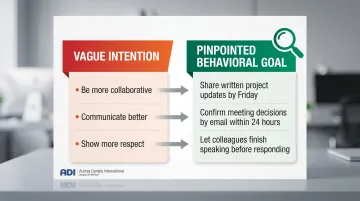
| Vague Intention | Pinpointed Behavioral Goal |
|---|---|
| "Be more collaborative" | "Share project updates with the cross-functional team in writing by Friday each week" |
| "Communicate better" | "Confirm meeting decisions by email to all attendees within 24 hours" |
| "Show more respect" | "Let colleagues finish their point before responding; acknowledge their input before presenting an alternative" |
Locke and Latham's foundational goal-setting research consistently found that specific, challenging goals outperform vague "do your best" goals — and that principle applies with equal force to behavioral agreements made in conflict resolution.
The Dead Man Test
Here's a quick check for any proposed behavioral goal: could a dead person technically achieve it?
"Stop interrupting" passes a dead person easily. That's a problem. Effective behavioral goals define what someone will do, not just what they'll stop doing. "Stop interrupting" becomes "Wait until my colleague has finished speaking and paused before I respond." Same underlying concern, but completely different goal quality — and that quality difference is what separates agreements that hold from ones that unravel.
Why Specificity Prevents Relapse
When both parties share an observable definition of success, disagreements about progress become factual rather than interpretive. "Did you send the Friday update?" has a clear answer. "Are you being more collaborative?" does not. Removing interpretive ambiguity eliminates one of the most reliable triggers for recurring conflict.
Antecedents and Consequences
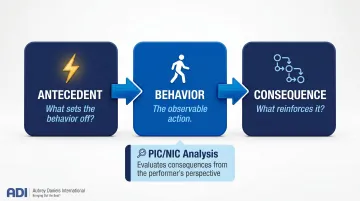
Understanding why a problem behavior persists is as important as defining what should replace it. The A-B-C framework (Antecedent, Behavior, Consequence) examines what situations trigger the behavior and what's been reinforcing it.
ADI's proprietary PIC/NIC Analysis® applies this framework directly. It analyzes the likely positive and negative consequences of a behavior from the performer's perspective, revealing why someone might continue a behavior that appears counterproductive to everyone else.
Applying this analysis before setting goals prevents a common mistake: targeting the symptom while leaving the conditions that produced it unchanged.
How to Identify Root-Cause Behaviors Behind Conflict
Before behavioral goals can be set, both parties need to surface the specific behaviors — not personality judgments — that drove the conflict. This is a deliberate shift in framing.
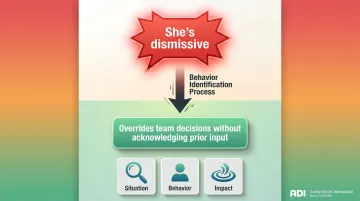
From: "She's dismissive and doesn't value input." To: "She overrides team decisions in meetings without acknowledging input that was shared beforehand."
One is a character assessment. The other is something that can be observed, measured, and changed.
The Behavior Identification Conversation
Each party lists the observable actions — their own and the other person's — that contributed to the conflict. This shared mapping creates a factual starting point and pulls the conversation out of blame-based territory.
Useful prompts:
- "What specific action did you observe that concerned you?"
- "What did you do in that moment that you'd handle differently?"
- "In what situations does this tend to happen?"
The SBI model (Situation, Behavior, Impact) provides a clean structure: anchor each piece of feedback to a specific situation, describe the observable behavior, and explain the impact. This keeps the conversation anchored to facts rather than interpretations.
Once behaviors are mapped, the next step is understanding what sets them off.
Antecedent Analysis
Once problem behaviors are identified, look at the conditions that precede them. High-pressure deadlines, ambiguous role boundaries, and public settings (where status feels at stake) are common triggers. Identifying these patterns informs what situations the behavioral goals need to account for — and sometimes reveals that environmental changes, not just personal commitments, are part of the fix.
Consequence Analysis
Behaviors persist because they're being reinforced — even inadvertently. Ask: what does this person get from the current behavior? Control over outcomes? Recognition for decisiveness? Avoidance of criticism?
When both parties understand why a behavior has been maintained, they can design goals that make the new behavior more rewarding than the old one. New commitments rarely stick when they're fighting an unchanged consequence structure.
A Step-by-Step Process for Setting Collaborative Behavioral Goals
Step 1: Structure the Goal-Setting Conversation
Set the session up before the first word is spoken. Establish ground rules:
- Focus on behaviors, not character
- Equal speaking time
- No interrupting
- The purpose is to define what success looks like, not to relitigate the conflict
If emotions are still charged, a neutral facilitator makes a measurable difference. The session should have a distinct agenda separate from the original conflict conversation.
Step 2: Define Observable Success from Both Sides
Each party states, in behavioral terms, what they need to see from the other person and what they commit to doing differently themselves. This must be mutual. One-sided behavioral contracts rarely hold because they preserve the power imbalance that often underlies the conflict in the first place.
The question for each party: "What would I see this person doing differently if things were working well?"
Step 3: Apply the Pinpoint Standard to Every Goal
Run every proposed goal through the pinpoint standard before accepting it.
Example refinement:
- Draft: "I will be more respectful in meetings."
- Refined: "I will let my colleague finish their point before I respond, and I will acknowledge their input before presenting an alternative view."
A goal passes the standard when both parties could independently observe whether it occurred. If one person could say "yes, that happened" while the other says "I'm not sure," the goal needs more specificity.
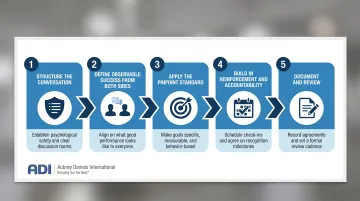
Step 4: Build in Reinforcement and Accountability
Behavioral goals without feedback mechanisms revert to intentions. Accountability isn't a punishment structure — it's a support structure. Define:
- Who will check in and when
- What signal each party will use if a goal isn't being met
- How progress will be acknowledged when new behaviors are demonstrated
ADI's Performance Management approach identifies consistent, timely positive reinforcement as the primary driver of sustained behavioral change. That principle applies directly here: when a colleague demonstrates a new behavior (acknowledging input before overriding a decision, following through on a communication commitment), that moment needs to be noticed and recognized.
If new behavior goes unacknowledged, the old pattern returns.
Step 5: Document and Review
Write the behavioral agreements down. Written records prevent post-conversation reinterpretation and give both parties a shared reference point when checking progress.
Set a review cadence with two specific check-ins:
- Two-week check-in: Are the goals being attempted? Are there obstacles?
- Four-week check-in: Are the behaviors consistent? Do any goals need adjustment?
Adjust goals at these reviews if the original pinpoints were too ambitious or missed the actual root cause. The process should be adaptive, not punitive.
Common Pitfalls When Setting Conflict Resolution Goals
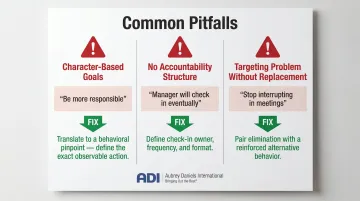
Pitfall 1: Character-Based Goals
Goals framed around personality — "be more professional," "show more empathy" — are unworkable because they're not observable or measurable. Neither party can agree on whether they occurred. Translate every character descriptor into a behavioral pinpoint — a specific, observable action — before it becomes a workable goal.
Pitfall 2: No Accountability Structure
Many conflict resolution conversations end with good intentions and no follow-up plan. Without a defined check-in process and a clear owner for accountability, well-written behavioral goals fade within weeks. The accountability structure isn't an afterthought — it belongs in the written agreement.
Pitfall 3: Only Targeting the Problem, Not the Replacement
Eliminating a problematic behavior requires replacing it with a rewarded alternative. If the new behavior goes unacknowledged, the old behavior — and the conflict — return.
CIPD's evidence review on performance feedback confirms that behavior-focused positive feedback produces measurable performance improvements. Focusing solely on what to stop, by contrast, tends to lower self-efficacy without producing the desired change.
Frequently Asked Questions
What is the goal of collaborative conflict management?
The goal is to reach a resolution that addresses the underlying needs of all parties, not just a surface-level compromise, by working together toward mutually acceptable outcomes. Done well, it preserves working relationships and improves the functional patterns that made conflict likely in the first place.
What are the four conflict-handling approaches?
The Thomas-Kilmann model identifies five modes (competing, avoiding, accommodating, compromising, and collaborating) mapped across assertiveness and cooperativeness dimensions. Some frameworks condense these into four by grouping related styles. Each mode reflects a different balance between pursuing your own goals and attending to the other party's needs.
What are the 5 C's of conflict?
One common practitioner version presents the 5 C's as: Clear communication, Calmness, Clarification, Collaboration, and Compromise. The framework is used to analyze and approach conflict systematically, working through communication and context before jumping to resolution. Variants exist across sources, so the specific version matters less than using a consistent diagnostic structure.
How do behavioral goals differ from general conflict resolution agreements?
Behavioral goals are specific, observable, and measurable: they define exactly what each person will do differently in named situations. General agreements tend to be attitude-based ("we'll communicate better") and open to interpretation. When both parties can observe whether a goal was met without needing to agree on interpretation, the goal is behavioral.
How can managers reinforce behavioral goals after a conflict resolution conversation?
Schedule follow-up check-ins at two and four weeks, and acknowledge new behaviors in the moment rather than offering delayed or generic praise. The first few weeks after a resolution conversation are a critical window: consistent reinforcement while the behavioral pattern is still forming significantly increases the likelihood it holds.