The reason comes down to a foundational principle from behavioral science: people do what they do because of what happens to them when they do it. Directives and rules can initiate behavior. Consequences are what sustain it. And the type of consequence matters enormously.
The rewarding approach to changing behavior puts positive consequences at the center of performance management — not as a feel-good add-on, but as a scientifically grounded strategy for building the behaviors organizations actually need. This approach is rooted in Applied Behavior Analysis (ABA) and has been applied in organizational settings for decades.
This article breaks down what the rewarding approach actually involves, the behavioral science that makes it work, and how to implement it in a way that generates lasting performance improvement rather than short-term compliance.
TLDR
- The rewarding approach uses positive consequences — delivered immediately and consistently after a specific behavior — to increase the likelihood that behavior recurs.
- It is grounded in operant conditioning and ABA, not intuition or general encouragement.
- Rewards and reinforcement are not the same thing; a consequence only functions as a reinforcer if it actually increases the behavior it follows.
- Applied correctly, this approach builds sustainable performance and generates what ADI calls Discretionary Effort — voluntary engagement that directive-based management cannot produce.
What Is the Rewarding Approach to Changing Behavior?
The rewarding approach is a behavior change strategy that relies on positive consequences — delivered after a desired behavior — to increase the probability that the behavior occurs again. It stands in contrast to management approaches that depend primarily on directives, job descriptions, or punishment when performance falls short.
Origins in Applied Behavior Analysis
The approach draws directly from operant conditioning, the branch of behavioral science developed by B.F. Skinner and formalized into the applied discipline now known as ABA. As Lumen Learning's operant conditioning overview explains, reinforcement is defined by its effect: a consequence increases a behavior, while punishment decreases it.
This is not pop psychology. ABA has decades of research behind it, and its organizational application — Organizational Behavior Management (OBM) — has produced measurable performance results across industries including:
- Manufacturing and operations
- Healthcare and pharmaceutical services
- Financial services and insurance
- Energy, mining, and utilities
Dr. Aubrey C. Daniels built Aubrey Daniels International (ADI) on exactly this foundation. A clinical psychologist convinced by Skinner's work, Daniels recognized that the same principles enabling patients to change their behaviors could transform organizational performance.
He founded ADI in 1978, coined the phrase "Performance Management," and spent the following decades demonstrating that behavioral science could be applied to workplace performance with precision.
Why Not Just Use Punishment?
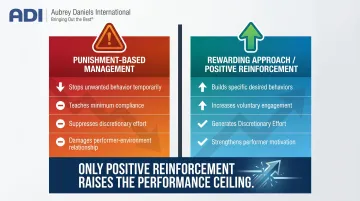
Punishment-based management — corrective action, criticism, threats of consequences — can stop an unwanted behavior temporarily. What it does not do is teach the behavior you actually want. It also tends to generate the minimum: employees who do just enough to avoid negative consequences, with no motivation to do more.
When the goal is simply avoiding punishment, discretionary effort — the performance employees could give if they wanted to — gets suppressed. There is nothing in it for anyone to go beyond the minimum. ADI frames this as the core failure of negative reinforcement as a management default.
Positive reinforcement, by contrast, builds the specific behaviors you need and creates the conditions where people want to perform well.
What "Rewarding" Actually Means Here
This is not about perks, prizes, or recognition programs for their own sake. The rewarding approach means identifying what genuinely motivates each individual and consistently connecting that positive consequence to the specific behaviors that drive performance. The mechanism is deliberate and behavior-specific, not a generalized gesture of goodwill.
The Behavioral Science That Makes Rewards Work
The ABC Model
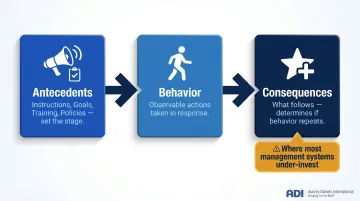
The core analytical framework behind the rewarding approach is the ABC model: Antecedents → Behavior → Consequences. Geller's behavior-based safety research describes this three-term contingency as foundational to designing effective workplace interventions.
Each element plays a distinct role:
- Antecedents (instructions, goals, training, policies) set the stage by prompting a behavior before it occurs.
- Behaviors are the observable actions people take in response to those conditions.
- Consequences are what follow — and they are what determine whether the behavior repeats.
Most management systems invest heavily in antecedents: clear job descriptions, onboarding training, process documentation. These are necessary but insufficient. OBM practitioners consistently observe that organizations over-invest in the antecedent side while neglecting the consequence side — which is why so many well-designed initiatives produce short-lived changes.
That gap between antecedents and lasting behavior change has a neurological explanation.
The Neuroscience Connection
Consequences shape behavior so powerfully because of how the brain processes positive outcomes. Research on dopamine signaling shows that behavior producing positive results activates the brain's reward circuitry, creating a learning loop that encodes the behavior as worth repeating.
That loop is why timely, contingent positive reinforcement builds behavior more durably than willpower, instruction, or corrective feedback alone.
The Four Types of Consequences
Behavioral science identifies four consequence types:
| Consequence | What It Does |
|---|---|
| Positive reinforcement | Adds something valued → increases behavior |
| Negative reinforcement | Removes something aversive → increases behavior |
| Punishment | Adds something aversive → decreases behavior |
| Extinction | Removes reinforcement → decreases behavior |
The rewarding approach prioritizes positive reinforcement for a specific reason: it is the only consequence type that simultaneously increases desired behavior and builds a positive relationship between the performer and the environment. ADI's position on this is direct: positive reinforcement is the most powerful leadership tool available to managers. Its frequent, targeted use is what separates cultures of genuine engagement from cultures of compliance.
What the Rewarding Approach Involves: Core Principles
Immediacy
Reinforce the behavior as close in time to its occurrence as possible. The longer the gap between the behavior and the consequence, the weaker the behavioral connection. Annual performance reviews are nearly useless as reinforcement tools — the delay is simply too long. Effective managers recognize performance in the moment, when it happens.
Contingency and Specificity
The reinforcer must be explicitly tied to a specific, observable behavior. Vague praise ("great job this week") is far less effective than behavior-specific recognition — for example: "The way you handled that client escalation by staying calm and following the protocol is exactly what we need." Specificity tells the performer precisely what to repeat. Research on feedback types confirms that the form and specificity of consequences significantly affects behavioral outcomes.
Individualization
What functions as a reinforcer varies from person to person. Public recognition motivates some employees and makes others uncomfortable. Autonomy, monetary rewards, skill development, and peer acknowledgment all land differently depending on the individual. Effective practitioners invest time in identifying what genuinely reinforces each person — rather than running a one-size-fits-all recognition program and expecting consistent results across the workforce.
Consistency and Frequency
Research on reinforcement schedules shows that continuous reinforcement (rewarding every occurrence) works best during early behavior acquisition, while intermittent reinforcement maintains behavior over time. The practical takeaway for managers:
- In early stages of behavior change, reinforce frequently to accelerate learning.
- As the behavior becomes established, reinforcement frequency can be gradually reduced.
- Inconsistent reinforcement — rewarding the same behavior sometimes but not others — creates confusion and weakens the pattern.
Building Desired Behaviors, Not Just Eliminating Unwanted Ones
The rewarding approach is constructive by design. Instead of focusing management attention on what people are doing wrong, it redirects attention toward catching people doing things right and reinforcing those behaviors immediately. That shift in focus — from correction to construction — is what separates sustainable performance improvement from temporary compliance.
This is where ADI's concept of Discretionary Effort becomes central. Defined by Dr. Daniels as "the level of effort people could give if they wanted to, but above and beyond the minimum required," Discretionary Effort is the voluntary, enthusiastic performance that distinguishes stellar performers from those who merely meet the standard.
ADI's position is direct: the only way organizations earn Discretionary Effort is through the effective use of positive reinforcement. Mandates, policies, and corrective action can establish a floor — they cannot raise the ceiling.
Rewards vs. Reinforcement: Why the Distinction Matters
These two terms are often used interchangeably, but they are not the same — and conflating them is one of the most common reasons rewarding approaches fail in practice.
A reward is something given after a behavior as recognition. A reinforcer is functionally defined: a consequence that actually increases the frequency of the behavior it follows. A gift card given to an employee who doesn't value gift cards has not reinforced anything.
The Overjustification Risk
When external rewards are given indiscriminately — or for behaviors someone was already intrinsically motivated to perform — they can reduce intrinsic motivation over time. Deci et al.'s widely cited 1999 review found that extrinsic rewards can undermine intrinsic motivation, with the effect varying based on how controlling versus informational the reward feels.
The goal is to use reinforcement strategically to build and strengthen specific behaviors — not to create dependency on external payouts.
Measurement Is Not Optional
Because reinforcement is defined by its effect, practitioners must track whether the targeted behavior is actually increasing. ADI makes this explicit: "consequences are defined by their impact, not their intention." If the behavior hasn't increased, it wasn't functioning as a reinforcer. The approach needs adjustment, not just repetition.
ADI builds this measurement requirement directly into its consulting work. Key tools include:
- Performance scorecards to track behavioral trends over time
- Individualized feedback reports tied to specific behavioral targets
- Behavioral tracking systems that confirm whether consequences are producing the intended outcomes
Applying the Rewarding Approach in the Workplace
Implementing this approach requires a deliberate system, not ad hoc goodwill. Managers must develop the ability to:
- Observe behavior precisely and objectively
- Identify what genuinely reinforces each individual
- Deliver consequences systematically, not sporadically
- Track behavioral outcomes to confirm what's working
These are trainable skills — and ADI has spent over 45 years developing the methodology and training infrastructure to build them in leaders across industries.
What It Looks Like in Practice
Across ADI's client engagements, the rewarding approach has produced measurable outcomes across multiple industries:
- A call center saw available customer service time jump from 50% to 90% within one week of implementing behavior-based performance systems.
- A pharmaceutical sales division moved from 52nd out of 55 in sales to 1st after applying behavioral methods.
- A glass manufacturing facility improved machine utilization from 65% to 85.6% and set 16 new productivity records.
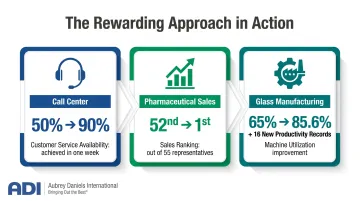
The common factor across each case was a shift from measuring outcomes after the fact to actively reinforcing the behaviors that produce them — which is exactly what ADI's training programs are built to teach.
ADI's Training Pathway
ADI offers three primary workshops for building this capability in leaders:
- Bringing Out the Best in People — A one-day introduction to behavioral science and the power of positive reinforcement.
- Behavioral Leadership Training — A two-day workshop developing feedback and coaching skills grounded in behavioral science.
- Applications of Behavioral Leadership — A four-day flagship program covering a five-step change process, behavioral roadmapping, and reinforcement-based coaching at scale.
Certification programs allow organizations to build internal behavioral training and coaching expertise, extending the capability across large teams without ongoing external dependence.
Frequently Asked Questions
What is a behavior change approach?
A behavior change approach is a structured strategy for systematically increasing desired behaviors and decreasing unwanted ones. Most evidence-based approaches draw on behavioral science principles : specifically, how antecedents, behaviors, and consequences interact to shape what people do over time.
What is the most effective way to change behavior?
Research points to positive reinforcement — a valued consequence delivered immediately after a desired behavior — as the most effective and sustainable method. It increases behavior while preserving motivation and engagement, unlike punitive approaches that may suppress performance.
What is the best way to reward behavior?
The best way is to ensure the consequence is individualized (valued by the recipient), delivered immediately after the specific behavior, and clearly linked to that behavior. A reward only functions as reinforcement if the targeted behavior actually increases ; if it doesn't, the approach needs to be adjusted.
What are the 4 laws of behavioral change?
James Clear's framework from Atomic Habits identifies four principles: make the behavior obvious, make it attractive, make it easy, and make it satisfying. The final element — the satisfying consequence — is the most powerful driver of lasting change, which aligns directly with positive reinforcement.
What are the 4 P's to support positive behavior?
"4 P's" frameworks vary by context. In education and PBIS settings, one common formulation includes Praise, Proximity, and Precorrection as core supports. Each element reflects the same underlying principle: desired behaviors must be recognized, prompted, and reinforced to become stable patterns.